Bitcoin Giants Shrink: Whales Quietly Hand Off Billions To Institutions

bitcoinistPubblicato 2025-07-06Pubblicato ultima volta 2025-07-06

Introduzione

Bitcoin’s price has held steady around $108,100 as of Saturday afternoon after big holders shipped out a massive load of...

Trusted Editorial content, reviewed by leading industry experts and seasoned editors. Ad Disclosure

Bitcoin’s price has held steady around $108,100 as of Saturday afternoon after big holders shipped out a massive load of coins.

Based on reports, whales—those early adopters and big miners—sold over 500,000 BTC in the past 12 months. At today’s rates, that stash is worth north of $50 billion. Institutions grabbed almost every coin they let go. It’s a huge shift in who really owns Bitcoin.

Whales Pass The Torch

According to Bloomberg’s review of 10x Research data, wallets holding between 1,000–10,000 BTC saw their balances slip from over 4.5 million coins in January 2023 to about 4.47 million in July 2025.

At the same time, addresses with 100–1,000 BTC jumped from nearly 4 million to 4.77 million. That shift shows big players trimming back while medium‑size holders, often funds or wealthy clients, build their stacks. It’s happening quietly through in‑kind transfers and private deals that skip public exchanges.
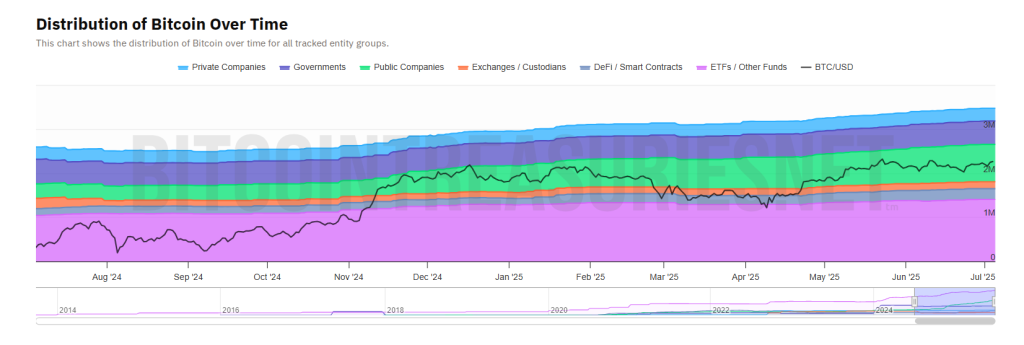
Source: Bitcoin Treasuries

Institutions Ramp Up Their Stakes

Funds, ETFs and corporate treasuries have scooped up almost every coin dropped by whales. Data from Bitcoin Treasuries shows private companies boosted their holdings from 279,374 BTC in July 2024 to 290,883 BTC today.

Public firms climbed from 325,400 BTC to 848,600 BTC. ETFs led the charge, raising their balance from 1,039,000 BTC to 1,405,480 BTC. In total, these groups added 899,198 BTC—about $96 billion—over the past year. That buying power has helped keep the market in balance as whales step back.

BTCUSD currently trading at $108,227. Chart: TradingView

Shift In On-Chain Holdings

Medium-sized wallets are growing while the largest ones shrink. That trend suggests new types of investors are moving in.

Edward Chin, co‑founder of Parataxis Capital, said in‑kind transfers let coins move from anonymous holders to regulated firms without public trades. This quiet pipeline boosts on‑chain activity and brings more oversight to big Bitcoin trades.

Volatility Hits Two-Year Low

As institutional flows rise, price swings have dulled. The Deribit 30‑day volatility gauge sits at its lowest level in two years. Jeff Dorman, CIO at Arca, compared today’s Bitcoin to a steady dividend payer that might deliver annual gains in the 10–20% range.

That’s a far cry from the 1,400% surge seen in 2017. For long‑term savers, steadier returns look more attractive than wild rallies.

Meanwhile, Fred Thiel, CEO of miner MARA Holdings, said his company still holds every coin it mines. But he warned that if whale selling picks up again and institutional appetite fades, prices could lurch lower.

Featured image from Meta, chart from TradingView

Editorial Process for bitcoinist is centered on delivering thoroughly researched, accurate, and unbiased content. We uphold strict sourcing standards, and each page undergoes diligent review by our team of top technology experts and seasoned editors. This process ensures the integrity, relevance, and value of our content for our readers.

Christian, a journalist and editor with leadership roles in Philippine and Canadian media, is fueled by his love for writing and cryptocurrency. Off-screen, he's a cook and cinephile who's constantly intrigued by the size of the universe.

Letture associate

After Half a Year as a Token Broker, She Has Fallen into Every Pitfall of the Relay Station Business

Sukie, who operated an AI API "middle station" service for six months, recently open-sourced her entire setup process. Her story reveals the harsh realities of this once-lucrative but now hyper-competitive market. The core challenge is cost. Legitimate, compliant API accounts are expensive. To compete, many players resort to cheaper, high-risk sources like stolen accounts. The market has seen prices plummet from 70-80% of official rates down to 30-50%, a level unsustainable for compliant operators. Sukie believes a 70-80% price point is the minimum for healthy margins using legitimate methods. A major mistake was targeting the Chinese market while incurring USD costs. She found Chinese developers extremely price-sensitive compared to Western clients, leading to thin margins compounded by currency and payment hurdles. Operational burdens are heavy: maintaining a pool of hundreds of accounts against rising platform bans, handling detailed technical support, and managing cross-border payments and invoices for different client types. Marketing channels like X (Twitter) and referrals work best, while platforms like Douyin (TikTok) and Xianyu have poor ROI due to low intent or pricing mismatches. The landscape shifted dramatically with high-profile entrants like Justin Sun, Fu Sheng, and the Trump family. For them, the middle station is a loss leader to attract users to their primary businesses—crypto ecosystems, corporate narratives, or token promotions. This makes competing on price alone impossible for independent operators. Sukie open-sourced her methodology both as marketing and to demystify the industry. By eliminating the "black box" technical premium, she hopes to shift competition from cutthroat pricing towards service quality, stability, and compliance. Her advice: this is not a viable full-time venture for newcomers. The compliant path can't compete with grey-area discounters or ecosystem-backed giants. If already involved, focus on niche B2B, academic, or overseas markets. The middle station business, she concludes, is an entry ticket, not a destination, in the broader AI landscape.

marsbit19 min fa

After Half a Year as a Token Broker, She Has Fallen into Every Pitfall of the Relay Station Business

marsbit19 min fa

a16z Weekly Chart: Tech Giants Rely on 'Side Hustle' Investments for Income, Great AI Products Can Sell Out in a Day

a16z Weekly Charts: Four Counterintuitive Signals in Tech 1. **Super Platforms' "Other Income"**: Amazon and Google recorded exceptionally high "other income" in Q1, largely from unrealized gains in their private investment portfolios (e.g., Amazon's Anthropic stake). This contributed to over one-third of their net profit, far above the historical 5-10%. The broader trend shows tech capital expenditure is now the primary driver of US GDP growth, accounting for 55% of all business investment. 2. **AI-Generated eBook Proliferation**: Since ChatGPT's launch, monthly eBook releases on Amazon have tripled to over 300,000, flooding the platform with AI-generated content. However, research indicates this has also increased the volume of "decent" books, providing a net gain in consumer surplus by 2025. AI tools have particularly boosted productivity for established authors. 3. **Call Center Jobs Defy AI Replacement**: Contrary to predictions, call center employment in the Philippines has grown steadily from 1.15 million in 2016 to 1.9 million in 2025, with further growth projected. In the US, customer service job postings are outperforming the overall market. The key reason: the full cost of voice AI agents remains roughly equal to human agents (~$92 vs. ~$90 per day). Cases like Klarna show initial replacement can lead to quality issues and re-hiring. 4. **Rapid Adoption of AI Mobile Apps**: AI app downloads, revenue, and user time spent on mobile nearly doubled year-over-year in Q1. The market is highly dynamic, with new products like Codex quickly surpassing incumbents like Claude Code in daily installs. In the B2B space, enterprises are using multiple AI vendors, with less than 20% relying on a single supplier, indicating no winner-takes-all dynamic yet.

marsbit29 min fa

a16z Weekly Chart: Tech Giants Rely on 'Side Hustle' Investments for Income, Great AI Products Can Sell Out in a Day

marsbit29 min fa

Musk vs. Altman: Who Will Be the 'Fisherman'?

Elon Musk and Sam Altman are locked in a fierce legal and commercial battle. Musk, a co-founder of OpenAI, has sued the company and Altman, alleging they betrayed its original non-profit, open-source mission by transforming into a for-profit entity with significant Microsoft backing, now valued at $852 billion. He demands damages, a return to a non-profit structure, and management changes. The lawsuit hinges on whether OpenAI's founding charter was a legally binding charitable trust or merely an idealistic statement. OpenAI counters that Musk himself pushed for a for-profit model in 2017 but left when he couldn't gain full control, and now acts as a commercial rival with his xAI venture. Despite the high-profile feud, the article suggests the real winners (the "fishermen") may be others in the AI race. While Musk has folded xAI into SpaceX to pursue a "space-based computing" vision, his Grok chatbot lags in market share and user growth compared to leaders. OpenAI faces its own challenges, notably from rival Anthropic, which is rapidly catching up in revenue and enterprise adoption. Musk is reportedly leasing significant computing power to Anthropic, creating an "enemy of my enemy" dynamic. Furthermore, Chinese AI models like DeepSeek are quickly closing the capability gap. Ultimately, the lawsuit is seen as setting a precedent for AI governance, but the intense competition between Musk and Altman may primarily benefit other players, infrastructure providers like Nvidia, and emerging third forces in the global AI landscape.

marsbit40 min fa

Musk vs. Altman: Who Will Be the 'Fisherman'?

marsbit40 min fa

‘TACO’ Is Outdated, Wall Street Embraces ‘NACHO’ Trading

The Wall Street trading meme "TACO" (Trump Always Chickens Out) is being replaced by "NACHO" (Not A Chance Hormuz Opens), signaling a major shift in market expectations. TACO bets anticipated de-escalation from political figures, but this pattern broke on March 23rd when a Trump social media post claiming progress with Iran was denied by Tehran, causing a sharp but temporary market reversal. Since then, markets have adopted a NACHO mindset, betting the Strait of Hormuz will remain closed for an extended period. This view is reflected in three key markets. First, war risk insurance premiums for vessels transiting the strait have skyrocketed. Second, the oil futures curve shows a steep backwardation, with near-term prices far exceeding long-dated contracts, indicating expectations for a prolonged but not permanent supply crunch. Third, Federal Reserve rate cut expectations for 2026 have been priced out to zero due to persistent oil-price inflation. While the S&P 500 continues hitting record highs, the market internally reflects NACHO's impact. The energy sector ETF (XLE) has vastly outperformed the transportation sector ETF (IYT), as high oil prices directly benefit producers but squeeze transport and logistics companies' margins. The NACHO trade has a concrete deadline. Analysts warn global commercial oil inventories could reach critical "operational pressure" levels by early June. If the strait remains closed into September, OECD stocks may fall below the operational floor. Prediction markets currently assign a very low probability to the strait reopening before June. The market has shifted from reacting to political headlines to pricing in the physical realities of oil supply and inventory clocks.

marsbit51 min fa

‘TACO’ Is Outdated, Wall Street Embraces ‘NACHO’ Trading

marsbit51 min fa

Trading

Spot
Futures
活动图片