Short-Term Bitcoin Holders Face Deep Losses – Early Bear Market Conditions Emerging?

bitcoinistPubblicato 2025-04-19Pubblicato ultima volta 2025-04-20

Introduzione

Bitcoin is trading at a critical juncture after several days of consolidation, ranging between $83,000 and $86,000. Despite brief attempts...

Trusted Editorial content, reviewed by leading industry experts and seasoned editors. Ad Disclosure

Bitcoin is trading at a critical juncture after several days of consolidation, ranging between $83,000 and $86,000. Despite brief attempts to break out, the price continues to stall, with neither bulls nor bears able to take full control. This indecision reflects the broader uncertainty gripping global financial markets as macroeconomic tensions, including the ongoing trade conflict between the US and China, keep investors on edge.

With no clear catalyst in sight, Bitcoin remains directionless, stuck below key moving averages and unable to reclaim the $90,000 level that many view as the threshold for a confirmed uptrend. At the same time, strong support around $81,000 has held so far, suggesting that long-term holders still provide a strong base of conviction.

According to Glassnode, unrealized losses normalized by percentage drawdown reveal that Short-Term Holders are already carrying significant losses—levels that resemble early bear market conditions in previous cycles. This data point suggests a fragile market structure where further downside pressure could trigger broader capitulation, or, conversely, a sharp rebound if sentiment shifts. For now, Bitcoin’s price remains compressed, and traders are watching closely for the breakout that will define the next major move.

Bitcoin Consolidation Continues Amid Volatility And Uncertainty

Bitcoin has entered a consolidation phase after enduring weeks of prolonged selling pressure and heightened volatility. The broader macroeconomic landscape remains hostile, with global tensions deepening as US President Donald Trump continues to escalate his trade war with China.

Although a 90-day tariff pause was announced last week for all countries except China, the move has done little to calm investor fears. The standoff between the world’s two largest economies continues to influence risk appetite, dragging on traditional markets and crypto alike.

On-chain data from Glassnode reveals that Bitcoin’s unrealized losses, when normalized by percentage drawdown, show that Short-Term Holders are already experiencing substantial losses. These levels are consistent with the early stages of previous bear markets, suggesting that downside risk remains elevated. While this does not confirm the start of a full-blown bear market, it highlights the vulnerability in the current structure. Until a major breakout or breakdown occurs, Bitcoin remains in limbo.

Bitcoin Unrealized Loss per Percent | Source: Glassnode on X

Bitcoin is currently trading below key moving averages, unable to reclaim momentum despite bouncing from short-term support levels. This signals a market still dominated by uncertainty and lacking a decisive catalyst. The $90K level remains a critical threshold that bulls must reclaim to shift sentiment, while the $81K region is acting as a crucial floor for now.

BTC Price Struggles Below Key levels As Market Awaits Confirmation

Bitcoin is currently trading at $84,900 after spending several days ranging just below the 200-day exponential moving average (EMA) around $85,000. Despite holding above the $83,000 support zone, bulls have failed to reclaim key moving averages that would signal renewed momentum. The 200-day simple moving average (SMA), currently around $88,000, remains the primary resistance level that must be cleared for a true recovery rally to begin.
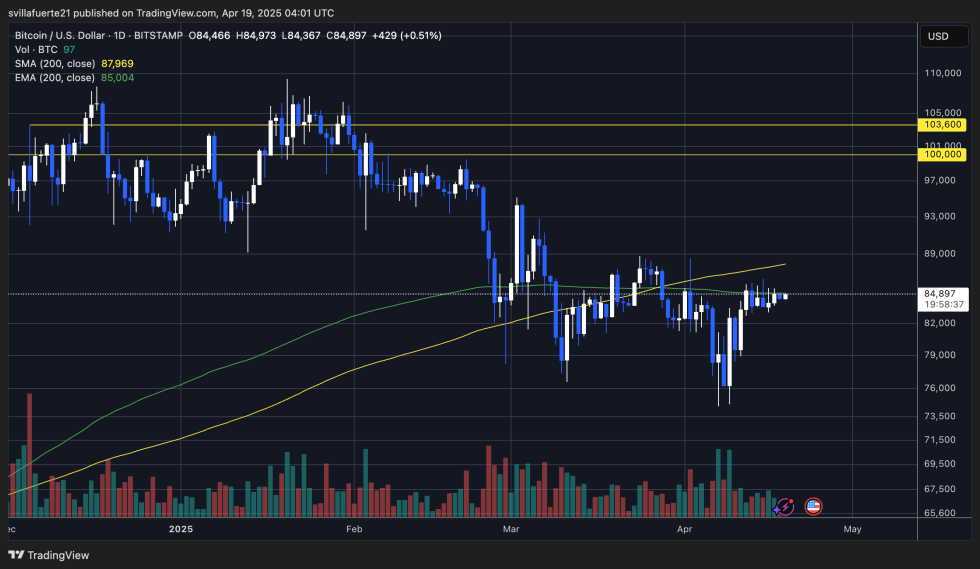
BTC trading below the 200-day EMA | Source: BTCUSDT chart on TradingView

The price action suggests indecision as buyers hesitate to commit amid ongoing macroeconomic uncertainty and global tensions. BTC’s inability to close convincingly above the EMA keeps the market in a state of cautious optimism. Bulls need to reclaim both the 200-day EMA and the 200-day SMA to confirm a bullish trend shift and attempt a retest of the $90,000 mark.

However, failure to hold above the $83,000 level could trigger a new wave of selling. If bears regain control and push BTC below this zone, a move toward $80,000—or potentially lower—becomes increasingly likely. For now, the market remains in a tight consolidation range, and traders are watching closely for a breakout in either direction. A decisive move will likely shape Bitcoin’s next major trend.

Featured image from Dall-E, chart from TradingView 

Editorial Process for bitcoinist is centered on delivering thoroughly researched, accurate, and unbiased content. We uphold strict sourcing standards, and each page undergoes diligent review by our team of top technology experts and seasoned editors. This process ensures the integrity, relevance, and value of our content for our readers.

Sebastian's journey into the world of crypto began four years ago, driven by a fascination with the potential of blockchain technology to revolutionize financial systems. His initial exploration focused on understanding the intricacies of various crypto projects, particularly those focused on building innovative financial solutions. Through countless hours of research and learning, Sebastian developed a deep understanding of the underlying technologies, market dynamics, and potential applications of cryptocurrencies. As his knowledge grew, Sebastian felt compelled to share his insights with others. He began actively contributing to online discussions on platforms like X and LinkedIn, focusing on fintech and crypto-related content. His goal was to expose valuable trends and insights to a wider audience, fostering a deeper understanding of the rapidly evolving crypto landscape. Sebastian's contributions quickly gained recognition, and he became a trusted voice in the online crypto community. To further enhance his expertise, Sebastian pursued a UC Berkeley Fintech: Frameworks, Applications, and Strategies certification. This rigorous program equipped him with valuable skills and knowledge regarding Financial Technology, bridging the gap between traditional finance (TradFi) and decentralized finance (DeFi). The certification deepened his understanding of the broader financial landscape and its intersection with blockchain technology. Sebastian's passion for finance and writing is evident in his work. He enjoys delving into financial research, analyzing market trends, and exploring the latest developments in the crypto space. In his spare time, Sebastian can often be found immersed in charts, studying 10-K forms, or engaging in thought-provoking discussions about the future of finance. Sebastian's journey as a crypto analyst and investor has been marked by a relentless pursuit of knowledge and a dedication to sharing his insights. His ability to navigate the complex world of crypto, combined with his passion for financial research and communication, makes him a valuable asset to the industry. As the crypto landscape continues to evolve, Sebastian remains at the forefront, providing valuable insights and contributing to the growth of this revolutionary technology.

Letture associate

Over 80% of New Tokens Peak at TGE, The Root Cause and Cure for Web3's False Prosperity Lies Here

More than 80% of new tokens in 2025 have seen their Fully Diluted Valuation (FDV) fall below their initial TGE valuation, with a median decline of 71%. Only 15% of tokens performed better post-TGE. This trend indicates that for most projects, the token generation event (TGE) represents their peak valuation. Statistical analysis of 113 token launches reveals that common success metrics—such as high fundraising amounts, large social media followings, and listings on major exchanges—have little to no statistical correlation with token performance. Projects raising more capital (e.g., over $10 million) did not perform better than those raising less (e.g., $300k–$500k). In fact, lower-funded projects often delivered higher returns per dollar raised. Social community size proved irrelevant; most "communities" are speculative and disappear when token prices fall. Token pricing also matters: tokens priced between $0.01–$0.05 at launch had the highest survival rate, while those priced outside this range generally failed. AI-related tokens outperformed others in both peak and current returns, while Gaming and DeFi sectors struggled significantly. Launch platforms (IDOs/IEOs) did not ensure success—most tokens on these platforms fell 70–93% post-launch. The root issue is a market that prioritizes hype over substance, narrative over data, and promises over products. To survive in 2026, projects should focus on lean fundraising, realistic token pricing, product-market fit, and tangible metrics like user retention and revenue—rather than vanity metrics. The old playbook is broken; a new, pragmatic approach is essential.

Odaily星球日报3 min fa

Over 80% of New Tokens Peak at TGE, The Root Cause and Cure for Web3's False Prosperity Lies Here

Odaily星球日报3 min fa

A New Perspective on the Four-Year Crypto Cycle: I Asked Seven Industry Veterans What Stage We're In Now

The article "A New Perspective on Crypto's Four-Year Cycle: Insights from Seven Industry Veterans" explores whether the traditional four-year market cycle, historically driven by Bitcoin halving events, still holds true in today's crypto market. Key points from seven experts include: - The four-year cycle, once driven by Bitcoin's supply reduction from halving, is now increasingly influenced by macro liquidity, institutional adoption, and global financial policies (e.g., U.S. elections, Fed policies). - ETF inflows and institutional capital have altered price action, flattening post-halving rallies and reducing volatility as Bitcoin matures into a trillion-dollar asset. - Experts disagree on the current market phase: some see a bearish transition due to declining miner profitability and capital outflow to AI stocks, while others view it as a mid-to-late bull cycle correction with potential for slow, structural growth driven by macro liquidity. - The "altcoin season" may not return in its traditional form; future outperformance will likely be selective, focused on utility-driven projects rather than broad speculative rallies. - Most experts have reduced altcoin exposure, favoring BTC, ETH, and stablecoins, with cash reserves above 50% in some cases. - Advice for investors: avoid leverage, consider gradual accumulation (e.g., below $60K for BTC), and prioritize discipline over timing. Consensus: The four-year cycle is evolving from a rigid halving-driven model to a more complex, macro-dependent framework, with reduced returns and slower, institution-led growth defining the future.

Odaily星球日报25 min fa

A New Perspective on the Four-Year Crypto Cycle: I Asked Seven Industry Veterans What Stage We're In Now

Odaily星球日报25 min fa

Trading

Spot
Futures

Discussioni

Benvenuto nella Community HTX. Qui puoi rimanere informato sugli ultimi sviluppi della piattaforma e accedere ad approfondimenti esperti sul mercato. Le opinioni degli utenti sul prezzo di BTC BTC sono presentate come di seguito.

活动图片