Wintermute Reveals: Are Retail Investors No Longer Trading Crypto?

marsbitDipublikasikan tanggal 2026-03-02Terakhir diperbarui pada 2026-03-02

Abstrak

Wintermute, a leading crypto market maker, reveals a significant shift in retail investor behavior: instead of simultaneously investing in both cryptocurrencies and stocks as in the past, retail traders are now choosing between them. Since late 2024, activity in crypto and equities has become negatively correlated—when retail buys stocks, crypto activity stagnates, and vice versa. Key factors driving this change include the structural compression of crypto’s volatility premium relative to stocks, reducing its appeal as a high-risk, high-reward asset. Technical developments, such as smoother on/off ramps via fintech integrations, make it easier for capital to flow between asset classes. Additionally, the rise of LLM-powered analysis tools gives retail a perceived edge in stock markets—a feeling absent due to crypto’s lack of clear valuation frameworks. As a result, traditional crypto indicators like M2 money supply are becoming less reliable. Investors should now view crypto through a multi-asset portfolio lens, acknowledging it as one option among many rather than the primary speculative arena.

Author: Jasper De Maere, Wintermute

Compiled and Edited: BitpushNews

Bitpush Note:

As a leading market maker in the crypto industry, Wintermute handles hundreds of billions of dollars in daily trading volume. Compared to ordinary researchers, they can cut through the fog and see the most authentic flow of retail funds. In this latest report, Wintermute puts forward an alarming view for the crypto circle: the "retail faith" that once supported the crypto market is wavering. In the past, cryptocurrencies and stocks usually rose and fell together, but since the end of 2024, this relationship has completely reversed—retail investors have begun to make a "binary choice" between the two.

Main Text:

Retail activity drives the cryptocurrency market. Through speculation, reflexive buying on dips, and agile capital rotation within the token world, retail investors define every major market cycle. However, new data suggests that the relationship between retail investors and cryptocurrencies is changing. For some time, we have observed that the stock market is attracting retail attention at the expense of altcoins. New data from J.P. Morgan's strategy department, combined with our own flow data, now indicates that stocks and cryptocurrencies are increasingly becoming complementary risk assets.

Key Points

  • Reversal Phenomenon: Retail investment activity in cryptocurrencies and stocks used to move in the same direction. But since the end of 2024, the two have shown an inverse relationship: when retail buys stocks, they are quiet in the cryptocurrency market, and vice versa.

  • Compressed Volatility Premium: The volatility premium of cryptocurrencies relative to stocks, which was once their biggest attraction to retail, is now structurally compressing. Volatility is no longer a diversifying product feature in cryptocurrency investment.

  • Technical Drivers: Some underappreciated technical reasons have accelerated this shift. For example, easier access to cryptocurrencies has dismantled the "captive audience" effect; meanwhile, large language model (LLM)-driven analysis is narrowing the cognitive advantage gap in the stock market, a phenomenon that has not yet occurred in the cryptocurrency space.

  • Traditional Indicators Fail: Traditional leading indicators of crypto risk appetite (such as M2 money supply) are failing. Investors should increasingly view cryptocurrencies through a multi-asset portfolio lens, similar to how they treat other mature asset classes.

Reversal Phenomenon

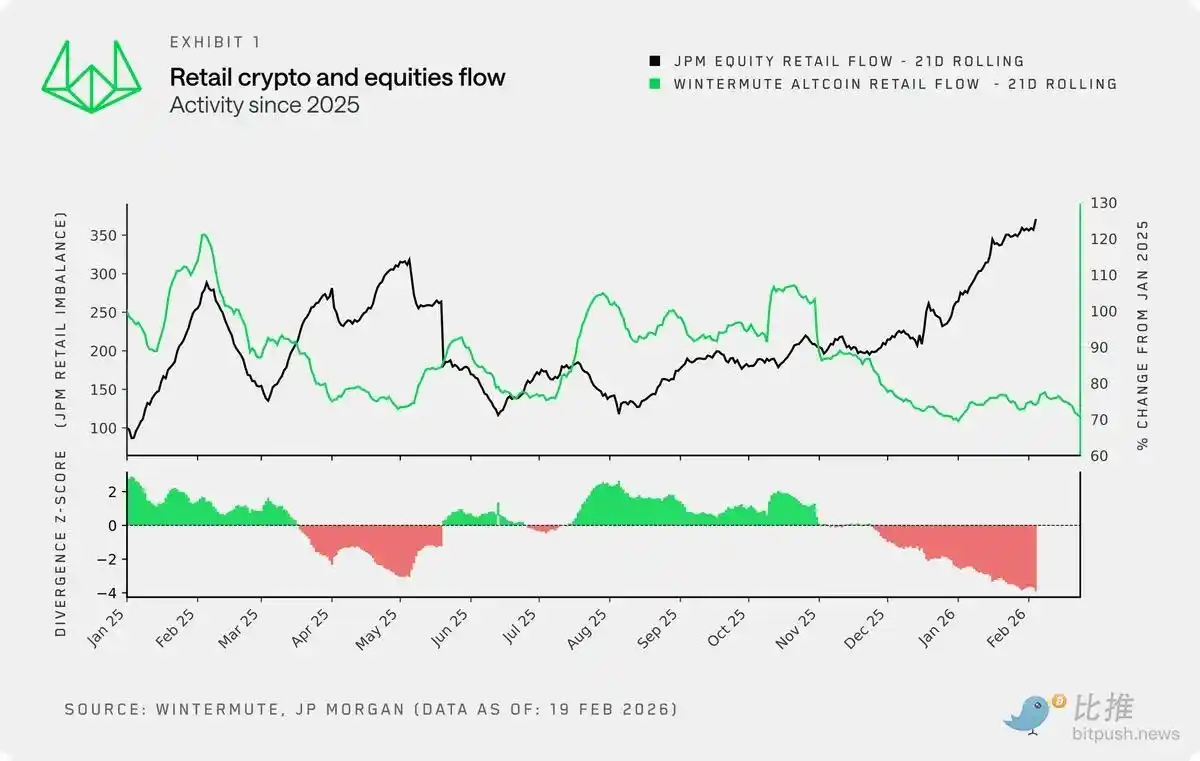
By overlaying Wintermute's proprietary crypto retail flow data with J.P. Morgan's retail stock inflow data, we gain a new perspective on the relationship between retail stock and crypto activity.

Historically, the two have maintained a synchronized trend until the end of 2024. At that time, high risk appetite drove buying in both, as they both acted as outlets for excess capital (see M2) and risk appetite.

However, since the end of 2024, this relationship has broken down: as retail flooded into the stock market at an unprecedented rate, they remained inactive in cryptocurrencies, and the divergence between the two has now reached a historical extreme.
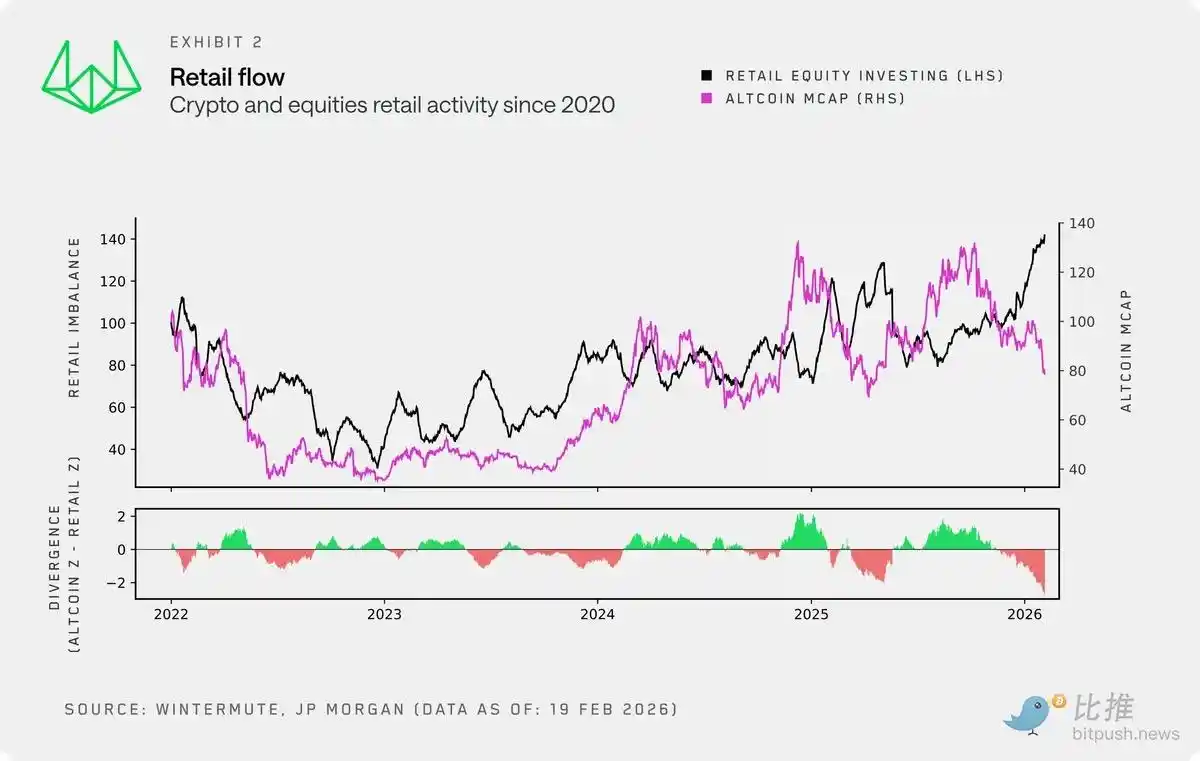
Zooming in, we use altcoin market capitalization as a long-term proxy for retail crypto activity.

It closely aligns with our retail flow data and has an unbiased and longer history. Between 2022 and the end of 2024, cryptocurrencies and stocks fluctuated roughly in sync, both being viewed by the retail sector as a type of high-risk investment portfolio. The decoupling at the end of 2024 is very noticeable, reflecting that retail activity has become more short-term driven, volatile, and to some extent, lacking in sustainability.
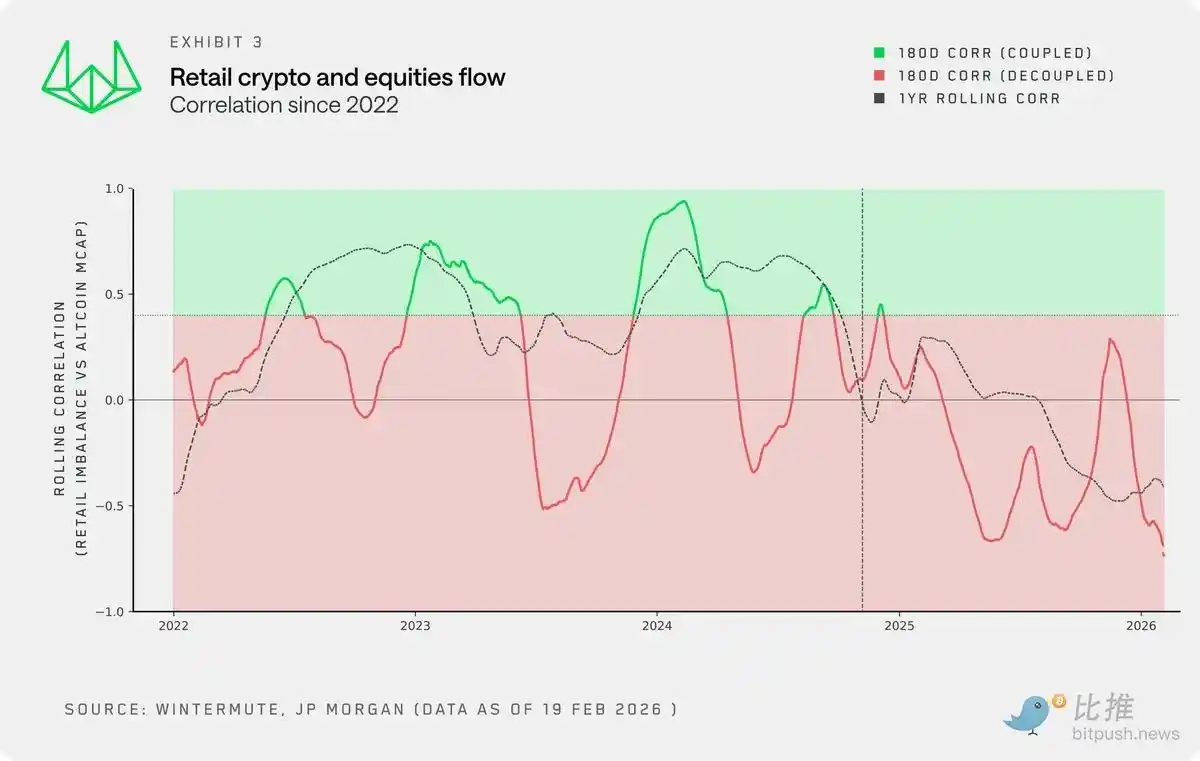
The rolling correlation between retail activity and altcoin market capitalization confirms this shift. What was once a volatile but generally positive relationship has turned negative. Retail is now allocating between the two, rather than injecting funds into both simultaneously.
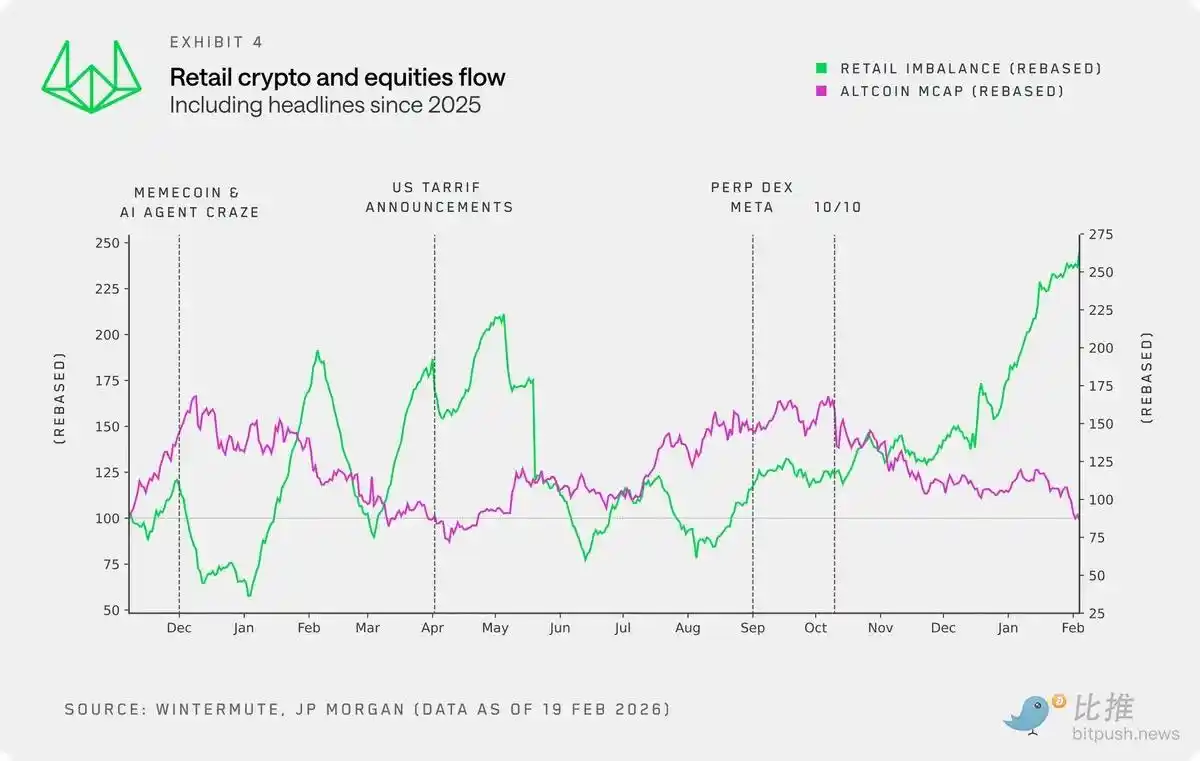
Focusing on 2025 and overlaying key catalysts makes this dynamic clearer. Several points are noteworthy:

  • Memecoins and AI agents had their moments in the spotlight when stock market activity stalled, as retail found speculative outlets elsewhere.

  • Retail continued to buy the dip aggressively in the stock market, both during the tariff policy announcement in April 2025 and in recent market volatility.

  • After October 10th, the market almost completely shifted to stocks, and this trend continues.

Causality

The rolling correlation between retail activity and altcoin market capitalization confirms this shift. The once volatile but overall positive relationship has now turned negative. Retail is now choosing between the two, rather than investing in both.

This new data also confirms this. Retail activity in the stock market has become a new variable that cryptocurrency investors should closely monitor to identify windows of opportunity where retail funds might more sustainably flow into cryptocurrencies.
Volatility = The Product Itself

One reason retail is attracted to and remains active in cryptocurrency is the asset's volatility characteristics. Volatility is the product. It was the initial force that drew retail into the crypto space.

However, although the actual volatility of cryptocurrencies still far exceeds that of stocks, a structural contraction trend has formed, and this trend is difficult to reverse in the short term. The volatility ratio of BTC to the Nasdaq Index (NDX) continues to decline, even compressing to below 2x in the first half of 2025.
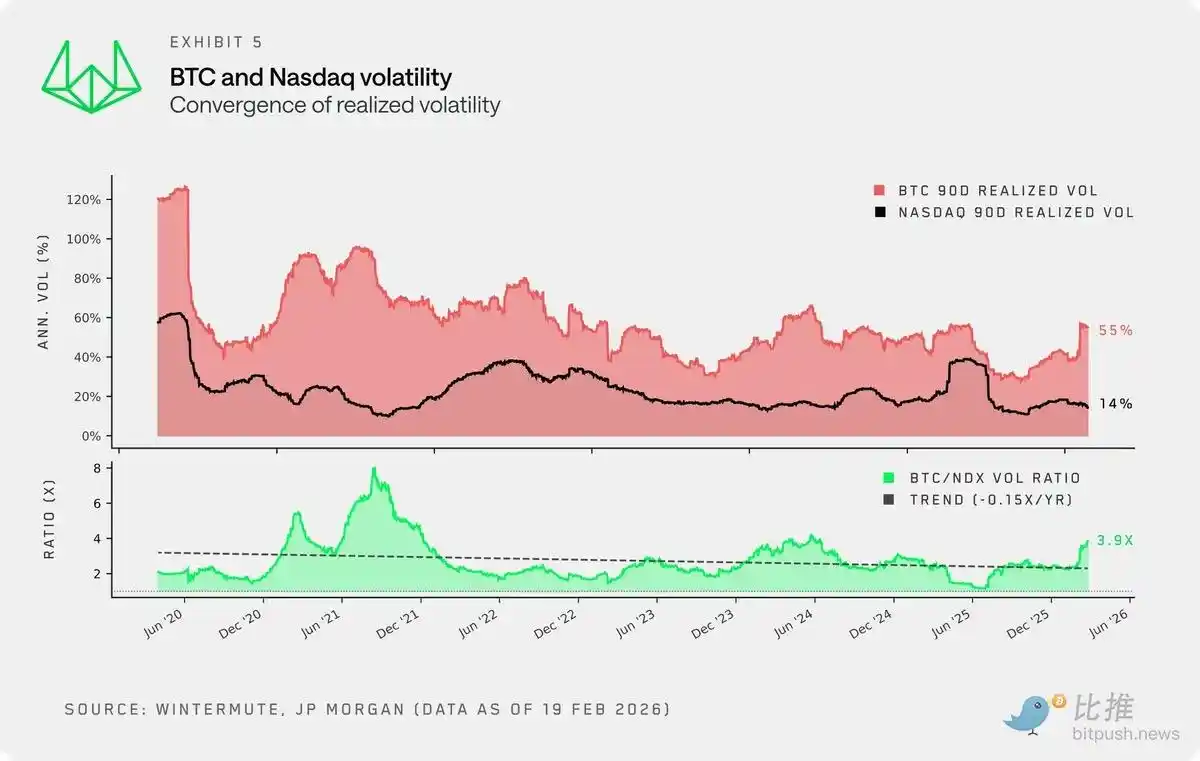
Thoughts on key drivers:

  • Market Maturation: With the increasing number of sophisticated investors and new liquidity tools such as ETFs and DATs, the reflexive volatility peaks that defined earlier cycles have been smoothed out.

  • Market Capacity: At a market capitalization of $2.3 trillion (even 40% below the all-time high), the market requires far greater capital flows to move than it did five years ago.

As volatility compresses, the core selling point of cryptocurrencies to retail erodes. The "excess volatility" that defined the 21-22 cycle and attracted a generation of retail investors is gone. For volatility-seeking retail, stocks are becoming increasingly attractive.

Technical Factors

In addition to the structural changes in the crypto market itself, some technical factors are also accelerating this shift, which is rarely mentioned.

  • Facilitation of Crypto Access — The integration of crypto trading by fintech companies and traditional brokerage platforms (or the introduction of stock trading by crypto-native platforms) has indeed lowered the barrier to entry, but its more profound impact is on the exit process. In previous cycles, the cumbersome process of depositing funds meant that once money entered the crypto market, it was easily "locked in" and naturally circulated among various tokens. Now, these smooth entry and exit channels mean that funds can flow freely between the stock market and the crypto market without significant obstacles.

  • Gaining an Information Edge — Retail seems to be increasingly attracted to the stock market, partly because they are gaining an unprecedented "analytical advantage" through artificial intelligence (AI). Large language models (LLMs) have greatly enhanced the analytical capabilities of retail investors, giving them a sense that they can compete on an equal footing with institutions.

This feeling does not exist in the cryptocurrency market. Although data-based analysis of cryptocurrencies is feasible, the crypto market lacks a consensus valuation framework, the value capture mechanisms of tokens are unclear, and the number of investable assets continues to膨胀, making it difficult for retail to gain that sense of "having an edge."

Conclusion

Retail investors, once the most reliable source of self-reinforcing demand for the crypto market, are increasingly satisfying their risk appetite elsewhere.

The stock market not only offers increasingly competitive volatility but also a growing analytical advantage, and the ability to seamlessly switch from crypto to stock trading through applications already on retail investors' phones.

Cryptocurrencies still have a place in retail investment portfolios, but they are now just one of many choices, no longer the main battlefield for speculation.

This shift should also reshape how investors view the market. Some proven traditional indicators have failed. For crypto investors, simply finding leading indicators of risk appetite and combining them with a crypto-native framework is no longer enough to win. Investors need to increasingly view cryptocurrencies through a cross-asset portfolio lens, just as is standard practice in stocks and fixed income.


Pertanyaan Terkait

QAccording to Wintermute, what major shift in retail investor behavior has occurred since late 2024 regarding stocks and crypto?

ASince late 2024, the relationship between retail investment in stocks and cryptocurrencies has reversed. Instead of moving in the same direction, they now show an inverse relationship. When retail investors buy stocks, they are inactive in the crypto market, and vice versa.

QWhat core attraction of cryptocurrency for retail investors is structurally compressing, according to the report?

AThe volatility premium of cryptocurrencies relative to stocks, which was a major attraction for retail investors, is structurally compressing. The high volatility that defined earlier market cycles and attracted a generation of retail traders no longer exists in the same way.

QWhat are two technical factors mentioned that are accelerating the shift of retail attention away from crypto?

ATwo technical factors are: 1) The facilitation of crypto on-ramps/off-ramps through fintech and traditional broker platforms, which allows capital to flow freely between stocks and crypto instead of being 'locked' in the crypto ecosystem. 2) The use of Large Language Models (LLMs) by retail investors, which provides them with a perceived 'analytical edge' in the stock market—a feeling of advantage that does not exist in the less structured crypto market.

QHow does the report suggest investors should now view cryptocurrency in light of these changes?

AThe report suggests that cryptocurrency should now be viewed through a multi-asset portfolio lens, similar to how other traditional asset classes like stocks and fixed income are analyzed. Relying solely on crypto-native frameworks and traditional leading indicators is no longer sufficient.

QWhat does the data show about the correlation between retail activity and altcoin market cap since the shift occurred?

AThe rolling correlation between retail activity and altcoin market cap, which was once volatile but generally positive, has turned negative. This indicates that retail investors are now allocating capital between stocks and crypto rather than injecting funds into both simultaneously.

Bacaan Terkait

Bersaing di Arena Pembayaran AI, Rangkaian Kartu Tradisional Bertarung Melawan Coinbase

Dengan semakin banyaknya agen AI yang menangani transaksi komersial, persaingan sengit untuk mendominasi infrastruktur pembayaran mendasar telah dimulai. Dua skema utama muncul: saluran pembayaran tradisional yang dijalankan oleh Visa dan Mastercard, yang menggunakan tokenisasi kartu bank, dan protokol berbasis mata uang kripto stabil seperti USDC yang dipelopori Coinbase dengan protokol x402-nya. Saluran kartu bank, melalui layanan seperti Agent Pay (Mastercard) dan Visa Intelligent Commerce, mengandalkan model pembayaran mapan dengan perlindungan penipuan dan penyelesaian sengketa yang kuat. Mereka cocok untuk transaksi eceran konsumen, seperti fitur "checkout dengan satu klik" ChatGPT atau pembelian oleh agen AI di Amazon. Sementara itu, jalur stablecoin dirancang untuk transaksi mesin-ke-mesin yang berfrekuensi tinggi dan bernilai rendah, seperti pembayaran untuk API, data, atau daya komputasi, dengan biaya minimal dan penyelesaian cepat di blockchain. Menariknya, Visa dan Mastercard tidak hanya mengandalkan saluran tradisional mereka. Mereka juga secara agresif berekspansi ke ekosistem stablecoin, dengan Visa membangun interoperabilitas dengan x402 dan Mastercard mengakuisisi platform stablecoin BVNK. Strategi ini menunjukkan niat mereka untuk menjadi gerbang pembayaran utama, terlepas dari saluran mana yang akhirnya mendominasi. Saat ini, aplikasi yang ada menunjukkan pembagian yang jelas: kartu bank mendominasi pembayaran konsumen, sementara stablecoin unggul dalam transaksi mesin. Lima proyek percontohan utama pada awal 2026 mencerminkan pemisahan ini. Ke depan, pertempuran akan berfokus pada zona penyatuan kedua skenario ini. Pemenang akhirnya akan ditentukan oleh apakah transaksi komersial yang digerakkan oleh AI lebih menyerupai ritel tradisional atau jaringan transaksi mikro mesin yang masif. Dengan bertaruh pada kedua kuda, jaringan kartu besar memposisikan diri mereka untuk tetap relevan terlepas dari hasilnya.

marsbit4m yang lalu

Bersaing di Arena Pembayaran AI, Rangkaian Kartu Tradisional Bertarung Melawan Coinbase

marsbit4m yang lalu

AI Mampu Meniru Sempurna, Bagaimana Pengguna Crypto Melindungi Diri dari Penipuan Jenis Baru?

Dengan kemajuan AI, penipuan di dunia kripto kini semakin canggih dan sulit dibedakan dari informasi asli. Dulu, kita bisa mengandalkan kesalahan ketik atau tata bahasa yang buruk untuk mendeteksi penipuan phishing. Namun, AI kini mampu menghasilkan teks, percakapan, dan bahkan situs web yang tampak sangat profesional dan meyakinkan. Ini menciptakan risiko unik bagi pengguna kripto. Berbeda dengan perbankan tradisional, transaksi kripto yang dikonfirmasi di blockchain umumnya tidak dapat dibatalkan. Penipu tidak selalu mencuri kunci pribadi; cukup dengan mengelabui pengguna untuk menyetujui transaksi berbahaya atau memberi izin (approval) tanpa batas kepada kontrak pintar jahat, aset bisa hilang dalam sekejap. Oleh karena itu, pendekatan keamanan harus berubah. Daripada mengandalkan penampilan, pengguna harus menjadikan **verifikasi** sebagai prioritas utama. Berikut adalah prinsip inti yang perlu diterapkan: 1. **Periksa Domain dengan Cermat**: Jangan hanya melihat desain situs. Selalu ketik URL secara manual atau gunakan bookmark yang sudah disimpan. Waspadalah terhadap domain palsu yang mirip, sering kali dengan karakter tambahan atau akhiran yang tidak biasa. 2. **Gunakan Hanya Tautan Resmi**: Jangan klik tautan dari pesan privat, iklan, atau komentar media sosial yang mencurigakan. Akses situs hanya melalui saluran komunikasi resmi proyek yang telah diverifikasi. 3. **Tinjau Izin Wallet Sebelum Menyetujui**: Sebelum menandatangani atau menyetujui permintaan apa pun di dompet Anda, periksa detailnya. Periksa alamat kontrak, jenis token, jumlah yang diizinkan untuk ditransfer, dan lingkup izin. Hindari pemberian izin tanpa batas (*unlimited approval*). 4. **Verifikasi Alamat Kontrak Token**: Jangan percaya hanya pada nama dan logo token. Selalu konfirmasi alamat kontrak resmi melalui situs web proyek atau explorer blockchain yang tepercaya. 5. **Waspadai Pesan "Dukungan" yang Tidak Diminta**: Penipu sering menyamar sebagai dukungan pelanggan di media sosial. Ingatlah bahwa layanan resmi hampir tidak pernah memulai percakapan privat untuk menawarkan bantuan dan **tidak akan pernah** meminta seed phrase atau kunci pribadi Anda. 6. **Hati-hati dengan Rasa Urgensi**: Penipuan sering menciptakan rasa panik ("akun Anda akan diblokir", "klaim hadiah segera sebelum kadaluarsa") untuk mendorong Anda bertindak gegabah. Jika ada yang mendesak Anda untuk segera bertindak, berhentilah dan verifikasi semuanya dengan tenang. Kesimpulannya, di era AI, penampilan yang halus dan teks yang sempurna bukan lagi jaminan keamanan. Pertahanan terbaik adalah kebiasaan verifikasi yang konsisten terhadap setiap tautan, permintaan dompet, dan komunikasi sebelum melakukan tindakan apa pun. Keamanan kripto sekarang adalah pertempuran untuk selalu memeriksa ulang.

marsbit23m yang lalu

AI Mampu Meniru Sempurna, Bagaimana Pengguna Crypto Melindungi Diri dari Penipuan Jenis Baru?

marsbit23m yang lalu

Matikan AI Baru Boleh Interview: Orang Seperti Apa yang Dicari Anthropic?

**Ringkasan Artikel: "Matikan AI Sebelum Wawancara: Siapa yang Dicari Anthropic?"** Anthropic, perusahaan AI bernilai fantastis (9650 miliar dolar AS), menerapkan proses rekrutmen yang sangat unik. Kunci utamanya adalah **larangan mutlak menggunakan AI selama semua tahap wawancara**. Fase terpenting adalah **"wawancara budaya"** yang menguji nilai, pandangan dunia, dan pemahaman kandidat tentang **risiko jangka panjang AI** — bukan sekadar risiko produk. Pertanyaannya mendalam dan personal, seperti "Keyakinan tidak biasa apa yang Anda pegang?" atau dilema etika nyata. Yang dinilai adalah kemampuan berpikir mandiri, keberanian mempertahankan pendapat, dan bahkan **keberanian untuk mengkritik Anthropic sendiri**. Pendekatan ini bertolak belakang dengan tren di perusahaan seperti Google, yang justru mengizinkan penggunaan AI (Gemini) dalam wawancara teknis untuk menilai kelancaran berkolaborasi dengan AI. Logika Anthropic adalah: Di era di mana **eksekusi (menulis kode, menghasilkan argumen) semakin murah dan otomatis** oleh AI, yang justru menjadi sangat berharga dan langka adalah **kemampuan berpikir mandiri, memiliki keyakinan yang otentik, dan kebijaksanaan yang berasal dari diri sendiri**. Mereka mencari orang yang **tidak mengalihdayakan pikirannya** kepada AI. Intinya, Anthropic percaya bahwa di masa depan AI, yang paling dibutuhkan bukanlah orang yang paling mahir menggunakan AI, tetapi **orang yang tetap memiliki sesuatu yang berharga di kepalanya bahkan setelah AI dimatikan**.

marsbit28m yang lalu

Matikan AI Baru Boleh Interview: Orang Seperti Apa yang Dicari Anthropic?

marsbit28m yang lalu

Mengucapkan Selamat Tinggal pada Klasik Bull-Bear, Pasar Masuki Era Rotasi Gelembung

Pasar keuangan telah berubah secara fundamental dari siklus pasar sapi dan beruang tradisional yang bergerak lambat. Saat ini, pasar beroperasi seperti sistem konvektif badai berantai, di mana gelembung atau "badai" aset bergantian muncul, berkembang, dan mereda secara berurutan. Pola baru ini didorong oleh delapan perubahan struktural permanen: partisipasi spekulatif yang meluas ke publik, pembelian permanen dari rencana pensiun, dominasi investasi pasif, kebangkitan dana multi-strategi dan perdagangan frekuensi tinggi, penekanan volatilitas, perubahan komposisi indeks (didominasi perusahaan berbasis narasi dan teknologi), hilangnya keterlambatan informasi, serta lingkungan fiskal dan moneter yang mendukung. Hasilnya adalah pasar yang ditandai dengan rotasi gelembung cepat di berbagai tema seperti infrastruktur AI, teknologi kuantum, robotika, dan bioteknologi. Setiap gelombang menjalani siklus yang dapat diprediksi: laten, pemicu, pembentukan narasi, divergensi, kehancuran, dan akhirnya memicu gelombang berikutnya dengan aliran keluar modalnya. Pasar tidak akan kembali ke model lama. Kesuksesan dalam lingkungan baru ini membutuhkan perspektif yang lebih tinggi untuk melihat pola rantai yang utuh, daripada terhanyut oleh badai tunggal. Kedua, investor memerlukan kedalaman penelitian untuk menilai kelayakan tema atau kemampuan untuk mengidentifikasi dan mengikuti tren yang ditetapkan oleh pelaku pasar utama.

marsbit37m yang lalu

Mengucapkan Selamat Tinggal pada Klasik Bull-Bear, Pasar Masuki Era Rotasi Gelembung

marsbit37m yang lalu

2 Menit Terakhir Sebelum Pembukaan Hynix, TradeXYZ Membuat Harga Akurat Hanya Selisih 0,13%

Dulu, pasar keuangan tradisional berhenti menemukan harga saat tutup. Namun, pasar derivatif on-chain seperti yang dipelopori Hyperliquid mengubah hal ini. Dengan HIP-3 Hyperliquid, aset seperti saham kini dapat diperdagangkan 24/7 di rantai, menjadi tempat penemuan harga bahkan saat pasar tradisional tutup. Contohnya pada saham SK Hynix. Pasar tradisional Korea (KRX) tutup pada 5 Juni dengan harga 2.070.000 KRW. Di Hyperliquid, kontrak xyz:SKHX terus aktif. Menjelang pembukaan KRX pada 8 Juni, harga on-chain turun hingga 1200.0 USDC pada pukul 08:56 KST, yang menyiratkan penurunan -10.21%. Tiga menit kemudian, KRX membuka dengan harga 1.856.000 KRW, turun -10.34%. Selisihnya hanya 0,13%. Artinya, pasar on-chain hampir secara sempurna memperkirakan besarnya penurunan harga pembukaan. Kemudian, dalam 120 detik terakhir sebelum pembukaan (08:58-08:59 KST), volume perdagangan xyz:SKHX melonjak ke level tertinggi akhir pekan, dan harga naik +2,31%. Ini tidak berarti prediksi gagal, tetapi kemungkinan besar pasar on-chain sudah memperdagangkan antisipasi pemulihan setelah pembukaan. Nyatanya, dalam beberapa menit setelah pembukaan, saham SK Hynix di KRX juga bangkit sekitar +2,64%. Kasus ini menunjukkan bagaimana pasar on-chain dapat berfungsi sebagai arena penemuan harga yang kontinu dan sangat responsif, bahkan mendahului pergerakan di pasar tradisional.

marsbit40m yang lalu

2 Menit Terakhir Sebelum Pembukaan Hynix, TradeXYZ Membuat Harga Akurat Hanya Selisih 0,13%

marsbit40m yang lalu

Trading

Spot
Futures
活动图片




