Can the Dual Currency Win Strategy Really Weather Bull and Bear Markets? A 6-Year Backtest Provides the Answer

marsbitDipublikasikan tanggal 2026-02-27Terakhir diperbarui pada 2026-02-27

Abstrak

"Can the Dual Currency Win (Wheel Strategy) truly weather bull and bear markets? A 6-year backtest (2020-2026) on Bitcoin and Ethereum provides the answer. The study compared two approaches: the 'Standard Rolling Strike' method, which dynamically sells covered calls at 105% of the current spot price, and the 'Fixed Anchor' method, which stubbornly sells calls at the original, higher cost basis after a drop, refusing to sell at a loss. Key findings reveal a significant performance gap. The Standard method, while sacrificing some upside, demonstrated superior risk-adjusted returns. For a 50/50 BTC/ETH portfolio, it achieved a +1347.32% total return with a -49.9% max drawdown and a Sharpe Ratio of 0.983, outperforming both Buy & Hold (+1665.52%, -77.8% drawdown, 0.85 Sharpe) on risk metrics and crushing the Fixed Anchor method (+592.77%, -61.8% drawdown, 0.766 Sharpe). The data shows the Standard strategy's strength lies in its dynamic adjustment mechanism, continuously resetting its strike price to balance income generation with participation in bullish trends. Conversely, the Fixed Anchor strategy's poor performance highlights the costly pitfall of the 'anchoring bias'—the human tendency to fixate on the entry price. This psychological trap cripples the ability to collect meaningful premium during bear markets and causes investors to miss subsequent bull runs when positions are called away at breakeven. The conclusion is clear: discipline and adaptability are far more valua...

Author: Michel Athayde

Can the Dual Currency Win Strategy Really Weather Bull and Bear Markets?

Using real market data from 2020-2026 for backtesting, we discovered:

Even with the same Dual Currency Win strategy, just by changing how the Calls are sold, the final profit difference can be nearly double.

The data tells us the problem isn't the strategy, it's human nature.

In the crypto market, the "Dual Currency Win" (Wheel Strategy) is often seen as a tool for collecting rent through bull and bear markets. But how do different underlying execution logics reshape long-term profit distribution?

To find the truth, we backtested Bitcoin and Ethereum over a complete bull-bear cycle from 2020-2026. In this sample, which includes crashes and an epic bull market, we compared two截然不同的双币赢玩法:

  • Standard Dual Currency Win (Rolling Strike): Follows the market. After taking delivery of the spot asset, each time a Covered Call is sold dynamically at 105% of the current price.

  • Break-even Type Dual Currency Win (Fixed Anchor): Anchors to cost. Once taking delivery at a high price, no matter how far the price falls, it stubbornly sells Calls at the "last delivery strike price," refusing to give up the chips until breaking even.

This is no longer a simple contest of "selling strategy vs. holding spot," but a deep test of "how trading psychology changes long-term profit distribution."

Core Data: Re-evaluating Risk and Return

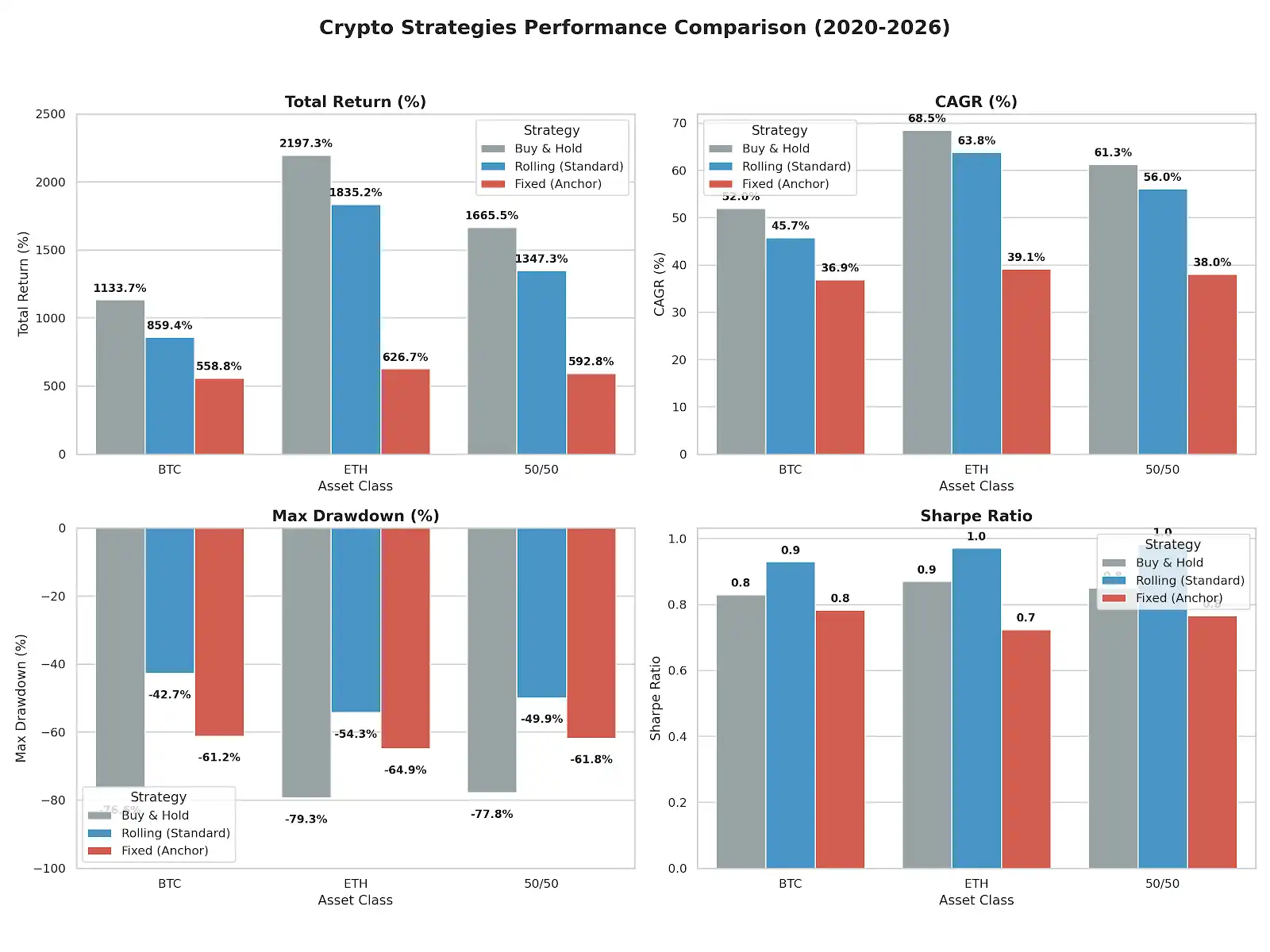
(Note: Backtest span 2020-2026, Puts priced at 30% annualized, Calls at 25% annualized, 7-day cycles)

Investment Strategy Total Return Annualized (CAGR) Max Drawdown Sharpe Ratio
BTC HODL (Buy & Hold) +1133.73% 51.95% 0.83
BTC Standard (Rolling) +859.43% 45.72% -42.74% 0.929
BTC Break-even (Fixed) +558.81% 36.88% -61.19% 0.783
--- --- --- --- ---
ETH HODL (Buy & Hold) +2197.31% 68.52% -79.30% 0.87
ETH Standard (Rolling) +1835.21% 63.78% -54.27% 0.971
ETH Break-even (Fixed) +626.74% 39.13% -64.87% 0.724
--- --- --- --- ---
50/50 HODL Portfolio +1665.52% 61.30% -77.80% 0.85
50/50 Standard Portfolio +1347.32% 56.05% -49.90% 0.983
50/50 Break-even Portfolio +592.77% 38.03% -61.80% 0.766

Faced with this real data, we need to re-examine two core propositions in trading.
The Risk-Return Balancing Act of the Standard Dual Currency Win

Many mistakenly believed the standard strategy would severely underperform in bull markets, but the data proves that with just a 5% upside buffer (spot price * 1.05), it exhibits极强的 risk-return balancing ability over a full cycle.

In the 50/50 portfolio, its Sharpe Ratio (0.983) thoroughly crushed buy-and-hold (0.85) and drastically compressed the nearly -78% abysmal drawdown to -49.9%.

Its advantage doesn't come from predicting the market, but from the mechanism of "continuously dynamically raising the strike price."

With every price change, the standard version relentlessly adjusts its target. Rolling本质上是在牛市中不断“重置成本”,而 Fixed Anchor 却是在不断“确认错误”. The standard version sacrifices a极小部分 of potential暴利上限,换取来了平滑资金曲线的巨大战略纵深.

"Anchoring to Cost" is the Most Expensive Psychological Placebo

The most thought-provoking part of the data is the comprehensive failure of the "Break-even (Fixed Anchor)" type. It fell far short of the standard version in both return and drawdown control.

This exposes the most common weakness in human trading psychology: Anchoring Effect. If you took delivery at a high of 60k, and stubbornly hang a Call at 60k when the price drops to 30k, you not only lose the "bleeding stop" ability of option premiums during the long bear market, but also risk having your chips called away at 60k during a V-shaped market reversal, completely missing the subsequent main upward浪.

The break-even strategy seems conservative, but it's actually using time to fight the trend. And in a trend-driven market, time is often on the side of the trend. Obsessing over "not selling at a loss" is ironically the fastest way to perfectly miss out on major cycle红利.

Conclusion

Markets are full of volatility, but data doesn't lie.

In trending assets like Bitcoin and Ethereum, the real risk is not drawdown, but being limited on the upside by your own psychological anchor.

The standard Dual Currency Win tells us:

As long as you keep adjusting dynamically and rolling continuously, a selling strategy can also coexist with the trend.

And the break-even strategy reminds us:

The market won't change direction because of your cost basis.

Discipline is far more important than breaking even.

Pertanyaan Terkait

QWhat is the main finding of the 6-year backtest (2020-2026) comparing the two versions of the Wheel Strategy?

AThe backtest revealed that the standard 'Rolling Strike' version significantly outperformed the 'Fixed Anchor' version, with the performance gap being nearly double in some cases. The key difference lies not in the strategy itself, but in the human psychology of anchoring to a cost basis.

QHow does the 'Rolling Strike' (Standard) version of the Wheel Strategy manage risk and return compared to simply holding the asset (Buy & Hold)?

AThe 'Rolling Strike' version demonstrated superior risk-adjusted returns. For the 50/50 portfolio, it achieved a higher Sharpe Ratio (0.983 vs 0.85 for Buy & Hold) and significantly reduced the maximum drawdown (-49.9% vs -77.8% for Buy & Hold), while still capturing substantial upside.

QWhy did the 'Fixed Anchor' version of the strategy perform poorly in the backtest?

AThe 'Fixed Anchor' strategy performed poorly because it falls victim to the 'anchoring effect' in behavioral finance. By stubbornly selling calls at the original, higher cost basis during a bear market, it loses the ability to collect meaningful premium ('stop the bleeding') and risks having the asset called away at the break-even point, missing out on a subsequent major bull run.

QAccording to the article, what is the most significant risk when investing in trend assets like Bitcoin and Ethereum using such strategies?

AThe most significant risk is not the price drawdown itself, but the psychological limitation of one's upside potential by being anchored to a specific cost price, which can cause an investor to miss out on major market trends.

QWhat is the core lesson about discipline from the article's conclusion?

AThe core lesson is that maintaining discipline by dynamically adjusting and rolling positions (as in the standard version) is far more important than the psychological desire to simply 'break even' on a trade. The market will not change direction based on an individual's cost basis.

Bacaan Terkait

Penarikan Bitcoin Terus Berlanjut: Penyimpanan 8 Tahun di Dompet Dingin Coldcard Berakhir dengan Nol

Dompet keras Coldcard Dihack, Aset Bitcoin Senilai $88,6 Juta Dicuri Dompet keras Coldcard mengalami kerentanan keamanan serius, menyebabkan gelombang penarikan paksa dana pengguna. Menurut Galaxy Research, total 1.367,05 BTC (sekitar $88,6 juta) telah dicuri dari 4.585 alamat yang rentan. Masalahnya bukan pada perangkat lunak (firmware), yang sudah diperbarui oleh pengembang Coinkite. Akar masalahnya ada pada seed phrase (frasa pemulihan) yang dihasilkan oleh perangkat antara Maret 2021 dan versi firmware tertentu. Kesalahan pemrograman menyebabkan generator angka acak perangkat beralih dari komponen keras ke generator perangkat lunak (Yasmarang) yang dapat diprediksi. Seed phrase yang dibuat dalam periode rentan ini dapat ditebak melalui serangan brute-force secara offline. Perangkat yang terdampak mencakup model Mk2/Mk3 (firmware 4.0.1–4.1.9), Mk4/Mk5 (sebelum v5.6.0), dan Q (sebelum v1.5.0Q). Satu-satunya cara untuk mengamankan dana adalah dengan membuat seed phrase BARU pada firmware yang telah diperbaiki dan memindahkan semua aset ke alamat baru tersebut. Memperbarui firmware saja tidak mengubah seed phrase lama yang sudah rentan. Insiden ini menghancurkan bagi investor jangka panjang. Satu korban, seorang pria 39 tahun, kehilangan 2 BTC ($130.000) yang ia kumpulkan selama 8 tahun melalui kerja keras. Ia menggunakan Bitcoin sebagai lindung nilai terhadap hiperinflasi di negaranya dan menyimpannya dengan aman di dompet dingin untuk pensiun dini. Pencurian instan ini menghancurkan rencananya dan mengungkap kerapuhan strategi 'simpan dan lupakan' meski dengan perangkat keras sekalipun. Kasus ini mengingatkan pada insiden serupa di masa lalu di mana kelemahan generator angka acak merusak keamanan kriptografi. Ini mempertanyakan asumsi bahwa penyimpanan offline selalu identik dengan keamanan mutlak.

cryptonews.ru1j yang lalu

Penarikan Bitcoin Terus Berlanjut: Penyimpanan 8 Tahun di Dompet Dingin Coldcard Berakhir dengan Nol

cryptonews.ru1j yang lalu

Mengapa Bitcoin Bertahan di $64.000 Setelah Jeda Ketat dari The Fed

Bitcoin berakhir di bulan Juli mendekati level $64.000, bertahan di tengah volatilitas pasca keputusan Federal Reserve AS untuk mempertahankan suku bunga dalam kisaran 3,50-3,75%. Meskipun tiga anggota komite voting mendukung kenaikan suku bunga, sinyal keseluruhan dari Fed tetap ketat, membatasi minat terhadap aset berisiko. Pasar kripto menunjukkan ketahanan dengan aliran bersih masuk $32,1 juta ke ETF Bitcoin spot, mengakhiri serangkaian arus keluar. Di sisi lain, ETF Ethereum mengalami penarikan dana sekitar $18,65 juta. Kapitalisasi pasar agregat bertahan di sekitar $2,29 triliun. Secara teknis, Bitcoin menemukan dukungan di zona $63.000-63.500 dengan hambatan utama di dekat $66.000. Sementara Ethereum diperdagangkan sekitar $1.900 dengan tekanan harga, metrik jaringan seperti antrian validator yang panjang menunjukkan komitmen jangka panjang. Pergerakan di altcoin beragam: ETF Solana mencatat aliran masuk yang kuat sekitar $19 juta, sementara XRP dan BNB bergerak dalam konsolidasi. Regulasi juga menjadi perhatian setelah penundaan pembahasan CLARITY Act di Senat AS hingga musim gugur, mengurangi harapan disahkannya undang-undang tersebut pada tahun 2026. Hari terakhir bulan Juli akan dipantau untuk data makro AS seperti inflasi dan pengeluaran konsumen, yang dapat memengaruhi pergerakan pasar. Skenario dasar untuk Bitcoin adalah konsolidasi dalam kisaran $63.000-66.000. Kelangsungan aliran masuk institusional dan pertahanan level kunci akan menjadi sinyal penting untuk pemulihan pasar di paruh kedua tahun 2026.

cryptonews.ru5j yang lalu

Mengapa Bitcoin Bertahan di $64.000 Setelah Jeda Ketat dari The Fed

cryptonews.ru5j yang lalu

Trading

Spot
活动图片





