Behind the 25% Surge: The On-Chain Life-and-Death Game of Hyperliquid

比推Dipublikasikan tanggal 2026-03-09Terakhir diperbarui pada 2026-03-09

Abstrak

A dramatic 25% surge in WTI crude oil prices, reaching $119.5 per barrel, has triggered a high-stakes on-chain showdown on the Hyperliquid derivatives exchange. The price spike was driven by a geopolitical crisis: the seven-day blockade of the Strait of Hormuz, a critical chokepoint for 20% of global oil supply. This event led to massive liquidations for several prominent traders who had heavily shorted oil. Key figures include trader CBB, who faced a $3.8 million unrealized loss on a $13.78 million short position, and the account "2 frères 2 fauves," the platform's largest oil short with a $3.4 million loss. Both faced liquidation at $120.76. Another whale, 0x8Af7, was fully liquidated, losing $1.55 million, only to immediately reopen a new $6.48 million short position. In contrast, Sky (formerly MakerDAO) co-founder Rune Christensen profited significantly, gaining over $1.36 million from a $7.82 million long position opened around $93. He employed a sophisticated macro-hedging strategy, simultaneously shorting ETH and equity indices to bet on war-driven oil premiums and risk-off sentiment. The event highlights the emergence and risks of on-chain commodity trading. Platforms like Hyperliquid offer democratized access to leveraged oil futures without traditional brokers or safeguards. However, the automated, unforgiving liquidation mechanisms provide no protection against black swan events like a geopolitical crisis, demonstrating that while the tools are new, the lessons ...

Written by: angelilu, Foresight News

Original title: Crude Oil Surges 25%, Hyperliquid Stages On-Chain Life-and-Death Game


"Friends shorting crude oil are completely fired up."

When on-chain analyst Ai Yi sent this tweet on the morning of March 9, WTI crude oil touched $108 per barrel. The account at the top of Hyperliquid's holdings leaderboard was facing a floating loss approaching $3.4 million, with the liquidation price set at $120.76.

As of publication, the WTI crude oil contract price reached an intraday high of $119.5 and is currently reported at $114.5, accumulating a gain of over 25% since last Friday's closing price.
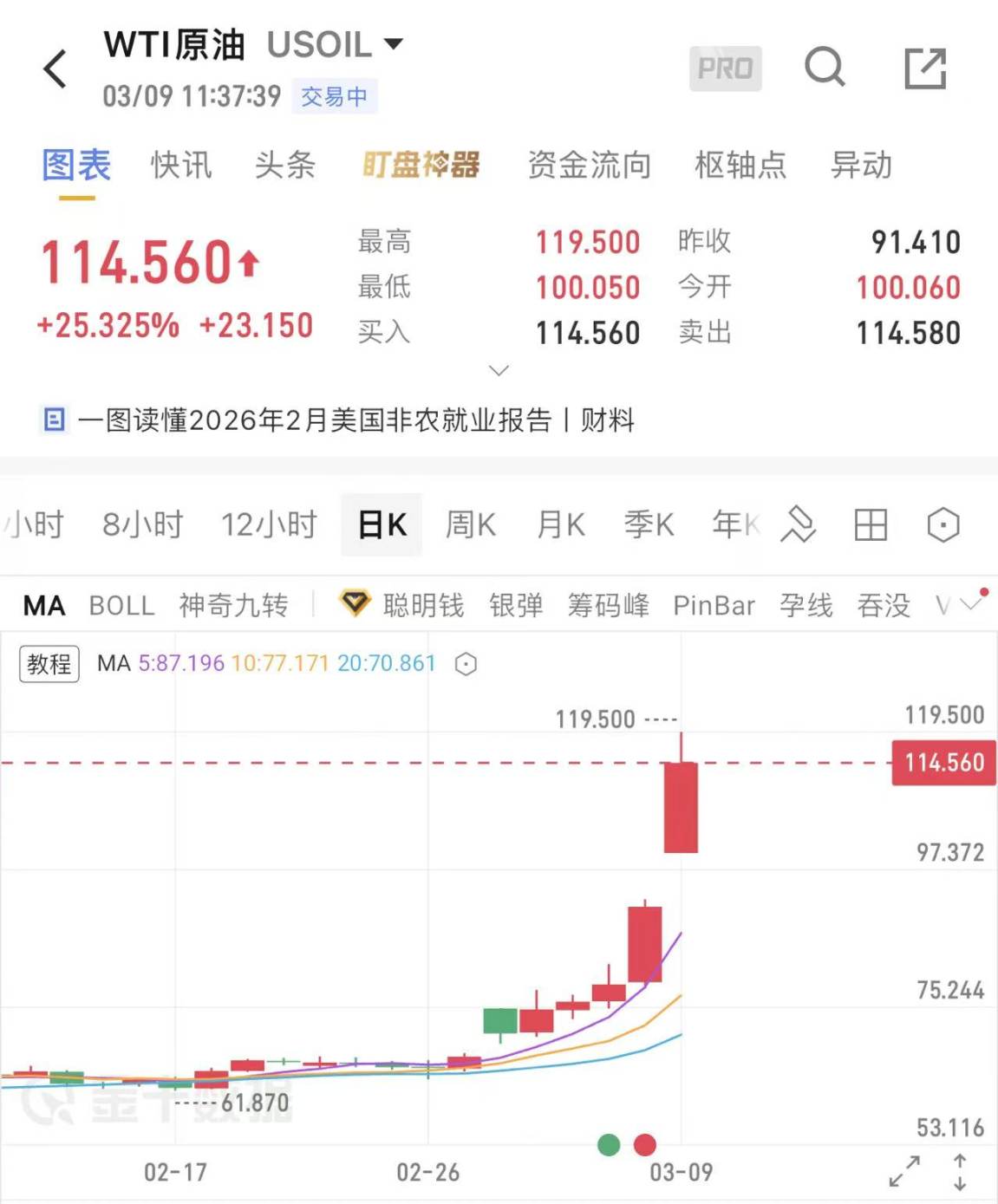
Due to a Strait, Crude Oil Surges Over 40% in a Week

The story begins with Iran's Strait of Hormuz.

By March 9, the Strait of Hormuz had been almost completely blocked for seven consecutive days. The shutdown of this choke point, which carries about 20% of the world's oil supply, triggered a market quake. By March 9, the WTI crude oil price had surged dramatically within just a week, setting a rare volatility record in recent years, accumulating a gain of over 40% compared to pre-conflict levels.

The shockwaves spread rapidly. The Nikkei index fell 5.4% in a single day, its largest drop since the tariff turmoil; South Korea's KOSPI plummeted 7%; Germany's DAX fell over 3%. Bitcoin was not spared either, falling below $66,000, with the crypto market seeing $120 million in liquidations within an hour. The Crypto Fear & Greed Index dropped to 12, entering the "extreme fear" zone.

But on Hyperliquid, another war was raging.

Three Stories of Shorting Crude Oil

In the on-chain circle, CBB (@Cbb0fe) is not an unfamiliar face. A few months ago, he publicly formed a team specifically to "hunt" another whale, @qwatio. This time, he himself became the prey.

https://x.com/lookonchain/status/2030817006107369727

According to Lookonchain monitoring, CBB shorted 127,175 xyz:CL (WTI crude oil mapping contracts) at an average price of $78.37, with a notional value of approximately $13.78 million. As oil prices soared, his floating loss reached $3.81 million, with the liquidation price hanging at $120.76.

Only a few tenths of a dollar away from that number. But no one knows when the situation in Iran will cool down.

Another account, "2 frères 2 fauves," is in equally dangerous territory. He entered a short position at $78.36, currently holding 12,717 CL with a notional value of approximately $13.37 million, ranking first in CL contract holdings on Hyperliquid. His floating loss is $3.4 million, with the same liquidation price of $120.76.

More dramatic is the experience of whale 0x8Af7. He shorted 72,179 CL (approx. $7.8 million). As oil prices rose, his short position was entirely force-liquidated, resulting in a loss exceeding $1.55 million.

Yet, just hours after the liquidation, he immediately reopened a position—60,166 new short contracts, with a notional value of $6.48 million.

Was it a misjudgment or inherent gambling tendencies? Perhaps both. But this choice itself speaks to a certain ethos of on-chain high-leverage trading: liquidation is not the end, just the conclusion of the previous round.

There Are Also Winners, The Other Side of a Sky Co-Founder

On the same Hyperliquid, during the same period, Sky (formerly MakerDAO) co-founder Rune Christensen was laughing on the other side, watching the storm.

On-chain analyst EmberCN disclosed that RuneKek (Rune's on-chain account) went long on approximately $7.82 million worth of crude oil contracts, with an entry cost around $93. As of today, with oil prices touching $109, his floating profit has exceeded $1.36 million.

More noteworthy is his portfolio strategy: while going long on crude oil, he also shorted some ETH and XYZ100 (US stock index mapping contracts). This makes his strategy more like a hedge against geopolitical conflict—crude oil benefits from war premiums, while stocks and cryptocurrencies suffer from risk-off sentiment. By positioning on both sides, he hedges out the risk of a one-way bet.

Rune Christensen, a DeFi protocol founder, used on-chain perpetual contracts to build a macro hedging portfolio. This fact itself is more noteworthy than how much money he made.

On-Chain Commodities: New Tools, Old Lessons

This round of oil行情 pushed a previously inconspicuous topic to the forefront: on-chain commodity trading.

The crude oil on Hyperliquid was launched by the Felix protocol (HIP-3 market deployer on Hyperliquid) on January 9, 2026, about two months ago. The initial parameters were a maximum of 5x leverage and an open interest cap of $2.5 million, representing an early small-scale launch. Trading volume only truly exploded after Iran blocked the strait.
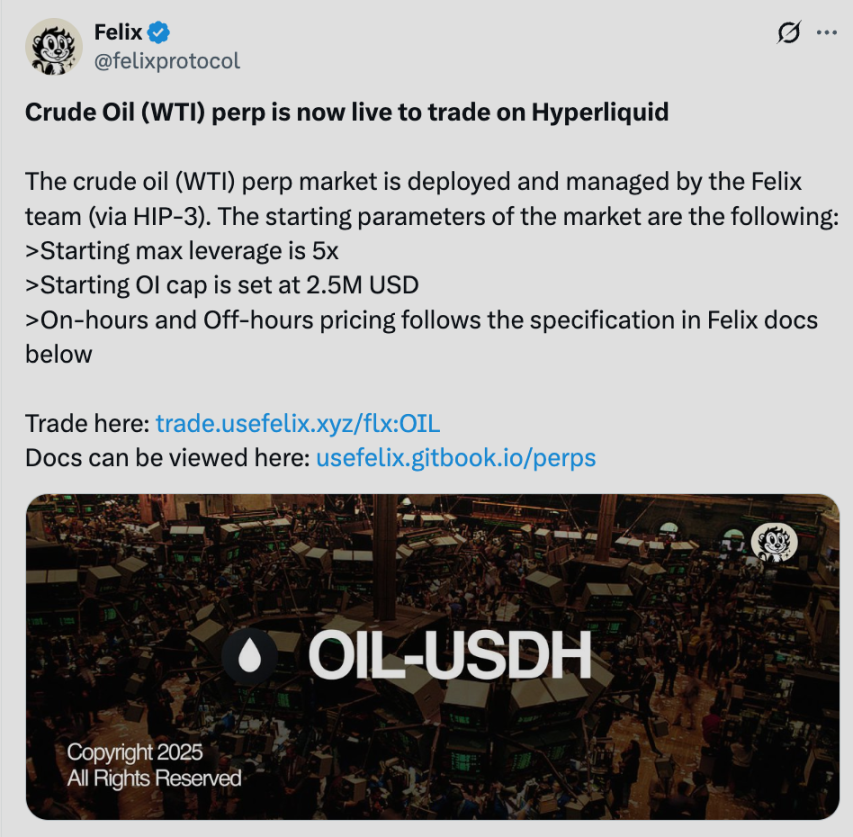
Platforms like Phantom have also陆续 launched perpetual contracts for traditional commodities like crude oil and gold. Theoretically, anyone with a wallet can trade crude oil futures like they trade Bitcoin, without opening a traditional futures account or needing a broker.
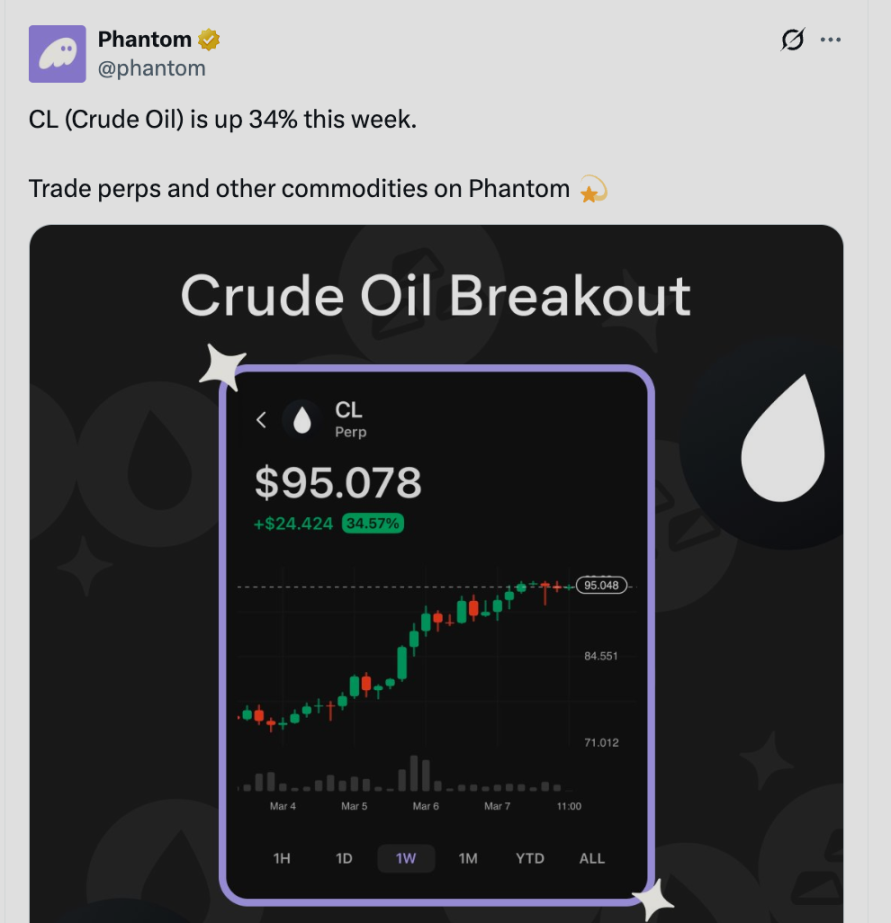
This is genuine financial democratization. But the other side of the coin is equally real.

Traditional commodity futures markets have strict margin systems, circuit breakers, position limits, and are backed by risk control teams from brokers constantly monitoring the screens. The rules of on-chain perpetual contracts are much simpler: if the position value falls to the liquidation line, the system automatically force-closes it. There are no phone call reminders, no manual intervention.

The liquidation prices for CBB, "2 frères 2 fauves," and others are all set near $120.76—this number isn't random; it's the "safety margin" they calculated when initially building their positions. In normal oil price fluctuations, having over fifty dollars of room from the entry price of $78 seemed quite ample.

But what they didn't anticipate was that a geopolitical crisis could push oil prices up 50% within 72 hours.

This isn't a strategy error; it's a black swan arrival. The problem is, on-chain, there is no mechanism to let you catch your breath when the black swan lands.

When DeFi Meets Hormuz

The connection between the crypto market and traditional geopolitics is happening faster than anyone anticipated.

Hyperliquid users now need to watch the latest developments in Iran's Strait of Hormuz; while DeFi OGs are using on-chain derivatives to hedge war risks.

As the variety of on-chain commodities and on-chain US stock mapping contracts continues to expand, on-chain players will only be increasingly exposed to macro risks. In the traditional financial world, this is called "global macro strategy," requiring professional teams and robust risk control systems. On-chain, it's called "one person's position."

Original link:https://www.bitpush.news/articles/7617972

Pertanyaan Terkait

QWhat event caused the price of WTI crude oil to surge by over 25% in a week on Hyperliquid?

AThe blockade of the Strait of Hormuz by Iran, a critical chokepoint for approximately 20% of global oil supply, for seven consecutive days caused the price surge.

QWhich prominent Hyperliquid user faced a significant unrealized loss of over $3.8 million on their short oil position?

AThe user CBB (@Cbb0fe) faced an unrealized loss of over $3.8 million on a short position of 127,175 xyz:CL contracts, with a liquidation price at $120.76.

QHow did Rune Christensen, a co-founder of Sky (formerly MakerDAO), profit from the oil price movement on Hyperliquid?

ARune Christensen profited by taking a long position on oil contracts worth approximately $7.82 million at a cost of around $93. As the price rose to $109, he realized an unrealized profit of over $1.36 million.

QWhat is a key difference between trading traditional commodity futures and their on-chain perpetual contract equivalents, as highlighted in the article?

AA key difference is that traditional markets have strict margin requirements, circuit breakers, position limits, and broker risk teams monitoring positions, while on-chain perpetual contracts have simpler rules with automatic liquidation at the margin call price without human intervention or warnings.

QWhat new type of trading strategy did Rune Christensen employ on Hyperliquid during the geopolitical crisis?

ARune Christensen employed a macro hedging strategy by simultaneously longing oil contracts and shorting both ETH and the XYZ100 (a US stock index mapping contract), betting that oil would benefit from war premiums while stocks and crypto would suffer from risk-off sentiment.

Bacaan Terkait

Robinhood Chain Sambut Pemain Berat, Uniswap Rancang "Pools", Sinyal Apa yang Dibawa?

Penulis: Flora, CryptoPulse Labs Pada 4 Agustus, diungkapkan oleh komunitas crypto, protokol pertukaran terdesentralisasi Uniswap sedang mengembangkan platform penerbitan token bernama "Pools" di Robinhood Chain. Saat ini, situs web pools.trade sudah aktif dengan pesan "Coming soon from Uniswap". Jika diluncurkan, ini menandai perluasan peran Uniswap dari infrastruktur perdagangan menjadi "platform penerbitan aset on-chain". **Perluasan Batas DEX:** Uniswap, sebagai infrastruktur perdagangan AMM terkemuka, kini bergerak ke ranah penerbitan aset. Pools bertujuan mengintegrasikan proses peluncuran, lelang, pembangunan likuiditas, dan perdagangan dalam satu protokol, menawarkan solusi "start-to-finish" untuk proyek Web3. **Mekanisme Pools:** Platform ini akan menawarkan dua mode utama: 1. **Crowd Launch:** Mekanisme lelang 4 jam yang adil. 50% token dilelang publik, 50% sisanya serta dana terkumpul akan membentuk pool likuiditas Uniswap v4. Jika target valuasi FDV $50K tercapai, token akan bermigrasi ke perdagangan bebas. 2. **Instant Launch:** Menggunakan mekanisme serupa "Bonding Curve", memungkinkan perdagangan instan dengan penemuan harga otomatis. 80% token untuk perdagangan kurva, 20% untuk likuiditas. Pools dibangun dengan teknologi seperti Continuous Clearing Auction (CCA) untuk penemuan harga yang lebih mulus. **Pilihan Robinhood Chain:** Deployment di Robinhood Chain strategis, menggabungkan infrastruktur DeFi asli Uniswap dengan basis pengguna investasi ritel Robinhood yang luas. Ini dapat membuka akses ke pengguna baru yang lebih besar dan memperkuat ekosistem on-chain Robinhood. **Peringatan atas Spekulasi:** Pasar telah melihat munculnya token komunitas (seperti FRONG) yang memanfaatkan antisipasi ini. Uniswap Labs belum mengonfirmasi token resmi POOLS apa pun. Investor disarankan menunggu pengumuman resmi. **Kesimpulan:** Nilai jangka panjang Pools terletak pada potensinya untuk mendefinisikan ulang penerbitan aset on-chain. Jika berhasil, Uniswap dapat berkembang dari DEX terbesar menjadi sistem operasi penerbitan aset Web3, menjadikan platform peluncuran on-chain sebagai medan kompetisi infrastruktur crypto berikutnya.

marsbit6m yang lalu

Robinhood Chain Sambut Pemain Berat, Uniswap Rancang "Pools", Sinyal Apa yang Dibawa?

marsbit6m yang lalu

Pendukung pembaruan BIP-110 untuk Bitcoin menyiapkan rencana 'darurat' jika proposal tidak disetujui: hal ini dapat mengubah nilai BTC secara radikal

Sementara diskusi tentang proposal BIP-110 berlanjut di jaringan Bitcoin, para pendukungnya telah menyiapkan rencana darurat yang drastis jika proposal tersebut ditolak oleh para penambang. Rencana ini melibatkan perubahan pada algoritma Proof-of-Work Bitcoin, yang dapat mengubah lanskap penambangan secara fundamental. Pengembang Bitcoin, Chris Guida, mengadaptasi kode yang awalnya dibuat oleh Luke Dashjr pada 2017 untuk versi Bitcoin Knots saat ini. Kode ini dianggap sebagai "opsi terakhir" jika para penambang tidak memberi sinyal dukungan untuk BIP-110. Guida menyatakan langkah ini diperlukan jika para penambang bersekongkol "mengkhianati Bitcoin." BIP-110 adalah softfork yang bertujuan membatasi sementara penyimpanan data arbitrer dalam transaksi Bitcoin (disebut juga "temporary datasize reduction softfork"). Aturan yang lebih ketat akan diterapkan pada output transaksi baru, bidang OP_RETURN, dan data witness, dan dirancang untuk berlangsung sekitar satu tahun sebelum berakhir secara otomatis. Jika kode darurat dijalankan, algoritma penambangan Bitcoin dapat diubah. Perubahan ini dapat membuat perangkat ASIC penambang saat ini tidak dapat lagi menghasilkan blok dalam rantai baru, memicu restrukturisasi besar-besaran jaringan penambangan Bitcoin. Namun, para pendukung BIP-110 menekankan bahwa ini hanyalah rencana cadangan untuk skenario terburuk. Luke Dashjr, pengembang Bitcoin Knots, juga berkontribusi pada kode tersebut dan berharap opsi ini tidak perlu digunakan. Seorang pendukung bernama Mechanic berargumen bahwa kemungkinan mengubah algoritma PoW dapat bertindak sebagai pencegahan bagi penambang, menegaskan bahwa aturan Bitcoin harus ditetapkan oleh pengguna/pemilik node, bukan penambang. Saat ini, dukungan dari penambang terhadap BIP-110 dilaporkan masih terbatas berdasarkan data pelacakan sinyal resmi.

cryptonews.ru2j yang lalu

Pendukung pembaruan BIP-110 untuk Bitcoin menyiapkan rencana 'darurat' jika proposal tidak disetujui: hal ini dapat mengubah nilai BTC secara radikal

cryptonews.ru2j yang lalu

Mengapa Harga Bitcoin Tetap Stabil dan Tidak Jatuh Meskipun Baru Saja Terjadi Peretasan Besar? Inilah Rahasianya

Dalam wawancara di saluran "Volk so vsekh ulits" (Wolf of All Streets), para pakar membahas alasan harga Bitcoin tetap stabil meskipun ada peretasan dompet dingin senilai $100 juta. Ryan Rasmussen dari Bitwise Research menyatakan pasar telah matang, beralih dari pemegang individu ke investor institusional. Mayoritas investor baru masuk melalui ETF spot atau layanan teregulasi seperti Coinbase, sehingga kerentanan dompet dingin individu hanya mempengaruhi bagian kecil pasar dan tidak memicu kepanikan luas. Matt Hougan, CIO Bitwise, menambahkan bahwa pasar kini lebih tangguh terhadap berita buruk karena penjual telah berkurang dan investor yang tersisa memiliki posisi kuat. Kehadiran modal institusional meredam tekanan pada harga. Tillman Holloway, CEO Arch Public, menyebut terjadi "pergantian penjaga" di sektor kripto, di mana kendali telah beralih dari penambang dan bursa individu ke Wall Street dan modal institusional. Hougan juga menekankan kesenjangan antara sentimen pesimis di media sosial dan pendekatan institusi keuangan besar seperti Morgan Stanley, yang melihat koreksi harga sebagai peluang beli dalam siklus 4-tahun. Rasmussen mencatat bahwa manajer portofolio berpengalaman mulai memasukkan aset kripto, dengan bank-bank besar merekomendasikan alokasi Bitcoin 1-6%, menandakan penurunan risiko persepsi dan integrasi ke dalam sistem keuangan tradisional.

cryptonews.ru3j yang lalu

Mengapa Harga Bitcoin Tetap Stabil dan Tidak Jatuh Meskipun Baru Saja Terjadi Peretasan Besar? Inilah Rahasianya

cryptonews.ru3j yang lalu

Pendiri Aave dengan Tegas Menentang Perubahan yang Direncanakan di Ethereum: "Ini Dapat Menyebabkan Kerusakan Signifikan"

Pendiri Aave, Stani Kulechov, menentang keras proposal EIP yang beredar di komunitas Ethereum yang bertujuan membatasi imbal hasil staking. Ia memperingatkan bahwa regulasi semacam itu justru dapat merusak ekosistem Ethereum dan daya tarik ETH sebagai aset investasi. Proposal tersebut berencana menurunkan imbal hasil staking hingga 0% jika jumlah ETH yang di-stake melebihi 50% dari total pasokan. Menurut Kulechov, hal ini akan membuat pendapatan staking menjadi tidak dapat diprediksi dan tidak menguntungkan bagi banyak partisipan, terutama investor institusional yang mengutamakan arus kas yang stabil. Ketidakpastian ini berisiko mengalihkan minat mereka ke jaringan blockchain lain. Kulechov juga menyatakan bahwa imbal hasil nol persen akan membuat strategi pinjam-meminjam dan yield farming berbasis ETH tidak efektif. Peminjaman ETH mungkin hanya akan digunakan untuk short selling, sementara investor bisa beralih ke stablecoin atau aset penghasil bunga lainnya, sehingga secara signifikan mengurangi pasar kredit dan hasil berbasis Ethereum. Dalam penilaian pribadinya, proposal ini dianggap akan melemahkan vitalitas ETH sebagai aset dan membatasi potensi jangka panjangnya. Ia berharap proposal tersebut tidak diterima, karena jika tidak, banyak pelaku pasar mungkin akan beralih fokus ke jaringan blockchain alternatif. Kulechov menegaskan Ethereum tidak boleh "dihukum" atas pertumbuhannya, dan setiap perubahan insentif ekonomi harus dipertimbangkan dengan cermat dampaknya terhadap DeFi, staking, dan adopsi institusional.

cryptonews.ru4j yang lalu

Pendiri Aave dengan Tegas Menentang Perubahan yang Direncanakan di Ethereum: "Ini Dapat Menyebabkan Kerusakan Signifikan"

cryptonews.ru4j yang lalu

Trading

Spot
活动图片