Bank of Japan Tightens Liquidity, Why Has Bitcoin Become the Stress Test Subject?

比推Dipublikasikan tanggal 2025-12-18Terakhir diperbarui pada 2025-12-18

Abstrak

Summary: On December 15, Bitcoin fell over 5% to $85,616, while gold remained nearly unchanged. The decline was largely attributed to expectations of the Bank of Japan (BOJ) raising interest rates by 25 basis points on December 19, marking its highest rate in 30 years. This triggered a unwinding of the yen carry trade, where investors borrowed low-cost yen to invest in higher-yielding assets like Bitcoin. As borrowing costs rise and the currency appreciates, institutions liquidate risk assets, with Bitcoin—due to its high liquidity and volatility—often being the first sold. Historically, BOJ rate hikes have correlated with significant Bitcoin pullbacks, such as the 23% drop in July 2024. The article argues that Bitcoin’s integration into traditional finance via ETFs has made it more susceptible to macro liquidity shifts, weakening its "digital gold" narrative. While the market has priced in the hike, the outcome depends on the BOJ’s forward guidance. The piece concludes that Bitcoin is now a high-beta risk asset, deeply tied to global liquidity dynamics.

Author: David, Shenchao TechFlow

Original Title: Why Did the Bank of Japan's Interest Rate Hike Scythe Swing at Bitcoin First?


On December 15, Bitcoin fell from $90,000 to $85,616, a single-day drop of over 5%.

There were no major negative events or crashes on this day, and on-chain data showed no abnormal selling pressure. If you only looked at crypto news, it was hard to find a "plausible" reason.

But on the same day, gold was quoted at $4,323 per ounce, down only $1 from the previous day.

One fell 5%, the other barely moved.

If Bitcoin is truly "digital gold," a tool to hedge against inflation and fiat currency devaluation, its performance during risk events should be more like gold's. But this time, its movement clearly resembled that of high-Beta tech stocks on the Nasdaq.

What is driving this round of decline? The answer might be found in Tokyo.

The Butterfly Effect from Tokyo

On December 19, the Bank of Japan will hold its monetary policy meeting. The market expects it to raise interest rates by 25 basis points, increasing the policy rate from 0.5% to 0.75%.

0.75% doesn't sound high, but it is Japan's highest interest rate in nearly 30 years. On prediction markets like Polymarket, traders have priced this rate hike at a 98% probability.
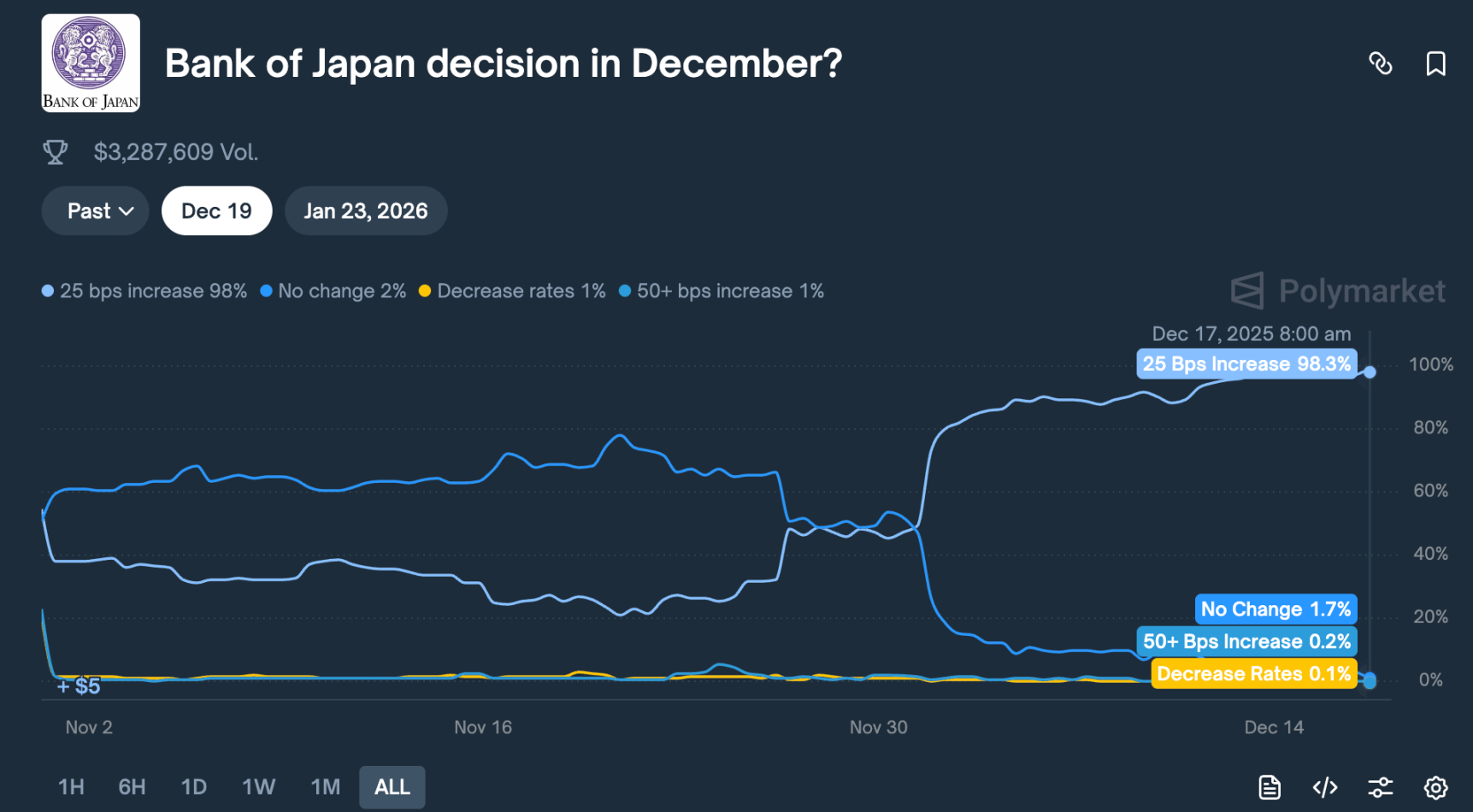
Why would a decision by a central bank far away in Tokyo cause Bitcoin to drop 5% in 48 hours?

It starts with something called the "Yen carry trade."

The logic is actually simple:

Japanese interest rates have long been near zero or even negative, making it almost free to borrow yen. So global hedge funds, asset management institutions, and trading desks borrow large amounts of yen, convert it to US dollars, and then buy higher-yielding assets, such as US Treasury bonds, US stocks, or even cryptocurrencies.

As long as the return on these assets is higher than the cost of borrowing yen, the interest rate differential is profit.

This strategy has existed for decades and is too large to measure precisely. Conservative estimates put it at several hundred billion dollars; if derivative exposures are included, some analysts believe it could be as high as several trillion.

Additionally, Japan has a special status:

It is the largest foreign holder of US Treasury bonds, holding $1.18 trillion in US debt.

This means that changes in Japanese fund flows directly affect the world's most important bond market, which in turn impacts the pricing of all risk assets.

Now, as the Bank of Japan decides to raise interest rates, the underlying logic of this game is shaken.

First, the cost of borrowing yen rises, narrowing the carry trade spread; more troublesome is that rate hike expectations will push the yen to appreciate, and these institutions originally borrowed yen and converted it to dollars to invest.

Now, to repay the loans, they must sell dollar-denominated assets and convert back to yen. The more the yen appreciates, the more assets they need to sell.

This "forced selling" doesn't pick a time or choose assets. Whatever has the best liquidity and is easiest to liquidate gets sold first.

Thus, it's easy to see why Bitcoin, traded 24/7 with no price limits and relatively shallower market depth compared to stocks, is often the first to be sold off.

Looking back at the timeline of the Bank of Japan's previous rate hikes, this speculation is somewhat corroborated by the data:
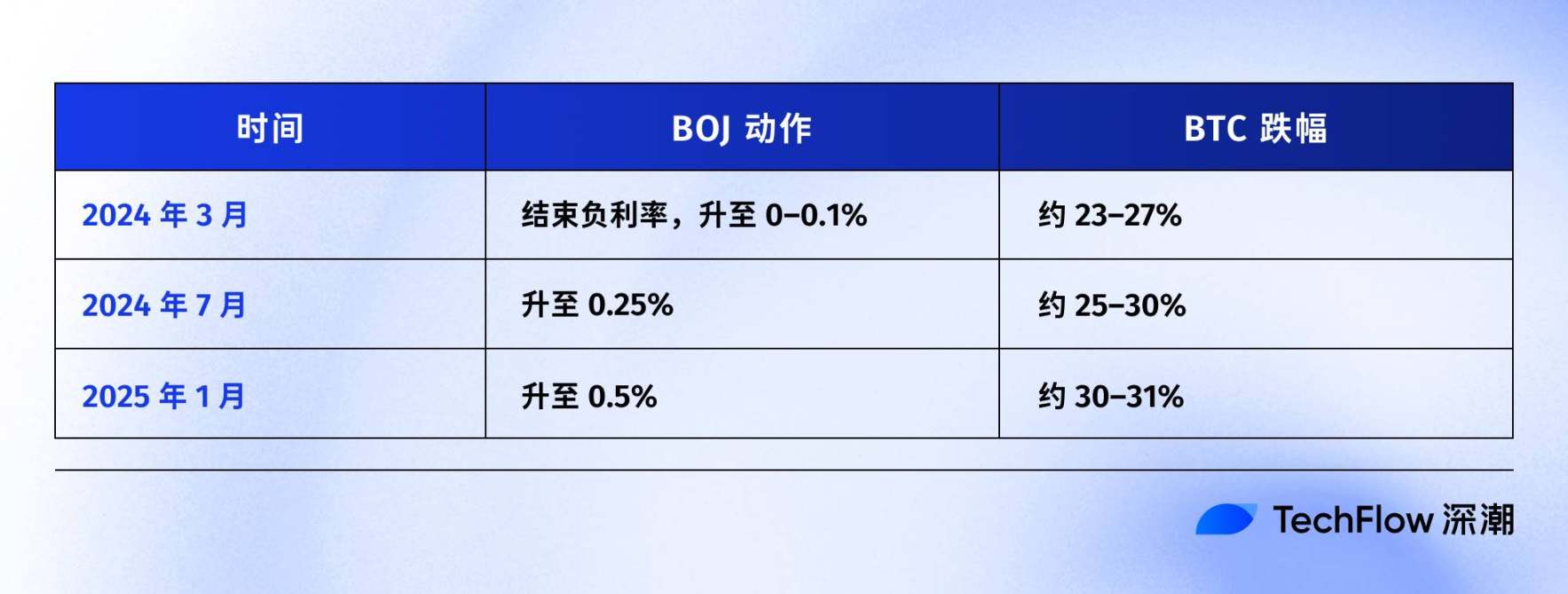
The most recent instance was on July 31, 2024. After the BOJ announced a rate hike to 0.25%, the yen appreciated against the dollar from 160 to below 140. BTC fell from $65,000 to $50,000 within the following week, a drop of about 23%, wiping $60 billion in market value from the entire crypto market.

According to statistics from several on-chain analysts, after the past three Bank of Japan rate hikes, BTC subsequently experienced drawdowns of over 20%.

The specific start and end points and time windows for these numbers vary, but the direction is highly consistent:

Every time Japan tightens monetary policy, BTC is hit hard.

Therefore, the author believes that what happened on December 15 was essentially the market "front-running." Even before the decision on the 19th was announced, funds had already started withdrawing.

On that day, US BTC ETFs saw a net outflow of $357 million, the largest single-day outflow in nearly two weeks; over $600 million in leveraged long positions were liquidated in the crypto market within 24 hours.

This likely wasn't panic selling by retail investors, but rather a chain reaction of carry trade unwinding.

Is Bitcoin Still Digital Gold?

The previous section explained the mechanism of the yen carry trade, but one question remains unanswered:

Why is BTC always the first to be sold and hurt?

A common explanation is that BTC has "good liquidity and 24/7 trading"—this is true, but it's not sufficient.

The real reason is that BTC has been repriced over the past two years: it is no longer an "alternative asset" independent of traditional finance but has been welded into Wall Street's risk exposure.

In January of last year, the US SEC approved spot Bitcoin ETFs. This was a milestone the crypto industry had waited a decade for. Trillion-dollar asset management giants like BlackRock and Fidelity could finally compliantly include BTC in their clients' investment portfolios.

The money did come. But along with it came an identity shift: the holders of BTC changed.

Previously, those buying BTC were crypto-native players, retail investors, and some aggressive family offices.

Now, those buying BTC are pension funds, hedge funds, and asset allocation models. These institutions also hold US stocks, US bonds, and gold, managing "risk budgets."

When the overall portfolio needs risk reduction, they don't just sell BTC or just sell stocks; they reduce positions proportionally across the board.

Data shows this binding relationship.

In early 2025, the 30-day rolling correlation between BTC and the Nasdaq 100 index once reached 0.80, the highest level since 2022. In contrast, before 2020, this correlation hovered between -0.2 and 0.2, essentially uncorrelated.
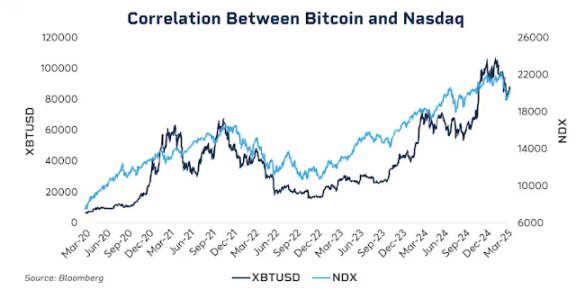
More notably, this correlation significantly increases during periods of market stress.

The March 2020 pandemic crash, the Fed's aggressive rate hikes in 2022, tariff concerns in early 2025... every time risk-off sentiment heats up, the linkage between BTC and US stocks tightens.

Institutions in panic don't distinguish between "this is a crypto asset" and "this is a tech stock"; they only see one label: risk exposure.

This leads to an awkward question: is the digital gold narrative still valid?

If you extend the timeline, gold has risen over 60% so far in 2025, its best year since 1979; BTC has drawn down over 30% from its high during the same period.

Both are called assets that hedge against inflation and fiat devaluation, yet they have charted completely opposite curves in the same macro environment.

This isn't to say BTC's long-term value is problematic; its five-year compound annual growth rate still far exceeds that of the S&P 500 and Nasdaq.

But at this current stage, its short-term pricing logic has changed: it is a high-volatility, high-Beta risk asset, not a safe-haven tool.

Understanding this is key to understanding why a mere 25 basis point rate hike by the Bank of Japan could cause BTC to drop thousands of dollars in 48 hours.

It's not because Japanese investors are selling BTC, but because when global liquidity tightens, institutions reduce all risk exposures according to the same logic, and BTC happens to be the most volatile and easiest-to-liquidate link in this chain.

What Will Happen on December 19?

As this article is being written, the Bank of Japan's monetary policy meeting is two days away.

The market has already treated the rate hike as a foregone conclusion. The yield on Japan's 10-year government bond rose to 1.95%, an 18-year high. In other words, the bond market has already priced in the tightening expectations.

If the rate hike is already fully expected, will there still be an impact on the 19th?

Historical experience says: yes, but the intensity depends on the wording.

The impact of a central bank decision is never just about the number itself, but the signal it sends. Even for the same 25 basis point hike, if Bank of Japan Governor Ueda says in the press conference "we will carefully assess future moves based on data," the market will breathe a sigh of relief;

If he says "inflation pressures persist, and further tightening cannot be ruled out," that could be the start of another wave of selling.

Japan's current inflation rate is around 3%, higher than the BOJ's 2% target. The market isn't worried about this one rate hike, but whether Japan is entering a sustained tightening cycle.

If the answer is yes, the unwinding of the yen carry trade is not a one-time event but a process that could last for months.

However, some analysts believe this time might be different.

First, speculative positioning on the yen has shifted from net short to net long. The sharp drop in July 2024 was partly because the market was caught off guard, with large amounts of funds still shorting the yen. Now the positioning has reversed, limiting the room for unexpected appreciation.

Second, Japanese government bond yields have been rising for most of the year, from 1.1% at the start of the year to nearly 2% now. In a sense, the market has "already raised rates itself," and the Bank of Japan is just acknowledging the fait accompli.

Third, the Fed just cut rates by 25 basis points; the general direction of global liquidity is easing. Japan is tightening against the trend, but if US dollar liquidity is sufficiently abundant, it might partially offset the pressure from the yen side.

These factors don't guarantee that BTC won't fall, but they might mean the drop won't be as extreme as in previous instances.

Looking at the performance after past BOJ rate hikes, BTC typically bottoms out within one to two weeks after the decision, then enters consolidation or a rebound. If this pattern still holds, the window from late December to early January might see the highest volatility, but it could also be an opportunity to position after any mispriced sell-off.

Being Accepted, Being Influenced

Stringing the previous sections together, the logical chain is clear:

Bank of Japan rate hike → Yen carry trade unwinding → Global liquidity tightening → Institutions reducing positions according to risk budget → BTC sold first as a high-Beta asset.

In this chain, BTC did nothing wrong.

It was simply placed in a position it cannot control: the end of the global macro liquidity transmission chain.

You might find it hard to accept, but this is the new normal in the ETF era.

Before 2024, BTC's price movements were mainly driven by crypto-native factors: halving cycles, on-chain data, exchange dynamics, regulatory news. Back then, its correlation with US stocks and bonds was low, and it somewhat resembled an "independent asset class."

After 2024, Wall Street arrived.

BTC was placed into the same risk management framework as stocks and bonds. Its holder structure changed, and so did its pricing logic.

BTC's market cap surged, rising from a few hundred billion dollars to $1.7 trillion. But it also brought a side effect: BTC's immunity to macro events disappeared.

A single sentence from the Fed or a decision by the Bank of Japan can cause it to fluctuate over 5% in a few hours.

If you believed in the "digital gold" narrative, believing it could provide shelter in turbulent times, the price action in 2025 is somewhat disappointing. At least at this current stage, the market is not pricing it as a safe-haven asset.

Perhaps this is just a phase of misalignment. Maybe institutionalization is still in its early stages, and once allocation ratios stabilize, BTC will rediscover its own rhythm. Perhaps the next halving cycle will once again prove the dominance of crypto-native factors...

But until then, if you hold BTC, you need to accept a reality:

You are also holding exposure to global liquidity. What happens in a conference room in Tokyo might determine your account balance next week more than any on-chain indicator.

This is the cost of institutionalization. Whether it's worth it or not, everyone has their own answer.


Twitter:https://twitter.com/BitpushNewsCN

Bitpush TG Discussion Group:https://t.me/BitPushCommunity

Bitpush TG Subscription: https://t.me/bitpush

Original Link:https://www.bitpush.news/articles/7596647

Pertanyaan Terkait

QWhy did Bitcoin experience a significant price drop on December 15th, while gold remained relatively stable?

AThe price decline was primarily driven by the market 'front-running' the anticipated interest rate hike by the Bank of Japan (BOJ). This triggered a chain reaction of unwinding yen carry trades, where global institutions sell liquid assets like Bitcoin to cover their positions, rather than any specific negative news within the crypto ecosystem. Gold, being a more traditional and established safe-haven asset, was less affected by this specific liquidity event.

QWhat is the 'yen carry trade' and how does it connect the BOJ's policy to Bitcoin's price?

AThe 'yen carry trade' is a strategy where investors borrow Japanese yen at very low interest rates (often near zero), convert it to other currencies like the US dollar, and invest in higher-yielding assets such as US treasuries, stocks, or cryptocurrencies. When the BOJ raises rates, it increases the cost of borrowing yen and can cause the yen to appreciate. This forces institutions to unwind their trades by selling their dollar-denominated assets (like Bitcoin) to buy back yen and repay their loans, creating significant selling pressure on those assets.

QHow has the correlation between Bitcoin and traditional risk assets like the Nasdaq changed, and what caused this shift?

AThe correlation between Bitcoin and the Nasdaq 100 index has significantly high, reaching a 30-day rolling correlation of 0.80 in early 2025, compared to historically being near zero. This shift was primarily caused by the approval of US spot Bitcoin ETFs in January 2024. This institutionalization meant Bitcoin was absorbed into the portfolios of large asset managers (pension funds, hedge funds) who manage risk across their entire portfolio. Now, during times of market stress, they reduce exposure to all risk assets, including Bitcoin, according to their risk models, tightly coupling its price action with traditional markets.

QDoes the recent price action challenge Bitcoin's narrative as 'digital gold'?

AYes, the recent performance significantly challenges the 'digital gold' narrative in the short term. While gold has surged over 60% in 2025, Bitcoin experienced a drawdown of over 30% from its highs. In the current macro environment, the market is pricing Bitcoin not as a safe-haven避险 asset that protects against inflation, but as a high-beta, high-volatility risk asset. Its behavior has been more aligned with tech stocks than with gold during this period of liquidity tightening driven by the BOJ's policy.

QWhat are the potential market implications if the Bank of Japan signals a sustained tightening cycle on December 19th?

AIf the BOJ signals a sustained tightening cycle, it would indicate that the unwinding of yen carry trades is not a one-time event but a process that could continue for months. This would likely lead to prolonged pressure on global liquidity, causing institutions to continue reducing risk exposure across their portfolios. As a high-beta and liquid asset, Bitcoin could face continued selling pressure. However, some analysts suggest the market has partially priced this in already, and the concurrent easing of US Federal Reserve policy might help mitigate the severity of the impact compared to previous BOJ hikes.

Bacaan Terkait

Menurunkan Ekspektasi untuk Bull Market Bitcoin Berikutnya

Artikel ini membahas penurunan ekspektasi penulis terhadap potensi kenaikan harga Bitcoin (BTC) pada siklus bull market berikutnya. Penulis, Alex Xu, yang sebelumnya memegang BTC sebagai aset terbesarnya, telah mengurangi porsi BTC dari full menjadi sekitar 30% pada kisaran harga $100.000-$120.000, dan kembali mengurangi di level $78.000-$79.000. Alasan utama penurunan ekspektasi ini adalah: 1. **Energi Penggerak yang Melemah:** Narasi adopsi BTC yang mendorong kenaikan signifikan di siklus sebelumnya (dari aset niche hingga institusi besar via ETF) sulit terulang. Langkah berikutnya, seperti masuknya BTC ke dalam cadangan bank sentral negara maju, dianggap sangat sulit tercapai dalam 2-3 tahun ke depan. 2. **Biaya Peluang Pribadi:** Penulis menemukan peluang investasi yang lebih menarik di perusahaan-perusahaan lain. 3. **Dampak Resesi Industri Kripto:** Menyusutnya industri kripto secara keseluruhan (banyak model bisnis seperti SocialFi dan GameFi terbukti gagal) dapat memperlambat pertumbuhan basis pemegang BTC. 4. **Biaya Pendanaan Pembeli Utama:** Perusahaan pembeli BTC terbesar, Stratis, menghadapi kenaikan biaya pendanaan yang memberatkan, yang dapat mengurangi kecepatan pembeliannya dan memberi tekanan jual. 5. **Pesaing Baru untuk "Emas Digital":** Hadirnya "tokenized gold" (emas yang ditokenisasi) menawarkan keunggulan yang mirip dengan BTC (seperti dapat dibagi dan dipindahkan) sehingga menjadi pesaing serius. 6. **Masalah Anggaran Keamanan:** Imbalan miner yang terus berkurang pasca halving menimbulkan kekhawatiran tentang keamanan jaringan, sementara upaya mencari sumber fee baru seperti ordinals dan L2 dinilai gagal. Penulis menyatakan tetap memegang BTC sebagai aset besar dan terbuka untuk membeli kembali jika alasannya tidak lagi relevan atau muncul faktor positif baru, meski siap menerima jika harganya sudah terlalu tinggi untuk dibeli kembali.

marsbit04/27 02:47

Menurunkan Ekspektasi untuk Bull Market Bitcoin Berikutnya

marsbit04/27 02:47

Trading

Spot
Futures

Artikel Populer

Apa Itu BITCOIN

Memahami HarryPotterObamaSonic10Inu (ERC-20) dan Posisinya dalam Ruang Crypto Dalam beberapa tahun terakhir, pasar cryptocurrency telah menyaksikan peningkatan popularitas koin meme, menarik minat tidak hanya dari para pedagang, tetapi juga mereka yang mencari keterlibatan komunitas dan nilai hiburan. Di antara token unik ini adalah HarryPotterObamaSonic10Inu (ERC-20), sebuah proyek menarik yang memadukan referensi budaya ke dalam dunia cryptocurrency. Artikel ini membahas aspek-aspek kunci dari HarryPotterObamaSonic10Inu, menjelajahi mekanismenya, etos yang digerakkan oleh komunitas, dan keterlibatannya dengan lanskap crypto yang lebih luas. Apa itu HarryPotterObamaSonic10Inu (ERC-20)? Seperti namanya, HarryPotterObamaSonic10Inu adalah koin meme yang dibangun di atas blockchain Ethereum, diklasifikasikan di bawah standar ERC-20. Berbeda dengan cryptocurrency tradisional yang mungkin menekankan utilitas praktis atau potensi investasi, token ini berkembang berdasarkan nilai hiburan dan kekuatan komunitasnya. Proyek ini bertujuan untuk menciptakan lingkungan di mana pengguna yang terlibat dapat berkumpul, berbagi ide, dan berpartisipasi dalam aktivitas yang terinspirasi oleh berbagai fenomena budaya. Salah satu fitur mencolok dari HarryPotterObamaSonic10Inu adalah nol pajak pada transaksi. Elemen menarik ini bertujuan untuk mendorong perdagangan dan keterlibatan komunitas, tanpa biaya tambahan yang dapat menghalangi pedagang berskala kecil. Total pasokan koin ditetapkan pada satu miliar token, sebuah angka yang menandakan niatnya untuk menjaga sirkulasi yang substansial di dalam komunitas. Pencipta HarryPotterObamaSonic10Inu (ERC-20) Asal usul HarryPotterObamaSonic10Inu agak diselimuti misteri; rincian tentang penciptanya tetap tidak diketahui. Pengembangan token ini tidak memiliki tim yang teridentifikasi atau cetak biru yang jelas, yang bukan hal yang aneh dalam sektor koin meme. Sebaliknya, proyek ini muncul secara organik, dengan kemajuannya sangat bergantung pada antusiasme dan partisipasi komunitasnya. Investor HarryPotterObamaSonic10Inu (ERC-20) Terkait investasi eksternal dan dukungan, HarryPotterObamaSonic10Inu juga tetap ambigu. Token ini tidak mencantumkan yayasan investasi atau dukungan organisasi yang signifikan. Sebaliknya, denyut nadi proyek ini adalah komunitas akar rumputnya, yang menginformasikan pertumbuhannya dan keberlanjutan melalui aksi kolektif dan keterlibatan di ruang crypto. Bagaimana HarryPotterObamaSonic10Inu (ERC-20) Bekerja? Sebagai koin meme, HarryPotterObamaSonic10Inu beroperasi terutama di luar kerangka tradisional yang sering mengatur nilai aset. Ada beberapa aspek khas yang mendefinisikan cara kerja proyek ini: Transaksi Tanpa Pajak: Dengan tidak ada biaya pajak pada transaksi, pengguna dapat membeli dan menjual token tanpa khawatir akan biaya tersembunyi. Keterlibatan Komunitas: Proyek ini berkembang melalui interaksi komunitas, memanfaatkan platform media sosial untuk menciptakan buzz dan memfasilitasi keterlibatan. Diskusi, berbagi konten, dan keterlibatan adalah elemen penting yang membantu memperluas jangkauannya dan membangun loyalitas di antara para pendukung. Tidak Ada Utilitas Praktis: Perlu dicatat bahwa HarryPotterObamaSonic10Inu tidak menawarkan utilitas konkret dalam ekosistem finansial. Sebaliknya, ia diklasifikasikan sebagai token yang terutama untuk hiburan dan aktivitas komunitas. Referensi Budaya: Token ini dengan cerdik menggabungkan elemen dari budaya populer untuk menarik minat, terhubung dengan penggemar meme dan pengikut crypto. HarryPotterObamaSonic10Inu menunjukkan bagaimana koin meme beroperasi berbeda dari proyek cryptocurrency yang lebih tradisional, memasuki pasar sebagai konstruksi sosial yang inovatif daripada aset utilitarian. Garis Waktu HarryPotterObamaSonic10Inu (ERC-20) Sejarah HarryPotterObamaSonic10Inu ditandai oleh beberapa tonggak yang patut dicatat: Penciptaan: Token ini muncul dari meme viral, menangkap imajinasi banyak penggemar crypto. Tanggal penciptaan spesifik tidak tersedia, menekankan kebangkitannya yang organik. Pendaftaran di Bursa: HarryPotterObamaSonic10Inu telah muncul di berbagai bursa, memungkinkan akses dan perdagangan yang lebih mudah oleh komunitas. Inisiatif Keterlibatan Komunitas: Kegiatan yang sedang berlangsung bertujuan untuk meningkatkan interaksi komunitas, termasuk kontes, kampanye media sosial, dan generasi konten dari penggemar dan pendukung. Rencana Ekspansi Masa Depan: Peta jalan proyek ini mencakup peluncuran koleksi NFT, merchandise, dan situs eCommerce yang terkait dengan tema budayanya, lebih lanjut melibatkan komunitas dan berusaha menambahkan lebih banyak dimensi ke ekosistemnya. Poin Kunci Tentang HarryPotterObamaSonic10Inu (ERC-20) Sifat yang Diggerakkan oleh Komunitas: Proyek ini memprioritaskan masukan dan kreativitas kolektif, memastikan bahwa keterlibatan pengguna berada di garis depan pengembangannya. Klasifikasi Koin Meme: Ini mewakili puncak cryptocurrency berbasis hiburan, terpisah dari kendaraan investasi tradisional. Tidak Ada Afiliasi Langsung dengan Bitcoin: Meskipun ada kesamaan dalam nama ticker, HarryPotterObamaSonic10Inu berbeda dan tidak memiliki hubungan dengan Bitcoin atau cryptocurrency lain yang mapan. Fokus pada Kolaborasi: HarryPotterObamaSonic10Inu dirancang untuk menciptakan ruang untuk kolaborasi dan berbagi cerita di antara para pemegangnya, memberikan saluran untuk kreativitas dan ikatan komunitas. Prospek Masa Depan: Ambisi untuk berkembang melampaui premis awalnya ke dalam NFT dan merchandise menggambarkan jalur bagi proyek ini untuk berpotensi memasuki lebih banyak saluran arus utama dalam budaya digital. Seiring dengan terus meningkatnya daya tarik koin meme di komunitas cryptocurrency, HarryPotterObamaSonic10Inu (ERC-20) menonjol karena keterikatan budayanya dan pendekatan yang berorientasi pada komunitas. Meskipun mungkin tidak sesuai dengan pola tipikal token berbasis utilitas, esensinya terletak pada kegembiraan dan persahabatan yang ditegakkan di antara para pendukungnya, menyoroti sifat cryptocurrency yang terus berkembang dalam era digital yang semakin meningkat. Saat proyek ini terus berkembang, akan penting untuk mengamati bagaimana dinamika komunitas mempengaruhi trajektori dalam lanskap teknologi blockchain yang selalu berubah.

1.5k Total TayanganDipublikasikan pada 2024.04.01Diperbarui pada 2024.12.03

Apa Itu BITCOIN

Cara Membeli BTC

Selamat datang di HTX.com! Kami telah membuat pembelian Bitcoin (BTC) menjadi mudah dan nyaman. Ikuti panduan langkah demi langkah kami untuk memulai perjalanan kripto Anda.Langkah 1: Buat Akun HTX AndaGunakan alamat email atau nomor ponsel Anda untuk mendaftar akun gratis di HTX. Rasakan perjalanan pendaftaran yang mudah dan buka semua fitur.Dapatkan Akun SayaLangkah 2: Buka Beli Kripto, lalu Pilih Metode Pembayaran AndaKartu Kredit/Debit: Gunakan Visa atau Mastercard Anda untuk membeli Bitcoin (BTC) secara instan.Saldo: Gunakan dana dari saldo akun HTX Anda untuk melakukan trading dengan lancar.Pihak Ketiga: Kami telah menambahkan metode pembayaran populer seperti Google Pay dan Apple Pay untuk meningkatkan kenyamanan.P2P: Lakukan trading langsung dengan pengguna lain di HTX.Over-the-Counter (OTC): Kami menawarkan layanan yang dibuat khusus dan kurs yang kompetitif bagi para trader.Langkah 3: Simpan Bitcoin (BTC) AndaSetelah melakukan pembelian, simpan Bitcoin (BTC) di akun HTX Anda. Selain itu, Anda dapat mengirimkannya ke tempat lain melalui transfer blockchain atau menggunakannya untuk memperdagangkan mata uang kripto lainnya.Langkah 4: Lakukan trading Bitcoin (BTC)Lakukan trading Bitcoin (BTC) dengan mudah di pasar spot HTX. Cukup akses akun Anda, pilih pasangan perdagangan, jalankan trading, lalu pantau secara real-time. Kami menawarkan pengalaman yang ramah pengguna baik untuk pemula maupun trader berpengalaman.

9.9k Total TayanganDipublikasikan pada 2024.12.12Diperbarui pada 2025.03.21

Cara Membeli BTC

Apa Itu $BITCOIN

EMAS DIGITAL ($BITCOIN): Analisis Komprehensif Pengenalan EMAS DIGITAL ($BITCOIN) EMAS DIGITAL ($BITCOIN) adalah proyek berbasis blockchain yang beroperasi di jaringan Solana, yang bertujuan untuk menggabungkan karakteristik logam mulia tradisional dengan inovasi teknologi terdesentralisasi. Meskipun berbagi nama dengan Bitcoin, yang sering disebut sebagai “emas digital” karena persepsinya sebagai penyimpan nilai, EMAS DIGITAL adalah token terpisah yang dirancang untuk menciptakan ekosistem unik dalam lanskap Web3. Tujuannya adalah untuk memposisikan diri sebagai aset digital alternatif yang layak, meskipun rincian mengenai aplikasi dan fungsionalitasnya masih dalam pengembangan. Apa itu EMAS DIGITAL ($BITCOIN)? EMAS DIGITAL ($BITCOIN) adalah token cryptocurrency yang dirancang secara eksplisit untuk digunakan di blockchain Solana. Berbeda dengan Bitcoin, yang menyediakan peran penyimpanan nilai yang diakui secara luas, token ini tampaknya lebih fokus pada aplikasi dan karakteristik yang lebih luas. Aspek-aspek penting meliputi: Infrastruktur Blockchain: Token ini dibangun di atas blockchain Solana, yang dikenal karena kemampuannya menangani transaksi berkecepatan tinggi dan biaya rendah. Dinamika Pasokan: EMAS DIGITAL memiliki pasokan maksimum yang dibatasi pada 100 kuadriliun token (100P $BITCOIN), meskipun rincian mengenai pasokan yang beredar saat ini belum diungkapkan. Utilitas: Meskipun fungsionalitas yang tepat tidak dijelaskan secara eksplisit, ada indikasi bahwa token ini dapat digunakan untuk berbagai aplikasi, yang mungkin melibatkan aplikasi terdesentralisasi (dApps) atau strategi tokenisasi aset. Siapa Pencipta EMAS DIGITAL ($BITCOIN)? Saat ini, identitas pencipta dan tim pengembang di balik EMAS DIGITAL ($BITCOIN) tetap tidak diketahui. Situasi ini umum terjadi di antara banyak proyek inovatif dalam ruang blockchain, terutama yang sejalan dengan keuangan terdesentralisasi dan fenomena koin meme. Meskipun anonimitas semacam ini dapat mendorong budaya yang dipimpin komunitas, hal ini juga meningkatkan kekhawatiran tentang tata kelola dan akuntabilitas. Siapa Investor EMAS DIGITAL ($BITCOIN)? Informasi yang tersedia menunjukkan bahwa EMAS DIGITAL ($BITCOIN) tidak memiliki pendukung institusional yang dikenal atau investasi modal ventura yang menonjol. Proyek ini tampaknya beroperasi dengan model peer-to-peer yang berfokus pada dukungan dan adopsi komunitas daripada jalur pendanaan tradisional. Aktivitas dan likuiditasnya terutama terletak di bursa terdesentralisasi (DEX), seperti PumpSwap, daripada platform perdagangan terpusat yang mapan, lebih menyoroti pendekatan akar rumputnya. Bagaimana EMAS DIGITAL ($BITCOIN) Bekerja Mekanisme operasional EMAS DIGITAL ($BITCOIN) dapat dijelaskan berdasarkan desain blockchain dan atribut jaringannya: Mekanisme Konsensus: Dengan memanfaatkan bukti sejarah (PoH) unik dari Solana yang dipadukan dengan model bukti kepemilikan (PoS), proyek ini memastikan validasi transaksi yang efisien yang berkontribusi pada kinerja tinggi jaringan. Tokenomik: Meskipun mekanisme deflasi tertentu belum dijelaskan secara mendetail, pasokan token maksimum yang besar menunjukkan bahwa ini mungkin ditujukan untuk mikrotransaksi atau kasus penggunaan niche yang masih perlu didefinisikan. Interoperabilitas: Ada potensi untuk integrasi dengan ekosistem lebih luas Solana, termasuk berbagai platform keuangan terdesentralisasi (DeFi). Namun, rincian mengenai integrasi spesifik tetap tidak ditentukan. Garis Waktu Peristiwa Kunci Berikut adalah garis waktu yang menyoroti tonggak penting terkait EMAS DIGITAL ($BITCOIN): 2023: Penempatan awal token terjadi di blockchain Solana, ditandai dengan alamat kontraknya. 2024: EMAS DIGITAL mendapatkan visibilitas saat tersedia untuk diperdagangkan di bursa terdesentralisasi seperti PumpSwap, memungkinkan pengguna untuk memperdagangkannya melawan SOL. 2025: Proyek ini menyaksikan aktivitas perdagangan sporadis dan potensi minat dalam keterlibatan yang dipimpin komunitas, meskipun belum ada kemitraan atau kemajuan teknis yang signifikan yang didokumentasikan hingga saat ini. Analisis Kritis Kekuatan Skalabilitas: Infrastruktur Solana yang mendasari mendukung volume transaksi yang tinggi, yang dapat meningkatkan utilitas $BITCOIN dalam berbagai skenario transaksi. Aksesibilitas: Potensi harga perdagangan yang rendah per token dapat menarik investor ritel, memfasilitasi partisipasi yang lebih luas karena peluang kepemilikan fraksional. Risiko Kurangnya Transparansi: Ketidakhadiran pendukung, pengembang, atau proses audit yang dikenal publik dapat menimbulkan skeptisisme mengenai keberlanjutan dan keandalan proyek. Volatilitas Pasar: Aktivitas perdagangan sangat bergantung pada perilaku spekulatif, yang dapat mengakibatkan volatilitas harga yang signifikan dan ketidakpastian bagi investor. Kesimpulan EMAS DIGITAL ($BITCOIN) muncul sebagai proyek yang menarik namun ambigu dalam ekosistem Solana yang berkembang pesat. Meskipun berusaha memanfaatkan narasi “emas digital”, perbedaannya dari peran Bitcoin yang sudah mapan sebagai penyimpan nilai menyoroti perlunya diferensiasi yang lebih jelas mengenai utilitas dan struktur tata kelolanya. Penerimaan dan adopsi di masa depan kemungkinan akan bergantung pada penanganan ketidakjelasan saat ini dan mendefinisikan strategi operasional dan ekonominya dengan lebih eksplisit. Catatan: Laporan ini mencakup informasi yang disintesis yang tersedia hingga Oktober 2023, dan perkembangan mungkin telah terjadi di luar periode penelitian.

93 Total TayanganDipublikasikan pada 2025.05.13Diperbarui pada 2025.05.13

Apa Itu $BITCOIN

Diskusi

Selamat datang di Komunitas HTX. Di sini, Anda bisa terus mendapatkan informasi terbaru tentang perkembangan platform terkini dan mendapatkan akses ke wawasan pasar profesional. Pendapat pengguna mengenai harga BTC (BTC) disajikan di bawah ini.

活动图片