ACDC Identified 556 Polymarket Wallets, Allegedly Belonging to Insiders

cryptonews.ruDipublikasikan tanggal 2026-08-20Terakhir diperbarui pada 2026-08-20

Abstrak

A new report from the Anti-Corruption Data Collective (ACDC) has identified 556 Polymarket wallets, labeled "Orcas," suspected of insider trading. These accounts allegedly place small, targeted bets on low-probability outcomes yet win over 75% of the time. Analyzing 78,496 high-risk bets (over $2,500 on odds of 35 cents or less), ACDC categorized bettors into Orcas, whales, bots, and small fish. While only 14% of high-odds bets win platform-wide, rates rise to 25% on political markets and 52% on military/defense markets. The report highlights that Orcas often place bets first on major military events, with whales and bots quickly copying, potentially broadcasting sensitive signals. Researchers estimate insider profits from military markets alone reached $9.3 million. ACDC argues this poses a national security risk, as blockchain transparency could allow foreign intelligence to act on these market movements. The organization concludes that banning the highest-risk market categories may be the only solution, citing recent insider trading cases involving a U.S. soldier and a Google engineer on Polymarket.

In a new report, the Anti-Corruption Data Collective (ACDC) identified 556 Polymarket accounts, which the organization refers to as "Orcas."

Reportedly, these accounts place small, targeted bets on low-probability outcomes and win more than 75% of the time.

What did ACDC discover about Polymarket?

The Anti-Corruption Data Collective (ACDC) published a report titled "Insider Trading Risk Classification," analyzing 78,496 high-risk bets placed from 12,355 wallets on Polymarket. ACDC defines a high-risk bet as one exceeding $2,500 placed on an outcome priced at 35 cents or less, meaning the perceived probability of the outcome is 35% or lower.

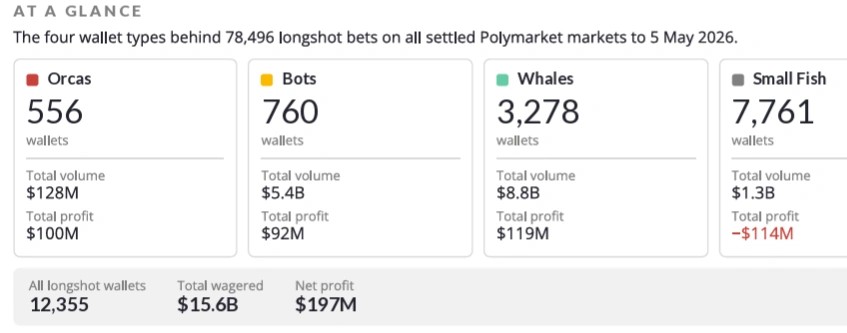
From this sample, researchers identified four groups: orcas, whales, bots, and "small fish." They recorded 556 wallets belonging to orcas, which placed bets on only a few markets and topics but won with an exceptionally high success rate of over 75%.
Win rate for high-odds bets across different player categories. Source: ACDC.

Large players, controlling 3,278 wallets, trade large volumes across many markets. Bots, with 760 wallets, appear to be partly automated, while the remaining 7,761 accounts are small players.

In its previous April report, ACDC found that across the entire Polymarket platform, only 14% of high-odds bets win, but this rate increases to 25% on political markets and to 52% on military and defense-related markets.

Michelle Kessler-Kret and David Szakonyi, authors of the report, estimated that on military markets alone, winning outsider bets have generated $9.3 million.

Why is insider trading on Polymarket a national security concern?

ACDC found that when betting on major military events, orcas place their bets first, followed by whales and bots, mimicking how experienced traders observe the public blockchain and copy insider actions in real time.

Such "copycat" trading is legal, but it can broadcast information about insider activity to the world.

For example, when an orca placed a bet on U.S. military action in Iran hours before the strikes in June 2025, a bot and a whale placed similar bets worth $200,000 and $100,000, respectively.

The same blockchain transparency that enables copycat trading also allows foreign military and intelligence services to act based on market signals.

Tracing a specific Orca account to a specific person is difficult, as the monetary trail is anonymous, and obtaining any information would require requesting data from exchanges holding funds for thousands of clients.

ACDC concluded that the only solution is a complete ban on the most risky market categories.

There have been several other incidents of insider trading on prediction platforms. In April, the Department of Justice charged a U.S. Army soldier named Gannon Ken Van Dike, accusing him of betting approximately $33,034 using secret information about a raid that captured Nicolás Maduro, and subsequently earning about $409,881.

In May, the U.S. Attorney's Office for the Southern District of New York charged Google engineer Michelle Spagnolo with using internal company data to earn $1.2 million on Polymarket.

Bubblemaps also recently claimed on CBS's "60 Minutes" program that it traced linked accounts that collectively won over $2.4 million in more than 80 bets on the Iran war with a 98% win probability.

"These numbers cannot be explained by luck alone," said Bubblemaps CEO Nicolas Vaiman.

end-content

Kripto yang Sedang Tren

Pertanyaan Terkait

QAccording to the ACDC report, how many wallets did they identify as 'Orcas', and what is their reported win rate on high-risk bets?

AACDC identified 556 wallets as 'Orcas'. These wallets reportedly have a win rate of over 75% on their high-risk bets.

QHow does ACDC define a 'high-risk' bet on Polymarket?

AACDC defines a 'high-risk' bet as a bet of more than $2,500 on an outcome priced at 35 cents or less, implying a perceived probability of 35% or lower.

QWhy does the ACDC consider insider trading on Polymarket's military/defense markets a national security concern?

AIt is a national security concern because the transparency of the blockchain allows 'copycat' trading by whales and bots, which can broadcast signals about insider activity in real-time. Foreign military and intelligence services could then act on these market signals.

QWhat specific example of potential insider trading on a military event is given in the article?

AThe article states that an Orca placed a bet on US military action in Iran just hours before the June 2025 strikes. A bot and a whale then placed similar bets of $200,000 and $100,000, respectively.

QWhat does ACDC conclude is the only solution to the problem of insider trading on these markets?

AACDC concludes that the only solution is to completely ban the most risky market categories, such as those related to military and defense events.

Bacaan Terkait

Trading

Spot

Artikel Populer

Cara Membeli DATA

Selamat datang di HTX.com! Kami telah membuat pembelian DATA Network (DATA) menjadi mudah dan nyaman. Ikuti panduan langkah demi langkah kami untuk memulai perjalanan kripto Anda.Langkah 1: Buat Akun HTX AndaGunakan alamat email atau nomor ponsel Anda untuk mendaftar akun gratis di HTX. Rasakan perjalanan pendaftaran yang mudah dan buka semua fitur.Dapatkan Akun SayaLangkah 2: Buka Beli Kripto, lalu Pilih Metode Pembayaran AndaKartu Kredit/Debit: Gunakan Visa atau Mastercard Anda untuk membeli DATA Network (DATA) secara instan.Saldo: Gunakan dana dari saldo akun HTX Anda untuk melakukan trading dengan lancar.Pihak Ketiga: Kami telah menambahkan metode pembayaran populer seperti Google Pay dan Apple Pay untuk meningkatkan kenyamanan.P2P: Lakukan trading langsung dengan pengguna lain di HTX.Over-the-Counter (OTC): Kami menawarkan layanan yang dibuat khusus dan kurs yang kompetitif bagi para trader.Langkah 3: Simpan DATA Network (DATA) AndaSetelah melakukan pembelian, simpan DATA Network (DATA) di akun HTX Anda. Selain itu, Anda dapat mengirimkannya ke tempat lain melalui transfer blockchain atau menggunakannya untuk memperdagangkan mata uang kripto lainnya.Langkah 4: Lakukan trading DATA Network (DATA)Lakukan trading DATA Network (DATA) dengan mudah di pasar spot HTX. Cukup akses akun Anda, pilih pasangan perdagangan, jalankan trading, lalu pantau secara real-time. Kami menawarkan pengalaman yang ramah pengguna baik untuk pemula maupun trader berpengalaman.

489 Total TayanganDipublikasikan pada 2026.07.01Diperbarui pada 2026.07.01

Cara Membeli DATA

Diskusi

Selamat datang di Komunitas HTX. Di sini, Anda bisa terus mendapatkan informasi terbaru tentang perkembangan platform terkini dan mendapatkan akses ke wawasan pasar profesional. Pendapat pengguna mengenai harga DATA (DATA) disajikan di bawah ini.

活动图片