South Korea’s long-awaited stablecoin legislation risks being delayed until next year, as financial authorities brawl with the Bank of Korea (BOK) over the role of banks in the sector.
BOK, Financial Regulators In Disagreement
On Tuesday, Korea JoongAng Daily reported that the highly anticipated stablecoin framework, which is expected to come by the end of 2025, seems unlikely to pass this year, arguing that while regulators aim to open the market to tech companies, the central bank insists that the financial institutions should hold a majority stake in the issuance of any won-pegged token.
According to the local news media outlet, the BOK and regulators agree that banks must be involved in the issuance of won-pegged tokens, but differ on the extent of the financial institutions’ role.
The central bank is pushing for a consortium of banks owning at least 51% of any stablecoin issuer seeking regulatory approval. Meanwhile, regulators are reportedly willing to take a chance at innovating Korea’s financial structure, involving diverse players in the process.
Korea JoongAng Daily affirmed that, “even if the two sides agree on the ownership issue, other issues remain unresolved, including limits on the total issuance amount and the regulatory framework.”
Moreover, the BOK is allegedly calling for a legally mandated interagency council to make stablecoin policy decisions by a unanimous vote. Nonetheless, financial regulators are seemingly pushing back, citing a lack of legal basis for this requirement.
In July, BOK Governor Lee Chang-yong expressed concerns about the issuance of stablecoins by non-bank entities, claiming that the digital assets could confuse monetary policies and foreign exchange regulations.
Lee asserted that “if multiple non-bank institutions issue won-pegged stablecoins, it could lead to confusion similar to that caused by private currency issuance in the 19th century,” adding that if won-pegged tokens are allowed to be issued “indiscriminately,” it may conflict with foreign exchange liberalization policies.
Last month, the central bank released a report warning that these digital assets could unlock new possibilities for the Korean economy but could also “sow the seeds of new instability.” In the report, the BOK affirmed that the promise behind stablecoin raises unrealistic expectations in the market.
“Allowing non-bank companies to issue stablecoins is essentially equivalent to permitting them to engage in narrow banking — simultaneously issuing currency and offering payment services,” the central bank claimed.
In addition, it warned that online platform companies issuing their own stablecoins could integrate payment and settlement services into their ecosystems, further consolidating “monopolistic power” and potentially altering banks’ profit structure.
Korea’s Stablecoin Sector Faces Regulatory Challenges
A BOK official, on condition of anonymity, told Korea JoongAng Daily that “banks, which are already under regulatory oversight and have extensive experience handling anti-money laundering protocols, are best positioned to serve as majority shareholders in stablecoin issuers.”
However, the report noted that financial authorities are concerned that giving a majority stake to banks could reduce participation from tech companies and constrain the Korean market’s innovation.
As reported by Bitcoinist, financial institutions in Korea have been preparing for two potential scenarios. Notably, the sector has allegedly explored a business model in which banks establish a joint venture to collectively issue stablecoins, while also contacting various non-bank companies to prepare for the upcoming framework.
The regulatory standoff has seemingly left the market in limbo, with some tech companies actively preparing to secure approval while others remain cautious due to the unclear regulatory direction.
An official at a fintech company revealed that “there’s doubt about whether a won-based stablecoin will catch on, and with no clarity on approval rules, most firms are taking a wait-and-see approach.”
Korea JoongAng Daily cited a recent report by Hashed Open Research, which argued that “to maintain competitiveness in the digital economy, Korea should adopt a capital market-led structure instead of a bank-centered one,” similar to major issuers such as Tether and Circle.
Kim Sang-bong, an economics professor at Hansung University, considers that “to earn public trust, stablecoins can’t be left entirely in the hands of tech firms, and financial institutions must be involved.”
“But if banks dominate, innovation could be stifled. A more realistic solution may be to start by granting licenses to card companies and other firms focused on payments,” Kim concluded.
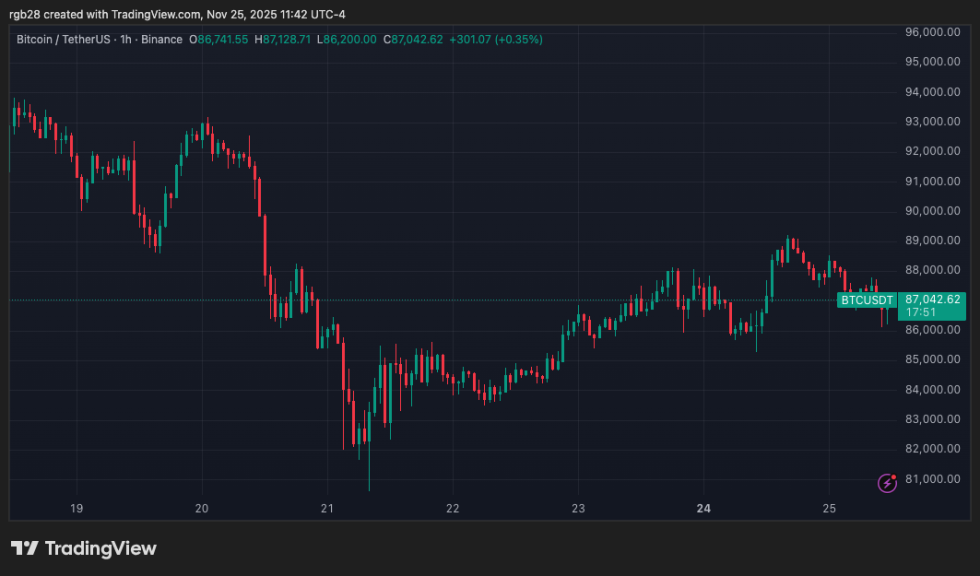
Bitcoin (BTC) trades at $87,042 in the one-week chart. Source: BTCUSDT on TradingView

Related Posts