ETC Proof of Work Course: 35. POW Must Be Attackable to be Secure

项目方ETC(Ethereum Classic)Dipublikasikan tanggal 2024-07-31Terakhir diperbarui pada 2025-11-10

Ethereum Classic Blog

ETC Proof of Work Course: 35. POW Must Be Attackable to be Secure

August 1, 2024
Donald McIntyre
Education, Series
The content on this website is user-generated and solely for informational purposes. Do not interpret any content as an endorsement of any product or service. There's "no official anything" in Ethereum Classic. Always do your own research, and remember: don't trust, verify!

You can listen to or watch this video here:

banner

In the previous class, 34, we talked about the activity that produces finality, and security in general, in POW blockchains such as ETC, which is mining.

We explained the metrics that make ETC a great business opportunity for cryptocurrency miners around the world.

In this class, 35, we will explain why proof of work (POW) blockchains must be attackable to be secure.

The Bias to Add Subjectivity to Blockchains
1

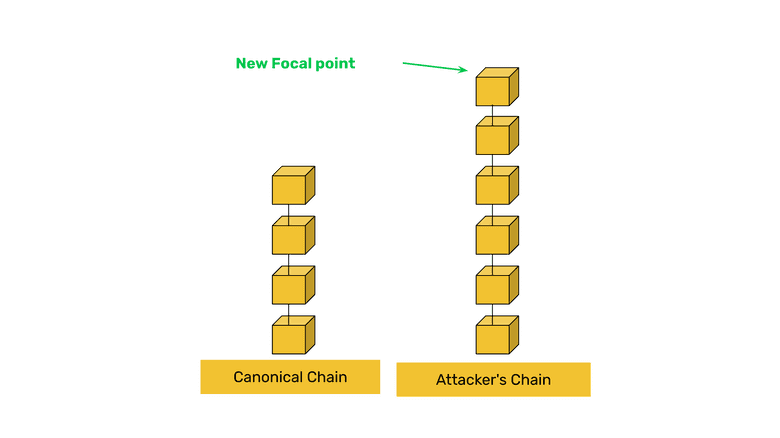
51% attacks on POW blockchains are actions were dishonest actors accumulate more than 50% of the mining power in a blockchain and use it to delete past transactions in the ledger. The purpose of deleting transactions is to steal property from their victims.

51% attacks are a known attack vector in POW blockchains, but it is a feature, not a bug of these systems.

People think that because POW blockchains can be attacked if bad actors control more than 50% of mining that it is necessary to add subjective contraptions to reject alternative blocks or chains that are proposed to replace the canonical chain.

Examples: Checkpointing and MESS

For example, if a POW network is working on block 100,000 and, suddenly, blocks 99,000 through 100,000 are reorganized by an attacker to replace or delete transactions from the recent past, then new rules such as checkpointing or to demand exponentially more hash power to reorganize blocks should be added to prevent these reorganizations.

Checkpointing predetermines certain block numbers in the past beyond which network nodes will not accept any reorganizations.

A system such as MESS (Modified Exponential Subjective Scoring) makes the nodes reject any reorganization of the chain if they have less than a certain hash power invested in it.

But Weak Subjectivity Is Bad

However, if this were done it would put in the hands of humans the decision of which is the correct chain to follow, and the whole decentralization of the blockchain accomplished by the simple verification of the work done, where anyone around the world can join and leave whenever they please with no permission nor checking with anyone else, would be thrown away just to prevent 51% attacks.

The original intent of using POW as a consensus mechanism was to eliminate any subjectivity precisely to enable complete decentralization of the system.

If nodes who are joining or exiting and joining again the network had to be checking with other nodes which is the correct blockchain based on arbitrary metrics and markers rather than on sheer computing power, then the figure of the “trusted third party” would be reintroduced into the system all over again!

And 51% Attacks Are Not That Important Anyway

It is not worth introducing trust into POW blockchains just to prevent 51% attacks as these are not that severe anyway.

51% attacks are very narrow attacks, very unlikely, have very few victims, and victims have other ways of protecting themselves, such as waiting for the correct number of block confirmations when receiving coins.

This is why it is not a good idea to add subjective rules to POW blockchains, and why they HAVE TO BE ATTACKABLE TO ACTUALLY BE SECURE, not the other way around.


Thank you for reading this article!

To learn more about ETC please go to: https://ethereumclassic.org

Kripto yang Sedang Tren

Bacaan Terkait

Penarikan Bitcoin Terus Berlanjut: Penyimpanan 8 Tahun di Dompet Dingin Coldcard Berakhir dengan Nol

Dompet keras Coldcard Dihack, Aset Bitcoin Senilai $88,6 Juta Dicuri Dompet keras Coldcard mengalami kerentanan keamanan serius, menyebabkan gelombang penarikan paksa dana pengguna. Menurut Galaxy Research, total 1.367,05 BTC (sekitar $88,6 juta) telah dicuri dari 4.585 alamat yang rentan. Masalahnya bukan pada perangkat lunak (firmware), yang sudah diperbarui oleh pengembang Coinkite. Akar masalahnya ada pada seed phrase (frasa pemulihan) yang dihasilkan oleh perangkat antara Maret 2021 dan versi firmware tertentu. Kesalahan pemrograman menyebabkan generator angka acak perangkat beralih dari komponen keras ke generator perangkat lunak (Yasmarang) yang dapat diprediksi. Seed phrase yang dibuat dalam periode rentan ini dapat ditebak melalui serangan brute-force secara offline. Perangkat yang terdampak mencakup model Mk2/Mk3 (firmware 4.0.1–4.1.9), Mk4/Mk5 (sebelum v5.6.0), dan Q (sebelum v1.5.0Q). Satu-satunya cara untuk mengamankan dana adalah dengan membuat seed phrase BARU pada firmware yang telah diperbaiki dan memindahkan semua aset ke alamat baru tersebut. Memperbarui firmware saja tidak mengubah seed phrase lama yang sudah rentan. Insiden ini menghancurkan bagi investor jangka panjang. Satu korban, seorang pria 39 tahun, kehilangan 2 BTC ($130.000) yang ia kumpulkan selama 8 tahun melalui kerja keras. Ia menggunakan Bitcoin sebagai lindung nilai terhadap hiperinflasi di negaranya dan menyimpannya dengan aman di dompet dingin untuk pensiun dini. Pencurian instan ini menghancurkan rencananya dan mengungkap kerapuhan strategi 'simpan dan lupakan' meski dengan perangkat keras sekalipun. Kasus ini mengingatkan pada insiden serupa di masa lalu di mana kelemahan generator angka acak merusak keamanan kriptografi. Ini mempertanyakan asumsi bahwa penyimpanan offline selalu identik dengan keamanan mutlak.

cryptonews.ru2j yang lalu

Penarikan Bitcoin Terus Berlanjut: Penyimpanan 8 Tahun di Dompet Dingin Coldcard Berakhir dengan Nol

cryptonews.ru2j yang lalu

Trading

Spot

Artikel Populer

Cara Membeli ETC

Selamat datang di HTX.com! Kami telah membuat pembelian Ethereum Classic (ETC) menjadi mudah dan nyaman. Ikuti panduan langkah demi langkah kami untuk memulai perjalanan kripto Anda.Langkah 1: Buat Akun HTX AndaGunakan alamat email atau nomor ponsel Anda untuk mendaftar akun gratis di HTX. Rasakan perjalanan pendaftaran yang mudah dan buka semua fitur.Dapatkan Akun SayaLangkah 2: Buka Beli Kripto, lalu Pilih Metode Pembayaran AndaKartu Kredit/Debit: Gunakan Visa atau Mastercard Anda untuk membeli Ethereum Classic (ETC) secara instan.Saldo: Gunakan dana dari saldo akun HTX Anda untuk melakukan trading dengan lancar.Pihak Ketiga: Kami telah menambahkan metode pembayaran populer seperti Google Pay dan Apple Pay untuk meningkatkan kenyamanan.P2P: Lakukan trading langsung dengan pengguna lain di HTX.Over-the-Counter (OTC): Kami menawarkan layanan yang dibuat khusus dan kurs yang kompetitif bagi para trader.Langkah 3: Simpan Ethereum Classic (ETC) AndaSetelah melakukan pembelian, simpan Ethereum Classic (ETC) di akun HTX Anda. Selain itu, Anda dapat mengirimkannya ke tempat lain melalui transfer blockchain atau menggunakannya untuk memperdagangkan mata uang kripto lainnya.Langkah 4: Lakukan trading Ethereum Classic (ETC)Lakukan trading Ethereum Classic (ETC) dengan mudah di pasar spot HTX. Cukup akses akun Anda, pilih pasangan perdagangan, jalankan trading, lalu pantau secara real-time. Kami menawarkan pengalaman yang ramah pengguna baik untuk pemula maupun trader berpengalaman.

298 Total TayanganDipublikasikan pada 2024.12.10Diperbarui pada 2026.06.02

Cara Membeli ETC

Diskusi

Selamat datang di Komunitas HTX. Di sini, Anda bisa terus mendapatkan informasi terbaru tentang perkembangan platform terkini dan mendapatkan akses ke wawasan pasar profesional. Pendapat pengguna mengenai harga ETC (ETC) disajikan di bawah ini.

活动图片













