ETC Proof of Work Course: 36. POW Is Not What Makes a Blockchain Unscalable

项目方ETC(Ethereum Classic)Dipublikasikan tanggal 2024-08-14Terakhir diperbarui pada 2025-11-10

Ethereum Classic Blog

ETC Proof of Work Course: 36. POW Is Not What Makes a Blockchain Unscalable

August 15, 2024
Donald McIntyre
Education, Series
The content on this website is user-generated and solely for informational purposes. Do not interpret any content as an endorsement of any product or service. There's "no official anything" in Ethereum Classic. Always do your own research, and remember: don't trust, verify!

You can listen to or watch this video here:

banner

In the previous class, 35, we explained why proof of work (POW) blockchains must be attackable to be secure, we went over the way POW works and how the bias to subjectivity could put at risk the consensus mechanism.

It is the format and security of POW based Nakamoto Consensus that puts constraints to the amount of data that can be distributed across secure blockchains, thus their unscalability.

This means that it is not the work in POW that makes blockchains unscalable, so in this class, 36, we will explain the elements that make them limited in this dimension.

What Is Scalability?

Scalability means to process more transactions per unit of time.

Bitcoin (BTC) processes from 7 to 14 transactions per second, Ethereum Classic (ETC) can process from 7 to 17 transactions per second, but Visa processes 24,000 transactions per second.

This gap of Proof of Work (POW) blockchains with respect to the large traditional payment systems has made a lot of people worry about the lack of scalability in these networks and blame the work in POW for it.

Many people think that POW is unscalable because it requires a lot of work, therefore it must process less transactions.

However, POW is not the cause!

The inefficiency is caused by the rule of full replication of the database in all nodes globally, which requires smaller and slower blocks. Proof of Stake (POS) and Proof of Authority (POA) networks that require full replication have exactly the same inefficiency.

Full Replication Is the Culprit
1

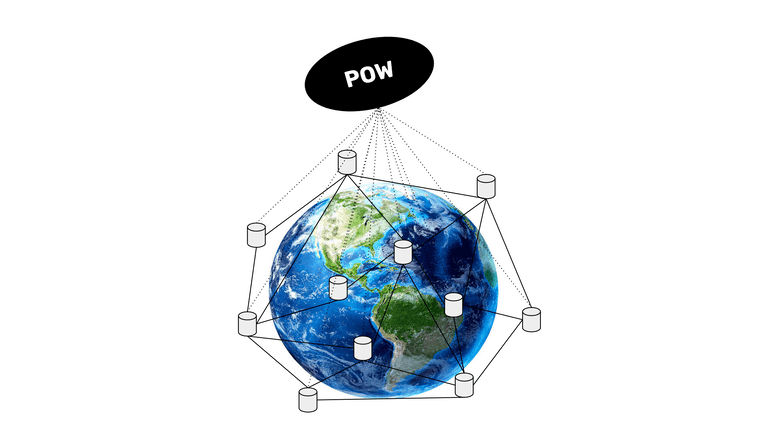
In a truly secure POW blockchain, both transactions and blocks are fully retransmitted to all participating nodes in the system. This is done so that all can keep and maintain an identical copy of the whole database.

This full replication of the database is the key security strategy of the blockchain model. The idea is to have all the accounts, balances, and smart contracts replicated in as many computers around the world as possible so they may be as decentralized as possible, and impossible to take down by man or natural events.

However, full replication of databases; let alone ledgers with accounts, balances, and smart contracts; in a totally decentralized way was not possible before, making the systems insecure and dependent on trusted third parties.

The solution to accomplish full replication globally in a totally decentralized way was the Proof of Work algorithm, which is a component of the Nakamoto Consensus design.

But POW is not what makes blockchains such as Bitcoin and Ethereum Classic unscalable. Full replication globally is the reason these networks have a cap of transactions they can process per day.

This is why Ethereum moved to POS but is still unscalable.

Any Truly Decentralized Blockchain Must Be Unscalable

Any truly decentralized POW blockchain will have to be unscalable.

The Nakamoto Consensus design specifies that all data must be replicated in all nodes, and all nodes must hold exactly the same copy of the database.

This puts a physical constraint in the size and frequency of blocks to ensure full propagation and synchronicity of all the nodes globally.

Restricted size and frequency of blocks means a limited amount of transactions will fit per block, thus making these systems unscalable.

It is important to understand that POW can process any size of block at any frequency. It is because of restrictions in retransmission and full replication, not POW, that blocks must be small and less frequent.

How Does Full Replication (And Not POW) Restrict Scalability?

Below we list several reasons why blocks must be small and less frequent in fully replicated networks, therefore produce less transactions per second:

1. Bloating: If blocks were larger and faster, then the database would grow larger very quickly and that would put pressure on node operators who have to keep up with sufficient computational storage to maintain their nodes. This would reduce the number of nodes in the chain and increase centralization. It would also go against common principles in the industry which are to “run your own node” and “verify everything” as people would prefer to use third party nodes rather than their own.

2. Technical: Related to bloating and centralization, the technical reasons why larger and faster blocks would be disadvantageous are that they would require higher bandwidth, thus limiting the areas in the world and kinds of operators who could process the data; they would require more powerful CPUs for validating the blocks, large data centers with big bandwidth, limiting the reach to operators with more capacity; and the initial blockchain download time (IBD) for new entrants or re-entrants would be very long, creating an additional barrier to participating in the system.

3. Miner economics: As the monetary policy in Bitcoin and ETC is decreasing and capped, miners will depend on fee revenues in the future. If blocks were larger and faster, then transaction fees would be lower. With scarce block space and low frequency, then fees will be higher thus financing the security that miners provide to these networks with their hashing power.

4. Block propagation: If blocks were larger, block propagation would be slower. This would benefit the larger, well geographically positioned miners in the world and eliminate the smaller miners in remote areas from the network, and would make mining centralized.

Layer 2 Systems Can Make Proof of Work Scalable

The solution to scalability is either to build layer 2 systems that may process more transactions, net them out, and then settle them at the POW base layer, or for users just to pay higher fees if they wish to use the security of POW blockchains.

Examples of layer 2 systems that may make Bitcoin and ETC more scalable are channel payments systems such as Lightning Network, regular centralized apps that settle on the POW blockchains such as centralized exchanges, and layer 2 decentralized networks that use proofs to anchor their systems on the base layer POW blockchains, such as Polygon and BitVM.


Thank you for reading this article!

To learn more about ETC please go to: https://ethereumclassic.org

Kripto yang Sedang Tren

Bacaan Terkait

Penarikan Bitcoin Terus Berlanjut: Penyimpanan 8 Tahun di Dompet Dingin Coldcard Berakhir dengan Nol

Dompet keras Coldcard Dihack, Aset Bitcoin Senilai $88,6 Juta Dicuri Dompet keras Coldcard mengalami kerentanan keamanan serius, menyebabkan gelombang penarikan paksa dana pengguna. Menurut Galaxy Research, total 1.367,05 BTC (sekitar $88,6 juta) telah dicuri dari 4.585 alamat yang rentan. Masalahnya bukan pada perangkat lunak (firmware), yang sudah diperbarui oleh pengembang Coinkite. Akar masalahnya ada pada seed phrase (frasa pemulihan) yang dihasilkan oleh perangkat antara Maret 2021 dan versi firmware tertentu. Kesalahan pemrograman menyebabkan generator angka acak perangkat beralih dari komponen keras ke generator perangkat lunak (Yasmarang) yang dapat diprediksi. Seed phrase yang dibuat dalam periode rentan ini dapat ditebak melalui serangan brute-force secara offline. Perangkat yang terdampak mencakup model Mk2/Mk3 (firmware 4.0.1–4.1.9), Mk4/Mk5 (sebelum v5.6.0), dan Q (sebelum v1.5.0Q). Satu-satunya cara untuk mengamankan dana adalah dengan membuat seed phrase BARU pada firmware yang telah diperbaiki dan memindahkan semua aset ke alamat baru tersebut. Memperbarui firmware saja tidak mengubah seed phrase lama yang sudah rentan. Insiden ini menghancurkan bagi investor jangka panjang. Satu korban, seorang pria 39 tahun, kehilangan 2 BTC ($130.000) yang ia kumpulkan selama 8 tahun melalui kerja keras. Ia menggunakan Bitcoin sebagai lindung nilai terhadap hiperinflasi di negaranya dan menyimpannya dengan aman di dompet dingin untuk pensiun dini. Pencurian instan ini menghancurkan rencananya dan mengungkap kerapuhan strategi 'simpan dan lupakan' meski dengan perangkat keras sekalipun. Kasus ini mengingatkan pada insiden serupa di masa lalu di mana kelemahan generator angka acak merusak keamanan kriptografi. Ini mempertanyakan asumsi bahwa penyimpanan offline selalu identik dengan keamanan mutlak.

cryptonews.ru2j yang lalu

Penarikan Bitcoin Terus Berlanjut: Penyimpanan 8 Tahun di Dompet Dingin Coldcard Berakhir dengan Nol

cryptonews.ru2j yang lalu

Trading

Spot

Artikel Populer

Cara Membeli O

Selamat datang di HTX.com! Kami telah membuat pembelian O1 exchange (O) menjadi mudah dan nyaman. Ikuti panduan langkah demi langkah kami untuk memulai perjalanan kripto Anda.Langkah 1: Buat Akun HTX AndaGunakan alamat email atau nomor ponsel Anda untuk mendaftar akun gratis di HTX. Rasakan perjalanan pendaftaran yang mudah dan buka semua fitur.Dapatkan Akun SayaLangkah 2: Buka Beli Kripto, lalu Pilih Metode Pembayaran AndaKartu Kredit/Debit: Gunakan Visa atau Mastercard Anda untuk membeli O1 exchange (O) secara instan.Saldo: Gunakan dana dari saldo akun HTX Anda untuk melakukan trading dengan lancar.Pihak Ketiga: Kami telah menambahkan metode pembayaran populer seperti Google Pay dan Apple Pay untuk meningkatkan kenyamanan.P2P: Lakukan trading langsung dengan pengguna lain di HTX.Over-the-Counter (OTC): Kami menawarkan layanan yang dibuat khusus dan kurs yang kompetitif bagi para trader.Langkah 3: Simpan O1 exchange (O) AndaSetelah melakukan pembelian, simpan O1 exchange (O) di akun HTX Anda. Selain itu, Anda dapat mengirimkannya ke tempat lain melalui transfer blockchain atau menggunakannya untuk memperdagangkan mata uang kripto lainnya.Langkah 4: Lakukan trading O1 exchange (O)Lakukan trading O1 exchange (O) dengan mudah di pasar spot HTX. Cukup akses akun Anda, pilih pasangan perdagangan, jalankan trading, lalu pantau secara real-time. Kami menawarkan pengalaman yang ramah pengguna baik untuk pemula maupun trader berpengalaman.

562 Total TayanganDipublikasikan pada 2026.06.19Diperbarui pada 2026.06.29

Cara Membeli O

Cara Membeli PROS

Selamat datang di HTX.com! Kami telah membuat pembelian Pharos (PROS) menjadi mudah dan nyaman. Ikuti panduan langkah demi langkah kami untuk memulai perjalanan kripto Anda.Langkah 1: Buat Akun HTX AndaGunakan alamat email atau nomor ponsel Anda untuk mendaftar akun gratis di HTX. Rasakan perjalanan pendaftaran yang mudah dan buka semua fitur.Dapatkan Akun SayaLangkah 2: Buka Beli Kripto, lalu Pilih Metode Pembayaran AndaKartu Kredit/Debit: Gunakan Visa atau Mastercard Anda untuk membeli Pharos (PROS) secara instan.Saldo: Gunakan dana dari saldo akun HTX Anda untuk melakukan trading dengan lancar.Pihak Ketiga: Kami telah menambahkan metode pembayaran populer seperti Google Pay dan Apple Pay untuk meningkatkan kenyamanan.P2P: Lakukan trading langsung dengan pengguna lain di HTX.Over-the-Counter (OTC): Kami menawarkan layanan yang dibuat khusus dan kurs yang kompetitif bagi para trader.Langkah 3: Simpan Pharos (PROS) AndaSetelah melakukan pembelian, simpan Pharos (PROS) di akun HTX Anda. Selain itu, Anda dapat mengirimkannya ke tempat lain melalui transfer blockchain atau menggunakannya untuk memperdagangkan mata uang kripto lainnya.Langkah 4: Lakukan trading Pharos (PROS)Lakukan trading Pharos (PROS) dengan mudah di pasar spot HTX. Cukup akses akun Anda, pilih pasangan perdagangan, jalankan trading, lalu pantau secara real-time. Kami menawarkan pengalaman yang ramah pengguna baik untuk pemula maupun trader berpengalaman.

1.2k Total TayanganDipublikasikan pada 2026.06.22Diperbarui pada 2026.06.29

Cara Membeli PROS

Apa Itu VERONA

I. Pengenalan Proyek VERONA adalah blockchain yang dibangun untuk semua orang, di mana saja melalui abstraksi rantai. Memanfaatkan lapisan Abstraksi Umum, VERONA membedakan dirinya dengan mengintegrasikan fungsionalitas blockchain yang kompleks, seperti akun, tanda tangan, dan interoperabilitas, langsung di tingkat protokol. Pendekatan ini memungkinkan keterlibatan dengan aplikasi blockchain tanpa perlu memahami teknologi yang mendasarinya.1) Informasi Dasar Nama:VERONA(VERONA)III. Tautan Terkait Link situs resmi:https://xion.burnt.com/ Whitepaper:https://xion.burnt.com/whitepaper.pdf Penjelajah:https://explorer.burnt.com/ Media Sosial: https://x.com/burnt_xion Catatan: Pengenalan proyek berasal dari materi yang diterbitkan atau disediakan oleh tim proyek resmi, yang hanya untuk referensi dan tidak merupakan nasihat investasi. HTX tidak bertanggung jawab atas kerugian langsung atau tidak langsung yang diakibatkan.

503 Total TayanganDipublikasikan pada 2026.06.22Diperbarui pada 2026.06.22

Apa Itu VERONA

Diskusi

Selamat datang di Komunitas HTX. Di sini, Anda bisa terus mendapatkan informasi terbaru tentang perkembangan platform terkini dan mendapatkan akses ke wawasan pasar profesional. Pendapat pengguna mengenai harga A (A) disajikan di bawah ini.

活动图片














