Why can’t Ethereum hold $3K? ETH recovery in doubt as data tilts bearish

cointelegraphPublished on 2025-12-16Last updated on 2025-12-16

Abstract

Ether (ETH) has been struggling to hold above the $3,000 level, facing resistance and declining momentum. Key factors contributing to this bearish pressure include a lack of demand in futures markets, aggressive selling by long-term holders, and reduced on-chain activity. The 50-day EMA at $3,260 is acting as a major resistance level, while support lies around $2,800. If this support breaks, technical analysis suggests a potential drop to $2,300 or lower. Additionally, Ethereum network fees have decreased significantly, reflecting weaker demand. Without a strong break above key resistance levels, ETH’s recovery remains uncertain, with further downside risk.

Ether (ETH) has oscillated around $3,000 for the past three weeks, a consolidation period following its flash crash to $2,620 on Nov. 21. Ether traders are now questioning the likelihood of a further correction if support at $2,800 is lost.

Key takeaways:

  • Ether slid below $3,000 again due to a lack of futures demand and aggressive selling by long-term holders.

  • Declining Ethereum network fees and activity suggest lower onchain demand.

  • Weak technical setups warned of a drop to $2,300 if the next support is lost.
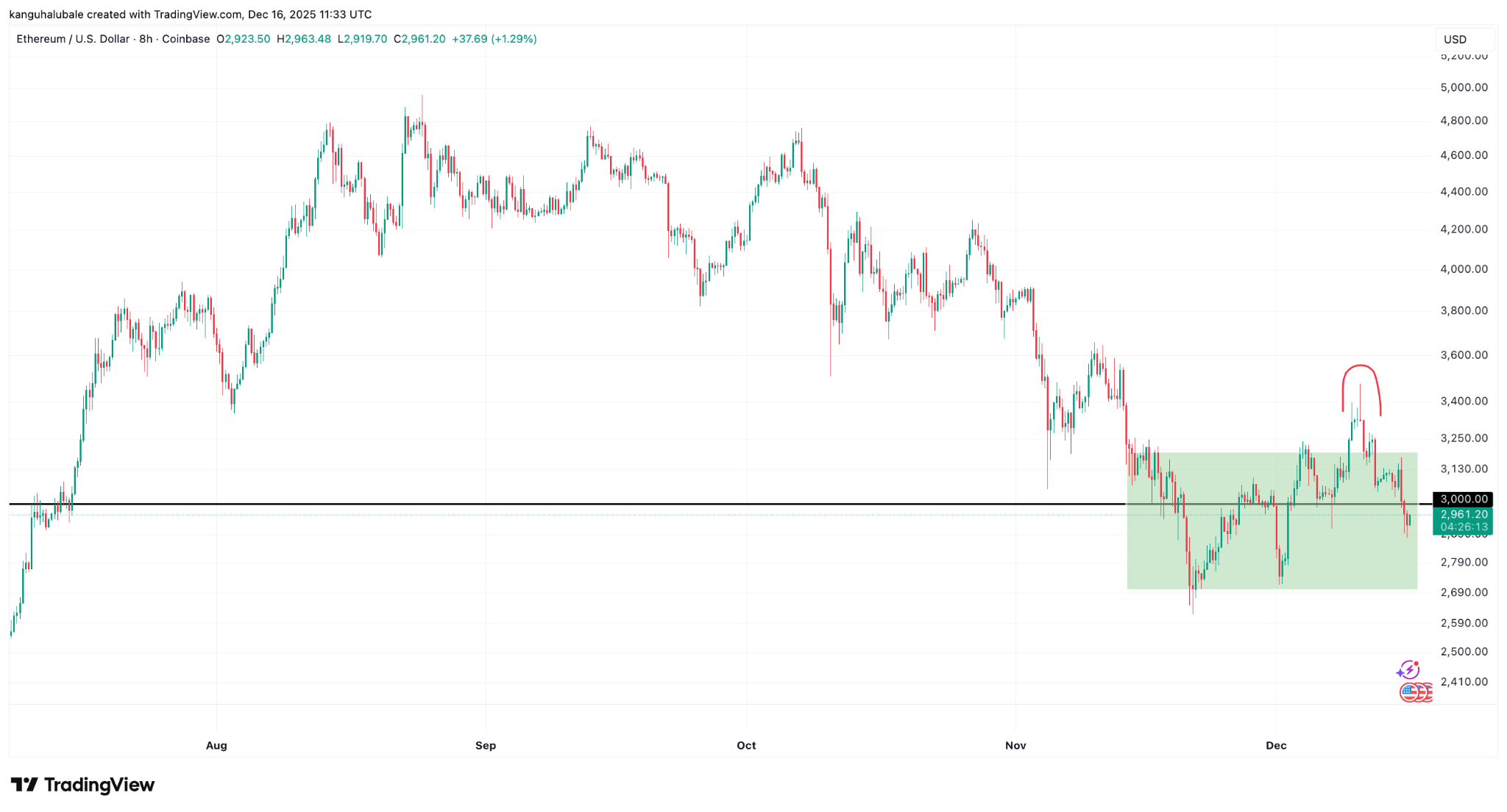
ETH/USD price chart. Source: Cointelegraph/TradingView


ETH price stuck between two trendlines

Ether’s recent recovery was rejected by resistance from the 50-day exponential moving average (EMA), which currently sits at $3,260, as shown on the daily chart below.

Related: Ether price trend forecasts triple-digit rally as ETH ETF inflows resume

This move, however, saw ETH/USD find support from the $2,800-$2,600 demand zone. The 200-week EMA is currently within this zone.
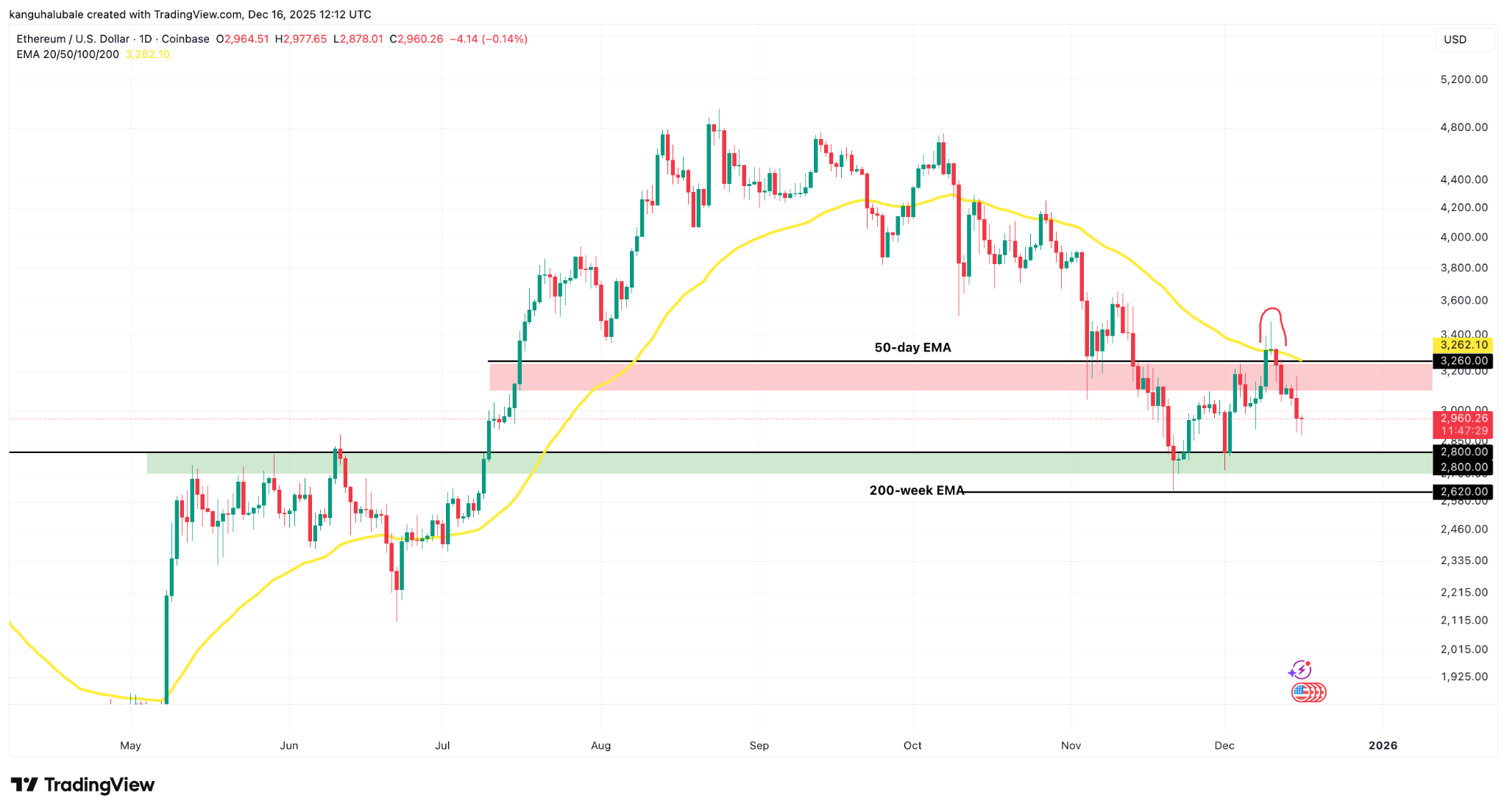
ETH/USD daily chart. Source: Cointelegraph/TradingView

ETH must rise above the resistance at $3,000 and surpass the 50-day EMA to break out of consolidation for a sustained recovery toward $4,000.

The Glassnode cost basis distribution heatmap showed resistance between $3,100 and $3,250, where investors acquired roughly 5.9 million ETH.

Ethereum: Cost basis distribution heatmap. Source: Glassnode

On the downside, the key support area is around $2,800, where 5.8 million ETH were previously purchased.

Ether price lacks bullish momentum

Ether futures are currently trading at a 3% premium relative to bearish ETH spot markets, reflecting declining demand from buyers using leverage.

In bearish market conditions, futures premiums typically stay below 5%, signaling weak demand for leveraged long positions and less optimism among traders.

More concerningly, even last week’s recovery to $3,750 did not restore sustained bullish sentiment among traders.

Ether annualized futures, three-month rolling basis. Source: Glassnode

The bearish trend in Ether futures coincided with a decline in long-term holder supply, which has decreased by 847,222 coins over the past 30 days, the largest drop since January 2021. This adds to the sell-side pressure that keeps ETH from staying above $3,000.
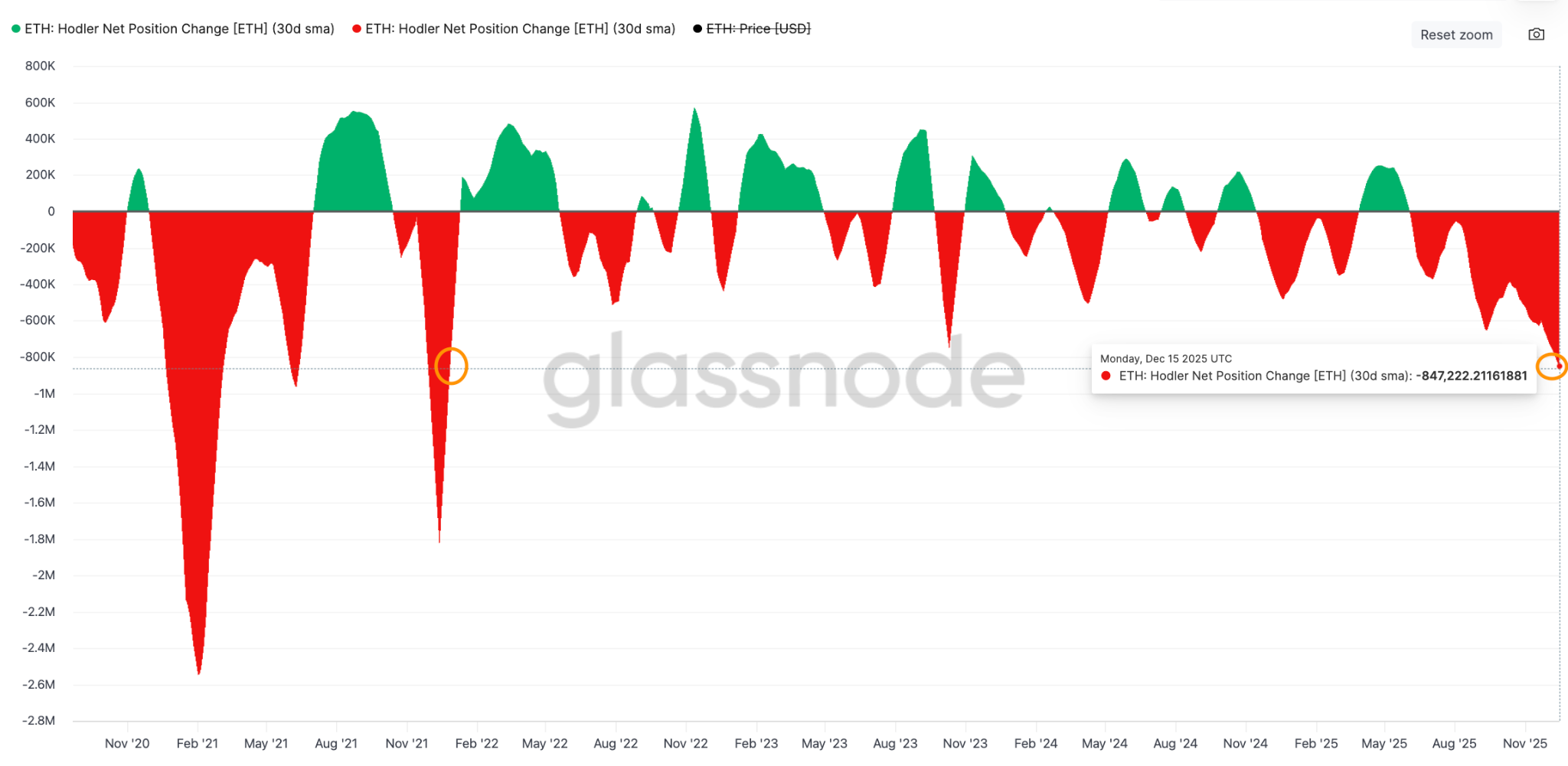
Ethereum 30-day rolling LTH supply change. Source: Glassnode

Ether’s inability to stay above $3,000 can also be attributed to the decline in Ethereum network fees, although this issue has affected the entire cryptocurrency market.
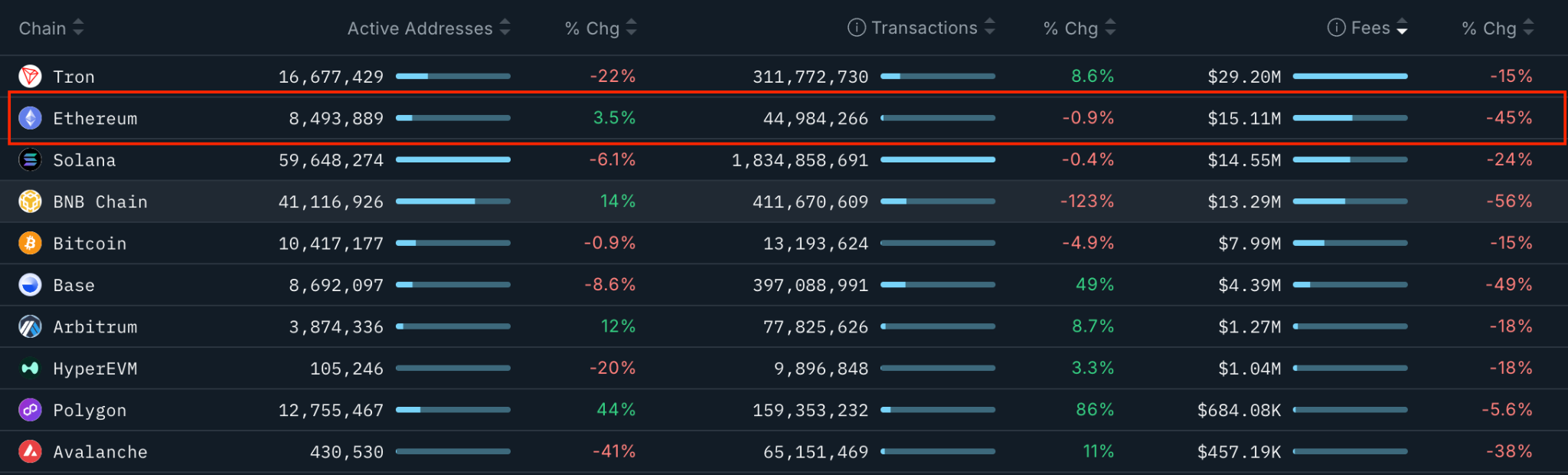
Blockchains ranked by 30-day fees, USD. Source: Nansen

Ethereum chain fees totaled $15.1 million over the past 30 days, representing a 45% decrease from the previous month. By comparison, fees on BNB Chain dropped 56%, and Tron experienced a 15% decline.

Although the number of active addresses on Ethereum’s base layer increased by 3.5% over the same period, it has decreased by 14% over the last seven days. The number of transactions is down by 11% over a seven-day period.

Ethereum bears target $2,300 ETH price

The ETH/USD pair has validated a bear flag on the daily chart after dropping below its lower boundary at $3,200, as shown below.

“Ethereum is consolidating after a sharp sell-off, forming a bear flag beneath prior support near the 3,173 to 3,250 zone,” said analyst Danny Naz in an X post on Sunday, adding:

“That area has flipped to resistance.”

The measured target of the flag is $2,300, representing a 22% drop from the current price.

ETH/USD daily chart. Source: Cointelegraph/TradingView

Zooming into the 12-hour time frame, a break and a close below the lower trendline of a megaphone pattern at $2,800 would open the way for a deeper correction toward the measured target of the pattern at $2,376.

Such a move would represent an 18% drop from the current price.
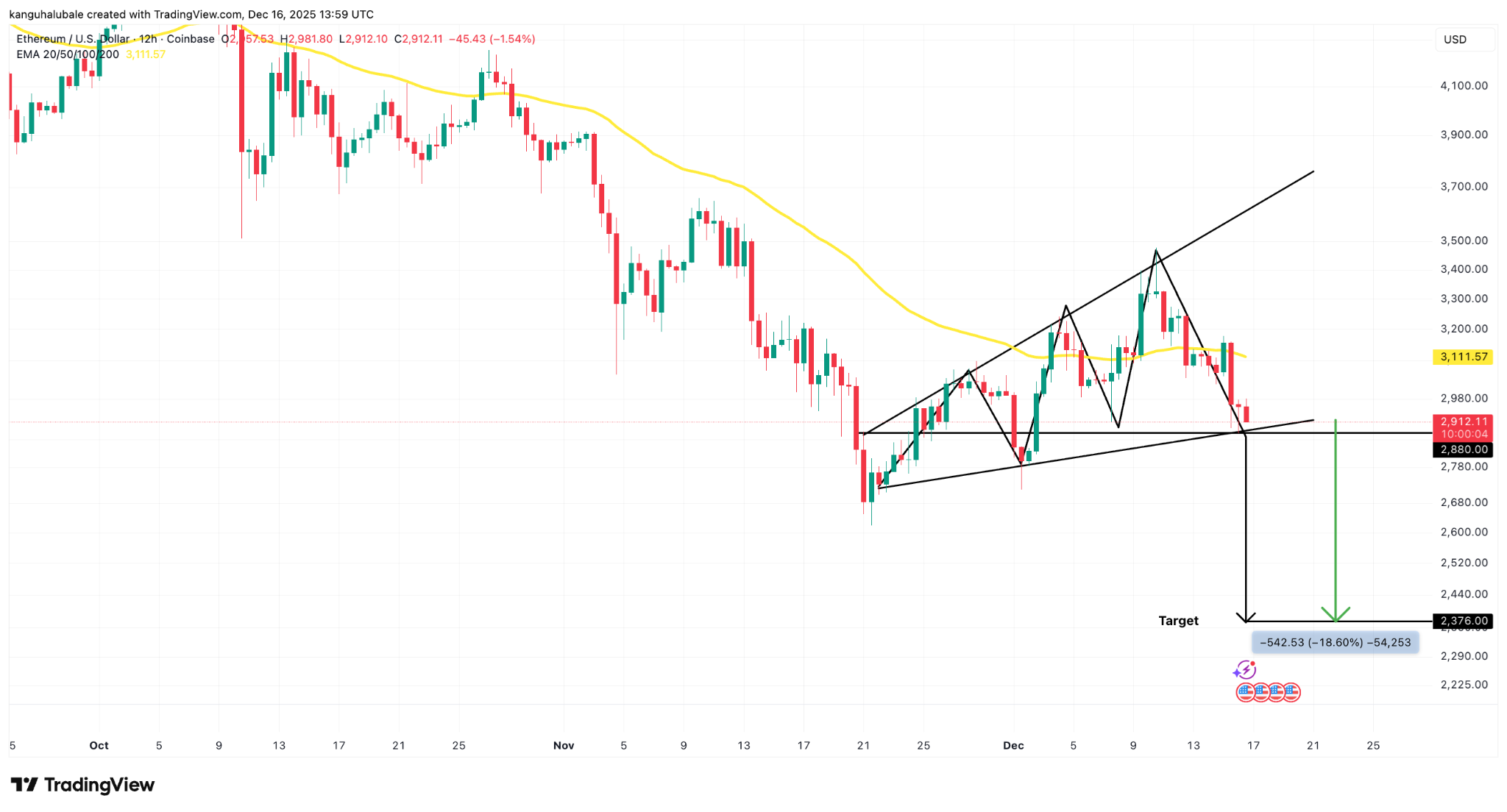
ETH/USD 12-hour chart. Source: Cointelegraph/TradingView

If this support fails and the bears manage to pull the price below $2,800, ETH price could descend to the next $2,716 to $2,623 support zone.

This article does not contain investment advice or recommendations. Every investment and trading move involves risk, and readers should conduct their own research when making a decision. While we strive to provide accurate and timely information, Cointelegraph does not guarantee the accuracy, completeness, or reliability of any information in this article. This article may contain forward-looking statements that are subject to risks and uncertainties. Cointelegraph will not be liable for any loss or damage arising from your reliance on this information.



Related Reads

U.S. Supreme Court Tariff Ruling Imminent, Trump Repeatedly Voices Warnings, Might He Lose?

A pivotal U.S. Supreme Court ruling expected in January 2025 threatens to overturn the Trump administration’s signature tariff policy, implemented under the International Emergency Economic Powers Act (IEEPA). President Trump has publicly expressed alarm, warning of a "devastating blow" to the nation if the tariffs are struck down, while his cabinet officials project confidence in having alternative legal tools. Market analysts, including Goldman Sachs, predict the Court is likely to rule the tariffs illegal. Two key cases challenge whether the President overstepped constitutional boundaries by using IEEPA to impose Congress’s exclusive taxing authority. If overturned, the administration may attempt to replace the tariffs using other statutes, such as Section 122 of the Trade Act of 1974 (capping tariffs at 15% for 150 days) or Section 338 of the Tariff Act of 1930 (allowing up to 50% tariffs). However, both face significant legal and political hurdles, likely triggering further litigation. A ruling against the government could lead to lower effective tariff rates and trigger massive refunds—estimated at $1.3 trillion and growing. It would also undermine the credibility of administration officials who claimed revocation would cause chaos and weaken the U.S. negotiating position with trade partners. The political fallout would also put Republican lawmakers in a difficult position ahead of the 2026 midterms.

marsbit5m ago

U.S. Supreme Court Tariff Ruling Imminent, Trump Repeatedly Voices Warnings, Might He Lose?

marsbit5m ago

Farewell to Buying Houses and Stocks: The Younger Generation Embraces Cryptocurrency as the Main Battlefield for Wealth

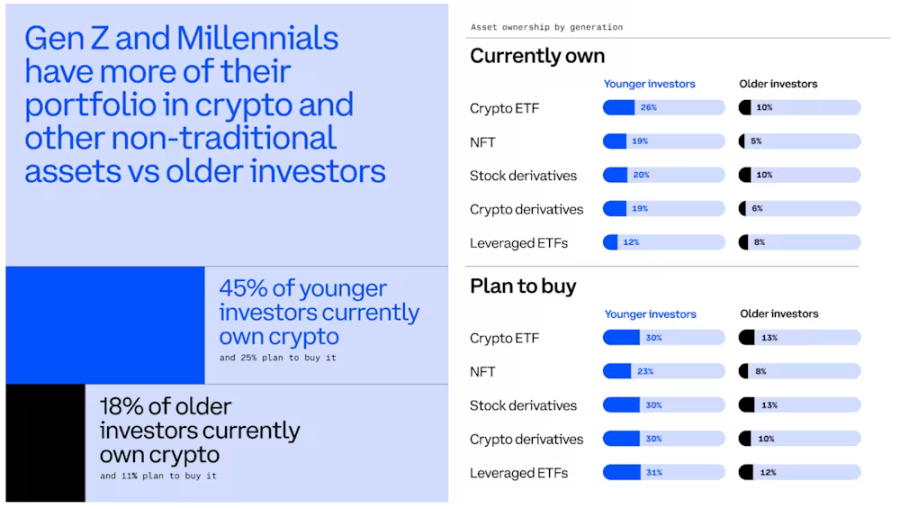
A new report by Coinbase reveals a significant generational shift in wealth-building strategies in the U.S. Younger investors, including Gen Z and millennials, are increasingly moving away from traditional paths like buying real estate and investing in stocks. Instead, they are turning to alternative assets, particularly cryptocurrencies, as a core component of their financial future. The study, conducted with Ipsos, found that 73% of young investors believe it's harder for their generation to build wealth through conventional means compared to their parents' generation. In response, they are actively diversifying their portfolios, allocating 25% to non-traditional assets like crypto, derivatives, and NFTs—three times the allocation of older investors. Nearly half (45%) of young investors already hold cryptocurrency, viewing it not as a speculative side investment but as a vital tool for catching up financially. They express strong optimism about crypto’s future, with 80% believing it offers financial opportunities outside the traditional system and will play a major role in the future of finance. This shift is driving demand for more innovative, internet-native financial products—such as crypto derivatives, DeFi, and 24/7 trading platforms—and reflects a broader move toward more active, risk-tolerant investment behavior among younger generations.

深潮27m ago

Farewell to Buying Houses and Stocks: The Younger Generation Embraces Cryptocurrency as the Main Battlefield for Wealth

深潮27m ago

Trading

Spot
Futures

Hot Articles

Discussions

Welcome to the HTX Community. Here, you can stay informed about the latest platform developments and gain access to professional market insights. Users' opinions on the price of T (T) are presented below.

活动图片