Vitalik Buterin pitches ZK-proofs to audit X algorithm and rankings

cointelegraphPublished on 2025-12-15Last updated on 2025-12-15

Abstract

Vitalik Buterin, co-founder of Ethereum, has proposed that social media platform X use zero-knowledge proofs (ZK-proofs) and blockchain technology to make its content-ranking algorithm transparent and verifiable. He argues this would prove the fairness of algorithmic decisions, prevent censorship, and ensure data integrity by timestamping content on-chain. Buterin also suggests publishing the full algorithm code with a 1-2 year delay. His comments follow criticism of Elon Musk’s leadership and X’s opaque content policies. The proposal aligns with broader SocialFi and decentralized social media principles, emphasizing the need for transparency amid growing regulatory scrutiny, such as the EU’s Digital Services Act, which recently fined X for non-compliance. Buterin’s stance highlights concerns about social media’s impact on free speech and misinformation.

Ethereum co-founder Vitalik Buterin is calling for social media platforms to use cryptography and blockchain tools to make their content-ranking systems more transparent and verifiable.

In a Monday X post, Buterin argued that X should use zero-knowledge proofs (ZK-proofs) and blockchain to prove the fairness of the algorithm that determines the reach of content on the platform. He raised an issue with how X operates on Dec. 9, claiming that its owner Elon Musk’s way of leading it is harmful:

“Elon Musk I think you should consider that making X a global totem pole for free speech, and then turning it into a death star laser for coordinated hate sessions, is actually harmful for the cause of free speech.“

Ethereum Foundation AI lead Davide Crapis reacted to this initial idea by saying, “If you want to claim X is the platform for free speech, you should disclose your algorithm optimization targets.” He added that “it should be legible to the users, and tweakable.”

Buterin suggested a verifiable system that employs ZK-proofs for every decision made by the algorithm and timestamps all content, likes, and retweets on a blockchain “so the server can’t censor or lie about time.” The platform should also “commit to publishing the full algorithm code with a 1-2 year delay.”
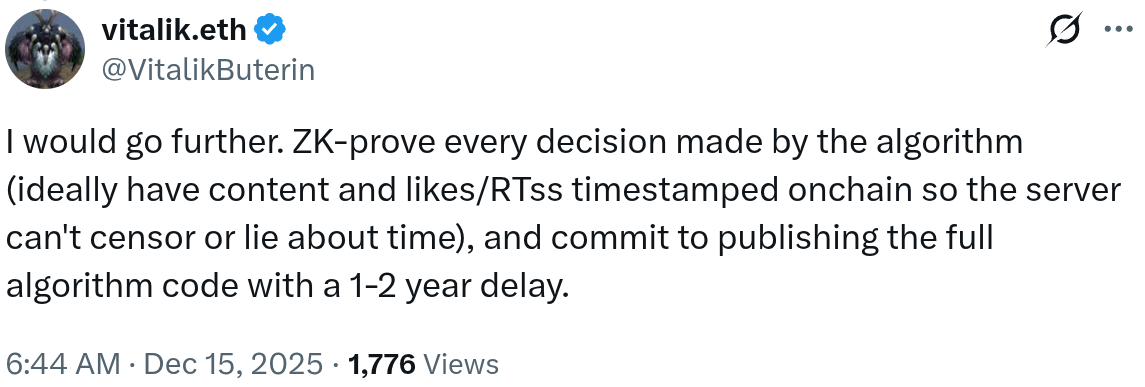
Source: Vitalik Buterin

ZK-proofs are a cryptographic way to prove that something is true without revealing the underlying data — for instance, proving that you are over 18 without sharing your full name. Buterin did not go into detail about what proofs would demonstrate in his suggested solution, but they would likely show that algorithmic decisions followed certain constraints without sharing sensitive details.

Related: Sunlight is more effective than censorship

Crypto takes on social media

Buterin’s post echoed the sentiment behind some decentralized social media platforms known as SocialFi. Such initiatives, despite none having reached mainstream adoption, appear to be taken seriously by their traditional centralized equivalents.

In early 2025, Meta, the parent company of Facebook and Instagram, blocked links to a decentralized Instagram competitor called Pixelfed. All links to the platform were labeled as “spam” and removed immediately. Others claimed that Facebook competitors, including Mastodon, were given the same treatment.

The crypto community — with its tendency to be wary of centralized control — has raised concerns about the potential impact of decisions made by social media platform leadership in the past. When Musk announced in early January that X would prioritize promoting content deemed informative or educational over other types of content, many were not convinced.

Critics questioned who would decide what qualifies and whether the policy could become a vehicle for suppressing certain viewpoints. Musk has also been accused by critics of limiting access to premium features for users who disagreed with him.

Buterin also chimed in at the time. He urged Musk to remain committed to free speech on the platform and not ban users for disagreements or expressing views.

Related: Buterin says X’s new location feature ‘risky’ as crypto users flag privacy concerns

The impact of social media on society

Research has long shown that social media has an outsized impact on society and the functioning of democratic processes. A paper published in 2024 suggested that “access to Facebook may increase belief in misinformation.”

Reuters also reported last month that recent court filings suggested that Meta shut down internal research into the mental health effects of Facebook after finding causal evidence that its products harmed users’ mental health. The study found that “people who stopped using Facebook for a week reported lower feelings of depression, anxiety, loneliness, and social comparison.”

The European Union attempted to tackle the issue with its Digital Services Act, which requires transparency on the main algorithm parameters and requires platforms to assess the risk and disclose the findings on the potential negative impact of their operations. Impacts considered explicitly include “negative effects on civic discourse and electoral processes, and public security.”

The Digital Services Act also requires that vetted researchers be given access to platform data to study their systemic risk independently. A lack of compliance by X with this specific requirement is among the reasons cited by the European Commission for imposing a 120 million euro fine earlier this month.

Other reasons include a lack of transparency on X’s ads repository and the platform’s blue checkmark purportedly deceiving users since “anyone can pay to obtain the ‘verified’ status without the company meaningfully verifying who is behind the account.”


Related Reads

From U.S. Stocks to On-Chain: The Next Structural Opportunity Is Brewing

The article discusses the potential impact of tokenized US stocks on the cryptocurrency market, arguing against the view that tokenized equities will entirely drain liquidity from the crypto space. While acknowledging that some crypto funds may flow into tokenized stocks, the author emphasizes that asset tokenization (including stocks, bonds, and gold) could significantly increase on-chain asset volume. This, combined with crypto’s composability and potential improvements in scalability and privacy, may lead to an explosion in on-chain transactions—attracting not only crypto-native funds but also traditional stock market participants. The piece suggests that tokenized assets won’t remain static on-chain; instead, they will interact with DeFi, derivatives, prediction markets, and other crypto-native applications. This could create new opportunities and even new sectors, similar to how perps and prediction markets emerged in previous cycles. Although the era of broad "altcoin seasons" may be over, high-quality crypto projects—especially those in infrastructure like DeFi, oracles, privacy, digital identity, and wallets—could still thrive. The convergence of tokenized traditional assets and crypto composability might spark innovative combinations, such as crypto AI agents or new financial instruments. Ultimately, the author believes that the next cycle will bring new "version winners," distinct from past cycles, and that while the wild west of crypto is fading, significant opportunities remain for innovative projects that leverage on-chain liquidity and composability.

比推15m ago

From U.S. Stocks to On-Chain: The Next Structural Opportunity Is Brewing

比推15m ago

Before Soaring to a $1.5 Trillion IPO, Musk Almost Lost Everything

Elon Musk's SpaceX is on the verge of a historic $150 billion IPO in 2026, targeting a $1.5 trillion valuation, which would make it one of the largest public offerings ever. This marks a dramatic turnaround from its near-collapse in 2008. Founded in 2002, SpaceX faced immense skepticism and multiple failures. Its first three Falcon 1 rockets exploded, nearly bankrupting the company and coinciding with Musk's personal crises during the financial crash. The fourth launch in September 2008 succeeded, saving the company and securing a crucial $1.6 billion NASA contract. SpaceX’s breakthrough came from challenging aerospace norms. It pioneered reusable rockets, first landing a Falcon 9 booster in 2015, drastically cutting costs. For its Mars-bound Starship, Musk applied first principles, opting for cheap stainless steel over expensive carbon fiber, simplifying manufacturing and reducing expenses. The key to its $800 billion pre-IPO valuation is Starlink. With over 7.65 million subscribers and projected 2026 revenues of $22-24 billion, it provides stable cash flow, transforming SpaceX from a launch provider into a global telecom giant. Musk, initially opposed to IPO distractions, now seeks capital for Mars colonization. The IPO’s $30 billion raise will fund ambitious plans, including uncrewed Mars landings by 2027 and a self-sustaining city on Mars within 20 years. For Musk, wealth is a means to make humanity a multi-planetary species.

深潮17m ago

Before Soaring to a $1.5 Trillion IPO, Musk Almost Lost Everything

深潮17m ago

Dialogue with Gate Founder Han Lin: Optimistic About 2026, and Why He Believes 'We Won't Return to a Deep Bear Market'

In a recent interview, Gate.io founder Lin Han shared his optimistic outlook on the crypto market, macroeconomic trends, and the evolving regulatory and technological landscape. He argued that the market is unlikely to return to a severe bear phase, citing strong macroeconomic conditions, expected monetary easing, and sustained institutional interest. While acknowledging potential risks like an AI sector correction, he emphasized that AI's tangible applications differentiate it from past tech bubbles. Han discussed the minimal impact of the recent October 11 market crash, attributing market resilience to ample stablecoin liquidity. He highlighted the industry-wide adoption of Proof of Reserves (PoR) post-FTX, advocating for enhanced methods incorporating zero-knowledge proofs and third-party audits. On emerging trends, he noted the resurgence of privacy-focused protocols like Zcash and the rapid growth of Perpetual DEXs (e.g., Hyperliquid), driven by improved blockchain infrastructure, lower costs, and better wallet experiences. He anticipates increased regulatory scrutiny on DeFi platforms in the future. Regarding Gate.io's strategy, Han emphasized a dual focus: expanding its Web3 ecosystem, as user activity migrates on-chain, and strengthening its global compliant exchanges, including its recently launched U.S. platform. He ruled out aggressive layoffs, reflecting Gate's consistent operational approach, and expressed long-term ambitions for a public listing following continued compliance efforts. He dismissed DATs (Digital Asset Trusts) as unsustainable and commented on the challenges of new stablecoin issuance due to strong network effects favoring incumbents like USDT. Finally, he addressed market manipulation concerns, noting improved exchange risk controls, and defended Gate's remote-work culture as aligned with the fast-paced, global nature of the crypto industry.

marsbit1h ago

Dialogue with Gate Founder Han Lin: Optimistic About 2026, and Why He Believes 'We Won't Return to a Deep Bear Market'

marsbit1h ago

Trading

Spot
Futures

Hot Articles

Discussions

Welcome to the HTX Community. Here, you can stay informed about the latest platform developments and gain access to professional market insights. Users' opinions on the price of ZK (ZK) are presented below.

活动图片