Strategy Not Slowed Down By USD Reserve—Drops Nearly $1 Billion On Bitcoin

bitcoinistPublished on 2025-12-09Last updated on 2025-12-09

Abstract

Strategy, a prominent corporate Bitcoin holder, has executed one of its largest acquisitions of the year, purchasing 10,624 BTC for $962.7 million. This purchase, funded through stock offerings, comes just one week after the company established a $1.44 billion USD reserve intended to manage short-term market volatility. With this latest addition, Strategy's total holdings now stand at 660,624 BTC, acquired at an average cost of $74,696 per coin. The company is currently holding an unrealized profit of approximately 21% on its massive Bitcoin treasury. This aggressive accumulation contrasts with the recent trend of net outflows from US spot Bitcoin ETFs, which resumed after a brief period of inflows, indicating ongoing market caution. Meanwhile, Bitcoin's price has retreated to around $89,900 after briefly surpassing $92,000.

Just a week after announcing its $1.44 billion USD Reserve, Strategy has made a Bitcoin purchase of nearly $1 billion, one of the largest for 2025.

Strategy Has Made Its Ninth Largest Bitcoin Buy Of The Year

In a new post on X, Strategy co-founder and chairman Michael Saylor has shared info related to the latest routine Monday Bitcoin purchase made by the treasury company.

While the timing of the buy is routine, its scale is not. In total, Strategy has added 10,624 BTC to its holdings with the acquisition. This is the biggest purchase since July’s 21,021 BTC mega-buy.

The new acquisition has cost the firm $90,615 per token or $962.7 million in total. In USD terms, this is the ninth largest addition to the company’s Bitcoin reserves.

This big purchase has come a week after Strategy announced a new shift for the company with its $1.44 billion USD reserve. Saylor said that the reserve will better position the firm to navigate short-term volatility.

The announcement was also accompanied by the usual Monday Bitcoin buy, but at just 130 tokens, it was a relatively small one. If the latest acquisition is to go by, however, the USD reserve doesn’t seem to be stopping Strategy in hoarding more of the cryptocurrency.

According to the filing with the US Securities and Exchange Commission, the new buy, which occurred in the period between December 1st and 7th, was funded using sales of the firm’s STRD and MSTR at-the-market (ATM) stock offerings.

Strategy now holds a total of 660,624 BTC, with an average cost basis of $74,696 per coin or total investment of $49.35 billion. At the current price of the asset, the Bitcoin treasury company’s holdings are worth about $59.68 billion, which means that it’s sitting on a profit of nearly 21% right now.

In some other news, while Strategy has continued its Bitcoin accumulation, the same hasn’t been true for another side of the sector: the spot exchange-traded funds (ETFs).

The spot ETFs refer to investment vehicles that allow investors to gain indirect exposure to BTC. That is, the funds hold the cryptocurrency on behalf of the investors, enabling them to invest into the asset without having to bother with the on-chain side of things.

Since mid-October, the US Bitcoin spot ETFs have mostly faced waves of net outflows as the cryptocurrency’s price has followed a bearish trajectory. The last week of November registered a small positive netflow, however, breaking a streak of four consecutive weeks of outflows.

This turnaround didn’t last, though, with the latest week once again ending with net outflows, as the below chart from SoSoValue shows.
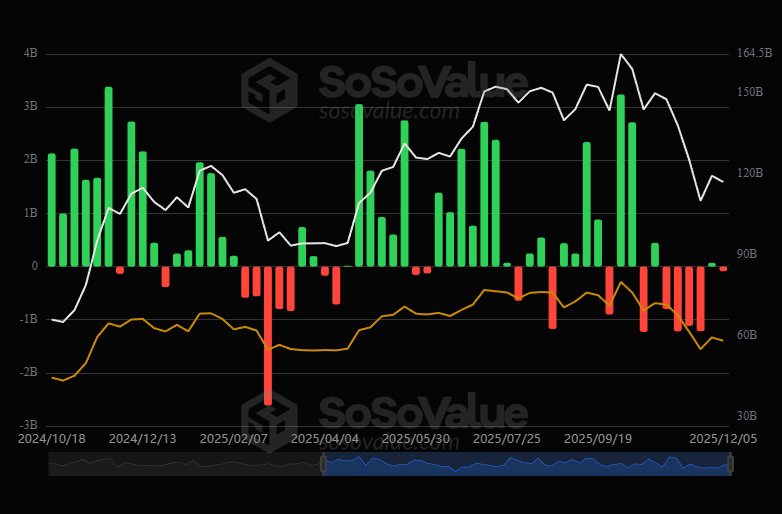
The trend in the weekly netflow of the US BTC spot ETFs | Source: SoSoValue

The outflows were only modest, coming out at about $87.8 million, but still indicate lingering pessimism in the market.

BTC Price

Bitcoin broke above $92,000 earlier in the day, but the coin has since faced a pullback as it’s now back at $89,900.

Looks like the price of the coin has retraced its latest recovery | Source: BTCUSDT on TradingView


Related Reads

Regulatory Crossroads: The United States, Europe, and the Future of Crypto Assets

The article "Regulatory Crossroads: The US, Europe, and the Future of Crypto Assets" examines the divergent regulatory paths shaping the cryptocurrency landscape. It begins by contrasting Bitcoin’s origins as a decentralized, anti-establishment innovation with its current status as a heavily industrialized, energy-intensive asset. The piece draws parallels between the unregulated pre-1933 US stock market and today's crypto space, arguing that a shift from a libertarian "wild west" to a compliant asset class is inevitable. The US approach is portrayed as increasingly pragmatic and institutionally friendly. Key developments include the GENIUS Act, which mandates 1:1 Treasury backing for stablecoins, the repeal of restrictive accounting rules, and a perceived regulatory "regime change" at the SEC under Paul Atkins. This framework aims to integrate crypto into traditional finance, with major banks like JPMorgan now offering crypto-backed loans and the Treasury viewing stablecoins as tools for extending dollar hegemony. In stark contrast, the EU’s Markets in Crypto-Assets (MiCA) regulation is criticized as a risk-averse, innovation-stifling "bureaucratic masterpiece." Its high compliance burdens, treatment of crypto founders like sovereign banks, and effective ban on non-euro stablecoins like USDT are seen as creating a "regulatory moat" that drives talent and startups to more favorable jurisdictions like Switzerland and the UAE. The article concludes that the US is poised to become the dominant global crypto financial center by normalizing DeFi, while Europe risks becoming a "financial museum" due to its oppressive regulatory framework. It calls for urgent, decisive action to build a functional crypto industry that protects investors and allows for safe institutional capital entry before the window of opportunity closes.

深潮2m ago

Regulatory Crossroads: The United States, Europe, and the Future of Crypto Assets

深潮2m ago

How to Build a Polymarket Passive Income Bot from Scratch

Polymarket, a leading prediction market platform on Polygon, allows users to bet on real-world events using USDC. Its open API, transparent order book, low fees, and numerous human traders making errors create a fertile ground for automated trading bots. This article breaks down bot strategies from basic to advanced. Beginner-level bots include airdrop farming bots that generate volume by repeatedly buying and selling the same position, and volatility捕捉 bots that bet on mean reversion after sharp price swings. Intermediate strategies involve market-making bots, which profit from bid-ask spreads and liquidity rewards by placing limit orders, though they require significant capital and risk losses during sudden market moves. Advanced bots include arbitrage bots that exploit pricing inefficiencies between related outcomes (e.g., YES/NO shares summing under 100%), and AI-powered bots that integrate multiple data sources—historical prices, news, on-chain activity, social sentiment—to identify mispriced probabilities and execute trades across hundreds of markets. All bots require access to Polymarket’s API, a Polygon wallet for USDC transactions, historical data storage (e.g., PostgreSQL), and a Python-based toolchain. Bots succeed due to their speed, discipline, scalability, and data-processing capabilities. However, effective risk management is crucial, as strategies can fail due to liquidity issues, unexpected news, or intense competition. Building a profitable AI bot is particularly resource-intensive, akin to running a startup.

Odaily星球日报30m ago

How to Build a Polymarket Passive Income Bot from Scratch

Odaily星球日报30m ago

Trading

Spot
Futures
活动图片