Shiba Inu records massive whale transfers – Momentum can extend IF…

ambcryptoPublished on 2025-12-10Last updated on 2025-12-10

Abstract

Shiba Inu recorded a significant spike in whale transactions, the highest since June 6, signaling a shift in large-holder behavior. Over 1.06 trillion SHIB flowed into exchanges, indicating repositioning by major traders. Despite heavy inflows, SHIB respected key structural support levels instead of declining under selling pressure. The token broke out of a falling wedge pattern and is now retesting the upper boundary, with the $0.00000883 zone acting as a critical support. Technical indicators like the MACD show upward momentum tilt. Moreover, the Taker Buy CVD confirms strong buyer dominance and absorption of sell-side pressure, suggesting accumulation. A massive 1,244% surge in the burn rate reduced circulating supply, potentially tightening market conditions. Funding rates turned positive, reflecting growing conviction among long traders. Overall, these factors—whale activity, successful breakout, buy-side strength, supply reduction, and positive sentiment—create a supportive structure for SHIB to extend its upward momentum if the retest zone holds.

Shiba Inu recorded its strongest wave of whale transactions since the 6th of June, and the spike signaled a shift in large-holder behavior.

Santiment reported 406 whale transfers above $100k, alongside over 1.06 trillion SHIB net increase on exchanges. That flow showed clear repositioning by large traders.

Although heavy inflows often spark uncertainty, the chart showed Shiba Inu [SHIB] respecting key structural zones rather than collapsing into sell-side pressure.

Whale activity often led direction during compressed volatility phases, and SHIB remained within such a setup.

That consistency gave traders a clearer read on underlying demand, although the price still needed confirmation above the retest area.

Breakout retest defines SHIB’s next step

SHIB broke out of its falling wedge and retested the upper boundary, creating a decisive validation point.

The breakout followed weeks of compression, and the retest now tested whether buyers defended that shift.

Price reacted repeatedly near $0.00000883, a zone visible on the chart. On top of that, the pattern typically held when buyers protected that boundary cleanly.

MACD tilted upward on the daily timeframe, and the histogram pulled away from earlier flattening.

That alignment helped traders gauge whether momentum might transition into clearer upside.

Even so, the price still moved inside a narrow band. The structure favored continuation only if buyers held the retest zone.

Shiba Inu CVD confirms aggressive buy-side absorption

Taker Buy CVD maintained buyer dominance across the 90-day window, and this behavior reinforced the underlying strength behind every bounce.

Buyers repeatedly absorbed dips, preventing deeper downside moves and forming a short-term base under intraday pressure.

Moreover, the combination of whale activity and buy-side CVD often marks the early stages of accumulation cycles.

The consistency of these flows suggested traders with size continue to scale gradually rather than rotate out of positions.

Although the price reaction remains measured, CVD displays a clearer directional lean, which strengthens the case for trend continuation.

Buy-side persistence now forms one of the most reliable indicators within SHIB’s structure as volatility builds.

Burn rate spikes as supply pressure drops

SHIB’s burn rate jumped by more than 1,244% over 24 hours, resulting in a meaningful reduction in circulating supply.

While burn events do not automatically guarantee upside, such abrupt increases often tighten supply conditions during periods of growing demand.

Additionally, SHIB benefits when burns occur alongside rising whale activity and strong CVD readings, because all three metrics reinforce a scarcity-driven narrative.

The current burn spike arrives precisely as SHIB forms a bullish technical structure, which adds weight to the setup.

Although long-term impact depends on trend continuation, supply reduction enhances short-term responsiveness.

This alignment gives bulls another pillar of support while the retest zone continues to shape the overall trajectory.

Funding flips positive as long traders gain conviction

Funding Rates flipped positive on CoinGlass data, and long traders gained visible conviction.

Earlier hesitation eased, and the OI-Weighted Funding Rate climbed while SHIB held its structure above the breakout line.

At the same time, liquidation heatmap clusters were built near $0.0000084 and $0.00000886, areas that often attracted volatility during hunts for liquidity.

Although higher funding sometimes increased risk, current readings showed alignment between Spot and Derivatives sentiment.

To sum up, SHIB now aligned with strong whale activity, a successful wedge breakout, aggressive buy-side CVD, a sharp burn-rate surge, and positive funding.

These combined signals create one of the most supportive structures the token has recorded in recent weeks. Therefore, SHIB holds a legitimate chance to extend its momentum if buyers defend the retest zone.


Final Thoughts

  • Shiba Inu’s latest metrics show a market finding its footing, even as traders wait for confirmation at familiar levels.
  • The setup may hold if buyers maintain control of the retest zone, especially with sentiment leaning constructive.


Related Reads

From Airdrop Myth to King of Derivatives: A Look Back at Hyperliquid's 2025 Conquest

Reviewing crypto's growth in 2025, Hyperliquid stands out. It began the year with an epic airdrop and strong price performance, capturing attention. By year's end, it transformed into a top-four revenue-generating platform in crypto, earning over $650M and at one point capturing 70% of all perp trading volume. Its success was no accident. In Q1, it solidified its reputation by being first to list new assets like the TRUMP perp and launched HyperEVM, a smart contract layer. Q2 saw explosive growth: HYPE token surged 4x from April lows, and HyperEVM's TVL grew from $350M to $1.8B. The platform gained mainstream media coverage. In Q3, major wallets like Phantom and MetaMask integrated via Hyperliquid's builder codes, routing $158B in volume and earning partners nearly $50M. A high-profile stablecoin bid war was won by Native Markets, aligning with Hyperliquid's bootstrapped ethos. However, new competitors like Aster and Lighter emerged with aggressive airdrops. Q4 brought permissionless listings via HIP-3, enabling new markets like stock perps and yield-bearing collateral. Yet, HYPE fell nearly 50% from its September peak due to market conditions, a rare ADL event during a crash, and the start of team token unlocks. As perps go mainstream in 2026, Hyperliquid's true test begins. Its success came from building a superior product and ecosystem without shortcuts. Maintaining leadership will require doing it all over again in a crowded field.

marsbit26m ago

From Airdrop Myth to King of Derivatives: A Look Back at Hyperliquid's 2025 Conquest

marsbit26m ago

ETC Olympia Development Part 1: Implementing ECIP-1111 and ECIP-1112

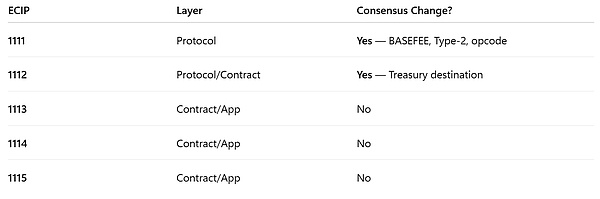
ETC Olympia Development Series Part 1: Implementing ECIP-1111 and ECIP-1112 This article introduces the first part of the Ethereum Classic Olympia development series, focusing on the implementation of ECIP-1111 and ECIP-1112. These two proposals are the only components within the broader Olympia framework that modify consensus behavior. ECIP-1111 modernizes the fee market by introducing an EIP-1559-style mechanism with a base fee and optional priority tip (miner tip). A key difference from Ethereum is that the base fee is not burned but is instead redirected to a treasury address defined by ECIP-1112. It also adds support for Type-2 transactions and the BASEFEE opcode (0x48), ensuring compatibility with modern EVM tooling and wallets. Crucially, it does not change miner rewards, monetary policy, or existing transaction types. ECIP-1112 defines an immutable, deterministic treasury smart contract that will receive the redirected base fees. This vault is designed to be receive-only upon activation, meaning it can accumulate value but cannot distribute funds until a separate, subsequent governance layer (defined in other ECIPs) is deployed and activated on the contract layer. The article emphasizes the modular architecture of Olympia. While the suite includes five ECIPs (1111-1115), only these two affect consensus. This separation ensures that the core protocol remains minimal and auditable, while future governance and funding mechanisms can evolve independently at the contract level without requiring further hard forks. The implementation is currently in the draft stage per the ECIP-1000 process. Any decision to move forward with mainnet activation will require extensive testing on the Mordor testnet and full community review.

金色财经30m ago

ETC Olympia Development Part 1: Implementing ECIP-1111 and ECIP-1112

金色财经30m ago

Trading

Spot
Futures
活动图片