Bitcoin Reclaims $94,000: A New Bull Market Beginning or a Bull Trap?

marsbitPublished on 2025-12-10Last updated on 2025-12-10

Abstract

Bitcoin has surged back to the $94,000 level, sparking debate over whether this marks the beginning of a new bull run or a short-term bullish trap. Despite the strong price performance, trading volume has not fully supported the upward move. Key resistance levels and the upcoming FOMC meeting have influenced market sentiment. After a brief period of consolidation, Bitcoin broke through $93,500, reestablishing a short-term bullish trend. Technical analysis indicates the formation of bullish patterns such as the "cup and handle" and "inverse head and shoulders," suggesting a potential rise to $104,000 if $96,000 is breached. However, failure to hold above $96,000 could trigger a pullback toward $88,000–$89,000 or even lower. Market liquidity presents mixed signals. The buy-sell ratio remains low, and retail participation—especially from South Korea—has cooled, though U.S. institutional demand appears stronger. On-chain data shows increased activity from large holders, indicating accumulation by "smart money." Macro factors include potential Fed rate cuts and supportive U.S. policy developments, such as proposed Bitcoin strategic reserves and stablecoin legislation. Bitcoin ETF approvals are also anticipated by mid-May, with traditional firms like Vanguard gradually opening access to crypto ETFs. Risks include overbought conditions, high leverage (with $120M in long liquidations possible below $87,000), and regulatory uncertainties outside the U.S. Investors should monitor t...

Last night, Bitcoin once again became the center of attention as its price strongly rebounded to the $94,000 mark. This breakthrough move has sparked widespread discussion in the market: does this mark the start of a new bull market, or is it just a brief technical rebound?

Despite the strong price performance, trading volume data did not fully support the upward trend.

Battle at Key Resistance and Market Sentiment Ahead of FOMC Meeting

After experiencing brief structural weakness on December 3rd, Bitcoin once struggled to secure a daily close above $93,000.

As the important macroeconomic event—the Federal Open Market Committee (FOMC) meeting—approached, most market participants chose to wait and see, leading to several days of sideways consolidation.

This stalemate was broken on December 5th when Bitcoin's price successfully broke through $93,500, forming the higher high needed to restore the short-term bullish trend.
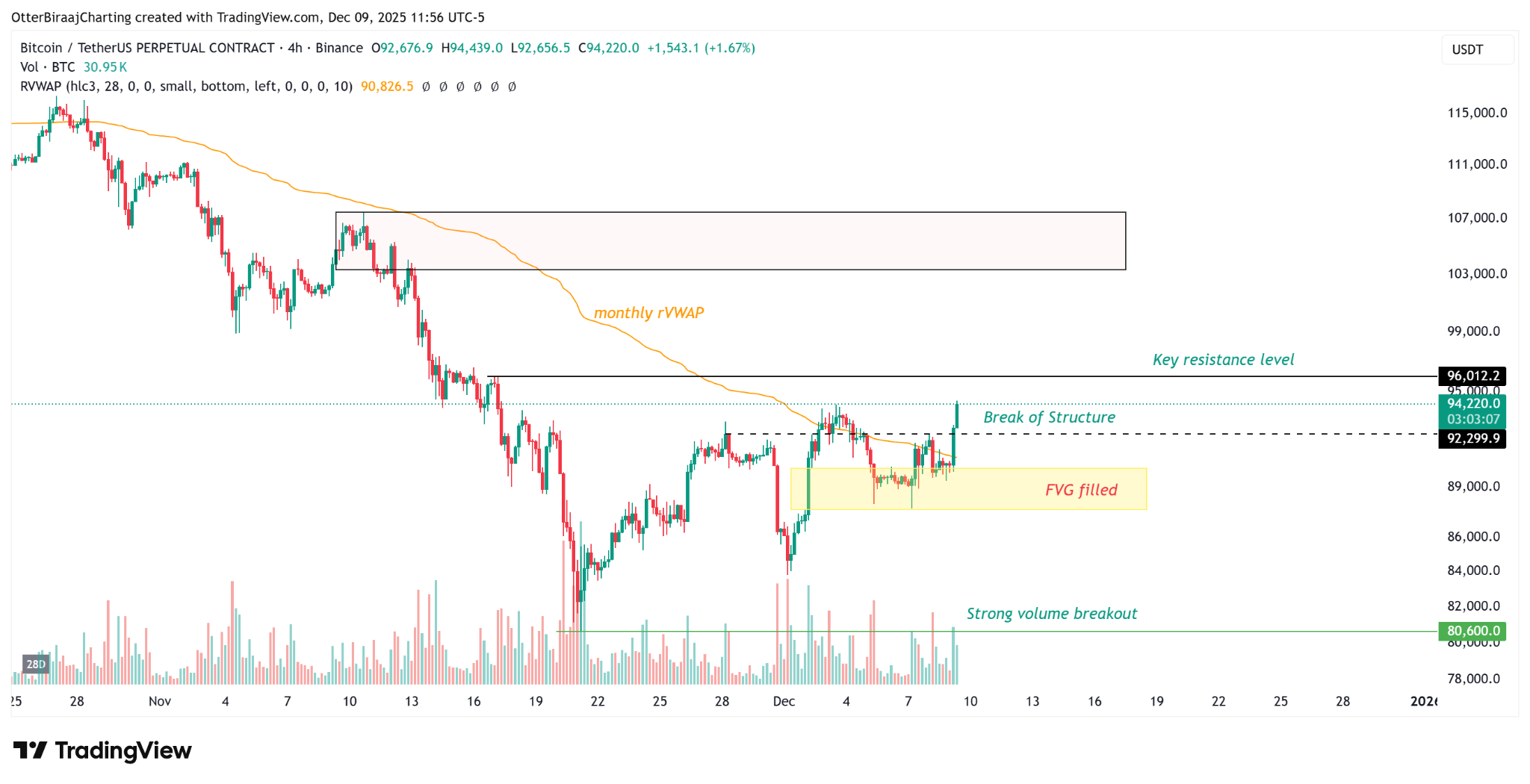
From a technical analysis perspective, on the four-hour chart, Bitcoin not only completely filled the fair value gap between $87,500 and $90,000 but also showed firm buying intent. The effectiveness of this breakthrough is particularly significant against the backdrop of potential volatility from upcoming macro events.


Technical Patterns and Key Level Analysis

Multiple bullish technical patterns have recently formed. A confirmed 'cup and handle pattern' is observed on the four-hour chart, suggesting that if Bitcoin can break above $96,000, the next target could be $104,000. Simultaneously, an 'inverse head and shoulders pattern' has also largely taken shape. These two bullish patterns together strengthen confidence among the bulls.

Market analysts generally view $94,000 as a key psychological level, coinciding with a descending trendline resistance. The criteria for judging trend sustainability are clear: if Bitcoin's daily closing price can stabilize above $96,000, it will be seen as a strong bullish reversal signal; conversely, failure at this resistance could lead to a rapid pullback to the $88,000-$89,000 range.

More broadly, the $95,000 area is seen as the 'main battlefield' between bulls and bears. A successful breakout above this area could open the door for the price to test the $99,000 to $107,000 range; whereas a failure to break through could result in a deeper correction, potentially retesting the $85,000 support, or even plunging further to $76,000 in extreme cases.


Contradictory Signals from Liquidity Conditions and Market Participation
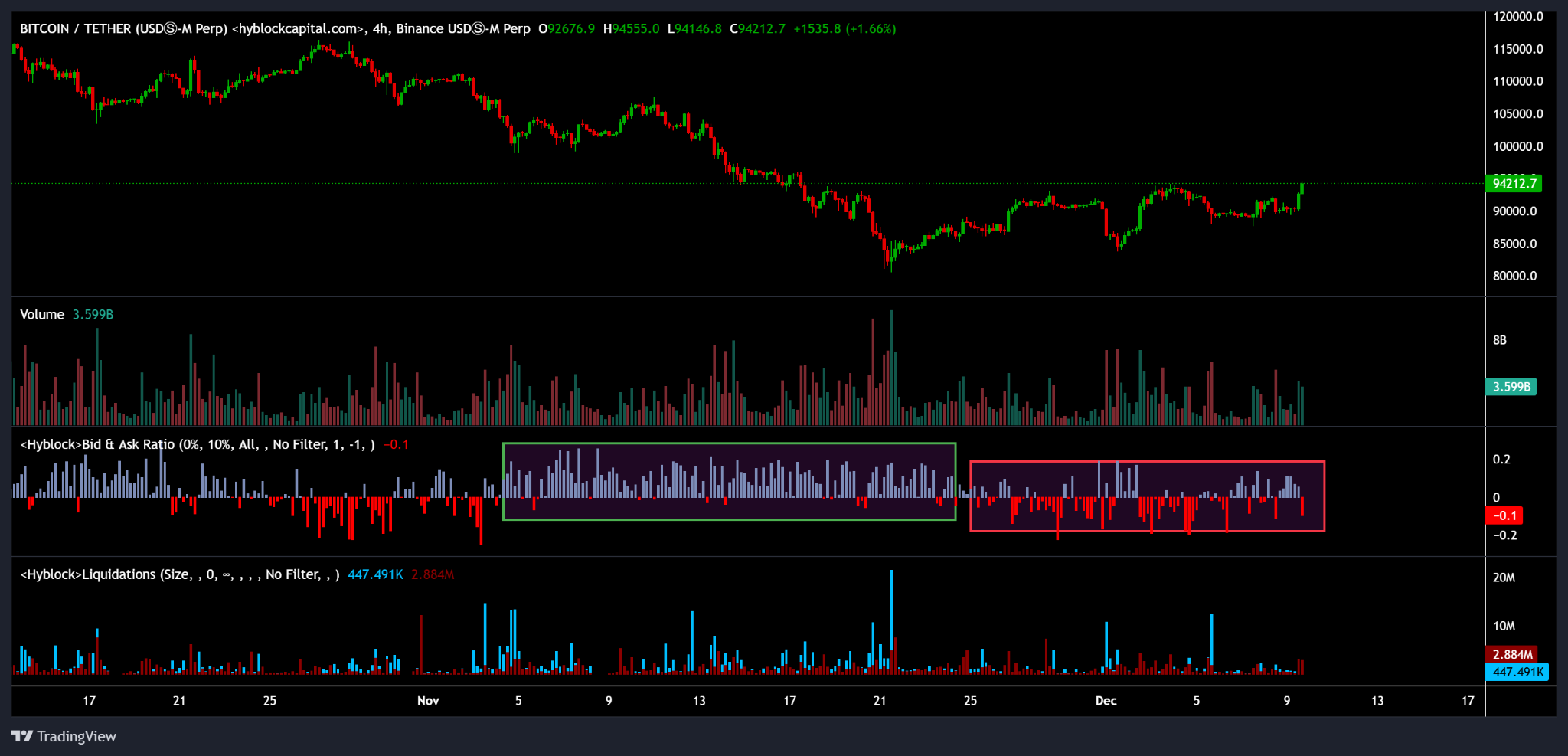
Analysis of Bitcoin's Preference-Sell Ratio and Liquidation Data. Source: Hyblock

Although the price action is encouraging, market liquidity indicators do not fully validate the upward trend. Bitcoin's buy-sell ratio remains at a relatively low and unstable level.

Unlike the aggressive buying seen during November's plunge from $100,000 to $80,000, the current rebound lacks the same intensity of buying support. This suggests that the recent rise is primarily driven by price movement rather than solid new demand. Exchange premium data also paints a complex picture.

The Kimchi Premium (a key indicator of retail sentiment in South Korea) has significantly cooled. Previously, the Korean market often traded at a premium during rallies, but this enthusiasm has now waned, approaching parity or slightly negative, indicating that retail speculators have not yet entered the market en masse.
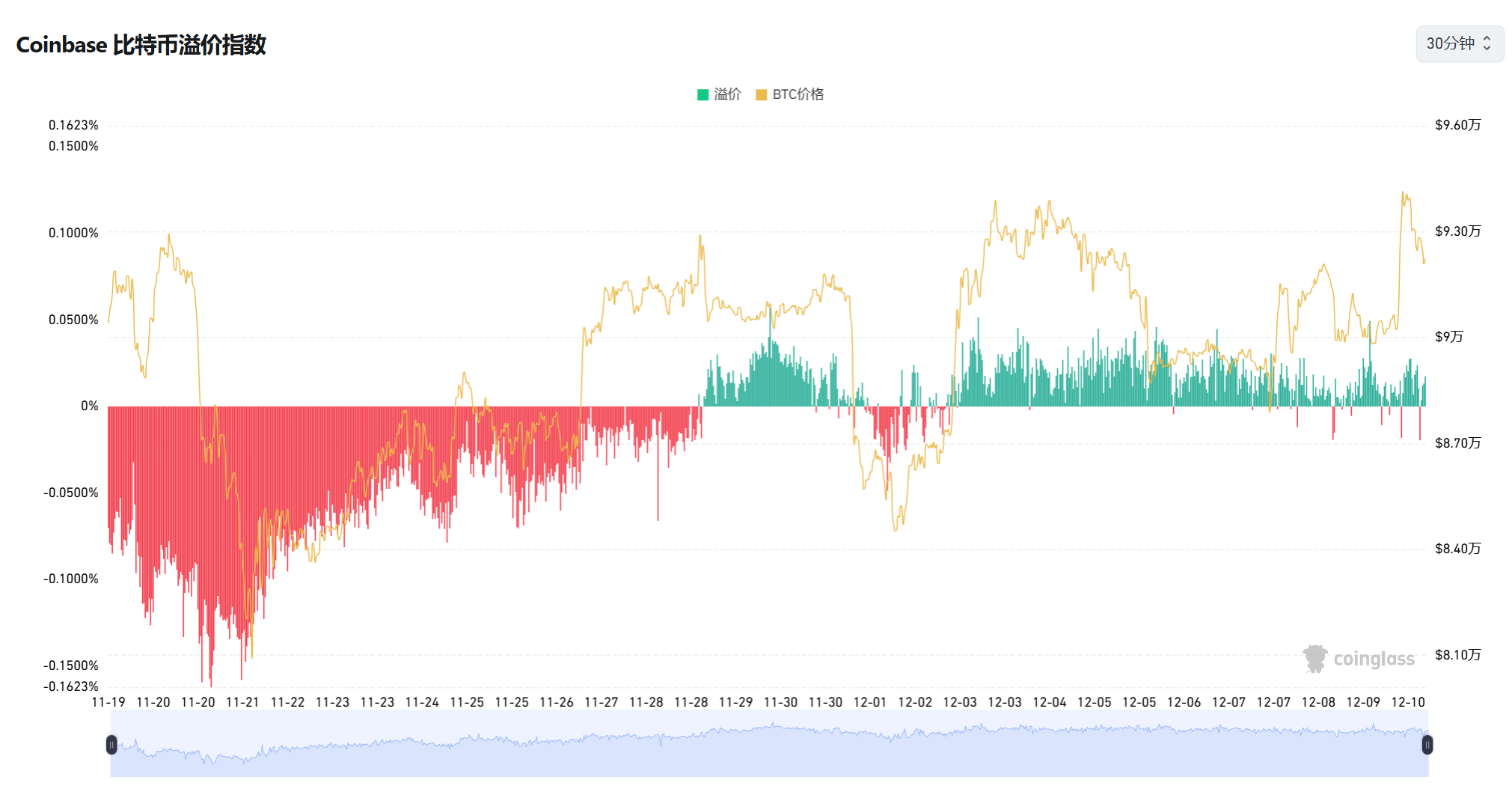
Meanwhile, the Coinbase Premium Index (representing U.S. institutional demand) has turned positive again.

Historical data shows that moderate positive readings often appear during early trend reversals and spot accumulation phases. This regional divergence makes the market outlook more complex.

On-chain data provides further insight. The number of 'whale' addresses holding at least 100 BTC has hit a new high for 2025, and large transfers have reached a three-month peak. This typically indicates that 'smart money' is building positions, rather than the market being dominated by short-term speculators. The average cost basis for short-term holders is now near $90,000, forming a psychological support level.


Macro Backdrop and Policy Catalysts

The Federal Reserve's monetary policy moves remain a key macro factor influencing Bitcoin's trajectory. Ahead of the FOMC meeting, the market widely anticipates a potential 25 basis point rate cut. Historical data shows that five out of the six FOMC meetings this year coincided with Bitcoin price pullbacks.

Furthermore, policy expectations have also become a major market driver. The Trump administration's proposed concept of a 'Bitcoin Strategic Reserve' and the advancement of U.S. stablecoin legislation have injected optimism into the market.

More crucially, the approval process for Bitcoin spot ETFs is entering its final stages, with Bloomberg analysts expecting a result by mid-May. Applications from institutions like BlackRock and Fidelity are queued awaiting approval.

Participation from traditional financial institutions is also deepening. Global asset management giant Vanguard has opened cryptocurrency ETF access to specific clients, including Bitcoin and Ethereum-related products. This widening of traditional financial channels removes another barrier for large-scale institutional capital inflows into the crypto market.


Market Risks and Potential Challenges

Despite the seemingly optimistic outlook, several risk factors cannot be ignored. From a technical indicator perspective, Bitcoin's Relative Strength Index (RSI) has entered overbought territory (>70), and the 200-day moving average around $96,216 poses strong resistance.

Leverage risk is particularly prominent. Data from Bybit and OKX shows that long positions account for 58%. If the price falls below $87,000, it could trigger a cascade of liquidations exceeding $120 million.

This high-leverage environment makes the market more prone to violent fluctuations. Regulatory uncertainty persists.

Although U.S. policy winds are warming, the EU's MiCA framework is just beginning to be implemented, and regulatory attitudes remain strict in some Asian countries. This global lack of regulatory synchronization could continue to affect market stability.


Conclusion

Bitcoin's climb back above $94,000 has undoubtedly injected new optimism into the market, but whether the bull market has truly restarted requires more evidence. The current market is at a resonance point of bullish technical signals and macro tailwinds, yet constrained by key resistance levels and liquidity concerns.

Investors should closely watch the situation around the $96,000 breakout and the Federal Reserve's policy moves, as these factors are more important than any single candlestick pattern. In an environment where volatility may intensify, position management and risk control are more crucial than chasing short-term gains.

The Bitcoin market has entered a new era of complex dynamics driven by ETF flows, leverage cycles, stablecoin liquidity, holder structure, and macro liquidity. Understanding the interrelationships of these signals will be key to navigating future markets.



Related Questions

QWhat are the two main bullish technical patterns mentioned in the article that have formed on Bitcoin's price chart?

AThe two main bullish technical patterns are a confirmed 'cup and handle pattern' and a nearly completed 'inverse head and shoulders pattern'.

QAccording to the article, what is the critical resistance level that Bitcoin needs to close above on a daily basis to signal a strong bullish reversal?

AA daily close above $96,000 is considered a strong bullish reversal signal.

QWhat contradictory signal does the market liquidity data show despite the encouraging price action?

AThe market liquidity data shows that the buy-to-sell ratio remains relatively low and unstable, indicating the recent rally is driven more by price movement than by solid new demand, unlike the aggressive buying seen during the November crash.

QWhich macroeconomic event is highlighted as a key catalyst and potential source of volatility for Bitcoin's price?

AThe Federal Open Market Committee (FOMC) meeting is highlighted as a key macroeconomic event and potential source of volatility, with markets widely anticipating a potential 25 basis point rate cut.

QWhat does the article identify as a significant risk due to the current high leverage in the market?

AA significant risk identified is the potential for a cascade of liquidations exceeding $120 million if the price were to drop below $87,000, due to the high proportion of long positions (58%) on exchanges like Bybit and OKX.

Related Reads

Farcaster Is Not a Pivot, It's Evolution: The True Ambition from Social to Wallet

Recently, Farcaster co-founder Dan Romero announced a shift in the project’s focus from "social-first" to "wallet-first," sparking widespread discussion. While some interpreted this as Farcaster abandoning social features or even signaling the failure of Web3 social networks, the move is better understood as a strategic evolution rather than a pivot. Farcaster’s integration of a built-in wallet is not a replacement for social functionality but an upgrade to improve user experience. It enables seamless on-chain interactions, especially as Frames evolve into more powerful Mini Apps. This enhancement allows users to mint NFTs, execute trades, and engage with decentralized applications without leaving the app—reducing friction and supporting richer crypto-native experiences. The shift reflects a broader trend: social apps are integrating wallets, and wallet apps are adding social features. This convergence is becoming the natural direction for consumer crypto applications. By combining social graphs with built-in wallets and Mini Apps, Farcaster enables closed-loop scenarios for asset creation, discovery, trading, and community interaction—all within a unified experience. Other platforms like Telegram, Zapper, Base App, and Binance are also exploring similar integrations, highlighting the growing importance of blending social context with financial activity. Farcaster’s open and composable social protocol allows developers to build diverse clients and applications, further expanding its ecosystem. In summary, Farcaster is not moving away from social—it is enhancing it. The integration of wallet functionality aims to drive growth, improve utility, and solidify its unique value proposition in the crypto space.

marsbit6m ago

Farcaster Is Not a Pivot, It's Evolution: The True Ambition from Social to Wallet

marsbit6m ago

Central Bank Names Bitcoin the Most Loss-Making Asset in November When Invested in Rubles

The Central Bank of Russia, in its latest "Financial Market Risks Review," identified Bitcoin as the worst-performing asset in November for ruble-denominated investments. The regulator included Bitcoin in its comparative table of asset returns, as it has done routinely. The list includes instruments from the Russian market, as well as gold, US government bonds, and other assets. In contrast to previous months, Russian stocks demonstrated the highest total returns in November. Although Bitcoin reached a new all-time high exceeding $126,000 on October 6th, this peak was not achieved against several currencies, including the euro, Swiss franc, and the Russian ruble. Against the ruble, the price remained below its December 2024 peak. According to the regulator's calculations, Bitcoin showed the worst returns in ruble terms for November (-19.9%), since the start of 2025 (-25.7%), and over the past 12 months (-31.9%). Notably, in reports prior to and including September 2025, Bitcoin was consistently among the top performers. However, since the beginning of 2022, Bitcoin remains the second-best performing asset after gold, having gained over 100% and significantly outperforming other assets. The report also provided data on Russian crypto investment activity. The volume of open positions held by individuals in cryptocurrency futures on the Moscow Exchange reached 3.5 billion rubles by the end of November. The majority of investors hold small positions, but the largest share of the volume comes from major participants. Additionally, thousands of investors have allocated funds to crypto CFAs and copy-trading strategies linked to crypto assets. Over 500 people participate in OTC crypto derivatives. The report also noted an 18% decline in the volume of transactions by Russians on foreign crypto exchanges in Q2 and Q3 2025 compared to the previous two quarters, alongside a decrease in estimated ruble balances on crypto exchanges and traffic to crypto platforms from Russia.

RBK-crypto30m ago

Central Bank Names Bitcoin the Most Loss-Making Asset in November When Invested in Rubles

RBK-crypto30m ago

Trading

Spot
Futures
活动图片