Why Do Gold Farming Studios Sustain World of Warcraft but 'Kill' All Web3 Games?

marsbitPublié le 2026-01-30Dernière mise à jour le 2026-01-30

Résumé

The article explores why gold farming studios, which thrived in games like World of Warcraft (WoW), have negatively impacted Web3 games. In WoW, gold farming did not destroy the game because in-game currency was not the ultimate value—prestige, achievements, and top-tier gear were untradeable and bound to player effort. Blizzard also managed the issue by incorporating gold buying into official systems, adding time-based constraints, and emphasizing social and cooperative elements that gold couldn’t bypass. Roblox, another successful game, avoids gold farming issues by focusing on creativity—monetizing through map creation and community engagement rather than repetitive tasks—and maintaining a closed economic system with limited cash-out options. In contrast, Web3 games often fail because they inherently link play and earn, allowing repeatable actions and free asset withdrawal. This design attracts capital and bots rather than genuine players, making it impossible to balance fun, profit, and scalability. The author argues that not everything should be financialized; some values, like memory and experience, are meant to be lived, not traded.

Written by: Lao Bai

A while ago, I tweeted about my son frantically recharging Robux in Roblox to steal other people's items, marveling at how this game is even more powerful than Genshin Impact's gacha system or Pop Mart's blind boxes—a true god of spending, which resonated with many folks. That post also had the highest traffic recently.

The next day, it suddenly occurred to me—why are there seemingly no "gold farming studios" in Roblox, despite it being such a cash-heavy game? Or even if there are, why do they have almost no impact on the game's lifecycle? Coincidentally, @j0hnwang also dug up his previous article on Roblox, mentioning this very point. I had bookmarked it before and went back to read it again.
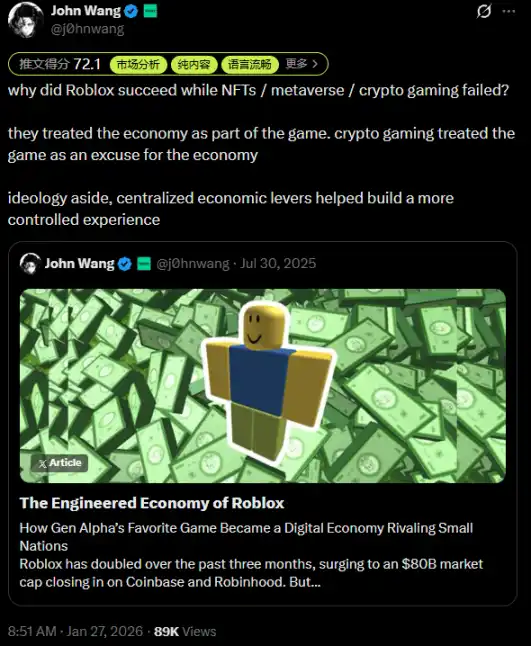
John's view is that Roblox treats the economic system as part of the game, while crypto games treat the game as a facade for the economic system. He believes that centralized economic mechanisms help build a more controllable gaming experience.

This makes sense. The lack of fun in Web3 games has been a common criticism, but the current generation of Web3 games has significantly improved in playability, and their economic mechanisms are also very centrally regulated. Yet, the outcome remains unchanged. There must be other reasons.

Then I thought about World of Warcraft and Kaito. On the day X blocked Kaito's API, I made the following comment.

Once Behavior Can Be Scaled, It Will Be Industrialized

From the "Chinese Farmers" in the Web2 era of World of Warcraft, to the scripts and gold farming studios in Web3's X2Earn, and now the inevitable "AI批量起号,多人矩阵嘴撸" (AI mass account creation, multi-account matrix farming) brought by嘴撸 (a term for farming).

So,嘴撸 wasn't ruined by clever retail players or KOLs; it was ruined by the property of "replicability." This isn't just a problem with the Kaito project; it's essentially the ultimate fate of all incentive systems.

So, what is the secret behind World of Warcraft and Roblox? Why can't studios kill them? Why did players complain about inflation and Chinese Farmers when they first appeared on the US servers, but eventually accept it as a fixed part of the game's ecosystem?

There must be something that Web3 games lack, and it's not just centralized economic mechanisms.

First, Let's Talk About World of Warcraft
1. Gold Is Not the "Endgame Value"

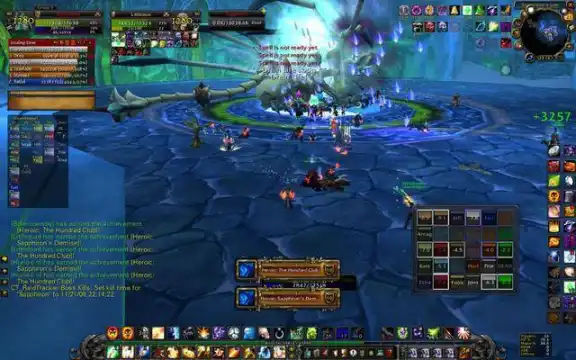
Those who have deeply played WOW should know this: in the game, gold has little to do with your status or identity. Your achievements, rankings, reputation, etc.—none of these can be directly bought with gold. When a top-tier item drops in a dungeon, you either roll for it or bid with DKP (Dragon Kill Points) based on contribution. The player who loots it also binds it immediately, so it can't be sold for cash.

So, gold can at most save you some time, but it can't turn you into a core player. Many domestic web games back then were the complete opposite—big spenders could dominate everything with RMB, similar to the current style of Web3 games.

Essentially, in World of Warcraft, all "meaningful things"—top equipment, achievements, titles, dungeon contribution, etc.—cannot be directly purchased with gold. So, although gold farming can be scaled, leading to the industrialization of the first Chinese Farmers, it始终无法主导游戏的核心体验 (could never dominate the core experience of the game). In other words, this "industrialization" was confined to the "peripheral layer" of the game.

2. The Official Approach: "Absorption, Not Confrontation"

After the emergence of gold farming studios, Blizzard made a series of moves that, in hindsight, were very clever:

  • First, official control—allowing you to buy gold with real money, but the price is regulated by the system, and there's no free financial exit, turning the underground black market into official currency exchange;
  • Second, adding various barriers—such as daily and weekly quests, various cooldown locks... No matter how many accounts or high levels you have, you still have to wait patiently, diluting the advantage of industrialization;
  • Third, adding more "meaningful things" that cannot be bought with gold, like guilds, raids, social reputation... This led to the later emergence of gold runs and GKP (Gold Kill Points), but various dungeon first kills were always achieved by top guilds, never by gold runs. So, gold farming in World of Warcraft always remained a "second-class citizen."

As for Roblox, the Logic Is Slightly Different
1. Encouraging Creativity Over Repetitive Labor

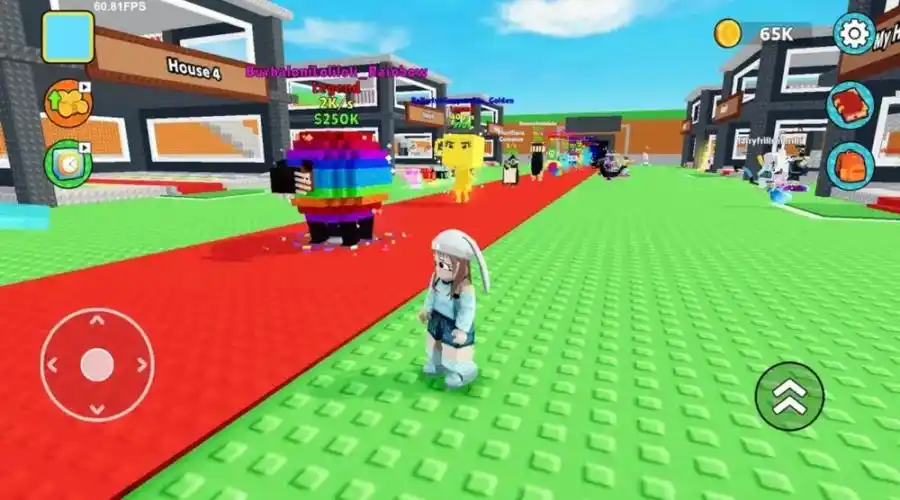
If you read the article I referenced in my previous post about Roblox, you'll know that the most profitable activities in Roblox are not repetitive tasks like farming resources, which offer little profit.

The real money is in creating maps, designing gameplay, and operating communities.

These are difficult for studios to scale and replicate. No matter how many resources you farm, you can't farm a gameplay that appeals to kids (though with AI now, this might also become "mass-producible").

2. Closed-Loop Internal Economic System, Restricted Asset Exchange

This is somewhat similar to John's idea. It's quick to buy Robux with a credit card, but converting Robux back to cash isn't as smooth—there are barriers, delays, and exchange rate losses, so arbitrage and搬砖 (a term for grinding/farming for profit) tactics don't work well here.

Moreover, most of the money in Roblox flows to platform fees, the top creators mentioned above, and in-game consumption, forming a closed-loop economic system with little overflow.

Of course, whether it's World of Warcraft or Roblox, being fun and having a large player base are the most important foundations, which is undeniable.

So, What Is the Real Reason Behind the Collective Demise of Web3 Games?

Thinking back, aside from the fun factor, perhaps the initial design intention of链游 (chain games/Web3 games) destined today's outcome.

Almost all链游 allow for "repeatable behavior" + "freely withdrawable assets."

In an era where Web2 gaming systems are already mature, this inevitably turns the final players of链游 into capital + scripts, not humans.

In other words, as long as Play and Earn are linked, this will always be the result.

Whether it's Play 2 Earn, the later improved Move 2 Earn, or Play & Earn, they are all different in name but not in essence.

This is somewhat like an impossible triangle for games. Among being fun, allowing speculators to make money, and enabling studios to scale, you can achieve at most two.
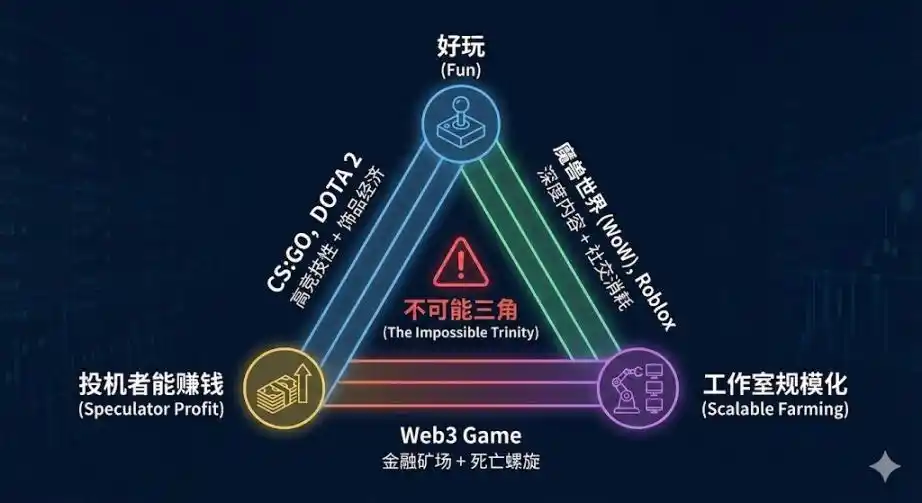
From this perspective, the problem with Web3 games isn't team quality or funding scale; it's that, at the most fundamental genetic level, they cannot be "fun."

Would Putting World of Warcraft on-Chain Work? Would It Be Meaningful?

I remember during the peak of链游 hype, we often fantasized about a scenario: what if World of Warcraft went on-chain?

Not the entire game, but putting WOW's economic system on-chain, including gold, items, mounts, etc., making them freely tradable, freely withdrawable, and financializable.

Now, thinking back, we were very naive. Doing this would注定会被系统毁掉 (destined to be destroyed by the system).

The underlying axioms of World of Warcraft's success:

  • Meaning cannot be traded—The most valuable things, top equipment, achievements, titles... are almost all bound, untradeable, non-transferable. These things signify what you have done, not what you own;
  • Progress does not equal wealth—Your time investment, operational skills, and team collaboration are your foundation. Gold can at most make you more comfortable; it cannot allow you to跨越阶级 (transcend classes);
  • Players are not asset owners but role-players—This equipment was obtained by me through effort / exchanged with DKP, this Boss was a world first kill by our guild, this character is my心血 (labor of love) trained over 10 years... Once this becomes "something I bought, an investment," this character emotionally bound to you downgrades into a skin for an asset account.

If we must talk about going on-chain, the things in World of Warcraft truly worth putting on-chain are these—for example, proof of a Boss's first kill, guild history, timestamps of your achievements, records of witnessing world events... What goes on-chain is not assets and value, but memories and traces.

The greatness of World of Warcraft lies precisely in the fact that its most important things can never be sold.

From this perspective, "链游必须死" (Chain games must die).

And it's not just链游. We once treated blockchain as a hammer, seeing everything as a nail to be struck. Little did we know that too many things in this world根本不需要被「金融化」 (simply do not need to be "financialized"). Their reason for existence is to be experienced, remembered, and told.


Questions liées

QWhy did gold farming studios not destroy World of Warcraft (WoW) like they did with Web3 games?

AIn WoW, gold is not the ultimate value; meaningful elements like top-tier equipment, achievements, and reputation cannot be directly bought with gold. The official response involved absorbing and regulating the economy rather than outright对抗, implementing systems like official currency exchange, time-gated content, and non-tradable prestigious items. This kept gold farming activity on the periphery without dominating the core game experience.

QHow does Roblox prevent gold farming studios from harming its ecosystem?

ARoblox encourages creative activities like map design and community management, which are hard to scale industrially, rather than repetitive resource grinding. Its economy is a closed loop with friction and delays for cashing out Robux, making arbitrage difficult. The platform's focus on creativity and internal consumption, combined with financial barriers to withdrawal, limits the impact of farming.

QWhat is the fundamental reason Web3 games fail according to the article?

AWeb3 games inherently link play and earn, allowing repeatable actions and freely withdrawable assets. This design inevitably attracts capital and bots rather than genuine players, making it impossible for the games to be truly fun. The 'impossible triangle' suggests that a game cannot simultaneously achieve being fun, allowing speculators to profit, and enabling studio scalability—Web3 games prioritize the latter two at the expense of enjoyment.

QWhat would happen if World of Warcraft's economy were fully put on-chain?

AFully on-chaining WoW's economy would destroy it because the game's success relies on non-tradable elements like bound items, achievements, and player identity rooted in effort and memory, not financial ownership. On-chaining would reduce characters to asset accounts, stripping away the emotional attachment and meaning that comes from earned progress and shared experiences.

QWhat does the article suggest is worth putting on-chain from games like WoW?

AThe article suggests that instead of assets and value, meaningful elements like proof of first kills, guild history, achievement timestamps, and records of world events should be put on-chain. These represent memories and traces of player experiences, which align with the emotional and narrative value of the game, rather than promoting financialization.

Lectures associées

Les CPU retrouvent leur place à la table : le coup d'envoi d'un spectacle « d'accession au pouvoir » de 170 milliards de dollars

La scène des processeurs (CPU) pour serveurs connaît une transformation majeure, catalysée par l'ère de l'IA Agent (agente). Alors que le GPU était au cœur de l'entraînement des grands modèles, le passage à la phase d'inférence et aux tâches d'Agent complexes (appels d'outils, raisonnements multi-étapes) renverse la donne : le CPU assume désormais 70% à plus de 90% de la charge de travail. Ce changement se traduit par un besoin accru de cœurs, de mémoire et de performances de gestion des données intermédiaires (comme le KV Cache), dépassant souvent la capacité mémoire limitée des GPU. Cette nouvelle dynamique modifie radicalement le ratio CPU/GPU dans les serveurs IA, passant d'environ 1:8 pour l'entraînement à 1:4 pour l'inférence, et approchant même 1:1 pour les scénarios Agent. Cette demande explosive, qualifiée de "variable la plus inattendue du cycle actuel de l'IA", entraîne une pression sur l'offre et une hausse des prix de 10% à 15% pour les CPU serveurs, du jamais-vu depuis plus de dix ans. Les acteurs historiques (Intel, AMD) et nouveaux (NVIDIA avec sa puce ARM Vera) se positionnent sur ce marché dont la taille potentielle est réévaluée à la hausse, pouvant atteindre 1700 milliards de dollars d'ici 2030 selon certaines analyses. Cette croissance provient non seulement des CPU d'accompagnement des GPU en cluster, mais aussi d'un nouveau segment : les nœuds CPU indépendants dédiés à l'exécution des Agents. En Chine, cette tendance mondiale coïncide avec les impératifs du "Xin Chuang" (remplacement des imports), offrant une opportunité aux fabricants locaux de CPU (comme Hygon, Huawei Kunpeng) et aux entreprises de la chaîne d'approvisionnement (emballage/test, puces d'interface mémoire). La maturité accélérée des outils logiciels pour les puces domestiques est un signe positif pour l'écosystème. L'enjeu n'est plus la performance brute d'une puce unique, mais la capacité de synergie entre CPU et GPU pour l'IA à grande échelle.

marsbitIl y a 1 h

Les CPU retrouvent leur place à la table : le coup d'envoi d'un spectacle « d'accession au pouvoir » de 170 milliards de dollars

marsbitIl y a 1 h

TechFlow Intelligence : Le Directeur AI d'AMD critique publiquement Claude Code pour être "devenu plus bête et plus paresseux", Trump affirme qu'un cessez-le-feu général aura lieu dans le détroit d'Ormuz mais que 80 mines y restent

Selon un rapport exclusif de Wired, SK Telecom, partenaire stratégique d'Anthropic, fait l'objet d'un examen des contrôles à l'exportation américains concernant le transfert technologique potentiel du modèle Mythos. Par ailleurs, Z.AI a lancé le modèle GLM-5.2, rivalisant avec Claude Opus et n'utilisant aucun puce Nvidia, illustrant une voie chinoise en matière de puissance de calcul. Dans le secteur des semi-conducteurs, Amazon envisage de commercialiser ses puces AI maison, tandis que des allégations américaines sur des équipements ASML avancés en Chine sont contestées par l'entreprise. Du côté de la sécurité, GitHub a vu plus de 10 000 dépôts distribuer des logiciels malveillants, et Apple a corrigé une faille critique d'écoute sur les Beats Studio Buds. Sur les marchés, les actions semi-conducteurs ont bondi, notamment Intel (+10.6%). Sur le plan géopolitique, bien qu'un accord ait été annoncé concernant le détroit d'Hormuz, l'association Intertanko signale qu'environ 80 mines y restent actives, retardant le transit de pétroliers chargés de 80 millions de barils. L'Iran a reporté un déplacement diplomatique en Suisse, et l'ancien président Trump a qualifié l'accord avec l'Iran de "reddition inconditionnelle". En résumé, tandis que les tensions géopolitiques laissent persister des incertitudes opérationnelles, les avancées et restructurations technologiques, notamment dans les puces et l'IA, se poursuivent à un rythme soutenu.

marsbitIl y a 2 h

TechFlow Intelligence : Le Directeur AI d'AMD critique publiquement Claude Code pour être "devenu plus bête et plus paresseux", Trump affirme qu'un cessez-le-feu général aura lieu dans le détroit d'Ormuz mais que 80 mines y restent

marsbitIl y a 2 h

La Corée du Sud se prépare à réguler les transferts cryptographiques transfrontaliers dans le cadre d'un nouveau système

La Corée du Sud prévoit d'inclure les entreprises de fintech dans son nouveau cadre d'autorisation pour les transferts d'actifs virtuels, qui doit entrer en vigueur en décembre. Cette décision suit l'introduction d'une période de grâce de six mois dans l'amendement de la loi sur les transactions de change. À partir de décembre, les entreprises effectuant des transferts transfrontaliers via des actifs virtuels devront s'enregistrer auprès du ministère de l'Économie et des Finances et déclarer leurs transactions via le système de déclaration des changes coréen. Ce cadre réglementaire vise à placer ces transferts sous surveillance officielle, les autorités ayant constaté que de nombreux transferts d'actifs numériques échappaient au contrôle des changes, présentant des risques de blanchiment d'argent et d'activités criminelles. Initialement, les règles s'appliquaient principalement aux plateformes d'échange de cryptomonnaies. Cependant, les régulateurs sud-coréens envisagent désormais d'élargir le champ des entités éligibles pour inclure des acteurs non traditionnels, comme les fintechs, si elles peuvent effectuer ces transferts de manière efficace. Le ministère et la Banque de Corée collaborent avec les acteurs du secteur pour finaliser les règles d'application avant le lancement en décembre. Cette initiative s'inscrit dans un contexte plus large de renforcement de la supervision des actifs numériques par la Corée du Sud, qui travaille également sur une réglementation pour les produits financiers tokenisés.

TheNewsCryptoIl y a 3 h

La Corée du Sud se prépare à réguler les transferts cryptographiques transfrontaliers dans le cadre d'un nouveau système

TheNewsCryptoIl y a 3 h

Trading

Spot
Futures
活动图片