Wall Street Plunged into 'AI Phobia': An Indiscriminate Sell-off Is Spreading

marsbitPublié le 2026-02-11Dernière mise à jour le 2026-02-11

Résumé

Wall Street is experiencing a widespread "AI panic," triggering indiscriminate sell-offs across sectors perceived as vulnerable to AI disruption. The fear intensified recently when a tax-strategy tool from startup Altruist Corp. caused sharp declines in shares of major wealth managers like Charles Schwab, Raymond James, and LPL Financial. This reflects a broader market shift from focusing on AI winners to hastily dumping stocks of companies—from small software firms to large financial services—deemed at risk of being replaced by AI-driven products. Similar sell-offs occurred earlier in software, insurance, and asset management after AI companies like Anthropic and Insurify launched new tools. While some investors see this as an overreaction, citing the slow pace of technological adoption historically, others warn that AI’s rapid advancement is fueling legitimate anxiety. High market valuations have made stocks particularly sensitive to any negative signals, amplifying the volatility. The key uncertainty remains how quickly and deeply AI will reshape industries, leaving the market in a state of cautious speculation.

Source: Jinshi Data

On Wall Street, growing fears about artificial intelligence are hammering the stocks of companies that could become its targets of disruption, from small software firms to large wealth management companies, none have been spared.

The latest round of selling erupted on Tuesday when a tax strategy tool launched by a little-known startup, Altruist Corp., caused shares of Charles Schwab Corp., Raymond James Financial Inc., and LPL Financial Holdings Inc. to fall by 7% or more.

This marked the steepest decline for some of these stocks since the market crash triggered by the trade war last April. But it is just the latest example of the "sell first, ask questions later" mentality—a mindset that is rapidly taking hold as the hundreds of billions of dollars poured into AI begin to translate into commercial products, sparking anxiety that AI could disrupt entire industries.

"Companies with any potential disruption risk are being sold off indiscriminately," said John Belton, a fund manager at Gabelli Funds.

Over the past few years, advancements in AI technology have been at the forefront of Wall Street, with tech stocks leading the gains. As this rally pushed stock prices to record highs, questions have persisted about whether this is a bubble about to burst or whether it will trigger a productivity boom that reshapes the American corporate landscape.

But since the beginning of last week, a series of AI product launches has triggered a noticeable market shift. Instead of focusing on picking winners, investors are quickly trying to avoid holding any company facing even the slightest risk of being replaced.

"I don't know what's going to happen next," said Will Rhind, CEO of Graniteshares Advisors.

"Last year's story was that we all believed in AI—but we were looking for applications, and as we keep discovering applications that seem increasingly powerful and persuasive, it is now leading to disruption."

For some time, the software industry has been troubled by concerns about AI. Last week, when a new tool from Anthropic PBC triggered sharp declines in stocks across industries such as software, financial services, asset management, and legal services, these worries began to shift more broadly to other sectors.

The same fears hit U.S. insurance broker stocks hard on Monday after the online insurance marketplace Insurify launched a new app using ChatGPT to compare auto insurance rates. On Tuesday, wealth management stocks became the next victim, as the product Hazel launched by Altruist—which helps financial advisors create personalized strategies for clients—dragged these stocks down.
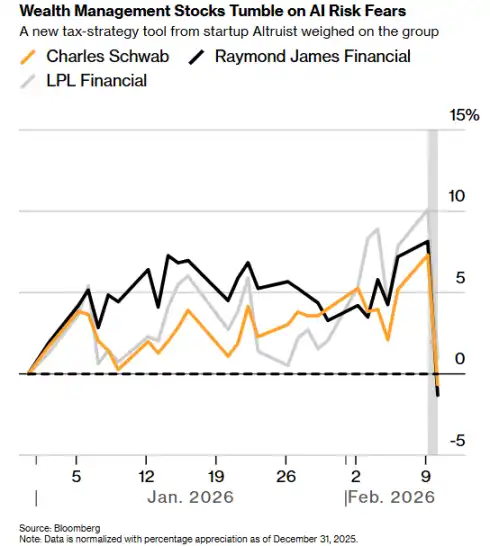
Wealth management stocks plunge on AI risk concerns

Altruist CEO Jason Wenk said he himself was surprised by the scale of the stock market reaction, which wiped tens of billions of dollars from the market value of several investment firms. But he said it sends a strong signal about the competitive threat his company poses.

"People are beginning to realize—the architecture we used to build Hazel, it can replace any job in wealth management," he said in an interview. "Usually these jobs are done by entire teams. And now, AI can effectively do these jobs for just $100 a month."

AI companies like OpenAI and Anthropic have already made solid progress in the field of software engineering with products that help developers simplify and debug code processes, and are now entering other industries.

However, many questions remain about how this technology will be adopted. Take banking, for example, which has periodically faced challenges from electronic services and other technologies, but these have ultimately failed to undermine its dominance.

Gabelli fund manager Belton is one of the skeptics about how Wall Street has shifted from worrying about an AI bubble to fearing its imminent disruption of large parts of the economy.

"There will be winners and losers in every industry," Belton said. But he added: "A rule of thumb is that technological disruption often takes longer to materialize than expected."

This pullback may also reflect widespread anxiety about the sharp rise in stock prices over the past few years, driven by the AI spending boom and an unusually resilient U.S. economy. This has already pushed valuations too high and made investors more sensitive to concerns about a reversal.

"As long as they emit a signal that the market perceives as somewhat negative, the stock will fall 10%, which would never happen in a market that hasn't reached current trading levels," said Graniteshares' Rhind.

For Ross Gerber, CEO of Gerber Kawasaki, the anxiety about AI losers that has been hitting parts of the market over the past week is premature. He said it is still too early to say exactly what the impact will be.

"We can try to extrapolate how AI will change the world in five years, but we just don't know," he said. "The market is trying to judge this while we are still at the beginning of this infancy."


Questions liées

QWhat is the main reason behind the recent sell-off in Wall Street stocks, particularly affecting companies like Charles Schwab and Raymond James?

AThe sell-off is primarily driven by growing fears that new AI products, such as Altruist Corp's tax strategy tool Hazel, could disrupt traditional business models in industries like wealth management, leading investors to indiscriminately dump stocks perceived as vulnerable to AI-driven disruption.

QHow did the launch of Altruist Corp's Hazel tool impact the stock prices of major financial firms?

AThe launch of Hazel caused significant stock price declines, with companies like Charles Schwab Corp., Raymond James Financial Inc., and LPL Financial Holdings Inc. falling by 7% or more, marking some of their worst drops since the market crash triggered by the trade war in April of last year.

QWhat shift in investor behavior is observed as AI products become commercially available?

AInvestors have shifted from focusing on picking AI winners to rapidly avoiding any companies that face even the slightest risk of being disrupted by AI, adopting a 'sell first, ask questions later' mentality.

QAccording to Jason Wenk, CEO of Altruist, why is AI seen as a threat to the wealth management industry?

AJason Wenk stated that AI tools like Hazel, built with advanced architectures, can replace various jobs in wealth management that are typically done by entire teams, performing these tasks effectively for as low as $100 per month.

QWhat skepticism do some experts, like John Belton of Gabelli Funds, express about the current AI-driven market disruption fears?

AJohn Belton expresses skepticism, noting that technological disruption often takes longer to materialize than expected, and while there will be winners and losers in every industry, the current panic may be premature given the early stage of AI adoption.

Lectures associées

Les récits des actions technologiques dépendent de plus en plus d'Anthropic

Le récit des actions technologiques dépend de plus en plus d'Anthropic. La société est devenue le centre d'un puissant écosystème comprenant Google, Amazon et SpaceX (Elon Musk). Cet axe, baptisé « A », s'oppose à l'alliance « O » d'OpenAI, Microsoft et SoftBank, marquant une division profonde dans le secteur de l'IA. L'importance d'Anthropic réside dans sa capacité à générer des revenus et à structurer les récits financiers. Malgré un nombre d'utilisateurs actifs inférieur à celui d'OpenAI, son revenu par utilisateur est bien plus élevé. Ses engagements de commandes de calcul massifs (centaines de milliards de dollars) avec Google et Amazon, ainsi que le nouveau contrat de location avec SpaceXAI, en font un « nœud financier systémique ». Les bénéfices trimestriels de Google et Amazon sont fortement influencés par les réévaluations de sa participation dans Anthropic. En revanche, OpenAI, bien que pionnier, voit sa part de marché et ses revenus relatifs diminuer face à la montée d'Anthropic et des modèles open source comme DeepSeek-V4. La pression pour se monétiser s'intensifie, comme le montre l'introduction de publicités dans ChatGPT. L'alliance « O » montre des signes de faiblesse, avec la fin de l'exclusivité entre Microsoft et OpenAI. Le marché est en train de passer d'un récit axé sur la puissance de calcul (symbolisée par Nvidia) à un récit axé sur l'application commerciale rentable, où Anthropic excelle. Cependant, cette concentration du capital et des espoirs sur une seule entreprise crée un risque systémique. La performance continue des modèles d'Anthropic est essentielle pour soutenir les valorisations de ses puissants alliés. La menace des modèles open source performants, comme DeepSeek, plane comme une épée de Damoclès sur ce modèle économique fermé, ce qui pourrait entraîner des mesures géopolitiques pour les contenir.

marsbitIl y a 11 mins

Les récits des actions technologiques dépendent de plus en plus d'Anthropic

marsbitIl y a 11 mins

Michael Saylor : J'ai bien dit que je vendrais du Bitcoin, mais c'est pour en acheter plus

Michael Saylor, président exécutif de MicroStrategy, clarifie sa récente déclaration sur la vente potentielle de bitcoin. Lors d'un appel sur les résultats, la société a mentionné qu'elle pourrait vendre du bitcoin pour payer les dividendes de son instrument de crédit numérique STRC, ce qui a suscité des débats. Saylor explique que l'objectif n'est pas d'être un vendeur net de bitcoin. Au contraire, MicroStrategy utilise le bitcoin comme "capital numérique" à haute appréciation (environ 40% par an) pour créer des outils de crédit comme le STRC. En émettant du STRC, la société lève des fonds pour acheter davantage de bitcoin. Les dividendes sont payés en capitalisant sur les plus-values du bitcoin. Par exemple, après avoir levé 3,2 milliards de dollars via le STRC en avril, le dividende à payer n'était que de 80-90 millions de dollars, ce qui signifie un achat net massif de bitcoin. Il souligne que le "taux d'équilibre" est d'environ 2,3%. Tant que la dette émise via le STRC reste inférieure à ce pourcentage des réserves de bitcoin et que le bitcoin s'apprécie d'au moins 2,3% par an, la société peut payer les dividendes tout en restant un acheteur net accumulant constamment du bitcoin. Saylor réitère sa philosophie : "Ne soyez jamais un vendeur net de bitcoin. À la fin de chaque année, vous devriez avoir plus de bitcoin qu'au début." Il présente le STRC comme un produit de crédit performant (ratio de Sharpe de 3, rendement de 11-12%), adossé à du bitcoin surcollatéralisé. Cette innovation démontre, selon lui, que l'application phare du bitcoin est de servir de collatéral pour le crédit numérique, un marché en pleine expansion. MicroStrategy est devenu le plus grand émetteur de crédit prioritaire aux États-Unis cette année. Concernant l'impact sur le prix du bitcoin, Saylor estime que le marché est trop liquide (des centaines de milliards de dollars échangés quotidiennement) pour qu'aucun acteur, même MicroStrategy, ne puisse le manipuler. Les principaux moteurs sont les facteurs macroéconomiques et géopolitiques. Il conclut que le bitcoin continuera sa progression ("grind up") grâce à l'adoption continue, les flux de capital et l'innovation du crédit numérique, les conditions macro influençant principalement le rythme de cette hausse.

marsbitIl y a 49 mins

Michael Saylor : J'ai bien dit que je vendrais du Bitcoin, mais c'est pour en acheter plus

marsbitIl y a 49 mins

De la survie à l'accélération : Le fondateur de ZODL retrace le parcours de Zcash vers le succès en trois ans

**Auteur : Josh Swihart, fondateur du ZODL** **Traduction : Felix, PANews** Il y a trois ans, Zcash, pionnier de la confidentialité, était aux prises avec des problèmes de gouvernance et une croissance stagnante. Aujourd'hui, le prix du ZEC a augmenté d'environ 1500% cette année, et 31% de l'offre (plus de 3 milliards de dollars) est détenue dans des portefeuilles anonymes contrôlés par les utilisateurs. Cette transformation repose sur quatre libérations clés : 1. **Libération de la gouvernance :** La suppression du modèle de financement direct et de l'accord de marque a mis fin au contrôle de facto de deux entités, redonnant le pouvoir aux détenteurs de ZEC et à la communauté. 2. **Libération du produit :** Le passage d'une focalisation sur la recherche cryptographique au développement centré sur l'utilisateur a donné naissance au portefeuille Zodl (anciennement Zashi), facilitant l'adoption de la confidentialité et contribuant à la forte croissance du pool anonyme. 3. **Libération du récit :** L'évolution de l'image de "monnaie de confidentialité" à celle de "monnaie privée" (avec la trilogie protocole/actif/portail) a élargi l'attrait institutionnel, ouvrant la voie à de nouveaux partenariats et supports. 4. **Libération organisationnelle :** La transition de l'équipe centrale vers ZODL, soutenue par un financement de 25 millions de dollars, a permis une structure plus agile et orientée vers la croissance. Les indicateurs actuels sont positifs : sentiment largement favorable, discussions en ligne en forte hausse, et l'activité de la communauté s'est déplacée vers le développement produit. Les priorités futures incluent l'amélioration de l'expérience utilisateur (Zodl), l'extensibilité (via le projet Tachyon) et les préparatifs pour l'ère post-quantique, visant à rendre Zcash plus rapide, plus facile à utiliser et plus sécurisé.

marsbitIl y a 1 h

De la survie à l'accélération : Le fondateur de ZODL retrace le parcours de Zcash vers le succès en trois ans

marsbitIl y a 1 h

Trading

Spot
Futures
活动图片




