Author: Xiaohui, A Fintech Goose
While we see slow growth in the domestic credit market, with major lending platforms and consumer finance companies tightening strategies and adopting cautious volume control, the overseas credit track stands in stark contrast, experiencing a period of rapid expansion.
Southeast Asia and Latin America markets are particularly active, which are also the primary choices for Chinese fintech companies expanding overseas.
Over the past two years, "A Fintech Goose" has been consistently following two highly representative companies in Southeast Asia and Latin America:
1 Shopee's parent company Sea's Monee;
2 Mercado Libre's Mercado Pago fintech division.
Judging from the Q1 financial report data this year, the credit businesses of both companies continue to grow steadily, bringing more momentum to their respective group revenues.
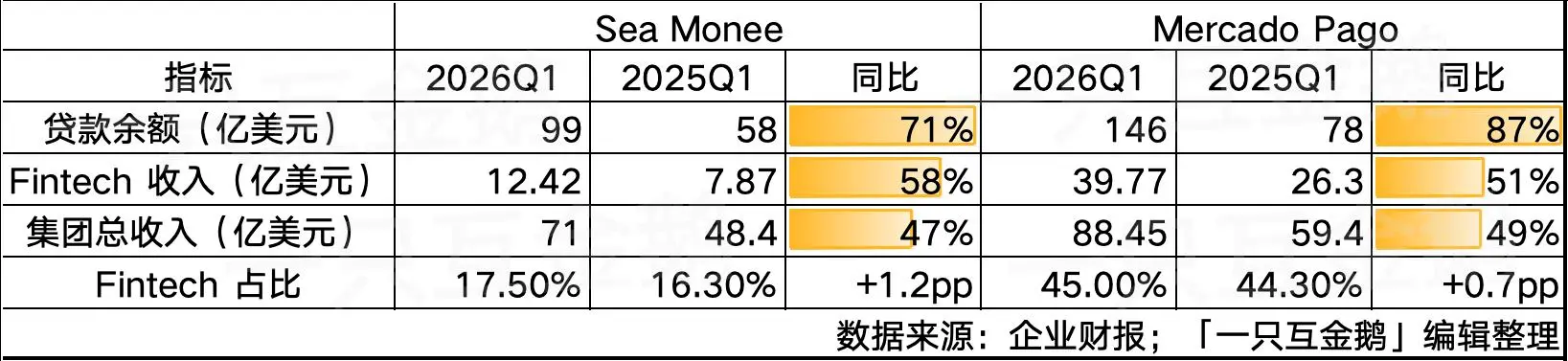
As of the end of Q1 2026:
-
Monee's loan balance reached $9.9 billion (approximately RMB 67 billion), up 71% year-on-year;
-
Mercado Pago's loan balance reached $14.6 billion (approximately RMB 98.7 billion), up 87% year-on-year.
For Q1 2026:
-
Monee's revenue reached $1.242 billion (approximately RMB 8.4 billion), accounting for 17.5% of Sea's total group revenue, up from 16.3% in Q1 2025;
-
Mercado Pago's revenue reached $3.977 billion (approximately RMB 26.9 billion), accounting for 45% of Mercado Libre's total group revenue, up from 44.3% in Q1 2025.
The development logic of "E-commerce + Fintech" for these two companies is not unfamiliar to us. Chinese giants like Ant, JD, and ByteDance all grew by following this path.
However, their differentiated approaches implemented in Southeast Asia and Latin America are also highly valuable as references for domestic fintech and internet giants expanding overseas.
Below, "A Fintech Goose" reviews the key data and development highlights for both giants in Q1 2026.
01 Sea's Monee: Obtained Financial Credit License in Brazil in Q1
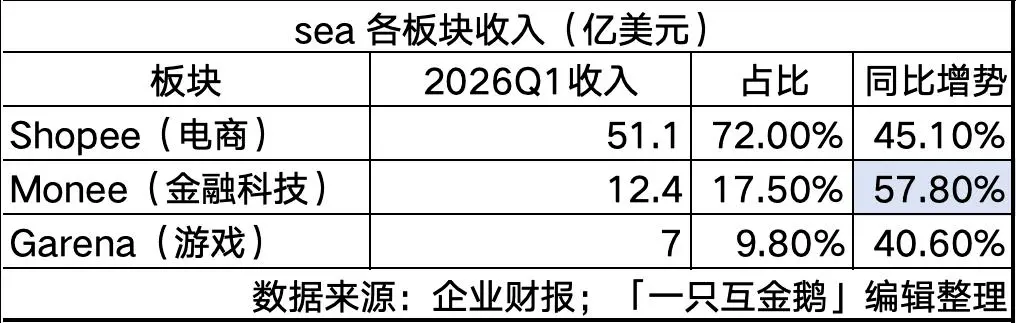
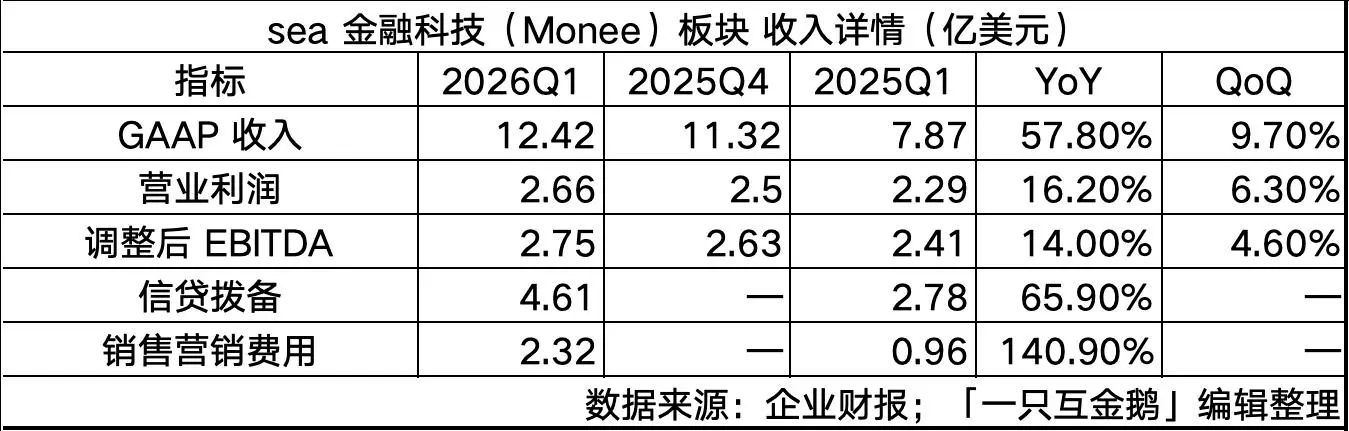
From the data, the fintech segment, i.e., Monee, significantly outperformed in revenue growth (+57.8% YoY) compared to the e-commerce segment Shopee (+45.1%) and the gaming segment Garena (+40.6%).
It's evident that the revenue contribution of the fintech segment Monee within the entire Sea group continues to increase.
Specific data for the fintech segment:
(1) Loan Balance
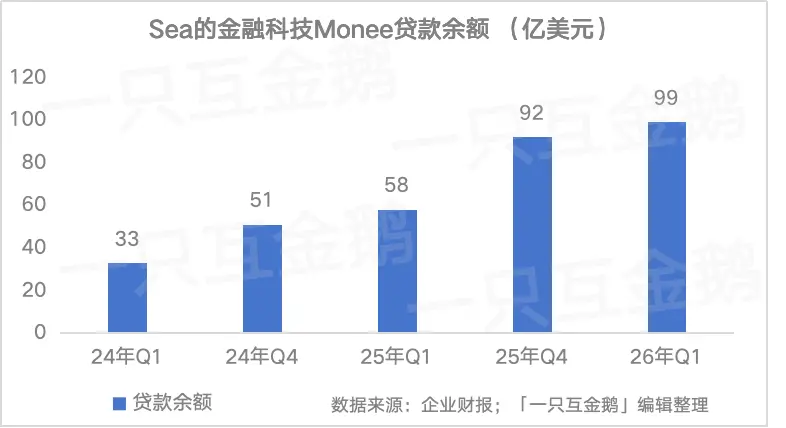
Each quarter, the loan balance maintains high double-digit growth.
During the investor call, management mentioned that Q1 is typically a consumption off-season, but this year Q1, Sea Monee's loan balance still achieved a sequential growth of +7.5%.
(2) Risk Performance:
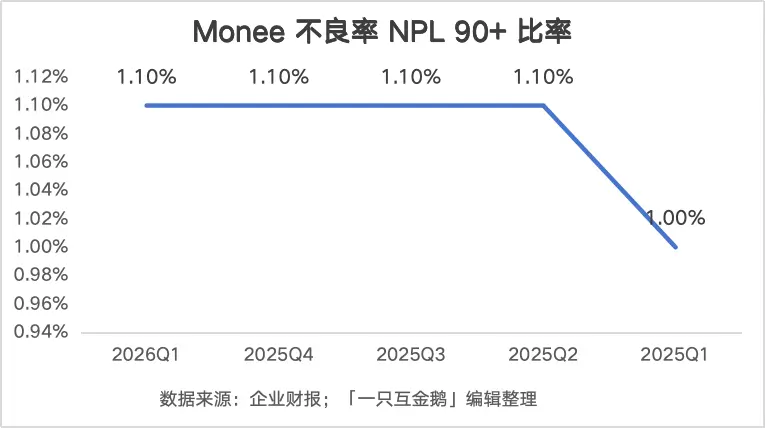
While the loan portfolio grew 71% within a year, the 90+ day NPL ratio only slightly increased from 1.0% to 1.1%, remaining stable at 1.1% for four consecutive quarters.
The stable NPL ratio indicates, to some extent, that their risk model has withstood the test of rapid credit expansion.
Important note on NPL ratio calculation: The denominator for the NPL 90+ ratio includes total loan principal from both "on-book + off-book" loans.
The financial report explains:
Off-book mainly refers to channeling arrangements, where cooperative financial institutions lend on the Sea platform.
(3) Three Growth Paths for Credit Business
Sea clearly outlined three growth paths for Monee's credit business in the conference call:
Path 1: Deepen relationships with existing users
Gradually increase credit limits as understanding of user repayment behavior deepens. This is reflected in the average loan balance per user increasing from $200 to $250 (+25%).
Path 2: Acquire high-quality new users
Launch targeted campaigns for customer segments with better risk scores and stronger spending power, attracting them with competitive pricing, higher credit limits, and longer repayment terms. Management explicitly stated "early signs show success."
Path 3: Expand credit scenarios outside the Shopee ecosystem (Off-Shopee)
This is the most promising growth direction.
In Thailand and Indonesia, Off-Shopee SPayLater loans exceeded 20% of the SPayLater portfolio by the end of Q1.
Notably, strong growth is seen in high-value categories in Indonesia (like electronics and two-wheelers), where installment credit plays a significant role in purchases.
(4) Brazil Market Shines Brightly
In Q1 2026, Brazil became Sea's fastest-growing market.
Both the e-commerce Shopee segment and the fintech Monee segment had highlights:
Shopee Brazil:
-
Q1 was the fastest-growing market while remaining profitable;
-
GMV growth exceeded market average, driven by active buyers, purchase frequency, and average order value;
-
Delivery times improved by over 1 day year-on-year;
-
3 new fulfillment centers were built, bringing the total to 5;
-
ShopeeMall GMV more than doubled year-on-year, accounting for about 15% of Brazil's total GMV;
-
ShopeeVIP membership program launched in Brazil in April (already over 10 million members in Asia).
Brazil Fintech (Monee Brazil):
-
The combined SPayLater + cash loan credit product launched last year aligns well with Brazilian consumers' credit habits. This drove strong growth in user numbers and repurchase rates.
-
In Q1 2026, Brazil's loan portfolio exceeded $1 billion, up 250% year-on-year, becoming the fourth market with a loan portfolio over $1 billion.
Note: The other three billion-dollar markets are Indonesia, Thailand, and Malaysia. -
SPayLater GMV penetration in Brazil is only about 10%, far below mature markets, indicating huge growth potential;
-
Average loan balance per user in Brazil doubled year-on-year, showing extremely strong user stickiness.
-
Crucially – they secured a key license!
In Q1 2026, Sea was approved for Brazil's SCFI license (Sociedade de Crédito, Financiamento e Investimento), also known as the Brazilian financial credit license.
Obtaining this license broadens the range of financial services that can be offered in Brazil. It lays a compliant foundation for independently conducting more diversified credit business in Brazil in the future. This is a key milestone.
02 Mercado Libre: Brazil Credit Business Q1 Revenue $1.124 Billion (approx. ¥8 billion RMB)
Now let's look at Mercado Libre.
Like Sea, Brazil is a significant part of Mercado Libre's operations across all countries.
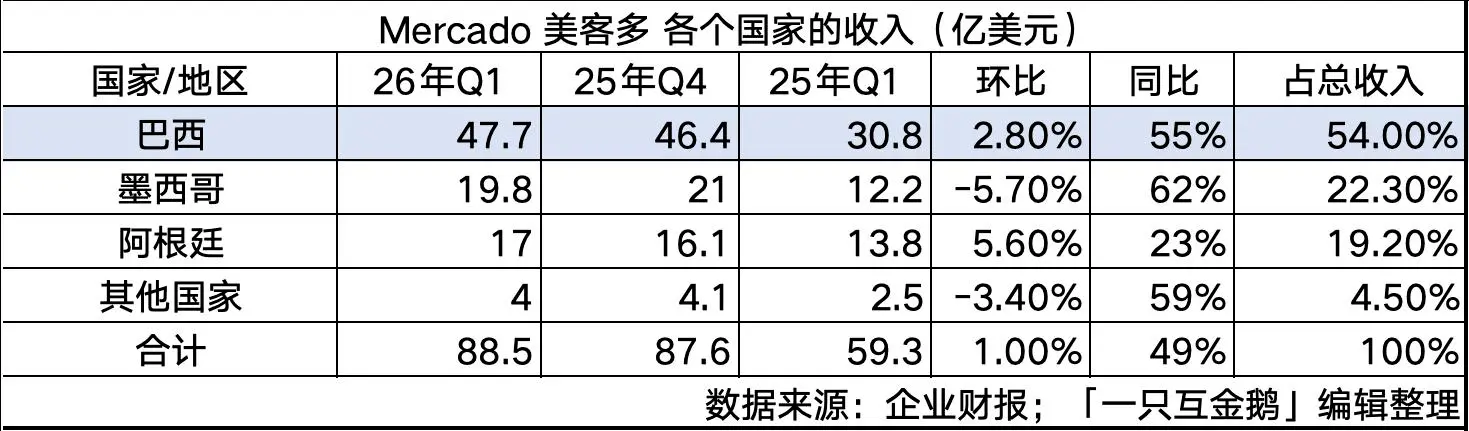
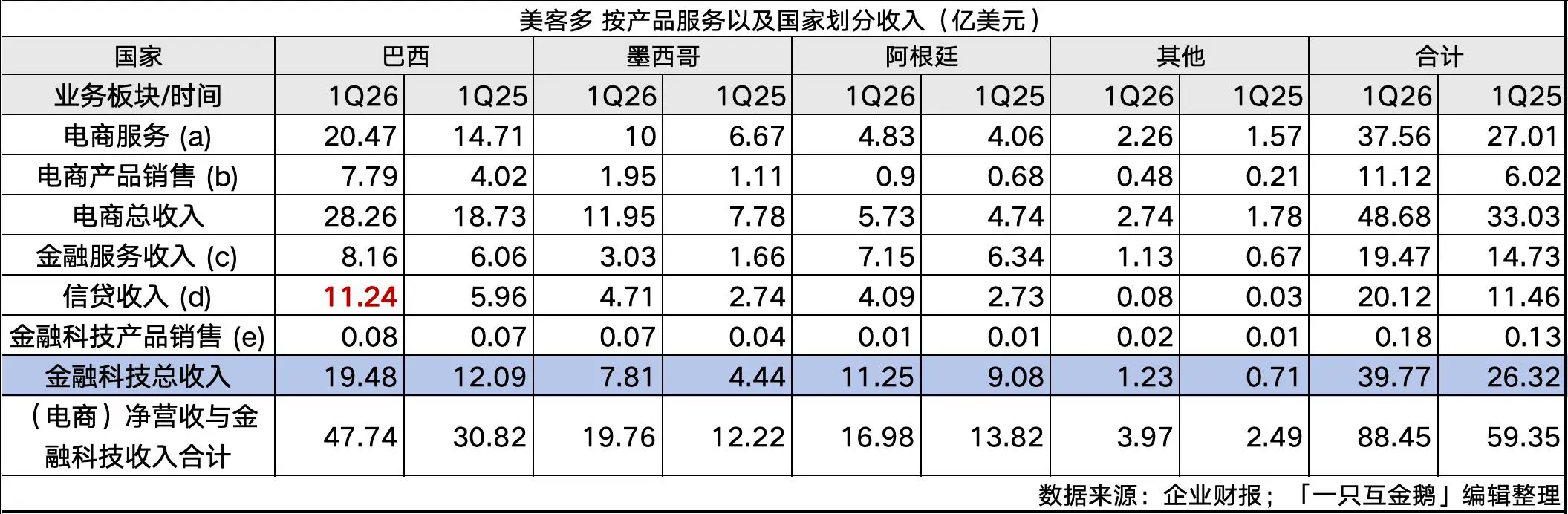
Looking at the Q1 2026 financial report, if revenue is broken down by country:
-
Brazil contributed over half of the total revenue, accounting for 54%;
-
Mexico was the fastest-growing market, with revenue up 62% year-on-year;
-
Argentina saw relatively moderate growth, with revenue up 23%, but considering Argentina's inflation and currency depreciation, the real local currency growth was high;
-
Other countries, including Chile, Colombia, Peru, etc., have a relatively small scale, collectively accounting for only 4.5%.
Looking at business segments in Q1 2026, the e-commerce segment declined slightly quarter-on-quarter (seasonal off-peak), but the Fintech segment bucked the trend with sequential growth of +4.1%.
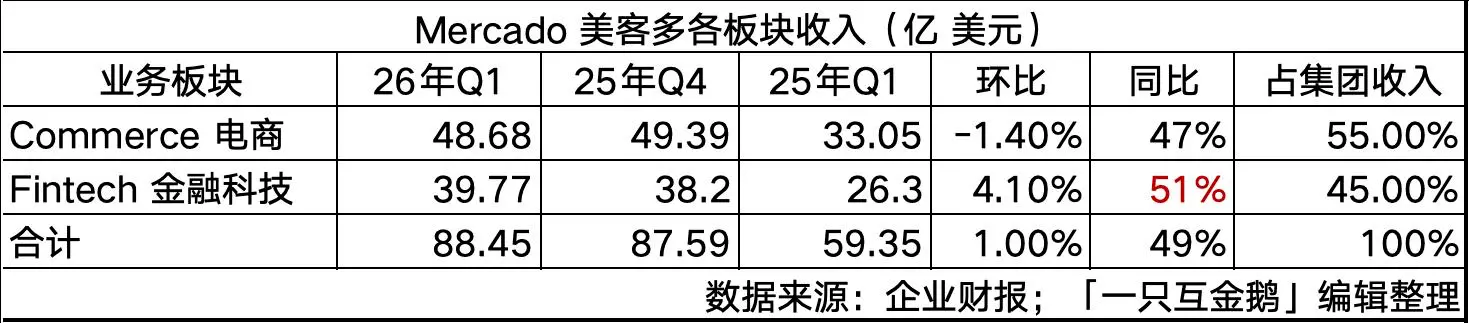
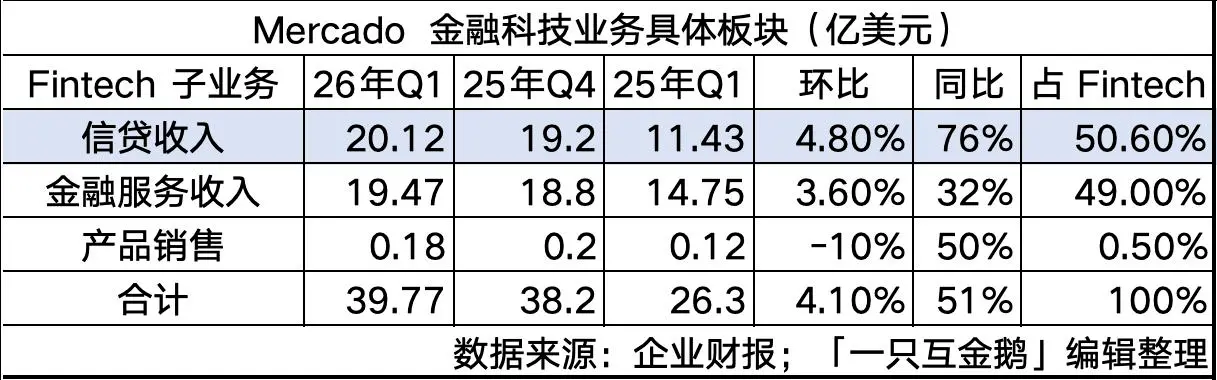
Interestingly, within the fintech segment, credit revenue surpassed financial services revenue for the first time, becoming the largest engine for Fintech.
In other words: the credit business supports the overall performance.
In previous articles, "A Fintech Goose" has detailed Mercado Libre's credit business.
Specifically, it includes:
1 Consumer loans; 2 Credit card business; 3 Merchant loans; 4 Auto loans.
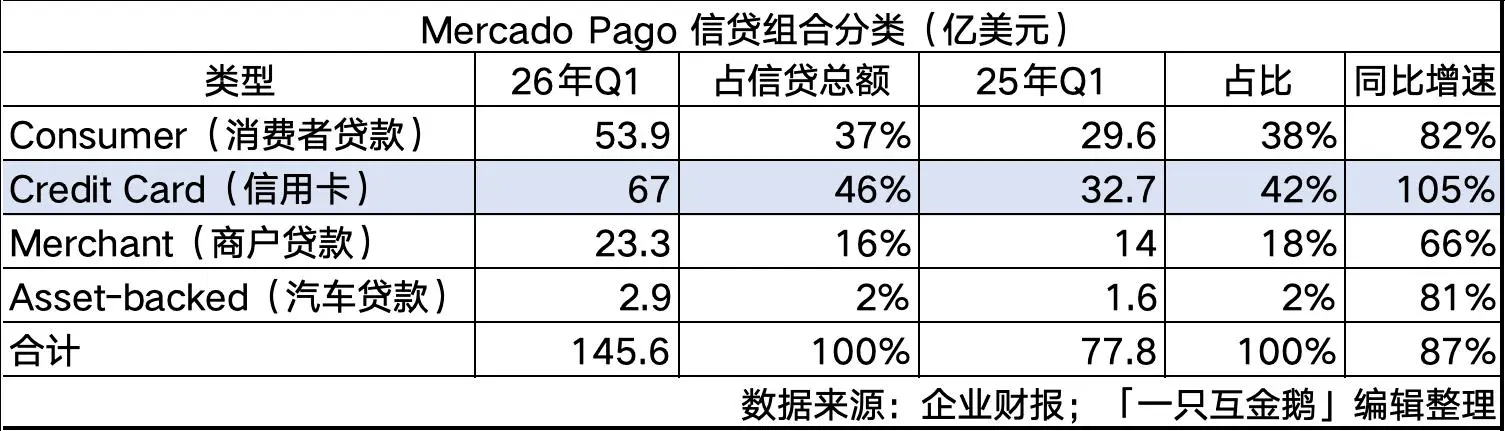
Looking at Q1 2026 data:
The credit card business showed significant loan portfolio growth (+105%), with its size accounting for 46%, taking the largest share.
No matter which country, credit cards are a business with an extremely long investment-return cycle.
In Latin America, Mercado Libre's credit card issuance incurs very high initial costs: zero annual fee + up to 40 days interest-free + up to 18 interest-free installments, plus substantial subsidies for customer acquisition. The required costs are extremely high.
Coupled with Brazilian users' habit of using interest-free installments, it takes a relatively long time from users "grabbing benefits" to "generating interest income."
(1) Strategic Significance of Credit Cards
During the investor call, management repeatedly mentioned the strategic significance of the credit card business.
They even used this phrase to describe it:"Investing in credit cards is as important for Mercado Pago as building our own logistics network was for the e-commerce platform ten years ago."
Key points summarizing Mercado Libre's credit card business:
-
Card issuance: Q1 saw 2.7 million new cards issued, credit card TPV grew 90% year-on-year, MAU grew 68% year-on-year.
-
Cross-selling flywheel: Many credit card users were previously only platform buyers and have now become active Fintech users.
-
Ecosystem effect: Credit cards improve platform conversion rates, GMV per user, and cross-ecosystem transaction volume.
-
5-year investment in Brazil: Credit cards in Brazil have been invested in for 5 years. Older vintages are maturing as expected, gradually offsetting the dilution effect of new vintages.
-
Acceleration in Mexico: Credit card issuance in Mexico is accelerating, with an attractive payback period.
-
New start in Argentina: Credit cards were just launched in Argentina last August-September, with early performance similar to the initial stage in Brazil.
(2) Credit Risk Performance
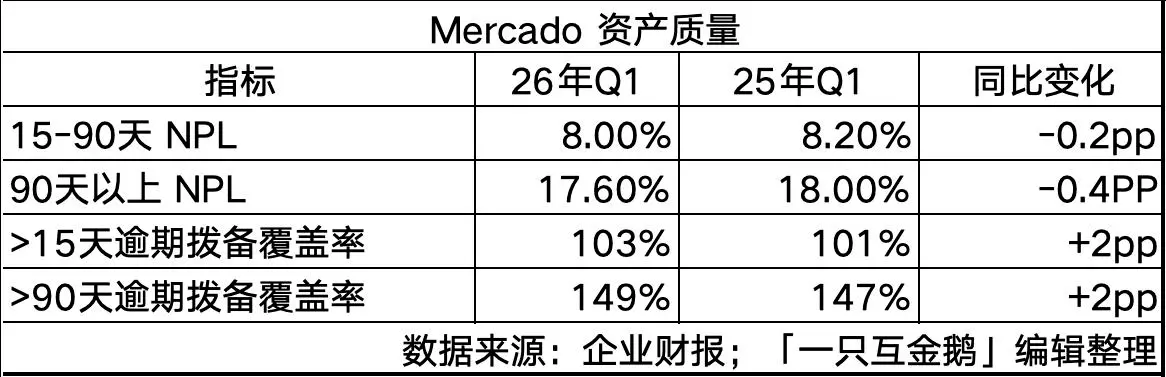
Special note: An NPL ratio over 17% seems alarming, but lending rates in the local market are also higher than in China.
Based on Mercado Libre's NIMAL and public information from the Brazilian market, it's estimated:
Personal Loans: Annual interest rate 146%;
Payroll Loans: Annual interest rate 28% (secured, lowest rate);
Credit Card revolving interest annual rate 451% (Central Bank of Brazil, March 2026).
(3) Net Interest Margin Remains Impressive
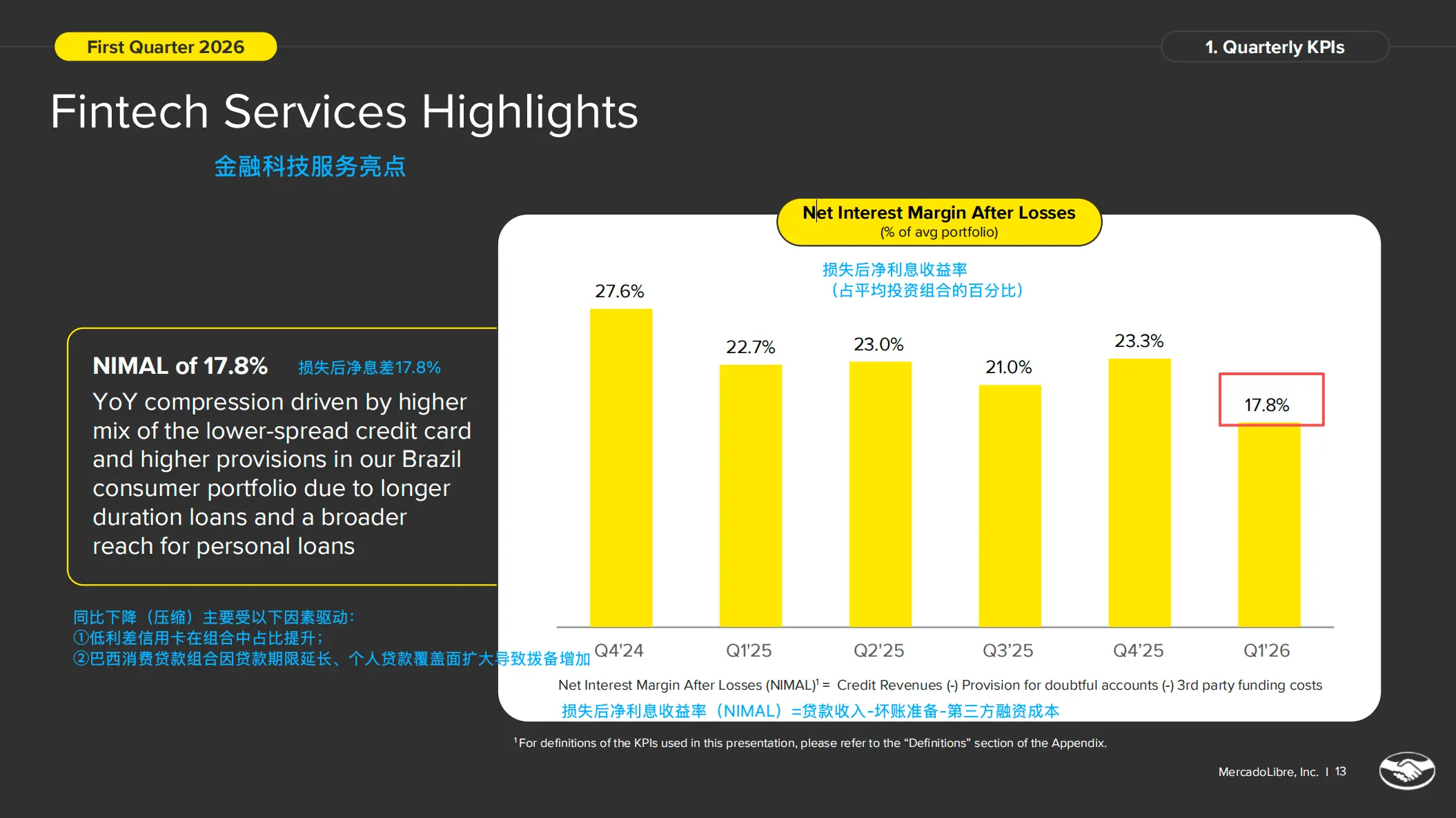
Screenshot from Mercado Libre Investor Report (Click image to enlarge)
Mercado Libre's net interest margin remains impressive.
It declined from 22.7% in Q1 2025 to 17.8% in Q1 2026, a drop of 4.9 percentage points, but this is still an extremely high level.
For comparison, in China, China Merchants Bank's Q1 2026 NIM was only 1.83%; WeBank, China's "profit king" among private banks, had an NIM of only 4.19% in 2025 (pre-provision basis).
Moreover, Mercado Libre's metric calculation is more stringent.
-
Mercado Libre NIMAL = Credit revenue - Bad debt provisions - Funding cost, i.e., Net Interest Margin after deducting bad debts.
-
Domestic bank NIM = (Interest income - Interest expense) / Interest-earning assets, i.e., before bad debt deduction.
Mercado Libre's investor call mentioned: The 4.9ppts year-on-year decline in NIMAL was primarily due to:
-
Increased proportion of credit cards (2/3 of the compression from this factor): Initial NIMAL for credit cards is lower because full expected loss provisions need to be booked at issuance;
-
Longer terms and broader coverage of consumer loans in Brazil (1/3 of the compression): Terms extended from 5 months to 8 months, reaching more credit score segments.
-
Notably, each sub-portfolio remains profitable. Consumer loan portfolio still maintains double-digit margins, merchant loans have the highest spread. Credit cards follow a "first loss, then profit" model, and older vintages in Brazil have already started generating profits.
(4) Brazil Market, the Biggest Surprise
Management expressed pleasant surprise and the importance of the Brazil market in the shareholder letter:
"Twenty-six years after launch, Mercado Libre is growing at startup rates across all of our major markets. Nowhere is this more evident than in Brazil, our largest and most established market, where growth is not just fast – it is accelerating."
Mercado Libre's e-commerce revenue in Q1 2026 was $2.826 billion, up 51% year-on-year.
Specifically in Q1, e-commerce GMV grew 38% year-on-year, items sold grew 56%, and active buyers grew 32%.
This growth primarily stemmed from the decision in 2025 to lower the free shipping threshold, which management called "one of the most important decisions in 2025" – lowering the free shipping threshold to R$19 (approximately RMB 25.49) greatly reduced the psychological barrier for first-time purchases.
Looking at the fintech segment –
-
Fintech in Brazil contributed $1.948 billion in revenue in Q1 2026, accounting for 22.0% of the group's total revenue;
-
Within that, credit-related revenue was $1.124 billion, accounting for 12.7% of the group's total revenue. This revenue was $596 million in Q1 last year, representing 89% year-on-year growth.
Currently, Brazil's credit business is undoubtedly a key growth engine for Mercado Libre.
The credit revenue from a single market already accounts for nearly one-eighth of Mercado Libre's global total revenue.
In short, while both Sea and Mercado Libre are betting big on Brazil, with growth rates often doubling, it is indeed an extremely tempting market.
However, this rapid growth seems to be reserved for the giants. Other fintech players—without e-commerce transaction scene data, without a payment loop to cultivate users—find it extremely difficult to operate credit businesses in Brazil. The local tax system is also particularly complex, making it hard for general players to establish themselves, and it's not recommended.