Top Audit Expert Warns: All DeFi is Unsafe, Withdraw Now!

marsbitPublié le 2026-05-28Dernière mise à jour le 2026-05-28

Résumé

A leading DeFi security expert has issued a stark warning: all DeFi is now unsafe. Manuel Aráoz, founder of major security audit firm OpenZeppelin, stated on X that he is advising friends and family to withdraw funds from major protocols like Aave, MakerDAO, and Compound. The core reason for this drastic shift is the rise of AI. Aráoz argues that AI-powered coding agents can now identify and exploit smart contract vulnerabilities at an exponentially faster rate. This turns DeFi's transparency into a liability, providing a vast training dataset for attackers. The fundamental asymmetry of security—where defenders must patch every flaw, but attackers need only find one—is being catastrophically unbalanced by AI. Recent months provide chilling evidence. April saw massive exploits, including a $280 million loss at Drift Protocol and a $292 million theft from Kelp DAO. The trend continued into May with multiple high-value attacks on protocols like THORChain, Verus, Echo Protocol, and StakeDAO, demonstrating vulnerabilities across both on-chain code and off-chain management. AI acts as a force multiplier for hackers, enabling near-instantaneous vulnerability scanning, automated exploit script generation, and sophisticated social engineering. The recent development of ultra-powerful AI models like Anthropic's Mythos—so advanced its public release was delayed over security fears—signals even greater threats ahead. The article concludes that the risk-reward calculus for DeFi partic...

Original | Odaily Planet Daily(@OdailyChina)

Author | Azuma(@azuma_eth)

“I believe all DeFi is now unsafe.”

This assertion left by OpenZeppelin founder Manuel Aráoz on X yesterday, like a depth charge, once again rocked the already stagnant DeFi market.
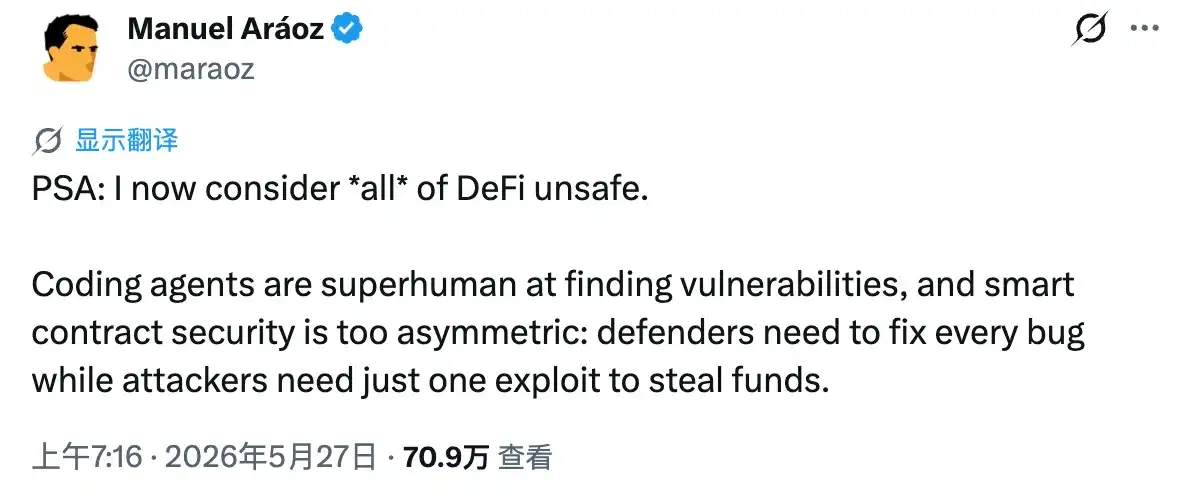
Manuel even stated that he has started advising friends and family to withdraw funds from major DeFi protocols, including blue-chip protocols like Aave, MakerDAO, and Compound, which were once considered low-risk.

This is not alarmism from an outsider. On the contrary, Manuel himself is one of the core builders of the DeFi security system, and OpenZeppelin is one of the industry's most mainstream security auditing firms. Its contract libraries, security standards, and audit frameworks have permeated nearly the entire DeFi world.

The reason for Manuel's complete shift in attitude lies in AI. Manuel pessimistically believes that the ability of AI Coding Agents to identify and exploit smart contract vulnerabilities is increasing exponentially.

This means that issues which previously required top-tier white-hat teams weeks to discover might now be scanned by AI in minutes; where hackers once needed long-term study of protocol logic, attack paths can now be analyzed automatically by AI; the "open and transparent" nature of DeFi, once an advantage, has now become the best training corpus for attackers.

Manuel also raised a more fatal problem: Smart contract security is essentially an extremely asymmetric game — the defense must patch all vulnerabilities, while the attacker only needs to find one to steal funds. As AI begins to exponentially enhance attack efficiency, this asymmetry is rapidly becoming unbalanced.

The Cold Reality: DeFi Has Become a Cash Cow for Hackers

Looking back at DeFi security incidents over the past few months, you'll find that Manuel's concerns are not exaggerated.

April was almost the worst month in DeFi's history.

  • On April 1st, April Fool's Day, Drift Protocol lost $280 million due to manager privilege hijacking and multi-signature execution vulnerabilities (details in "An April Fool's Joke? Drift Protocol Hacked for Over $280M, Potentially Becoming Solana Ecosystem's Second-Largest DeFi Heist").
  • Subsequently, on April 19th, Kelp DAO lost $292 million due to a bridge protocol breach (details in "DeFi Hacked Again for $292M, Is Even Aave Unsafe Now?"). The hacker later escaped via lending protocols like Aave, casting the shadow of bad debt and its cascading effects over the entire DeFi sector.

Entering May, incidents not only didn't decrease but further proliferated.

  • On May 15th, THORChain was attacked. A newly joined node operator exploited a vulnerability in the GG20 Threshold Signature Scheme (TSS), reconstructed the vault private key, and directly executed outbound transactions, causing over $10 million in losses.
  • On May 18th, Verus's bridge protocol was attacked. The attacker forged cross-chain import payloads, bypassed verification to extract assets from the Ethereum reserve, stealing approximately $11.58 million.
  • On May 19th, Echo Protocol on Monad was attacked due to a private key leak. The attacker minted 1,000 eBTC (worth $76.7 million) and extracted funds via Curvance using a previously tested attack path.
  • On May 24th, StablR, a compliant stablecoin issuer under the MiCA regulatory framework, was attacked. The hacker profited over $2.8 million by minting EURR and USDR, causing EURR and USDR to depeg.
  • On May 25th, the SquidRouter module was attacked, resulting in approximately $3 million in assets stolen from 86 Gnosis Safe wallets.
  • On May 27th, the StakeDAO deployer private key was leaked on Arbitrum. The attacker minted about 5.45 trillion vsdCRV and exchanged part of it for 43.7 ETH to escape.

The frequently occurring security incidents have sounded the alarm. DeFi seems to be collapsing across the board, from on-chain code to off-chain management.

AI Has Become the Hackers' Nuclear Weapon

Why has the DeFi offense-defense dynamic suddenly accelerated towards collapse this summer? Beyond the evolution of traditional hacking techniques, the rapid advancement of AI large language models is becoming the ultimate factor tipping the balance.

In the past, finding a complex smart contract vulnerability (especially those involving cross-chain, multi-layer nesting, or extremely hidden reentrancy logic) required top hackers weeks or even months of code review. However, with the maturity of AI agents possessing ultra-long context, strong logical reasoning, and autonomous tool-calling capabilities, this has changed fundamentally.

  • Second-Level Scanning and Global "Zero-Day" Vulnerability Mining: Attackers only need to feed the open-source codebase to the new generation of AI reasoning models. The AI can, within seconds, deduce hundreds of extreme interaction scenarios like a seasoned security expert, accurately pinpointing edge cases missed by human auditors during fatigue.
  • Automated Attack Script Generation: AI can not only discover vulnerabilities but also automatically write, test, and deploy the "hacker smart contracts" used to extract funds.
  • Perfect Orchestration of Off-Chain DevOps and Social Engineering: AI can impersonate perfect developers for phishing or monitor DeFi teams' GitHub commit logs around the clock. Once a team uploads code containing sensitive information or unverified fixes, the AI will launch an attack within seconds—far faster than any human security team's response time.

In this security warfare augmented by AI, hackers, armed with AI, possess nearly infinite ammunition and second-level attack speed. DeFi, however, is constrained by slow-paced governance voting, multi-signature confirmations, and lagging security audits, making it difficult to mount a corresponding defensive response.

Last month, Anthropic, the AI development company behind Claude, officially announced its next-generation model, Mythos (details in "Anthropic Creates the Most Powerful AI Model Ever, But Dares Not Release It..."). This is the first model in human history to break the hundred-trillion parameter threshold (in contrast, mainstream models currently range from hundreds of billions to one trillion parameters), with a staggering training cost of $10 billion.

However, due to Mythos's specialized capabilities in cybersecurity (Anthropic disclosed that using Mythos, they identified thousands of zero-day vulnerabilities in just a few weeks), Anthropic even dares not publicly release the model directly, for fear of malicious use by hacking groups. Instead, they plan to first allow leading large companies to test and preemptively patch potential vulnerabilities through a "Glasswing" initiative.

With the DeFi security situation already so severe at this stage, it's hard to imagine what new threats the industry's security defenses will face once Mythos is publicly released.

The Biggest Problem: Risk-Reward Ratio Has Long Been Unbalanced

For ordinary DeFi participants, liquidity providers (LPs), and whales, the most important question now is to sit down and calculate.

For a long time, the reason users chose to deposit funds into DeFi was to pursue annualized yields several times higher than those in traditional finance. During bull markets or the frenzy of liquidity mining, yields of 10%, 20%, or even higher were enough to cover people's psychological expectations for "potential technical risks."

But today, this underlying logic has long been shaken and even overturned. The risk-reward ratio of DeFi is already unbalanced. On the reward side, as the market enters a game of limited players and safety margins thicken, the real yields of most mainstream, relatively reliable DeFi protocols have fallen back to single-digit ranges. On the risk side, users' principal is exposed to a black box that could be breached by AI at any moment and emptied by a flash loan in an instant. Once a protocol is hacked, token prices plummeting to zero and liquidity pools being drained often happen within minutes, with no legal recourse, insurance, or central bank to provide coverage.

The risk of losing 100% of principal to chase roughly 5% annualized yield is clearly not a good deal.

Manuel's words may be somewhat absolute, but they tear off DeFi's last fig leaf. In the face of the reality where hackers have made AI a conventional weapon and security incidents continue to erupt in the industry, if you are not prepared for the psychological expectation of losing 100% of your principal for a certain yield, then "withdrawing funds as soon as possible and realizing profits" might be the most rational and risk-control-principled choice in the current market cycle.


Questions liées

QAccording to the article, what is the main reason Manuel Aráoz gives for his statement that all DeFi is unsafe?

AThe main reason is the exponential enhancement of AI Coding Agents in identifying and exploiting vulnerabilities in smart contracts, making it easier and faster for attackers to find and exploit flaws.

QWhat does the article highlight as the fundamental asymmetry in smart contract security?

AThe fundamental asymmetry is that defenders must fix all vulnerabilities to be secure, while attackers only need to find a single vulnerability to steal funds.

QWhy is the AI model 'Mythos' from Anthropic mentioned as a particular concern in the context of DeFi security?

AMythos is a concern because it has demonstrated a powerful specialization in cybersecurity, being able to identify thousands of zero-day vulnerabilities in a short time, which could be weaponized by hackers if publicly released.

QWhat is the article's conclusion about the risk-reward ratio for users participating in DeFi protocols currently?

AThe article concludes that the risk-reward ratio is imbalanced. The potential risk of losing 100% of principal now outweighs the relatively low single-digit percentage annual yields offered by many protocols.

QWhich two major DeFi protocols were specifically mentioned as examples from which Manuel Aráoz is advising friends and family to withdraw funds?

AAave and Compound were specifically mentioned as examples of previously considered low-risk blue-chip protocols from which he advises withdrawal.

Lectures associées

Après trois trimestres consécutifs de baisse, le marché des cryptomonnaies pourra-t-il connaître une fenêtre de stabilisation au troisième trimestre ?

Le marché des cryptomonnaies a enregistré son pire trimestre depuis 2022, avec une capitalisation totale chutant de 12,6% à 2 100 milliards de dollars. Tous les indicateurs clés (volume des échanges, valeur des stablecoins) montrent une sortie nette de capitaux. Le Bitcoin a perdu 14,2% et l'Ethereum 25,4% sur le trimestre, rompant sa corrélation antérieure avec les actions technologiques. Les ETF spot américains sur le Bitcoin ont subi des rachats massifs, avec une sortie nette de 4,67 milliards de dollars au Q2, indiquant une pression de vente continue. Le resserrement de la politique de la Fed et les ventes d'entreprises comme Strategy ont accentué la déleveragisation du secteur. L'attention du marché se porte désormais presque exclusivement sur la réunion de la Fed fin juillet. Une position accommodante pourrait stabiliser le Bitcoin entre 68 000 et 84 000 dollars, tandis qu'un ton hawkish pourrait le faire osciller autour de 50 000-56 000 dollars. Parallèlement, la progression du *CLARITY Act*, une loi cruciale pour la clarté réglementaire, est au point mort au Sénat, réduisant les chances d'adoption en 2026 et maintenant une prime de risque élevée sur l'ensemble du secteur. Malgré ce contexte difficile, quelques secteurs résistent : les marchés de prédiction ont vu leur volume nominal augmenter de 48,7% et les biens collectionnables tokenisés ont progressé d'environ 143%. La tokenisation d'actifs du monde réel (RWA) continue également sa croissance régulière, portée par des fondamentaux indépendants du cycle crypto. Les bases d'un effondrement extrême semblent absentes, mais le marché est désormais guidé par les politiques monétaires, les prix et les attentes de taux, plutôt que par le simple récit haussier. La fin des sorties massives des ETF et le retour des achats des détenteurs à long terme pourraient indiquer une phase de stabilisation potentielle.

marsbitIl y a 3 h

Après trois trimestres consécutifs de baisse, le marché des cryptomonnaies pourra-t-il connaître une fenêtre de stabilisation au troisième trimestre ?

marsbitIl y a 3 h

The SpaceX Trade, Unlocked: SPCXON Débarque sur WEEX

En juin 2026, SpaceX a réalisé la plus grande introduction en bourse de l'histoire, mais l'accès à l'action a été limité pour de nombreux investisseurs en raison de restrictions régionales et de frictions liées aux courtiers. La plateforme WEEX propose désormais une solution via SPCXON/USDT, un instrument tokenisé sur le marché au comptant qui permet d'obtenir une exposition au cours de SpaceX en utilisant l'USDT, sans nécessiter de compte de courtage américain. SPCXON est un produit tokenisé construit sur l'infrastructure d'Ondo, conçu pour refléter l'économie de la détention d'actions SpaceX pour les traders éligibles en dehors des États-Unis, avec des dividendes réinvestis. Le cas d'investissement repose sur la croissance des revenus de Starlink et les progrès de Starship, malgré un valorisation déjà élevée et des risques liés à un flottant public réduit et à des déblocages d'actions internes à venir. Il est important de noter que SPCXON offre une exposition, et non la propriété directe d'actions ou de droits de vote. Son prix peut évoluer avec une prime ou une décote par rapport à la valeur liquidative. WEEX propose également d'autres produits tokenisés comme MSTRON et MUON dans un compte unifié, permettant une rotation entre crypto-monnaies et actions traditionnelles sans transfert de fonds. La plateforme souligne ainsi comment les barrières entre la finance traditionnelle et les actifs numériques s'estompent.

TheNewsCryptoIl y a 4 h

The SpaceX Trade, Unlocked: SPCXON Débarque sur WEEX

TheNewsCryptoIl y a 4 h

BIT Trading Moment : Le BTC reste sous la pression de l'EMA 200 hebdomadaire, un rejet pourrait relancer la baisse, les actions de stockage et de semi-conducteurs qui ont bondi cette nuit ont baissé en séance de nuit

**Résumé des marchés : Bitcoin sous pression, actions technologiques en réajustement** Le marché crypto poursuit son rebond, avec Bitcoin évoluant autour de 66 000 $. Il fait face à une résistance clé vers 68 000 $, niveau correspondant au coût moyen des investisseurs sur cinq mois. Les traders surveillent les moyennes mobiles clés (200 MA à ~63 333 $ et 200 EMA à ~68 328 $ en hebdomadaire). Une rupture au-dessus de 68 000 $ ouvrirait la voie à une hausse, tandis qu'un échec pourrait entraîner un retest des 63 000 $. L'analyse suggère que la dynamique actuelle ressemble à un rebond estival à faible liquidité plutôt qu'au début d'un véritable marché haussier. Sur le marché actions américain, après une forte séance mardi portée par les semi-conducteurs et les titres du stockage (Micron, AMD, Intel...), les contrats à terme indiquent une ouverture en baisse. Les secteurs ayant récemment bondi, comme les semi-conducteurs et le stockage, reculent en séance de nuit. Certaines valeurs se démarquent néanmoins, comme Super Micro Computer (SMCI), en hausse après des résultats et des perspectives robustes liées à la demande de serveurs IA. Des vents contraires persistent : les prix du pétrole (Brent >91$) et les rendements des obligations d'État américaines grimpent, ravivant les craintes inflationnistes. En Asie, les marchés ont suivi le rebond technologique américain, mais de manière hésitante. La tension reste forte sur le yen japonais, qui atteint son plus bas niveau depuis des décennies. **Points clés à surveiller :** * **Crypto :** Niveaux techniques de Bitcoin (68k$/63k$), flux des ETF spot. * **Actions :** Saison des résultats (Tesla, Alphabet, Intel...), activité d'AMD sur l'IA. * **Économie :** Données américaines sur l'emploi, décision de la BCE, tensions géopolitiques et prix de l'énergie.

marsbitIl y a 4 h

BIT Trading Moment : Le BTC reste sous la pression de l'EMA 200 hebdomadaire, un rejet pourrait relancer la baisse, les actions de stockage et de semi-conducteurs qui ont bondi cette nuit ont baissé en séance de nuit

marsbitIl y a 4 h

Gate Research Institute : La vague de « Wall Streetisation » des produits financiers cryptographiques, concurrence ou fusion ?

Le titre de l'article est : "Gate Institute : La vague de 'Wall Street-isation' des produits financiers cryptos, est-ce une compétition ou une fusion ?" Résumé en français (environ 1400 caractères) : Il y a dix-sept ans, Bitcoin fut créé avec une vision décentralisée et anti-establishment financier. Aujourd'hui, paradoxalement, son adoption massive passe souvent par des ETF émis par des géants comme BlackRock. Cet article analyse cette "Wall Street-isation" apparente des actifs cryptos : les institutions traditionnelles s'emparent-elles du pouvoir d'émission, de tarification, de garde et de distribution ? La réalité est plus nuancée. C'est une convergence à double sens. D'un côté, les plateformes cryptos comme Gate.io étendent leurs services aux actions traditionnelles (états-uniennes, hongkongaises, sud-coréennes), aux CFD et aux produits tokenisés, offrant un compte unifié. De l'autre, des courtiers traditionnels comme Robinhood intègrent les cryptomonnaies et explorent la tokenisation d'actions sur blockchain. Cette fusion vise à créer le "super-compte" financier de demain, où actions, cryptos, ETF et obligations tokenisées (RWA) coexistent dans une même interface, comblant les faiblesses de chaque écosystème. Les RWA, notamment les obligations d'État tokenisées, agissent comme une couche intermédiaire unificatrice. En conclusion, Wall Street n'a pas conquis la crypto, et la crypto n'a pas contourné Wall Street. Ils construisent ensemble une nouvelle forme de marché des capitaux, plus efficace et mondial, où l'idéal décentralisé persiste dans les protocoles, tandis qu'une expérience utilisateur unifiée émerge à l'interface.

marsbitIl y a 4 h

Gate Research Institute : La vague de « Wall Streetisation » des produits financiers cryptographiques, concurrence ou fusion ?

marsbitIl y a 4 h

Trading

Spot
活动图片




