Tiger Research: The Next Bull Market, Waiting for the Wind

比推Publié le 2026-02-04Dernière mise à jour le 2026-02-04

Résumé

Tiger Research analyzes whether the crypto market is currently in a "crypto winter" and outlines the conditions for the next bull run. Unlike previous bear markets triggered by internal crises (Mt. Gox hack, ICO crackdown, FTX collapse), the current downturn is driven by external factors like macro policies and tariffs, while internal fundamentals remain intact. The market has structurally split into three layers: a regulated sector (stable, institutional), an unregulated sector (speculative, experimental), and shared infrastructure (e.g., stablecoins, oracles). ETF inflows remain confined to Bitcoin and do not trickle down to altcoins. The next bull market requires: 1) a "killer app" emerging from the unregulated sector (e.g., AI agents, InfoFi), and 2) favorable macro conditions like liquidity injections. The era of broad-based rallies is over; growth will be segmented between regulated stability and unregulated volatility.

Source: Tiger Research

Author: Ryan Yoon

Original Title: Is This a Crypto Winter? Post-Regulation Market Shift

Compiled and Edited by: BitpushNew


As the market enters a downward cycle, skepticism towards the crypto market is growing. The core question at hand is: Have we entered a "crypto bear market"?

Core Views

  • The evolution path of a crypto winter: Major event → Collapse of trust → Brain drain.

  • The particularity of this cycle: Past winters were triggered by internal problems; the current surge and crash are both driven by external factors. It is neither a "winter" nor a "spring".

  • Three-tier market structure post-regulation: The market has split into a compliant zone, a non-compliant zone, and shared infrastructure; the past "Trickle-down effect" has disappeared.

  • Limitations of ETF funds: Funds remain within Bitcoin and do not flow outside the compliant zone.

  • Prerequisites for the next bull market: The birth of a "killer app," coupled with a favorable macroeconomic environment.

1. How Did Past Crypto Winters Evolve?
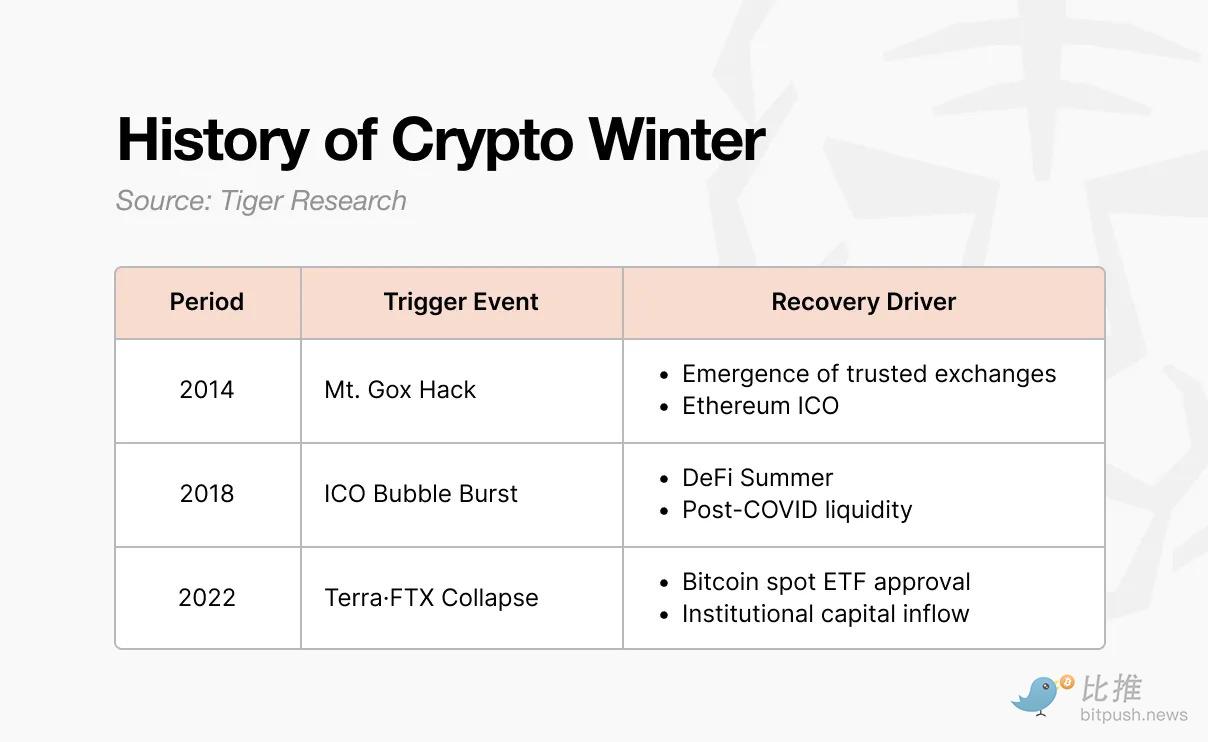
The first winter occurred in 2014. At that time, the Mt. Gox exchange handled 70% of global Bitcoin trading volume. Due to a hack, approximately 850,000 BTC vanished, leading to a complete collapse of market trust. Subsequently, various new exchanges with internal controls and audit functions emerged, and trust was slowly restored. Meanwhile, Ethereum was born through ICOs (Initial Coin Offerings), presenting a new vision and financing method for the industry.

This ICO model became the spark for the next bull market. When anyone could issue tokens and raise funds, the frenzy of 2017 was ignited. Projects raising billions with just a whitepaper were rampant, but most had no substance.

In 2018, South Korea, China, and the US successively introduced strict regulatory measures, the bubble burst, and the second winter arrived. This winter lasted until 2020. After the COVID-19 pandemic, liquidity began to pour in, and DeFi protocols like Uniswap, Compound, and Aave gained attention, leading to a return of funds.

The third winter was the most severe. The Terra-Luna collapse in 2022 triggered the successive failures of Celsius, Three Arrows Capital, and FTX. This was not just a simple price drop but a shake-up of the entire industry's structure. It wasn't until January 2024, when the U.S. Securities and Exchange Commission (SEC) approved the Bitcoin spot ETF, followed by the Bitcoin halving and Trump's pro-crypto policies, that funds began to flow in again.

2. The Pattern of Crypto Winters: Major Event → Collapse of Trust → Brain Drain

The first three winters all followed the same evolutionary logic: a major negative event triggered a collapse of the trust system, ultimately leading to a large-scale brain drain.

  • Starts with a major event: Whether it was the Mt.Gox hack, the ICO regulatory crackdown, or the Terra-Luna collapse and subsequent FTX bankruptcy, the scale and form varied, but the result was the same—the entire market was thrown into turmoil and panic.

  • Spreads to a collapse of trust: This shock quickly turned into a crisis of confidence. People who once discussed "what to build next" began to question whether crypto technology had real value. The collaborative atmosphere among builders disappeared, replaced by mutual blame.

  • Leads to brain drain: Doubts about the前景 led to an exodus of talent. The builders who had once created momentum in the blockchain space fell into pessimism. In 2014, they flowed into fintech and big tech companies; in 2018, they turned to traditional institutions and the AI field. They left here for places that seemed more certain.

3. Is This a Crypto Winter Now?

On the surface, some signs of past crypto winters are still clearly visible today:

  • Major events:

    • Trump memecoin: Its market cap once reached $27 billion in a single day, then plummeted by 90%.

    • The "10.10" liquidation event: The US announced 100% tariffs on China, triggering the largest liquidation wave in Binance's history ($19 billion).

  • Collapse of trust: Skepticism is spreading within the industry, and the focus of discussion has shifted from "building" to "blame-shifting."

  • Pressure of brain drain: The AI industry is growing rapidly, offering faster and more lucrative monetization paths than cryptocurrency.

However, it is difficult to define the current situation as a typical "crypto winter." Past winters erupted from within the industry—the Mt. Gox hack, ICOs going to zero, FTX blowing up—these were all cases of the industry destroying its own Great Wall.

The current situation is截然 different:

The approval of ETFs started the bull market, while tariff policies and interest rate changes drove the decline. External factors lifted the market, and external factors also dragged it down.
Builders have not left the field either:

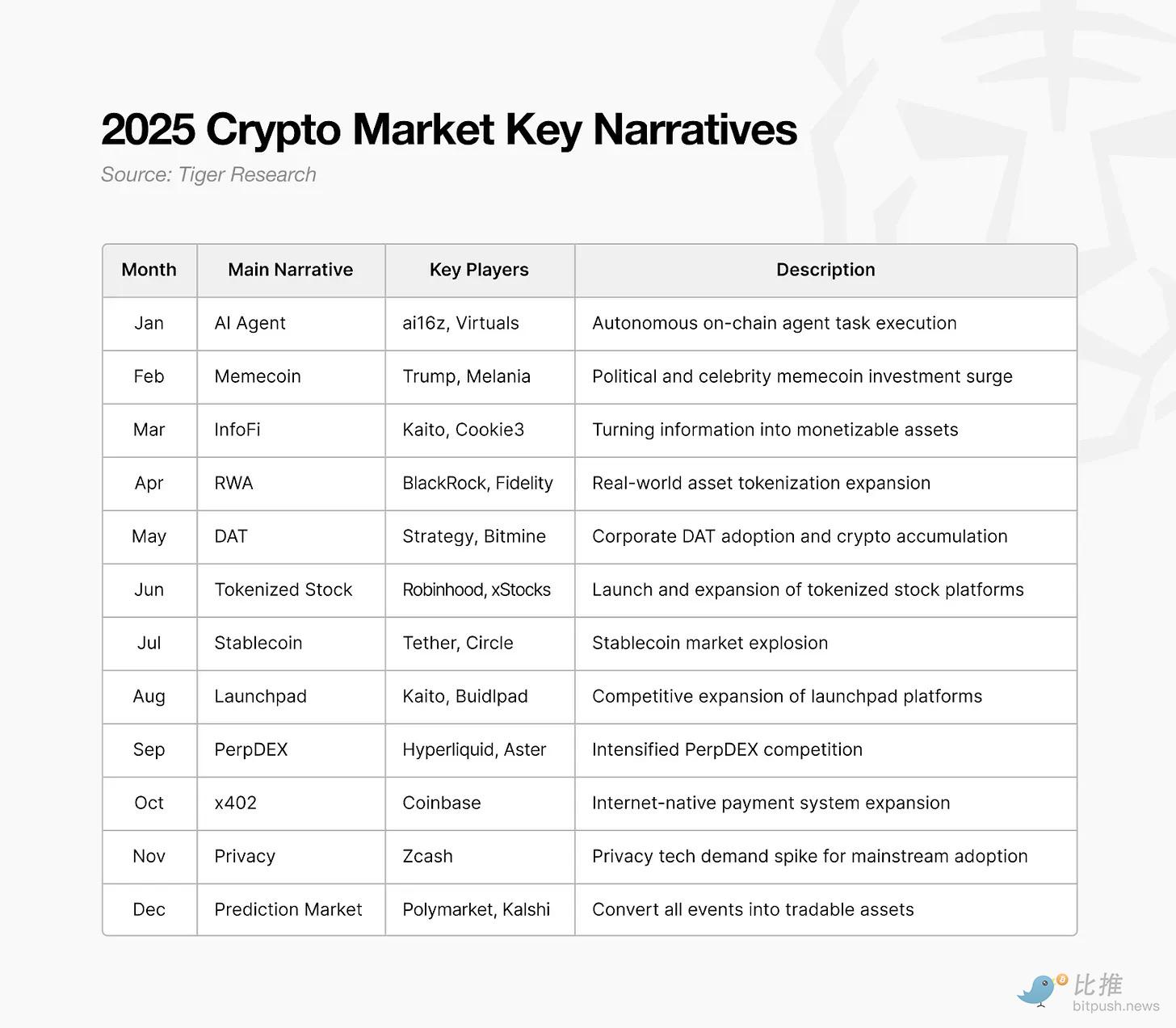
New narratives such as RWA (Real World Assets), perpDEX (perpetual contract exchanges), prediction markets, InfoFi, and privacy protocols are emerging one after another and continue to iterate. Although they have not driven a full-market rally like DeFi did back then, they have not disappeared. The industry's fundamentals have not collapsed; only the external environment has changed.

Just as we did not personally create this "warm spring," there is currently no so-called "winter."

4. Fundamental Changes in Market Structure Post-Regulation

Behind this phenomenon lies the profound evolution of the market structure post-regulation. The market has now split into three levels: 1) The Compliant Zone, 2) The Non-Compliant Zone, and 3) Shared Infrastructure.
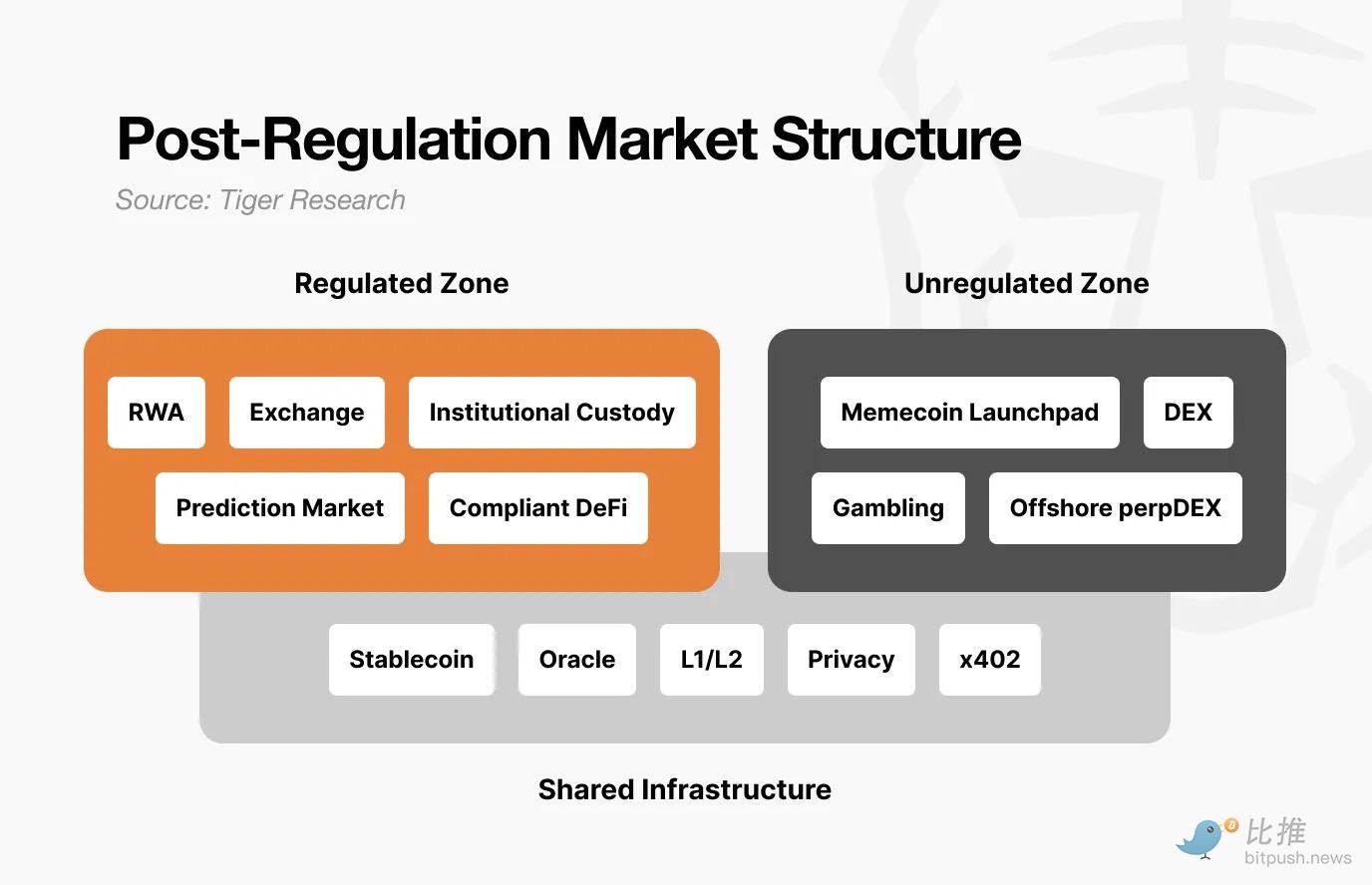
  • Compliant Zone: Includes RWA tokenization, licensed exchanges, institutional-grade custody, legal prediction markets, and compliant DeFi. These areas undergo audits, fulfill disclosure obligations, and are legally protected. Although growth is slower, the capital规模 is huge and stable.

    • Characteristics: After entering the compliant zone, it is difficult to expect the explosive 100x returns of the past. Volatility decreases, the上限 is limited, but the下限 is also guaranteed.

  • Non-Compliant Zone: This area will have an even stronger speculative色彩 in the future. Low barriers to entry, fast pace, surging 100x today and dropping 90% tomorrow will become the norm.

    • Significance: This space is not meaningless. The non-compliant zone is a cradle of creativity. Once a track is proven effective, it will migrate to the compliant zone (like DeFi back then and prediction markets now). It serves as an "experimental field," but itself will increasingly剥离 from compliant businesses.

  • Shared Infrastructure: Includes stablecoins and oracles. They serve both zones simultaneously. The same USDC can be used for institutional-grade RWA payments and for speculative trading on Pump.fun; oracles provide data verification for tokenized treasuries and support liquidations for anonymous DEXs.

This differentiation has changed the flow path of funds.

In the past, Bitcoin's rise would带动山寨币齐涨 through the "Trickle-down effect." Now it's different: institutional funds entering through ETFs stop dead within Bitcoin; funds in the compliant zone no longer flow to the non-compliant zone. Liquidity only stays where value is proven. Even Bitcoin itself, its属性 as a safe-haven asset has not yet been fully proven against risk assets.

5. Conditions for the Next Bull Market

The regulatory framework is being完善, and builders are still working hard. Two more conditions need to be met:

  1. A new "killer app" is born in the non-compliant zone: Something must emerge that can create全新 value, like the "DeFi Summer" of 2020. AI agents, InfoFi, and on-chain social are potential candidates, but they have not yet reached a scale that触动全局. The良性流动 of "non-compliant zone experiment → successful verification → migration to the compliant zone" must be formed again.

  2. Cooperation from the macroeconomic environment: Even if regulation is settled, builders are working hard, and infrastructure is perfect, if the macro environment is not supportive, the upside space is still limited. The 2020 DeFi boom erupted after the pandemic amid global massive liquidity injection; the post-ETF rise in 2024 also coincided with expectations of interest rate cuts. No matter how well the crypto industry does itself, it cannot control interest rates and liquidity. For the value built within the industry to gain widespread recognition, the macro environment must reverse.

A crypto season with "universal上涨" like in the past is unlikely to reappear. Because the market has彻底分裂. The compliant zone will grow steadily, while the non-compliant zone will continue to fluctuate剧烈.

The next bull market will eventually come, but it will not favor everyone.


Twitter:https://twitter.com/BitpushNewsCN

Bitpush TG Discussion Group:https://t.me/BitPushCommunity

Bitpush TG Subscription: https://t.me/bitpush

Original article link:https://www.bitpush.news/articles/7608772

Questions liées

QWhat are the three stages of evolution in a crypto winter according to the article?

AThe three stages are: 1) A significant negative event triggers the downturn, 2) This leads to a collapse of trust within the market, and 3) Ultimately results in a massive exodus of talent from the industry.

QHow does the current market downturn differ from previous crypto winters?

APrevious crypto winters were triggered by internal industry problems (e.g., Mt. Gox hack, ICO crackdown, FTX collapse). The current cycle is different because both the rally (driven by ETF approval) and the subsequent decline (driven by external factors like tariff policies and interest rates) were propelled by external factors, not internal industry failures.

QWhat are the three layers of the post-regulation market structure described in the article?

AThe market has split into three layers: 1) The Compliant Zone (e.g., tokenized RWA, licensed exchanges), 2) The Non-Compliant Zone (a space for speculation and experimentation), and 3) Shared Infrastructure (e.g., stablecoins, oracles that serve both zones).

QWhy has the 'trickle-down effect' of Bitcoin's price rally on altcoins disappeared?

AThe 'trickle-down effect' has disappeared because institutional capital entering through Bitcoin ETFs remains largely confined to Bitcoin itself within the Compliant Zone and does not flow into the Non-Compliant Zone where most altcoins reside. Liquidity now stays only in areas with proven value.

QWhat two conditions are necessary for the next crypto bull market to begin?

ATwo conditions are necessary: 1) A new 'killer app' must emerge from the Non-Compliant Zone, creating entirely new value (similar to DeFi Summer in 2020), and 2) There must be a favorable macroeconomic environment, such as lower interest rates and increased liquidity, which is outside the control of the crypto industry itself.

Lectures associées

9,42 millions de particuliers se ruent sur Changxin Technology, qui a été attribué ?

Les résultats de l'offre publique initiale (IPO) de Changxin Technology sont publiés. L'émission a attiré 942 880 investisseurs particuliers et 285 institutions, avec un nombre record d'actions allouées en ligne. Le taux de succès pour les particuliers s'élève à environ 0,4714%, le plus élevé jamais enregistré pour une nouvelle action sur le marché STAR. Après un mécanisme de rapatriement des actions, le nombre d'actions offertes en ligne a été porté à 3,851 milliards, représentant 50,07% du total. Environ 7,7 millions de numéros gagnants ont été attribués. Les estimations suggèrent qu'un gain potentiel pour un lot gagnant (500 actions) pourrait se situer entre 10 600 et 25 600 yuans selon la valorisation boursière post-introduction. Côté institutions, 285 investisseurs ont reçu 2,173 milliards d'actions, avec un taux d'allocation de 0,1756%. Taikang Asset Management a été la plus grande bénéficiaire. Parmi les fonds communs de placement, E Fund, Southern Fund et ICBC Credit Suisse Trust sont en tête. Dans la catégorie des fonds privés, Liang Wenfeng, fondateur de la société d'IA DeepSeek, via ses entités Ningbo Fantasia Quant et Zhejiang Jiuzhang Asset, a obtenu la plus grande part, avec une allocation d'environ 202,5 millions d'actions d'une valeur de 1,75 milliard de yuans. Des gains potentiels pour ses fonds sont estimés à 7,3 milliards de yuans si la capitalisation atteint 3 000 milliards de yuans. Le Fonds de sécurité sociale national figurait parmi les 30 investisseurs stratégiques, ayant reçu pour 144,37 milliards de yuans d'actions avec une période de blocage. La société devrait être cotée vers le 27 juillet. Les valorisations anticipées par les analystes vont de 1 000 à 4 250 milliards de yuans, malgré des récentes corrections sur les marchés technologiques mondiaux qui pourraient influencer ses débuts en bourse.

marsbitIl y a 41 mins

9,42 millions de particuliers se ruent sur Changxin Technology, qui a été attribué ?

marsbitIl y a 41 mins

Une "déesse de la charité" de 3 millions d'abonnés entièrement créée par IA, un orphelinat factice, un "faux philanthrope" transnational s'effondre du jour au lendemain

**[Guide] Scandale : Une influenceuse australienne prétendant aider des orphelins avec 3 millions d'abonnés a été démasquée pour avoir utilisé l'IA afin de créer de fausses images et vidéos de son oeuvre caritative.** L'ABC révèle que Lily Jay, une influenceuse australienne convertie à l'islam avec près de 3 millions d'abonnés, a orchestré une vaste escroquerie caritative en utilisant l'intelligence artificielle. Sa fondation, le "Lily Jay Foundation", prétendait construire des mosquées, distribuer de la nourriture à Gaza et gérer un orphelinat en Ouganda. Cependant, l'enquête montre que des vidéos clés, notamment celle de l'inauguration de l'orphelinat où des enfants tiennent des sucettes, étaient intégralement générées par IA, avec des incohérences typiques comme des erreurs de texte sur les vêtements. Aucune trace de l'orphelinat "Ada Nur" ou de la boulangerie à Gaza n'a pu être vérifiée sur place. Un trophée "humanitaire" présenté en mai 2026 portait le filigrane invisible d'un générateur d'images AI. Le site web de la fondation admettait discrètement ne pas être un organisme de bienfaisance enregistré, échappant ainsi aux obligations de transparence financière. Opérant depuis Chypre et le Kosovo, Lily Jay (de son vrai nom Lily Jay Hinson) mène une vie luxueuse sur ses réseaux personnels. Après les questions de l'ABC, le site a modifié son contenu pour les visiteurs australiens, supprimant les options de don et les pages compromettantes, tout en les conservant pour le public international. Les experts alertent sur la dangerosité de ces escroqueries qui exploitent la générosité et la volonté de croire en de belles histoires. À l'ère du deepfake, la défense reste un questionnement critique : est-ce vrai ?

marsbitIl y a 1 h

Une "déesse de la charité" de 3 millions d'abonnés entièrement créée par IA, un orphelinat factice, un "faux philanthrope" transnational s'effondre du jour au lendemain

marsbitIl y a 1 h

L2 « recalibrage » : quand L1 devient son propre Rollup, quel est le destin final d’Ethereum ?

"L2 Recalibration": When L1 Becomes Its Own Rollup, What Is Ethereum's Endgame? In recent years, the proliferation of L2s (Rollups) has solved Ethereum's scalability issues but at the cost of fragmenting liquidity, user states, and the unified chain experience. This has prompted a fundamental reevaluation of the relationship between L1 and L2 within the Ethereum community. Ethereum's roadmap is evolving. The core challenge is no longer just creating more block space, but redefining the roles of L1, L2, execution, and settlement layers in a fragmented ecosystem. L1 is actively enhancing its own scalability (increasing Gas Limit, statelessness, zkEVM). Consequently, L2s can no longer rely solely on "cheaper, faster transactions" for long-term value. Their future role shifts towards providing differentiated features (privacy, custom governance, application-specific optimizations) that L1 cannot easily offer uniformly, while still contributing extra capacity. Interoperability is key to restoring a seamless user experience. The goal is not just cross-chain bridges but enabling different execution environments to trust each other's states faster and at lower cost. Initiatives like Open Intents Frameworks and the Ethereum Interoperability Layer (EIL) aim to make cross-L2 interactions feel like single-chain transactions. Crucially, shortening Ethereum's finality time (from minutes to seconds) is a major focus, as it directly benefits cross-chain applications by reducing the trust latency for state changes. A provocative idea from researcher Barnabé Monnot suggests that as proof systems (like zkEVM) mature on mainnet, L1 itself could become a form of "its own Rollup." Here, specialized nodes would execute transactions and generate validity proofs, while validators would verify these proofs instead of re-executing everything. This blurs the traditional L1/L2 hierarchy, making "Rollup" more of a general execution-verification architecture than a strict layer. The vision is a future where multiple L2s act as specialized execution domains (for DeFi, gaming, privacy, etc.) under a shared Ethereum security, settlement, and state framework—a system that is fragmented in execution but unified in trust and liquidity. In conclusion, Ethereum's endgame is not L2s replacing L1 or being made obsolete by a scaled L1. It is an ecosystem where L2s become a spectrum of execution environments with varying features, all capable of securely interoperating and sharing Ethereum's foundational security and liquidity. The next phase is about re-integrating what was fragmented back into a coherent, user-friendly "one chain" experience.

marsbitIl y a 1 h

L2 « recalibrage » : quand L1 devient son propre Rollup, quel est le destin final d’Ethereum ?

marsbitIl y a 1 h

Trading

Spot
活动图片