Theft Is Just the Beginning: The Slow Collapse Behind Cyber Attacks

比推Publié le 2026-03-23Dernière mise à jour le 2026-03-23

Résumé

The article "Theft Is Just the Beginning: The Slow Collapse Behind Hacker Attacks" discusses the long-term impacts of cryptocurrency hacks beyond the initial financial loss. Based on Immunefi’s "2026 On-Chain Security Report," the analysis reveals that while attacks themselves are swift, the aftermath unfolds over months, causing prolonged damage such as declining token prices, reduced funding, halted hiring, and delayed development. Key findings include: - The median direct loss per attack is around $25 million, but tokens experience a median drop of 61% within six months, with 16% recovering to pre-attack levels. - Although the number of attacks remains steady (94 in 2024, 97 in 2025), the concentration of losses is alarming: the top five attacks accounted for 62% of total stolen funds. - Centralized platforms, though fewer in attack frequency, represent over half of the financial losses, highlighting persistent vulnerabilities in trusted intermediaries. The report emphasizes that the true crisis begins after the theft—projects face extended recovery periods, reputational harm, and operational disruption, making survival particularly challenging for less-resourced teams. The interconnected nature of DeFi ecosystems further amplifies risks, as single incidents can trigger broader market repercussions. Ultimately, the article underscores that resilience is not just about preventing hacks but enduring their prolonged secondary effects.

Author: Andjela Radmilac

Compiled by: Saoirse, Foresight News

Original title: Under the Shadow of Hackers, More Than Just the Demise of Funds


Cryptocurrency exploits can drain a wallet in minutes, but the full extent of the losses often takes months to fully materialize. Token prices continue to fall, project treasuries shrink, hiring freezes, and even projects that survive the theft may completely lose their future in the subsequent turmoil.

Cryptocurrency hacks never end the moment the wallet is emptied. The theft is swift and direct, followed by a slower collapse that begins to spread within the project.

Tokens continue to decline, funding pools shrink accordingly, hiring plans are cut, product development is delayed, and partners withdraw one after another. Projects that should be focusing on recovery end up spending months rebuilding credibility instead of building.

This is precisely the scene depicted in Immunefi's latest "2026 On-Chain Security Status Report." Its core argument applies to any market—whether in the crypto industry or traditional sectors: the initial loss is only part of the damage.

The more serious issue lies in the devastating impact of the exploit on the project's future. Immunefi data shows that the average direct amount stolen per attack in their sample was approximately $25 million, while the median drop in stolen tokens within six months was as high as 61%. During this period, 84% of the tokens failed to return to their pre-attack prices, and project teams spent at least three months on post-incident recovery, delaying normal development.

However, this data comes with a caveat: token declines have multiple causes, and many projects were already vulnerable before the attack—suffering from poor liquidity, overvaluation, or having already lost momentum.

Immunefi acknowledges that they cannot completely separate the impact of hacks from broader market weakness or the projects' own issues. Even so, the patterns revealed in the report are still noteworthy: hacker attacks are no longer isolated theft events but more like a long-tail corporate crisis.

The value of this report lies in its proof that, after the热点 news fades, the后续 effects of hacker attacks continue to cause long-term harm.

Median Attack Losses Are Decreasing, but Extreme Attacks Are Becoming More Dangerous

According to Immunefi's statistics, 191 crypto attacks occurred in 2024-2025, with total losses of $4.67 billion; over five years, 425 attacks累计 occurred, with total losses reaching $11.9 billion.

The number of attacks per year has hardly changed: 94 in 2024, 97 in 2025, roughly flat with 2023. This indicates that the overall security of the market has not significantly improved. Hacker attacks have become the norm in the crypto industry, and a few giant attacks are enough to define the industry's risk for an entire year.

The report reveals a core contradiction:

The median loss from attacks in 2024-2025 was $2.2 million, lower than the $4.5 million in 2021-2023. On the surface, this seems like progress. However, the average loss was still about $24.5 million, more than 11 times the median; previously, this gap was only 6.8 times. The top five attacks accounted for 62% of all stolen funds; the top ten accounted for 73%.

This is an extremely dangerous distribution pattern: the market appears stable and safe until a giant event tears it apart. The scale of ordinary attacks has become smaller, but the real致命 risk lies in the tail—a few特大 incidents absorb the vast majority of losses and冲击 the entire market in a single day.

The most typical case is Bybit. The exchange's $1.5 billion exploit became the most iconic hack of 2025, with this single incident accounting for 44% of all funds stolen that year.

It's easy to view such events as news spectacles, but they expose a deeper problem of risk concentration: a single failure at a core platform is enough to distort the annual loss structure of the entire industry, revealing that huge risks are still piled up on a few critical nodes.

The Protracted Decline Is Where the Project Truly Begins to Collapse

The data on stolen funds in the report is certainly noteworthy, but the most alarming part is the section on price impact.

In Immunefi's sample of 82 hacked tokens:

  • Within two days of the hack, the median drop was about 10%, roughly flat with the previous cycle;

  • But the real冲击 emerged later: the median drop expanded to 61% after six months, higher than the 53% in 2021-2023.

Six months later:

  • 56.5% of the hacked tokens had fallen more than 50%;

  • 14.5% had fallen more than 90%;

  • Only about 16% of tokens returned to or exceeded their pre-attack price levels.
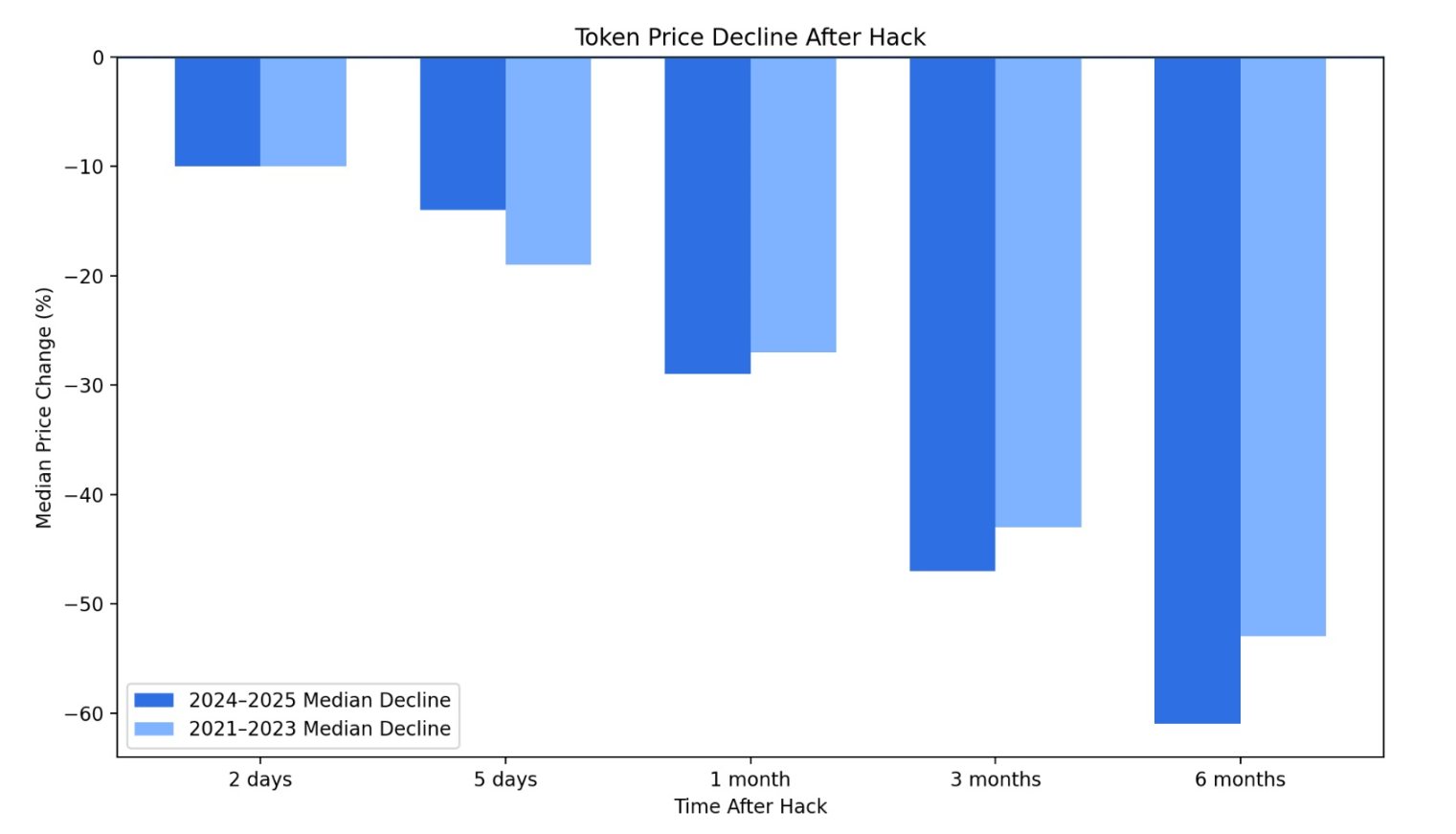
Chart shows the median token price decline for 82 hacked tokens in Immunefi's sample from 2024 and 2025 (Source: Immunefi)

To understand the full impact of a hack, we can no longer view token price as an isolated market indicator. For the vast majority of crypto projects, the token is the treasury, the foundation for fundraising, and the public report card of credibility. A prolonged暴跌 directly cripples the project's operational cycle, hiring ability, bargaining power in partnerships, and internal morale.

The report points out that projects that suffer attacks often lose their security lead within weeks and enter a recovery period of at least three months. Even if the timeline varies by project, the consequences are clear: projects with crashed tokens and damaged brands have almost no breathing room or chance for a turnaround.

Many markets can withstand a theft, a bad quarter, or even a reputation crisis. But the crypto industry often compresses all three into the same event: the attack empties the treasury → the token暴跌 publicly revalues the project → partners withdraw before the internal cleanup is even finished.

Recovery in this environment is extremely difficult, and致命 for teams that were not well-funded to begin with.

Interdependency makes the situation worse. Immunefi believes the DeFi ecosystem has become increasingly interconnected, forming longer, more fragile risk chains between cross-chain bridges, stablecoins, liquid staking, restaking, and lending markets.

Although some cases in the report require external verification, the overall trend is undeniable: today's crypto systems have more complex layers, meaning the impact of a single attack will extend far beyond the affected protocol itself.

Centralized platforms remain at the epicenter of explosions.

The report shows that out of the 191 attacks in 2024-2025, only 20 targeted centralized exchanges, but these 20 caused losses of $2.55 billion, accounting for 54.6% of the total losses.

This shifts the problem from smart contract vulnerabilities back to asset custody, key management, and over-concentrated infrastructure. For an industry that often sells itself on "decentralized risk resistance," most of the huge losses still occur on highly trusted, centralized nodes.

But this does not mean all hacked projects are doomed to fail. The industry has entered a new phase: a project's survival no longer depends on whether it can withstand an attack, but on whether it can withstand the six months *after* the attack.

Theft is just the beginning of the crisis. What truly determines whether a project has a future is the long, slow,持续的 secondary damage that follows the attack.


Twitter:https://twitter.com/BitpushNewsCN

Bitpush TG Discussion Group:https://t.me/BitPushCommunity

Bitpush TG Subscription: https://t.me/bitpush

Original link:https://www.bitpush.news/articles/7622471

Questions liées

QWhat is the main finding of Immunefi's '2026 On-Chain Security Status Report' regarding the impact of crypto hacks?

AThe main finding is that the initial theft is only part of the damage; the more severe problem is the devastating impact on a project's future, including prolonged token price declines, drained treasuries, halted hiring, and delayed development, which can lead to a slow, long-term collapse.

QAccording to the report, what was the median percentage drop in the price of hacked tokens after six months?

AThe median percentage drop in the price of hacked tokens after six months was 61%.

QWhat does the report reveal about the distribution of losses from crypto hacks between 2024 and 2025?

AThe report reveals a highly dangerous distribution: while the median attack loss decreased, the average loss was high, and a small number of extreme attacks accounted for the majority of the losses. The top 5 attacks represented 62% of all stolen funds, and the top 10 represented 73%.

QWhich type of platform was responsible for the majority of the financial losses from hacks in 2024-2025, despite having fewer incidents?

ACentralized exchanges were responsible for the majority of financial losses. Although only 20 attacks targeted CEXs, they resulted in losses of $2.55 billion, accounting for 54.6% of the total losses during that period.

QWhat key factor does the report suggest ultimately determines whether a project can survive a hack?

AThe report suggests that a project's survival is no longer determined by its ability to withstand the initial attack, but rather by its ability to withstand the subsequent six months of slow, prolonged secondary damage, including price collapse and reputational harm.

Lectures associées

9,42 millions de particuliers se ruent sur Changxin Technology, qui a été attribué ?

Les résultats de l'offre publique initiale (IPO) de Changxin Technology sont publiés. L'émission a attiré 942 880 investisseurs particuliers et 285 institutions, avec un nombre record d'actions allouées en ligne. Le taux de succès pour les particuliers s'élève à environ 0,4714%, le plus élevé jamais enregistré pour une nouvelle action sur le marché STAR. Après un mécanisme de rapatriement des actions, le nombre d'actions offertes en ligne a été porté à 3,851 milliards, représentant 50,07% du total. Environ 7,7 millions de numéros gagnants ont été attribués. Les estimations suggèrent qu'un gain potentiel pour un lot gagnant (500 actions) pourrait se situer entre 10 600 et 25 600 yuans selon la valorisation boursière post-introduction. Côté institutions, 285 investisseurs ont reçu 2,173 milliards d'actions, avec un taux d'allocation de 0,1756%. Taikang Asset Management a été la plus grande bénéficiaire. Parmi les fonds communs de placement, E Fund, Southern Fund et ICBC Credit Suisse Trust sont en tête. Dans la catégorie des fonds privés, Liang Wenfeng, fondateur de la société d'IA DeepSeek, via ses entités Ningbo Fantasia Quant et Zhejiang Jiuzhang Asset, a obtenu la plus grande part, avec une allocation d'environ 202,5 millions d'actions d'une valeur de 1,75 milliard de yuans. Des gains potentiels pour ses fonds sont estimés à 7,3 milliards de yuans si la capitalisation atteint 3 000 milliards de yuans. Le Fonds de sécurité sociale national figurait parmi les 30 investisseurs stratégiques, ayant reçu pour 144,37 milliards de yuans d'actions avec une période de blocage. La société devrait être cotée vers le 27 juillet. Les valorisations anticipées par les analystes vont de 1 000 à 4 250 milliards de yuans, malgré des récentes corrections sur les marchés technologiques mondiaux qui pourraient influencer ses débuts en bourse.

marsbitIl y a 39 mins

9,42 millions de particuliers se ruent sur Changxin Technology, qui a été attribué ?

marsbitIl y a 39 mins

Une "déesse de la charité" de 3 millions d'abonnés entièrement créée par IA, un orphelinat factice, un "faux philanthrope" transnational s'effondre du jour au lendemain

**[Guide] Scandale : Une influenceuse australienne prétendant aider des orphelins avec 3 millions d'abonnés a été démasquée pour avoir utilisé l'IA afin de créer de fausses images et vidéos de son oeuvre caritative.** L'ABC révèle que Lily Jay, une influenceuse australienne convertie à l'islam avec près de 3 millions d'abonnés, a orchestré une vaste escroquerie caritative en utilisant l'intelligence artificielle. Sa fondation, le "Lily Jay Foundation", prétendait construire des mosquées, distribuer de la nourriture à Gaza et gérer un orphelinat en Ouganda. Cependant, l'enquête montre que des vidéos clés, notamment celle de l'inauguration de l'orphelinat où des enfants tiennent des sucettes, étaient intégralement générées par IA, avec des incohérences typiques comme des erreurs de texte sur les vêtements. Aucune trace de l'orphelinat "Ada Nur" ou de la boulangerie à Gaza n'a pu être vérifiée sur place. Un trophée "humanitaire" présenté en mai 2026 portait le filigrane invisible d'un générateur d'images AI. Le site web de la fondation admettait discrètement ne pas être un organisme de bienfaisance enregistré, échappant ainsi aux obligations de transparence financière. Opérant depuis Chypre et le Kosovo, Lily Jay (de son vrai nom Lily Jay Hinson) mène une vie luxueuse sur ses réseaux personnels. Après les questions de l'ABC, le site a modifié son contenu pour les visiteurs australiens, supprimant les options de don et les pages compromettantes, tout en les conservant pour le public international. Les experts alertent sur la dangerosité de ces escroqueries qui exploitent la générosité et la volonté de croire en de belles histoires. À l'ère du deepfake, la défense reste un questionnement critique : est-ce vrai ?

marsbitIl y a 1 h

Une "déesse de la charité" de 3 millions d'abonnés entièrement créée par IA, un orphelinat factice, un "faux philanthrope" transnational s'effondre du jour au lendemain

marsbitIl y a 1 h

L2 « recalibrage » : quand L1 devient son propre Rollup, quel est le destin final d’Ethereum ?

"L2 Recalibration": When L1 Becomes Its Own Rollup, What Is Ethereum's Endgame? In recent years, the proliferation of L2s (Rollups) has solved Ethereum's scalability issues but at the cost of fragmenting liquidity, user states, and the unified chain experience. This has prompted a fundamental reevaluation of the relationship between L1 and L2 within the Ethereum community. Ethereum's roadmap is evolving. The core challenge is no longer just creating more block space, but redefining the roles of L1, L2, execution, and settlement layers in a fragmented ecosystem. L1 is actively enhancing its own scalability (increasing Gas Limit, statelessness, zkEVM). Consequently, L2s can no longer rely solely on "cheaper, faster transactions" for long-term value. Their future role shifts towards providing differentiated features (privacy, custom governance, application-specific optimizations) that L1 cannot easily offer uniformly, while still contributing extra capacity. Interoperability is key to restoring a seamless user experience. The goal is not just cross-chain bridges but enabling different execution environments to trust each other's states faster and at lower cost. Initiatives like Open Intents Frameworks and the Ethereum Interoperability Layer (EIL) aim to make cross-L2 interactions feel like single-chain transactions. Crucially, shortening Ethereum's finality time (from minutes to seconds) is a major focus, as it directly benefits cross-chain applications by reducing the trust latency for state changes. A provocative idea from researcher Barnabé Monnot suggests that as proof systems (like zkEVM) mature on mainnet, L1 itself could become a form of "its own Rollup." Here, specialized nodes would execute transactions and generate validity proofs, while validators would verify these proofs instead of re-executing everything. This blurs the traditional L1/L2 hierarchy, making "Rollup" more of a general execution-verification architecture than a strict layer. The vision is a future where multiple L2s act as specialized execution domains (for DeFi, gaming, privacy, etc.) under a shared Ethereum security, settlement, and state framework—a system that is fragmented in execution but unified in trust and liquidity. In conclusion, Ethereum's endgame is not L2s replacing L1 or being made obsolete by a scaled L1. It is an ecosystem where L2s become a spectrum of execution environments with varying features, all capable of securely interoperating and sharing Ethereum's foundational security and liquidity. The next phase is about re-integrating what was fragmented back into a coherent, user-friendly "one chain" experience.

marsbitIl y a 1 h

L2 « recalibrage » : quand L1 devient son propre Rollup, quel est le destin final d’Ethereum ?

marsbitIl y a 1 h

Trading

Spot
活动图片