The World Cup has only been played for a few days, but some AI prediction models have already been crowned as oracles, while others have stumbled badly.

marsbitPublié le 2026-06-16Dernière mise à jour le 2026-06-16

Résumé

The 2026 FIFA World Cup has sparked significant interest not only on the pitch but also in AI-driven match prediction. Major models like Qwen, Copilot, and ChatGPT are being used to forecast outcomes, scores, upsets, red cards, and key player performances. Qwen gained early attention by accurately predicting Mexico's 2-0 win over South Africa (including a red card risk) and South Korea's 2-1 victory over the Czech Republic in the opening matches. Copilot's pre-tournament predictions had notable successes, such as correctly calling the Mexico 2-0 scoreline, South Korea's 2-1 win, and Brazil's 1-1 draw with Morocco. However, it also had clear misses, failing to predict upsets like Australia's 2-0 win over Turkey or Switzerland's draw with Qatar. ChatGPT provided detailed analytical reasoning, correctly predicting Mexico's 2-0 win, but its full-tournament predictions tended to favor favorites, missing several underdog results and draws. Tests pitting multiple models (ChatGPT, Gemini, Grok, Claude) against the same match, like Mexico vs. South Africa, showed varying predictions, with only some hitting the exact score. In summary, while AI models like Qwen have shown promising early results in specific match details, and others have had isolated successes, they collectively struggle to consistently identify upsets and underdog performances. AI is becoming an additional reference tool for prediction markets but is far from a definitive source.

The most exciting place at this World Cup isn't just on the pitch.

As interest in World Cup prediction events heats up, more and more users are participating in trading with real money. Who will win, what will the score be, will there be an upset, will there be a red card, which player will score—these topics, originally just casual pre-match chatter among fans, are now broken down into individual tradable prediction events.

When predictions become trades, users need more than just emotions and intuition: odds fluctuations, team form, injury news, head-to-head history, and market sentiment all become reference points before making a trade. In this process, AI models are being frequently brought into World Cup prediction scenarios.

Large models like Qwen, ChatGPT, Gemini, Claude, DeepSeek, Qwen, and Copilot can not only answer 'which team is more likely to win' but also provide score predictions, likelihood of upsets, red card risks, key player performances, and match flow analysis. For prediction market participants, AI's pre-match analysis is becoming another layer of reference beyond odds, news, team data, and market sentiment.

However, predictions ultimately have to be judged against the actual matches.

With the official start of the World Cup, the results of the first few matches have come in. Those AI analyses that users consulted to aid their judgments before the matches now have answers to compare against: Were the scores predicted correctly? Were upsets foreseen? How many details like red cards, last-minute winners, and match flow were actually captured by the models?

The first to go viral was, surprisingly, Qwen

The most entertaining performance on the opening day of the World Cup undoubtedly belonged to Qwen.

For the opening match between Mexico and South Africa, Qwen's pre-match prediction was Mexico 2:0 South Africa. After the match ended, the score was indeed 2:0. What's more interesting is that the match saw a total of three red cards, which also largely aligned with Qwen's pre-match risk assessment of 'South Africa's overly aggressive defending, potentially leading to playing with ten men early on.'
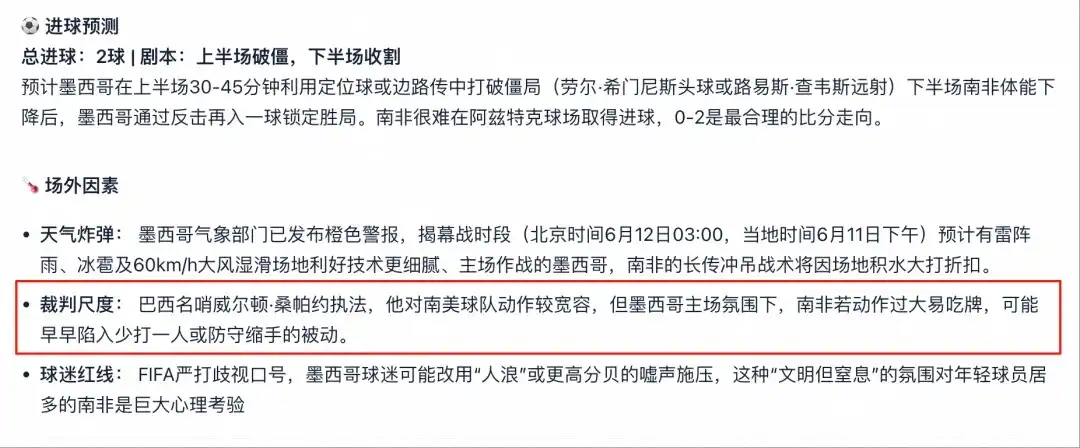
If it were just predicting a Mexico win, that wouldn't be too surprising. As one of the hosts, Mexico was favored anyway. But what Qwen nailed this time were the more specific match details: the 2:0 scoreline, South Africa's red card risk, and the pace of the game gradually opening up in the later stages.

Next, for the match between South Korea and the Czech Republic, Qwen gave a prediction of South Korea 2:1.

This match wasn't easy to call before kick-off. The Czech Republic had physicality, set-piece threats, and the usual big-tournament experience of European teams. The match process was indeed not one-sided; the Czechs took the lead first, South Korea equalized later, and the game was deadlocked at 1:1 for a long time. It wasn't until the final stages that South Korea scored the winning goal, with the final score becoming 2:1.

This gave Qwen's prediction an even stronger sense of 'scriptwriting.' Predicting the winner can rely on paper strength, score predictions can involve luck, but process details like red cards, comebacks, and last-minute winners are what truly make people think 'there's something to this.' After two matches on the opening day, Qwen first raised the profile of AI World Cup predictions.

Copilot: Moments of brilliance, but also obvious stumbles

Before the tournament, USA Today had Copilot predict all 104 matches of this World Cup. Judging from the completed matches so far, these predictions have both highlights and obvious misses.

Among them, three match predictions stood out.

For the opening match Mexico vs. South Africa, Copilot predicted Mexico 2:0, which matched the final score exactly. For South Korea vs. the Czech Republic, it predicted South Korea 2:1, again consistent with the result. For Brazil vs. Morocco, Copilot gave a 1:1 prediction, and Brazil was indeed held to a draw by Morocco.

Especially the Brazil 1:1 Morocco match, the prediction had significant merit. Brazil is, after all, a traditional powerhouse, with a squad and level of attention in the top tier.

Although Morocco reached the semi-finals in the last World Cup, predicting a draw against Brazil before the match was not a particularly safe choice. After the match, Brazil failed to get a winning start, and Morocco continued its resilience in major tournaments—Copilot's prediction for this match was indeed a 'stroke of genius.'

But Copilot's issues also became apparent quickly.

It predicted Canada would beat Bosnia and Herzegovina 2:1, but the match ended 1:1; it predicted Switzerland would edge Qatar 1:0, but Switzerland was also held to a draw; it predicted the USA would beat Paraguay 2:0—the direction was correct, but the actual score was 4:1, significantly underestimating the attacking intensity.

More obvious stumbles occurred in several matches involving upsets and strong teams being held back.

For Turkey vs. Australia, Copilot predicted Turkey would win 2:1, but Australia pulled off a 2:0 upset win. For Ecuador vs. Ivory Coast, it predicted Ecuador 2:1, but Ivory Coast won 1:0. For the Netherlands vs. Japan, it predicted the Netherlands 2:1, but Japan came back twice to level, ending in a 2:2 draw. For Sweden vs. Tunisia, it predicted 1:1, but Sweden thrashed them 5:1.

The fact that Copilot could nail the exact scores for Mexico, South Korea, and Brazil shows it doesn't just follow the favorites. But matches like Australia beating Turkey, Qatar drawing with Switzerland, and Japan drawing with the Netherlands also expose its judgments on upsets and draws as still being relatively conservative.

ChatGPT: Analysis is thorough, but not sharp enough on upsets

Compared to Copilot's full tournament predictions, ChatGPT is more like a 'pre-match analytical player.'

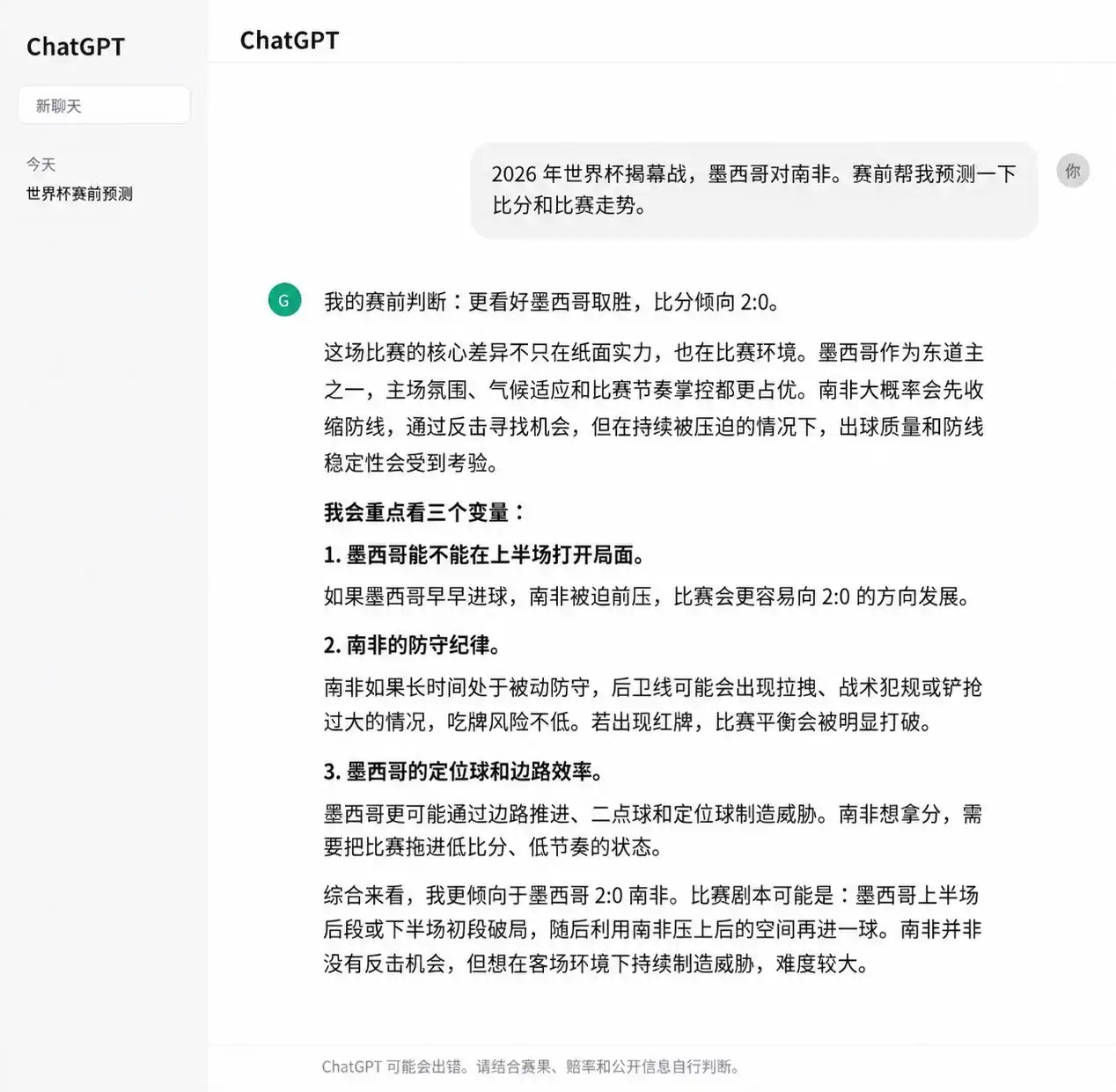
In its opening match prediction, ChatGPT predicted Mexico 2:0 South Africa, hitting the final score. The reasoning it provided was also quite thorough, including Mexico's home advantage, recent form, South Africa's lack of attacking threat, and factors like the high altitude of Mexico City and the home crowd atmosphere. In this prediction, ChatGPT didn't just give a result; the underlying logic also aligned with the match outcome.
However, when it comes to full tournament predictions, ChatGPT's stability isn't as strong. While it correctly predicted Mexico 2:0 South Africa and Brazil 1:1 Morocco, and got the win/loss direction right for several matches like Scotland, Germany, and Sweden, for matches like South Korea 2:1 Czech Republic, Qatar 1:1 Switzerland, Australia 2:0 Turkey, and Japan 2:2 the Netherlands, ChatGPT's predictions favored the team with stronger paper strength. For example, it predicted Switzerland should beat Qatar, Turkey should beat Australia, and the Netherlands should edge Japan.

ChatGPT is not without predictive ability; it can break down team strength, home conditions, and recent form clearly, and can hit the score in some matches. But based on current results, it seems better at explaining 'why the favorite is more logical' rather than identifying in advance which matches might deviate from the favorite's script.

Gemini, Grok, Claude: Different models write different scripts for the same match

Besides Qwen, Copilot, and ChatGPT, some social media users have fed the same match to multiple models for pre-match predictions.

Taking the opening match Mexico vs. South Africa as an example, one blogger simultaneously tested four AI models—ChatGPT, Gemini, Grok, and Claude—for pre-match predictions. The results showed that both ChatGPT and Gemini predicted Mexico 2:0 South Africa, hitting the final score; Grok predicted Mexico 2:1, and Claude predicted Mexico 3:1. While both correctly predicted a Mexico win, they didn't nail the exact score.

For this opening match prediction, different models offered three different 'scripts.' ChatGPT Go and Gemini Pro were closer to the actual match: Mexico dominant, South Africa lacking in attack, ending with a clean sheet. Grok gave a more open scoreline, suggesting South Africa would get a goal back on the counter. Claude Sonnet set higher expectations for Mexico's attack, predicting a more open 3:1 result.

Summary

Since the number of AI prediction samples available for review is still limited at this stage, it's not yet possible to directly judge which model is the most 'football-savvy.'

But just looking at the few matches completed so far, differences are already starting to show. Qwen currently has the most memorable moments, hitting Mexico 2:0 South Africa and South Korea 2:1 Czech Republic on the opening day, and also catching red card risks and match flow, representing a standout performance in a small sample. However, whether it can sustain this accuracy requires verification from more matches.

Copilot and ChatGPT both have highlights of hitting exact scores, but they also share a common issue—their judgment remains insufficiently sensitive to matches that deviate from paper strength, like Australia beating Turkey, Qatar drawing with Switzerland, and Japan drawing with the Netherlands.

As for models like Gemini, Grok, and Claude, the publicly available samples are more focused on single matches or social media comparisons; they have reference value but are not yet suitable for direct rankings.

AI can already serve as one layer of reference for World Cup prediction market users, but it is far from being the standard answer.


Questions liées

QAccording to the article, which AI model had the most impressive start in predicting the World Cup matches?

AAccording to the article, the AI model Qwen (千问) had the most impressive start. It correctly predicted the exact scores (2:0 for Mexico vs. South Africa and 2:1 for South Korea vs. Czech Republic) for the first two matches it covered, and also accurately flagged the risk of a red card for South Africa.

QWhat are the major strengths and weaknesses identified for Copilot's predictions in the article?

AThe article states that Copilot's major strengths included accurately predicting exact scores for several matches, notably a 1:1 draw for Brazil vs. Morocco. Its major weakness was a tendency to be conservative in predicting upsets and draws, as it missed calls for matches like Australia beating Turkey, Qatar drawing with Switzerland, and Japan drawing with the Netherlands.

QHow does ChatGPT's approach to World Cup prediction differ from Copilot's, as described in the article?

AThe article describes ChatGPT as more of a 'pre-match analysis' tool that provides detailed reasoning for its predictions, such as considering home advantage and team form. In contrast, Copilot provided a complete forecast for all 104 tournament matches. However, both models shared a similar weakness in underestimating the likelihood of upsets.

QWhat was the key difference in the predictions for the Mexico vs. South Africa opener between models like ChatGPT/Gemini and Grok/Claude?

AFor the Mexico vs. South Africa opener, ChatGPT and Gemini correctly predicted the exact 2:0 scoreline. Grok predicted a 2:1 win for Mexico, and Claude predicted a 3:1 win. While all four models correctly predicted a Mexico victory, only ChatGPT and Gemini got the specific score and the fact that South Africa would be shut out.

QWhat is the article's overall conclusion about the current state of AI models in predicting World Cup outcomes?

AThe article concludes that while AI models can provide a useful additional reference for prediction market participants, they are far from being a definitive 'standard answer.' Their performance varies, and with a limited sample size of matches, it's too early to definitively judge which model is best. Models have shown they can predict specific scores and trends, but they still struggle with consistently identifying potential upsets or unexpected results.

Lectures associées

9,42 millions de particuliers se ruent sur Changxin Technology, qui a été attribué ?

Les résultats de l'offre publique initiale (IPO) de Changxin Technology sont publiés. L'émission a attiré 942 880 investisseurs particuliers et 285 institutions, avec un nombre record d'actions allouées en ligne. Le taux de succès pour les particuliers s'élève à environ 0,4714%, le plus élevé jamais enregistré pour une nouvelle action sur le marché STAR. Après un mécanisme de rapatriement des actions, le nombre d'actions offertes en ligne a été porté à 3,851 milliards, représentant 50,07% du total. Environ 7,7 millions de numéros gagnants ont été attribués. Les estimations suggèrent qu'un gain potentiel pour un lot gagnant (500 actions) pourrait se situer entre 10 600 et 25 600 yuans selon la valorisation boursière post-introduction. Côté institutions, 285 investisseurs ont reçu 2,173 milliards d'actions, avec un taux d'allocation de 0,1756%. Taikang Asset Management a été la plus grande bénéficiaire. Parmi les fonds communs de placement, E Fund, Southern Fund et ICBC Credit Suisse Trust sont en tête. Dans la catégorie des fonds privés, Liang Wenfeng, fondateur de la société d'IA DeepSeek, via ses entités Ningbo Fantasia Quant et Zhejiang Jiuzhang Asset, a obtenu la plus grande part, avec une allocation d'environ 202,5 millions d'actions d'une valeur de 1,75 milliard de yuans. Des gains potentiels pour ses fonds sont estimés à 7,3 milliards de yuans si la capitalisation atteint 3 000 milliards de yuans. Le Fonds de sécurité sociale national figurait parmi les 30 investisseurs stratégiques, ayant reçu pour 144,37 milliards de yuans d'actions avec une période de blocage. La société devrait être cotée vers le 27 juillet. Les valorisations anticipées par les analystes vont de 1 000 à 4 250 milliards de yuans, malgré des récentes corrections sur les marchés technologiques mondiaux qui pourraient influencer ses débuts en bourse.

marsbitIl y a 38 mins

9,42 millions de particuliers se ruent sur Changxin Technology, qui a été attribué ?

marsbitIl y a 38 mins

Une "déesse de la charité" de 3 millions d'abonnés entièrement créée par IA, un orphelinat factice, un "faux philanthrope" transnational s'effondre du jour au lendemain

**[Guide] Scandale : Une influenceuse australienne prétendant aider des orphelins avec 3 millions d'abonnés a été démasquée pour avoir utilisé l'IA afin de créer de fausses images et vidéos de son oeuvre caritative.** L'ABC révèle que Lily Jay, une influenceuse australienne convertie à l'islam avec près de 3 millions d'abonnés, a orchestré une vaste escroquerie caritative en utilisant l'intelligence artificielle. Sa fondation, le "Lily Jay Foundation", prétendait construire des mosquées, distribuer de la nourriture à Gaza et gérer un orphelinat en Ouganda. Cependant, l'enquête montre que des vidéos clés, notamment celle de l'inauguration de l'orphelinat où des enfants tiennent des sucettes, étaient intégralement générées par IA, avec des incohérences typiques comme des erreurs de texte sur les vêtements. Aucune trace de l'orphelinat "Ada Nur" ou de la boulangerie à Gaza n'a pu être vérifiée sur place. Un trophée "humanitaire" présenté en mai 2026 portait le filigrane invisible d'un générateur d'images AI. Le site web de la fondation admettait discrètement ne pas être un organisme de bienfaisance enregistré, échappant ainsi aux obligations de transparence financière. Opérant depuis Chypre et le Kosovo, Lily Jay (de son vrai nom Lily Jay Hinson) mène une vie luxueuse sur ses réseaux personnels. Après les questions de l'ABC, le site a modifié son contenu pour les visiteurs australiens, supprimant les options de don et les pages compromettantes, tout en les conservant pour le public international. Les experts alertent sur la dangerosité de ces escroqueries qui exploitent la générosité et la volonté de croire en de belles histoires. À l'ère du deepfake, la défense reste un questionnement critique : est-ce vrai ?

marsbitIl y a 1 h

Une "déesse de la charité" de 3 millions d'abonnés entièrement créée par IA, un orphelinat factice, un "faux philanthrope" transnational s'effondre du jour au lendemain

marsbitIl y a 1 h

L2 « recalibrage » : quand L1 devient son propre Rollup, quel est le destin final d’Ethereum ?

"L2 Recalibration": When L1 Becomes Its Own Rollup, What Is Ethereum's Endgame? In recent years, the proliferation of L2s (Rollups) has solved Ethereum's scalability issues but at the cost of fragmenting liquidity, user states, and the unified chain experience. This has prompted a fundamental reevaluation of the relationship between L1 and L2 within the Ethereum community. Ethereum's roadmap is evolving. The core challenge is no longer just creating more block space, but redefining the roles of L1, L2, execution, and settlement layers in a fragmented ecosystem. L1 is actively enhancing its own scalability (increasing Gas Limit, statelessness, zkEVM). Consequently, L2s can no longer rely solely on "cheaper, faster transactions" for long-term value. Their future role shifts towards providing differentiated features (privacy, custom governance, application-specific optimizations) that L1 cannot easily offer uniformly, while still contributing extra capacity. Interoperability is key to restoring a seamless user experience. The goal is not just cross-chain bridges but enabling different execution environments to trust each other's states faster and at lower cost. Initiatives like Open Intents Frameworks and the Ethereum Interoperability Layer (EIL) aim to make cross-L2 interactions feel like single-chain transactions. Crucially, shortening Ethereum's finality time (from minutes to seconds) is a major focus, as it directly benefits cross-chain applications by reducing the trust latency for state changes. A provocative idea from researcher Barnabé Monnot suggests that as proof systems (like zkEVM) mature on mainnet, L1 itself could become a form of "its own Rollup." Here, specialized nodes would execute transactions and generate validity proofs, while validators would verify these proofs instead of re-executing everything. This blurs the traditional L1/L2 hierarchy, making "Rollup" more of a general execution-verification architecture than a strict layer. The vision is a future where multiple L2s act as specialized execution domains (for DeFi, gaming, privacy, etc.) under a shared Ethereum security, settlement, and state framework—a system that is fragmented in execution but unified in trust and liquidity. In conclusion, Ethereum's endgame is not L2s replacing L1 or being made obsolete by a scaled L1. It is an ecosystem where L2s become a spectrum of execution environments with varying features, all capable of securely interoperating and sharing Ethereum's foundational security and liquidity. The next phase is about re-integrating what was fragmented back into a coherent, user-friendly "one chain" experience.

marsbitIl y a 1 h

L2 « recalibrage » : quand L1 devient son propre Rollup, quel est le destin final d’Ethereum ?

marsbitIl y a 1 h

Trading

Spot
活动图片