The Stablecoin Yield Debate: How It's Stalling U.S. Crypto Regulatory Legislation?

marsbitPublié le 2026-03-23Dernière mise à jour le 2026-03-23

Résumé

The debate over stablecoin yields has become a central obstacle to U.S. cryptocurrency regulatory legislation, stalling the Senate’s proposed CLARITY Act. The conflict centers on whether dollar-pegged stablecoins should function solely as payment tools or also offer yield-bearing features that compete with traditional bank deposits and money market funds. Banks argue that yield offerings could drain deposits—potentially up to $500 billion by 2028—undermining their lending capacity and harming local economies. They are pushing Congress to explicitly prohibit such returns. In contrast, crypto firms contend that limited incentives could help digital dollars compete with traditional payment systems and drive mainstream adoption. A Congressional Research Service report highlighted legal ambiguities in the earlier GENIUS bill, which banned direct issuer-yield payments but left room for intermediaries to distribute benefits. This regulatory gap has intensified the legislative standoff. With political deadlines tightening ahead of elections, the window for passing the bill is narrow—likely closing by late April or early May. If Congress fails to act, regulators may impose rules independently, such as the OCC’s proposed restrictions on indirect yield mechanisms. The outcome will shape not only the future of stablecoin yields but also broader crypto market structure, including asset classification and regulatory clarity. Failure could delay legal certainty, forcing the industry to ...

Written by: Oluwapelumi Adejumo

Compiled by: Saoirse, Foresight News

This legislative effort, backed by the President and aimed at establishing more comprehensive regulatory rules for the U.S. cryptocurrency market, is approaching a political deadline at the congressional level. Meanwhile, the banking industry is pressuring lawmakers and regulators to prohibit stablecoin companies from offering yields similar to bank deposit interest.

This contest has become one of the core unresolved issues on Washington's crypto agenda. The focus of the debate is: Should dollar-pegged stablecoins focus solely on payment and settlement functions, or can they add wealth management attributes that compete with bank accounts and money market funds?

The Senate's market structure bill, named the "CLARITY Act," has stalled due to a breakdown in negotiations surrounding so-called "stablecoin yields."

Industry insiders and lobbyists say that if the bill is to have a realistic chance of passage before the election year schedule tightens, the practical window for advancing the bill is from late April to early May.

Congressional Research Service Sharpens the Legal Dispute

The Congressional Research Service's (CRS) definition of this issue is narrower than the public debate suggests.

In a March 6th report, the CRS noted that the "GENIUS Act" prohibits stablecoin issuers from paying yields directly to users, but it does not fully clarify the legality of what it calls the "three-party model"—where intermediaries like exchanges stand between the issuer and the end-user.

The CRS stated that the bill does not explicitly define "holder," leaving room for debate on whether intermediaries could still pass on economic benefits to their customers. This ambiguity is precisely why the banking industry wants Congress to clarify this issue anew within the broader market structure bill.

Banks argue that even limited yield incentives could make stablecoins a strong competitor to bank deposits, impacting regional and community banks particularly hard.

However, crypto firms argue that incentives tied to payments, wallet usage, or network activity can help digital dollars compete with traditional payment channels and potentially elevate their status in mainstream finance.

This divergence also reflects differing perceptions of the future positioning of stablecoins.
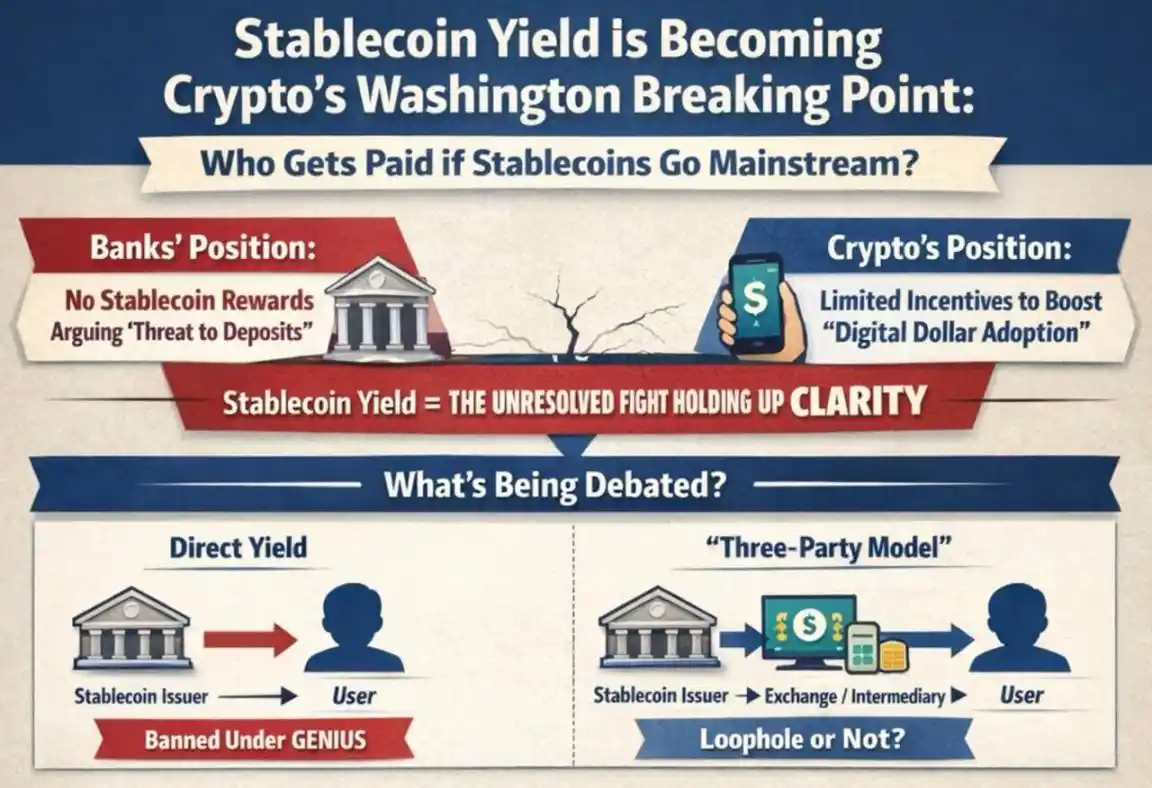
Infographic shows a serious divide between banks and crypto firms on the question of 'who should get stablecoin yields' as the use of digital dollars expands.

If lawmakers primarily view stablecoins as payment tools, the rationale for imposing stricter limits on related rewards becomes stronger. Conversely, if they see them as part of a major shift in how value flows on digital platforms, the argument for supporting limited incentives holds more ground.

Banking associations have urged lawmakers to close what they call a "regulatory loophole" before such reward mechanisms become more widespread. Banks claim that allowing rewards on idle balances would lead depositors to move funds out of banks, thereby weakening the core funding source for loans to families and businesses.

Standard Chartered estimated in January that stablecoins could drain about $500 billion in deposits from the U.S. banking system by the end of 2028, with small and medium-sized banks facing the most pressure.

Infographic compares why banks and crypto care about the stablecoin bill, showing deposit outflows, impact on lenders, cash-back rewards, and bank protectionism.

Banks are also trying to demonstrate to lawmakers that their position has public support. The American Bankers Association recently released a poll result:

  • When the question mentioned that 'allowing stablecoin yields could reduce lendable funds for banks, affecting communities and economic growth,' respondents supported a congressional ban on stablecoin yields by a 3:1 ratio;
  • By a 6:1 ratio, they believed stablecoin-related legislation should be cautious to avoid disrupting the existing financial system, especially community banks.

But the crypto industry counters that banks are simply trying to protect their own funding models by restricting competition from digital dollars.

Industry figures, including Coinbase CEO Brian Armstrong, argue that under the "GENIUS Act," reserve requirements for stablecoin issuers are stricter than for banks—issued stablecoins must be fully backed by cash or cash equivalents.

Transaction Volume Size Raises the Stakes in Washington's Game

Market size has made this yield debate impossible to dismiss as a niche issue.

Boston Consulting Group estimated that the total circulation volume of stablecoins last year was about $62 trillion. After excluding bot trading, internal exchange flows, and other activities, real economic activity was only about $4.2 trillion.

The huge gap between surface trading volume and actual economic use also explains why the "yield" debate has become so critical.

If stablecoins remain primarily a settlement tool for trading and market structure, lawmakers find it easier to define them as payment instruments; but if yield mechanisms turn stablecoins into a widely used cash storage tool in user apps, the pressure on banks would rise rapidly.

To this end, the White House earlier this year tried to broker a compromise: allowing limited yields for specific scenarios like peer-to-peer payments, but prohibiting returns on idle funds. Crypto firms accepted this framework, but banks rejected it, causing Senate negotiations to completely stall.

Even if Congress does not act, regulators may step in to tighten yield models.

The Office of the Comptroller of the Currency (OCC), in a proposed rule implementing the "GENIUS Act," suggested that if a stablecoin issuer provides funds to an affiliate or third party, which then pays yields to stablecoin holders, it would be deemed a disguised payment of prohibited yields.

This means that if Congress cannot legislate a clear stance, the executive branch may draw boundaries itself through regulatory rules.

Congress is Running Out of Time

The current contest is divided into two tracks:

  • Congress debates whether to solve the problem with statute law;
  • Regulators define the boundaries of corporate behavior within the existing legal framework.

For the Senate bill, time itself is the greatest pressure.

Galaxy Digital Head of Research Alex Thorn wrote on social media:

If the CLARITY Act does not pass committee review by the end of April, the probability of passage in 2026 will be extremely low. The bill must reach the full Senate floor for a vote by early May. Legislative time is running out, and the probability of passage decreases with each passing day.

He also cautioned that even if the yield dispute is resolved, a breakthrough for the bill is hardly assured:

It is currently believed externally that the stablecoin yield dispute is holding up the CLARITY Act. But even if a compromise is reached on the yield issue, the bill would likely still face other obstacles.

These obstacles could include decentralized finance (DeFi) regulation, regulatory agency authority, or even ethical issues.

Before the midterm elections in November, crypto regulation is likely to become a larger political battleground. This makes the current stalemate more urgent—once delayed, the bill will face a more crowded political schedule and a more difficult legislative environment.

Prediction markets also reflect a shift in sentiment. In early January, Polymarket gave the bill an ~80% chance of passage; after recent setbacks (including Armstrong calling the current version unworkable), the probability has dropped to near 50%.

Kalshi data shows the probability of the bill passing before May is only 7%, and the probability of passing by the end of the year is 65%.

Bill Failure Would Cede More Decision-Making to Regulators and the Market

The impact of failure extends far beyond the yield debate. The core purpose of the CLARITY Act is to define whether crypto tokens are securities, commodities, or another category, providing a clear legal framework for market regulation.

If the bill is shelved, the entire industry will rely more heavily on regulatory guidance, interim rules, and future political changes.

This is also one reason the market is highly focused on the bill's fate. Bitwise Chief Investment Officer Matt Hougan said earlier this year that the CLARITY Act would codify the current crypto-friendly regulatory environment into law; otherwise, future administrations could reverse existing policies.

He wrote that if the bill fails, the crypto industry will enter a period of "proving itself," needing three years to make itself indispensable to ordinary people and traditional finance.

Under this logic, future industry growth would rely less on the expectation of "legislative landing" and more on whether products like stablecoins and asset tokenization can truly achieve mass adoption.

This presents the market with two截然不同的 paths:

  • Bill Passes → Investors price in the growth of stablecoins and tokenization early;
  • Bill Fails → Future growth relies more on actual adoption, while facing uncertainty from potential policy shifts in Washington.

Flowchart shows the countdown to a stablecoin decision in the Senate, with deadlines on March 6th and late April or early May leading to two paths: if Congress acts, it brings regulatory clarity and faster growth; if Congress fails to act, uncertainty follows.

At this stage, the next move is up to Washington. If senators can restart this market structure bill this spring, lawmakers can still personally define: to what extent stablecoins can pass value to users, and how much of a crypto regulatory framework can be written into statute law. If not, regulators are clearly prepared to draw at least some of the rules themselves.

Regardless of the outcome, this debate has long surpassed "whether stablecoins belong in the financial system," delving into: how stablecoins will operate within the system, and who will benefit from their development.


Questions liées

QWhat is the core issue that has stalled the progress of the CLARITY Act in the U.S. Senate?

AThe core issue stalling the CLARITY Act is the debate over 'stablecoin yields'—specifically, whether stablecoin companies should be allowed to offer interest-like rewards to users, which traditional banks argue creates unfair competition for deposits.

QAccording to the Congressional Research Service (CRS), what legal ambiguity exists in the GENIUS Act regarding stablecoin yields?

AThe CRS report pointed out that the GENIUS Act prohibits stablecoin issuers from paying yields directly to users but does not clearly define 'holder,' leaving a legal ambiguity that allows intermediaries (like exchanges) to potentially pass on economic benefits to end-users.

QWhy are U.S. banks lobbying against allowing stablecoin yields?

ABanks argue that allowing yields on stablecoins would lead to significant deposit outflows from the banking system, especially from community and regional banks, undermining their ability to lend to households and businesses and harming economic growth.

QWhat are the two potential paths for the U.S. crypto market if the CLARITY Act fails to pass?

AIf the CLARITY Act fails, the crypto market faces two paths: 1) Growth becomes more dependent on actual adoption and real-world utility (like payments and tokenization) rather than legislative certainty, and 2) Regulatory agencies may step in to set rules independently, creating a patchwork of guidance and increased policy uncertainty.

QWhat is the practical legislative deadline for the CLARITY Act to have a realistic chance of passage in an election year?

AThe practical window for the CLARITY Act to have a realistic chance of passage is from late April to early May. If it doesn't clear committee by the end of April, its chances in 2026 are considered extremely low due to the tightening election-year schedule.

Lectures associées

Dialogue avec Ray Dalio : Nous sommes actuellement dans une bulle de l'IA, 1% de mon portefeuille est en Bitcoin

Ray Dalio, fondateur de Bridgewater Associates, met en garde contre la bulle actuelle de l'IA, présentant des signes classiques similaires aux précédents krachs financiers. Il explique qu'une combinaison de spéculation excessive, d'endettement et de changements de taux d'intérêt pourrait provoquer son éclatement, entraînant une récession économique. Dalio décrit également un « grand cycle » mondial d'environ 80 ans, caractérisé par des inégalités croissantes, des déficits publics élevés et des tensions géopolitiques. Nous serions actuellement dans une phase de déclin de ce cycle, avec un ordre mondial en transition. Pour protéger leur patrimoine, il conseille aux investisseurs de diversifier leurs actifs (actions, obligations, or, immobilier) plutôt que de détenir uniquement des liquidités. Il mentionne détenir environ 1% de Bitcoin, mais préfère l'or physique pour sa stabilité. Concernant l'IA, Dalio souligne qu'elle remplacera progressivement le travail intellectuel humain, creusant les inégalités. L'avenir appartiendra à ceux qui sauront allier intelligence humaine et collaboration avec l'IA. Enfin, il évoque un monde de plus en plus régionalisé, avec un affaiblissement de la puissance américaine, visible dans des conflits comme celui avec l'Iran, et la montée en puissance d'autres pôles, notamment la Chine.

marsbitIl y a 3 h

Dialogue avec Ray Dalio : Nous sommes actuellement dans une bulle de l'IA, 1% de mon portefeuille est en Bitcoin

marsbitIl y a 3 h

7,2 billions de KRW en une journée, les achats nets des investisseurs étrangers atteignent un record historique ce vendredi ! Wall Street : Les vents contraires sur les flux de capitaux sud-coréens se sont dissipés

Les marchés boursiers sud-coréens montrent des signes tangibles d'amélioration des flux de capitaux. Le 31 juillet, les investisseurs étrangers ont réalisé un achat net record de 7 200 milliards de wons sur une seule journée dans le KOSPI, marquant un renversement de la tendance de sorties massives observée ces derniers mois. En juillet, leurs ventes nettes mensuelles se sont fortement réduites à 9 800 milliards de wons, contre 48 400 et 44 500 milliards en juin et mai respectivement. Parallèlement, les institutions domestiques comme les fonds de pension ont inversé leur tendance, passant à un achat net de 1 000 milliards de wons en juillet. La Commission des services financiers a également resserré l'accès aux ETF à effet de levier sur actions individuelles pour les investisseurs de détail, réduisant ainsi la volatilité du marché. Citigroup Research maintient son objectif pour le KOSPI à 10 000 points, estimant que les vents contraires liés aux flux de capitaux s'atténuent. Des facteurs tels que les fondamentaux solides du secteur des puces mémoire, les faibles valorisations du marché, une économie robuste et un environnement politique favorable devraient soutenir le marché. La possibilité d'interventions des autorités pour stabiliser le marché offre également un filet de sécurité.

marsbitIl y a 3 h

7,2 billions de KRW en une journée, les achats nets des investisseurs étrangers atteignent un record historique ce vendredi ! Wall Street : Les vents contraires sur les flux de capitaux sud-coréens se sont dissipés

marsbitIl y a 3 h

Choc ! La prochaine IA d'OpenAI résout 10 problèmes du calibre de la Médaille Fields

**OpenAI provoque un séisme mathématique avec son nouveau modèle Astra** OpenAI a dévoilé des avancées mathématiques majeures réalisées par son modèle interne Astra, présenté par Sam Altman. L'IA aurait résolu ou fait progresser dix problèmes complexes dans des domaines variés comme la géométrie haute dimension, la théorie des groupes et la complexité quantique. Le résultat le plus marquant est la construction du premier groupe "non sofic" infini et finiment présenté, réfutant une conjecture de Mikhail Gromov vieille de 27 ans. Cette seule découverte est qualifiée de niveau "Prix Fields". Astra a également amélioré une borne fondamentale sur le problème de l'empilement des sphères en haute dimension, stagnant depuis 1978, et a réfuté la conjecture de rigidité d'Alain Connes en construisant une infinité de groupes non isomorphes partageant la même algèbre de von Neumann. Ces résultats, compilés dans un document de 249 pages, sont accompagnés de preuves formelles vérifiées par l'assistant Lean 4. OpenAI précise que le coût total de génération de ces démonstrations aurait été inférieur à 2000 dollars. La communauté mathématique réagit avec stupeur, certains experts y voyant un tournant historique où l'IA démontre une intuition et une capacité de raisonnement pouvant surpasser les meilleurs mathématiciens humains.

marsbitIl y a 5 h

Choc ! La prochaine IA d'OpenAI résout 10 problèmes du calibre de la Médaille Fields

marsbitIl y a 5 h

Grâce aux lancers de dés, les clés Bitcoin sont stockées hors ligne, mais tout le monde ne s'y mettra pas

Le titre « Les clés Bitcoin protégées par des dés, mais la méthode reste marginale » introduit un article sur la génération manuelle de graines de portefeuille Bitcoin à l'aide de dés. L'article explique le concept d'entropie, illustré par Claude Shannon, où un dé à six faces génère environ 2,585 bits d'incertitude. Il aborde le scandale récent de Coldcard, où une vulnérabilité du générateur de nombres aléatoires matériel a compromis des fonds. Les utilisateurs ayant généré leur phrase de récupération avec des dés (environ 99 lancers pour une haute sécurité) n'étaient pas affectés pour leur seed principal. Cependant, l'analyse du chercheur Kevin Loaec montre que d'autres fonctions du portefeuille (clés de copie, portefeuilles papier, mots de passe, etc.) utilisaient ce générateur défectueux et restaient vulnérables. L'article souligne les défis pratiques de la méthode des dés : elle est longue, sujette aux erreurs de saisie, et peu adaptée aux nouveaux utilisateurs qui pourraient mal l'exécuter. Il conclut que si cette méthode manuelle est robuste pour les experts, l'objectif à long terme est d'avoir un matériel et des logiciels générant une entropie fiable de manière simple et sécurisée. Il conseille aux propriétaires de Coldcard de vérifier leur firmware et les fonctions utilisées, et rappelle l'intérêt des solutions multi-signatures avec différents fabricants pour limiter les risques.

cryptonews.ruIl y a 8 h

Grâce aux lancers de dés, les clés Bitcoin sont stockées hors ligne, mais tout le monde ne s'y mettra pas

cryptonews.ruIl y a 8 h

Trading

Spot
活动图片




