The Midlife Crisis of Crypto GPs: No PMF, No Next Check from LPs

marsbitPublié le 2026-06-01Dernière mise à jour le 2026-06-01

Résumé

The article "The Midlife Crisis of Crypto GPs: No PMF, No Next LP Check" analyzes the shifting crypto fundraising landscape. It argues the era of selling grand visions to LPs is over; GPs must now offer products with clear Product-Market Fit (PMF). The author categorizes crypto fundraising products into three types: Primary (VC funds), Liquid (trading strategies), and CeFi/DeFi Native Yield. This summary focuses on the Primary market. Key points include: * **Market Shift:** LPs are impatient, demand immediate returns, and are skeptical of future promises. The "easy money" narrative has faded. * **GP Value Erosion:** LP learning curves have shortened (aided by AI), reducing the value of a GP's basic "crypto knowledge." Superior judgment is now rare. * **Weakened LP Motivations:** Traditional reasons for LPs to invest in crypto VC funds (capturing industry beta, gaining access, leveraging GP judgment) have weakened due to new products like ETFs and increased LP sophistication. * **Surviving in Primary:** The primary market will likely persist for: 1) large funds in endowment mandates treating it as a lottery ticket, 2) family offices/HNWIs using proprietary capital, 3) a few funds with proven recent outperformance, and 4) funds with strong ecosystem "deal-making" capabilities. * **Conclusion:** For most GPs, rebuilding trust requires starting over in a niche, demonstrating alpha-generating ability, or providing concrete value/services to LPs.

Author: Yi.Pineapple

LPs are no longer buying dreams; GPs must sell products. This article will attempt to categorize current crypto fundraising products into three types: Primary, Liquid, and CeFi / DeFi Native Yield. The first part focuses on Primary: after VC blind pools have lost their appeal, who remains at this table, and who must prove themselves anew? The answer is at the end; you can scroll directly to the bottom.

Note: This article aims to provide a landscape overview of the entire crypto fundraising market. The first part mainly categorizes and explains the current market situation from a product perspective, while the second part will analyze more from the perspective of LPs. As the author is primarily based in the Asian market, this article may have a regional bias.

Market Status

Having lost the grand vision, most Crypto GPs who failed to earn excess returns this cycle must get down to earth and launch a product with PMF. They must either prove they still have the ability to generate excess returns for LPs through some niche market or help LPs/partners solve specific problems in order to survive.

  • For most GPs, this market has long moved from the stage of "buying a future vision" to the stage of "buying a specific product."
  • LPs have lost patience and no longer want to gaze at the stars and the sea; they want to see something that can make money immediately, right away, and with relative certainty.
  • Crypto LPs have lost trust in the market and are no longer willing to easily believe the "next cycle" narrative (this has been discussed too much and will not be elaborated here). Moreover, many did not make easy money this cycle. Once the way to make money becomes difficult, investment actions tend to become more cautious and conservative.
  • Most traditional LPs have also completed a round of learning and moved past the story-listening stage. The 2020/2021 bull market was the time of peak FOMO. Dollar funds were cheap (Treasury yield close to 0), LPs were still making money relatively easily (on the eve of the economic downturn), and Crypto was in an explosive period (there were many wealth creation myths, and there was still a dream to sell). Back then, many people, even with only a vague understanding of crypto, were willing to make impulsive purchases for the dream; or, for strategic reasons, paid to enter and learn.
  • AI and falling labor costs have also changed the positioning of GPs. The costs for LPs to learn, hire, analyze data, trade, and make small direct investments are all declining. The trend of LPs transforming into GPs is significant. If GPs only offer the vague capability of "I understand crypto," their value will become increasingly precarious.
  • As for the storytelling track, unless they are U.S.-based funds with strong brand power, who, based on their past track records, can still tell stories and visions in specific niches (e.g., a16z leveraging its advantage in the AI sector to talk about crypto * AI, Dragonfly leveraging its investments in Ethena/Polymarket to talk about internet capital markets), there is still an opportunity. In Asia, this positioning is already difficult. After all, to some extent, in both crypto projects and funds, the opportunity to tell stories often goes to those with a "white paper" (a play on words implying Western or native English speakers have an advantage).

Product Overview

This article categorizes crypto fundraising products into three major types for discussion: Primary, Liquid, and CeFi / DeFi Native Yield (Note: This categorization is not entirely precise; there are some blurred lines between the three). (*This time, only Primary is covered)

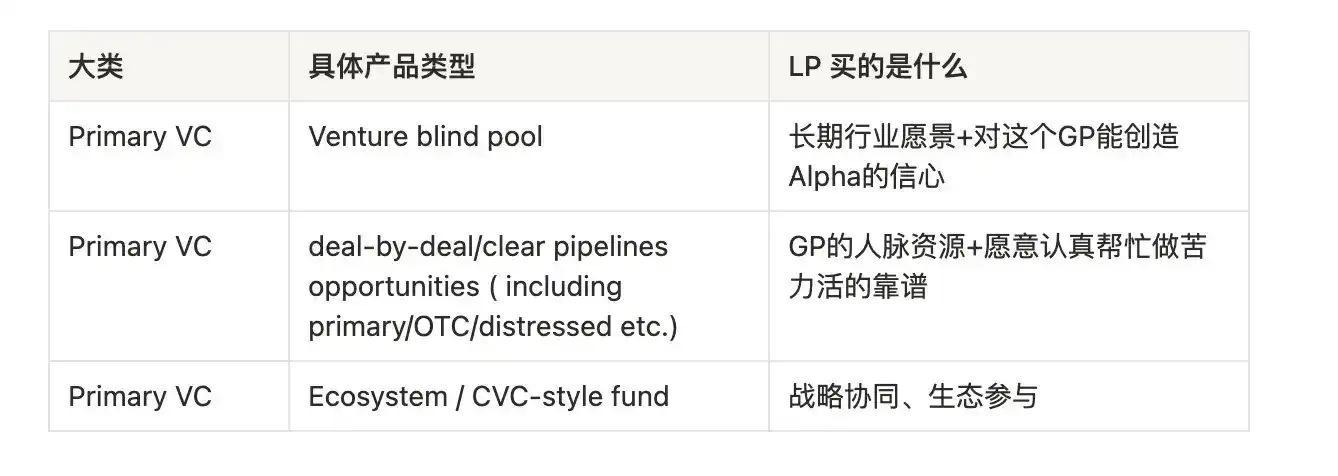
Primary VC:

In terms of transparency, they can be roughly divided into blind pools and those with clear pipelines.

In terms of liquidity, they can be roughly divided into primary and primary-secondary.
Liquid:

In terms of source of returns, roughly divided into alpha-focused (buying GP's personal ability) and beta-focused (buying industry trends).

In terms of directionality, roughly divided into directional (buying cycle judgments) and market neutral (buying market inefficiencies in immature markets).
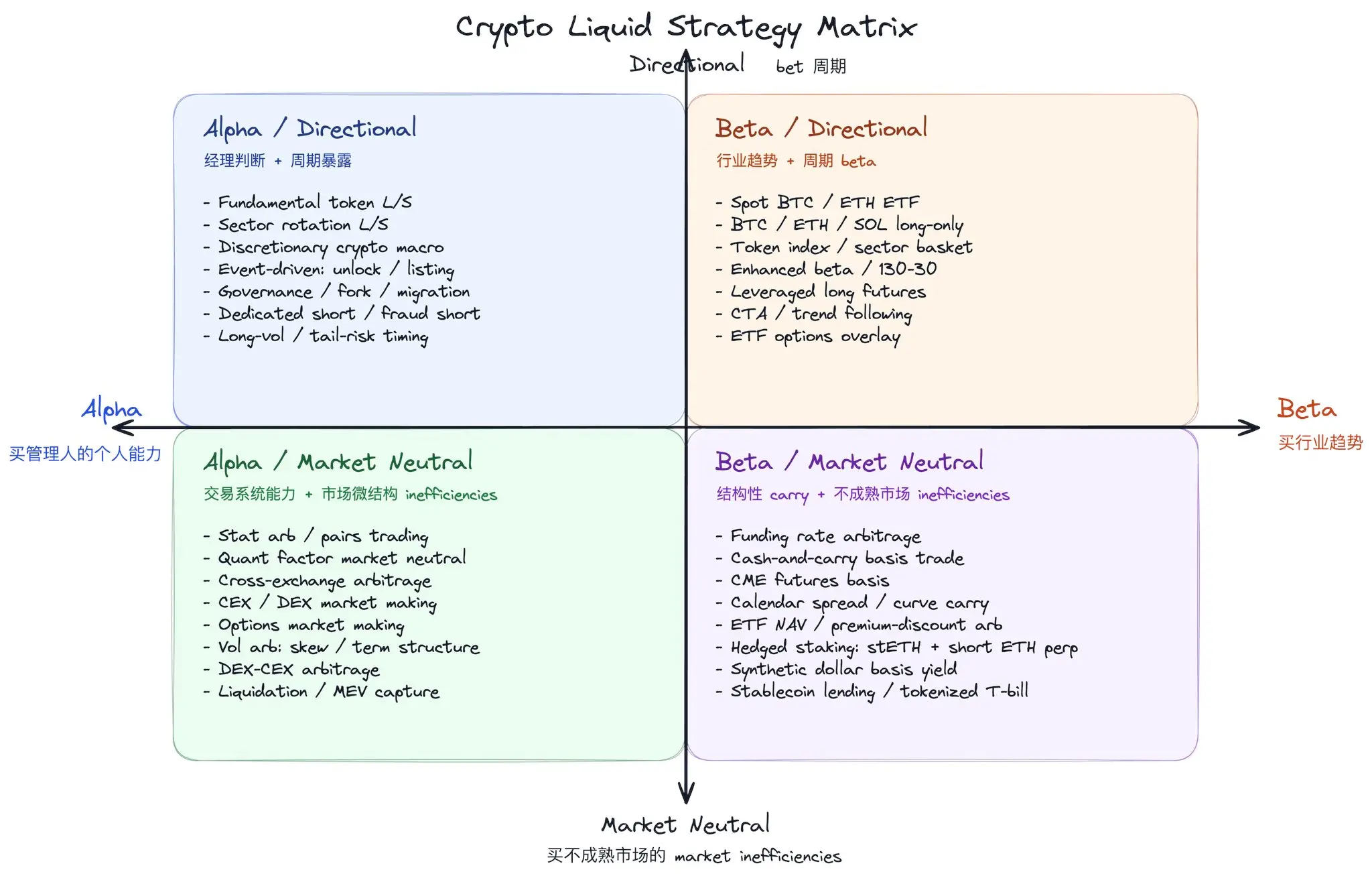
There are many ways to categorize; this is just to provide an idea

CeFi/DeFi Native Yield:

In theory, CeFi/DeFi Native Yield can be viewed as a type of return source within or spanning the crypto primary market and liquid market. The reason for listing it separately is mainly because, from the perspective of TradFi investors, they usually use the framework of traditional financial markets to understand crypto: for example, crypto VC can be understood as a sub-sector under the VC category, and staking/lending yield can be analogized to fixed income or cash management products.

However, crypto indeed contains some玩法 (play/mechanisms) and return mechanisms not entirely corresponding to traditional financial markets, such as mine-trade-sell, points/airdrop farming, protocol incentives, on-chain liquidity mining, etc. These are more like crypto-native issuance, user acquisition, and incentive mechanisms, warranting separate discussion.

Secondly, for many Crypto Native Investors, their earliest entry point and understanding of financial markets were not the traditional equity/bond market, but rather crypto-native scenarios like exchange wealth management products, staking, DeFi lending, LP, points/airdrop farming, basis trade, etc. Therefore, when they look at this part of the yield, they may not necessarily translate it into TradFi's fixed income, cash management, or alternative yield first. Instead, they more naturally understand it from the perspectives of protocol incentives, liquidity provision, token emission, on-chain risk, counterparty risk, and capital efficiency.

For Crypto Native LPs, accessing this part of the yield does not require a GP; at most, they might need a reliable key account manager.

For TradFi LPs, there are now some institutions packaging this part of the yield into fund forms to sell to TradFi LPs.

Primary Market

From the perspective of the entire primary market, crypto VC is just a sub-sector under the VC category. 2021 was a crazy year; whether crypto or non-crypto, the real returns of that vintage are not good. As a cruel fact, LPs have learnt their lessons, tired of any products with ultra-long lock-up periods (traditional VC typically 10 years, crypto VC also often 5-10 years). Because without a hard lock-up, they at least have the chance to withdraw part of their money if circumstances change.

In a sense, crypto is even worse off than traditional VC because the entire vision has collapsed. It is not a new industrial revolution; at most, it's a revolution in financial infrastructure. This judgment is not to disparage crypto—a revolution in financial infrastructure is still very important—but it's not as grand as many imagined in the last bull market. Worse, the market was too immature back then, and many projects were invested in without sufficient due diligence and legal protection. Many failed projects are a combination of investment failure and founders running away. There are already too many articles in the industry discussing the current dire situation; it will not be elaborated here.

Investing in VC is like VC investing in projects—a power-law business, a lottery-like business. As long as there are people willing to buy lottery tickets, this table will not disappear.

Why LPs invested in crypto VC back then, and why these reasons have weakened now

1. Invest to capture the beta of the industry

This reason was especially valid for tradfi LPs. It was true in the early days because market choices were few. For outsiders, on-ramping, buying tokens, going on-chain, using CEXs, and managing wallets were all difficult. They worried about losing private keys and CEXs running away. Investing in VC seemed like a more reliable access point then.

But today, when a traditional LP enters crypto, they have a whole set of choices before them: BTC ETF, ETH ETF, crypto ETP, DAT, custody accounts, SMAs, structured products. More importantly, these products do not require them to learn on-chain operations; they can trade just like they used to buy stocks.

According to CoinShares, the AUM of global digital asset investment products it covered reached about $156.9B in mid-May 2026. This number is not the total industry AUM, only the ETF/ETP/trust/closed-end funds and other listed or quotable products. But it's enough to show that gaining crypto exposure no longer requires investing in VC blind pools.

However, for long-term capital with clear mandates (e.g., endowment, etc.), this reason still applies. For them, to position in an industry often requires allocating to a basket of assets, so there is still likely a 1~2% allocation to Crypto VC.

2. Invest for accessibility

This usually happened to crypto LPs and some tradfi LPs with strategic positioning visions. At that time, many such LPs did not have the energy/time/ability to build their own investment teams, so they gave money to GPs, hoping to get good deal access.

But they later found this reason unstable too. When the market is good, GPs themselves don't have enough allocation, and it's hard for LPs to get truly good access. When the market is bad, competition is not fierce, and if you are willing to engage, getting allocation is not that difficult.

For traditional LPs, access had another meaning: they knew nothing at the time but hoped to enter the ecosystem and gain insider information by investing in crypto-native GPs. This was a strategic investment when there was no clear strategic target. Now the situation has changed. Many traditional LPs have either left for hotter industries like AI or have developed their own internal teams. AI and cheap researchers have narrowed the knowledge gap. New learners still exist, but their learning speed is accelerating, and their paths are multiplying; investing in the primary market with ultra-long lock-ups may not be the optimal choice for them.

3. Invest for judgment

This is the trickiest part. In a market developing extremely fast, unless GPs can continuously self-iterate, the judgment premium will disappear quickly. The rules of the game change every cycle, but it's not easy for people to change themselves (is this another version of "old habits die hard"?).

We must face a cruel reality: most GPs did not prove to LPs in the last cycle that they had superior judgment.

For traditional LPs, part of the purpose of investing in crypto-native GPs back then was to educate themselves and learn the industry through the GP's judgment. This typically happened to two types: one was companies hoping to strategically enter web3, such as large internet companies; the other was sophisticated tradfi investors, such as traditional GPs or family offices, who wanted to do their own web3 direct investment in the future. The learning period is now over, and only a small number of GPs who have truly proven they have superior judgment can remain on their investment lists.
For crypto LPs, they found that rather than betting on a GP's judgment, it's better to lose money themselves. Losing money themselves at least has emotional value, and they don't have to pay management fees.

4. Invest for deal-making ability

From an investment return perspective, deal-making ability mainly manifests as whether it can achieve a good exit for the project ultimately. Ideally, it would be best to help the project achieve healthy growth and ultimately obtain good returns in the secondary market. Otherwise, having the ability to organize the next round of financing is also important (essentially the difference between relying on retail investors or large investors to take over).

However, as a form of financial innovation, Crypto sometimes resembles a large-scale capital game. Sometimes, investment is just a way of exchanging interests, ensuring everyone has aligned interests and can make money together relatively assuredly.

5. Invest for reputation

For some large LPs, the money invested in a single VC is only about 1% of their overall portfolio, negligible. Sometimes they invest in a GP just to be cool (like investing in A16Z). However, most GPs are not in this category.

Who can still stay at the primary table

From a pure capital source perspective, the players most likely to continue staying at the primary table are:

Funds large enough to enter the mandates of endowments/other similar long-term patient capital. These institutions buy crypto VC as lottery tickets, without short-term funding pressure.

FOs, companies, HNW proprietary primary crypto investments using their own money. FOs/HNWs are more likely to do accelerator-like, very early funds; companies are more likely to do direct strategic investments/acquisitions.

The few funds that really made bets/accumulated BTC this cycle and actually generated excess returns for LPs. LPs believe they can win next time.

Funds with clear deal-making ability, possessing ecosystem resources that can be exchanged for interests with LPs.

For other players, if trust has been lost, it might be better to mentally start over and rebuild trust. Prove the ability to generate excess returns for investors again in a niche sector, or provide some specific service/value, and then scale up based on that.


Cryptos en tendance

Questions liées

QAccording to the article, what is the main reason why most crypto GPs are now forced to develop a product with Product-Market Fit (PMF)?

AThe main reason is that LPs have lost patience and are no longer willing to invest based on future visions or 'the next cycle' narrative. They now demand immediate, relatively certain profit opportunities or specific problem-solving capabilities. The market has shifted from 'buying a future vision' to 'buying a specific product.'

QInto which three broad categories does the article classify crypto fundraising products?

AThe article classifies crypto fundraising products into three categories: 1. Primary (like VC funds), 2. Liquid (trading-focused products), and 3. CeFi / DeFi Native Yield (products based on staking, lending, airdrop farming, etc.).

QWhat was a key reason for traditional LPs to invest in crypto native GPs in the past that has now significantly weakened?

AA key past reason was 'Invest for accessibility'—LPs lacked the knowledge, team, or operational ability to enter crypto directly and used GPs to access deals and insider information. This has weakened as learning resources improved, internal teams were built, and easier access products (like ETFs) emerged, reducing the necessity of a VC blind pool for exposure.

QWhat does the article identify as 'the most tricky part' regarding the 'Invest for judgement' reason for backing a GP?

AThe most tricky part is that the 'judgement premium' of a GP can disappear quickly in the fast-evolving crypto market unless the GP can continuously self-iterate. The article states the harsh reality that most GPs failed to prove they had superior judgement in the last cycle, eroding LP trust.

QBased on the article, which types of players are most likely to remain at the 'primary' investment table?

A1. Large funds that fit into the mandate of long-term, patient capital like endowments. 2. Family Offices, companies, and High-Net-Worth individuals investing their own money. 3. A few funds that delivered outsized returns in this cycle. 4. Funds with clear ecosystem resources and deal-making ('攒局') capabilities for利益置换 (interest exchange).

Lectures associées

Après trois trimestres consécutifs de baisse, le marché des cryptomonnaies pourra-t-il connaître une fenêtre de stabilisation au troisième trimestre ?

Le marché des cryptomonnaies a enregistré son pire trimestre depuis 2022, avec une capitalisation totale chutant de 12,6% à 2 100 milliards de dollars. Tous les indicateurs clés (volume des échanges, valeur des stablecoins) montrent une sortie nette de capitaux. Le Bitcoin a perdu 14,2% et l'Ethereum 25,4% sur le trimestre, rompant sa corrélation antérieure avec les actions technologiques. Les ETF spot américains sur le Bitcoin ont subi des rachats massifs, avec une sortie nette de 4,67 milliards de dollars au Q2, indiquant une pression de vente continue. Le resserrement de la politique de la Fed et les ventes d'entreprises comme Strategy ont accentué la déleveragisation du secteur. L'attention du marché se porte désormais presque exclusivement sur la réunion de la Fed fin juillet. Une position accommodante pourrait stabiliser le Bitcoin entre 68 000 et 84 000 dollars, tandis qu'un ton hawkish pourrait le faire osciller autour de 50 000-56 000 dollars. Parallèlement, la progression du *CLARITY Act*, une loi cruciale pour la clarté réglementaire, est au point mort au Sénat, réduisant les chances d'adoption en 2026 et maintenant une prime de risque élevée sur l'ensemble du secteur. Malgré ce contexte difficile, quelques secteurs résistent : les marchés de prédiction ont vu leur volume nominal augmenter de 48,7% et les biens collectionnables tokenisés ont progressé d'environ 143%. La tokenisation d'actifs du monde réel (RWA) continue également sa croissance régulière, portée par des fondamentaux indépendants du cycle crypto. Les bases d'un effondrement extrême semblent absentes, mais le marché est désormais guidé par les politiques monétaires, les prix et les attentes de taux, plutôt que par le simple récit haussier. La fin des sorties massives des ETF et le retour des achats des détenteurs à long terme pourraient indiquer une phase de stabilisation potentielle.

marsbitIl y a 4 h

Après trois trimestres consécutifs de baisse, le marché des cryptomonnaies pourra-t-il connaître une fenêtre de stabilisation au troisième trimestre ?

marsbitIl y a 4 h

The SpaceX Trade, Unlocked: SPCXON Débarque sur WEEX

En juin 2026, SpaceX a réalisé la plus grande introduction en bourse de l'histoire, mais l'accès à l'action a été limité pour de nombreux investisseurs en raison de restrictions régionales et de frictions liées aux courtiers. La plateforme WEEX propose désormais une solution via SPCXON/USDT, un instrument tokenisé sur le marché au comptant qui permet d'obtenir une exposition au cours de SpaceX en utilisant l'USDT, sans nécessiter de compte de courtage américain. SPCXON est un produit tokenisé construit sur l'infrastructure d'Ondo, conçu pour refléter l'économie de la détention d'actions SpaceX pour les traders éligibles en dehors des États-Unis, avec des dividendes réinvestis. Le cas d'investissement repose sur la croissance des revenus de Starlink et les progrès de Starship, malgré un valorisation déjà élevée et des risques liés à un flottant public réduit et à des déblocages d'actions internes à venir. Il est important de noter que SPCXON offre une exposition, et non la propriété directe d'actions ou de droits de vote. Son prix peut évoluer avec une prime ou une décote par rapport à la valeur liquidative. WEEX propose également d'autres produits tokenisés comme MSTRON et MUON dans un compte unifié, permettant une rotation entre crypto-monnaies et actions traditionnelles sans transfert de fonds. La plateforme souligne ainsi comment les barrières entre la finance traditionnelle et les actifs numériques s'estompent.

TheNewsCryptoIl y a 4 h

The SpaceX Trade, Unlocked: SPCXON Débarque sur WEEX

TheNewsCryptoIl y a 4 h

BIT Trading Moment : Le BTC reste sous la pression de l'EMA 200 hebdomadaire, un rejet pourrait relancer la baisse, les actions de stockage et de semi-conducteurs qui ont bondi cette nuit ont baissé en séance de nuit

**Résumé des marchés : Bitcoin sous pression, actions technologiques en réajustement** Le marché crypto poursuit son rebond, avec Bitcoin évoluant autour de 66 000 $. Il fait face à une résistance clé vers 68 000 $, niveau correspondant au coût moyen des investisseurs sur cinq mois. Les traders surveillent les moyennes mobiles clés (200 MA à ~63 333 $ et 200 EMA à ~68 328 $ en hebdomadaire). Une rupture au-dessus de 68 000 $ ouvrirait la voie à une hausse, tandis qu'un échec pourrait entraîner un retest des 63 000 $. L'analyse suggère que la dynamique actuelle ressemble à un rebond estival à faible liquidité plutôt qu'au début d'un véritable marché haussier. Sur le marché actions américain, après une forte séance mardi portée par les semi-conducteurs et les titres du stockage (Micron, AMD, Intel...), les contrats à terme indiquent une ouverture en baisse. Les secteurs ayant récemment bondi, comme les semi-conducteurs et le stockage, reculent en séance de nuit. Certaines valeurs se démarquent néanmoins, comme Super Micro Computer (SMCI), en hausse après des résultats et des perspectives robustes liées à la demande de serveurs IA. Des vents contraires persistent : les prix du pétrole (Brent >91$) et les rendements des obligations d'État américaines grimpent, ravivant les craintes inflationnistes. En Asie, les marchés ont suivi le rebond technologique américain, mais de manière hésitante. La tension reste forte sur le yen japonais, qui atteint son plus bas niveau depuis des décennies. **Points clés à surveiller :** * **Crypto :** Niveaux techniques de Bitcoin (68k$/63k$), flux des ETF spot. * **Actions :** Saison des résultats (Tesla, Alphabet, Intel...), activité d'AMD sur l'IA. * **Économie :** Données américaines sur l'emploi, décision de la BCE, tensions géopolitiques et prix de l'énergie.

marsbitIl y a 4 h

BIT Trading Moment : Le BTC reste sous la pression de l'EMA 200 hebdomadaire, un rejet pourrait relancer la baisse, les actions de stockage et de semi-conducteurs qui ont bondi cette nuit ont baissé en séance de nuit

marsbitIl y a 4 h

Gate Research Institute : La vague de « Wall Streetisation » des produits financiers cryptographiques, concurrence ou fusion ?

Le titre de l'article est : "Gate Institute : La vague de 'Wall Street-isation' des produits financiers cryptos, est-ce une compétition ou une fusion ?" Résumé en français (environ 1400 caractères) : Il y a dix-sept ans, Bitcoin fut créé avec une vision décentralisée et anti-establishment financier. Aujourd'hui, paradoxalement, son adoption massive passe souvent par des ETF émis par des géants comme BlackRock. Cet article analyse cette "Wall Street-isation" apparente des actifs cryptos : les institutions traditionnelles s'emparent-elles du pouvoir d'émission, de tarification, de garde et de distribution ? La réalité est plus nuancée. C'est une convergence à double sens. D'un côté, les plateformes cryptos comme Gate.io étendent leurs services aux actions traditionnelles (états-uniennes, hongkongaises, sud-coréennes), aux CFD et aux produits tokenisés, offrant un compte unifié. De l'autre, des courtiers traditionnels comme Robinhood intègrent les cryptomonnaies et explorent la tokenisation d'actions sur blockchain. Cette fusion vise à créer le "super-compte" financier de demain, où actions, cryptos, ETF et obligations tokenisées (RWA) coexistent dans une même interface, comblant les faiblesses de chaque écosystème. Les RWA, notamment les obligations d'État tokenisées, agissent comme une couche intermédiaire unificatrice. En conclusion, Wall Street n'a pas conquis la crypto, et la crypto n'a pas contourné Wall Street. Ils construisent ensemble une nouvelle forme de marché des capitaux, plus efficace et mondial, où l'idéal décentralisé persiste dans les protocoles, tandis qu'une expérience utilisateur unifiée émerge à l'interface.

marsbitIl y a 4 h

Gate Research Institute : La vague de « Wall Streetisation » des produits financiers cryptographiques, concurrence ou fusion ?

marsbitIl y a 4 h

Trading

Spot

Articles tendance

Comment acheter CHECK

Bienvenue sur HTX.com ! Nous vous permettons d'acheter Checkmate (CHECK) de manière simple et pratique. Suivez notre guide étape par étape pour commencer votre parcours crypto.Étape 1 : Création de votre compte HTXUtilisez votre adresse e-mail ou votre numéro de téléphone pour ouvrir un compte sur HTX gratuitement. L'inscription se fait en toute simplicité et débloque toutes les fonctionnalités.Créer mon compteÉtape 2 : Choix du mode de paiement (rubrique Acheter des cryptosCarte de crédit/débit : utilisez votre carte Visa ou Mastercard pour acheter instantanément Checkmate (CHECK).Solde :utilisez les fonds du solde de votre compte HTX pour trader en toute simplicité.Prestataire tiers :pour accroître la commodité d'utilisation, nous avons ajouté des modes de paiement populaires tels que Google Pay et Apple Pay.P2P :tradez directement avec d'autres utilisateurs sur HTX.OTC (de gré à gré) : nous offrons des services personnalisés et des taux de change compétitifs aux traders.Étape 3 : stockage de vos Checkmate (CHECK)Après avoir acheté vos Checkmate (CHECK), stockez-les sur votre compte HTX. Vous pouvez également les envoyer ailleurs via un transfert sur la blockchain ou les utiliser pour trader d'autres cryptos.Étape 4 : tradez des Checkmate (CHECK)Tradez facilement Checkmate (CHECK) sur le marché Spot de HTX. Il vous suffit d'accéder à votre compte, de sélectionner la paire de trading, d'exécuter vos trades et de les suivre en temps réel. Nous offrons une expérience conviviale aux débutants comme aux traders chevronnés.

685 vues totalesPublié le 2026.01.19Mis à jour le 2026.06.02

Comment acheter CHECK

Discussions

Bienvenue dans la Communauté HTX. Ici, vous pouvez vous tenir informé(e) des derniers développements de la plateforme et accéder à des analyses de marché professionnelles. Les opinions des utilisateurs sur le prix de CHECK (CHECK) sont présentées ci-dessous.

活动图片












