Tens of Millions of Errors Per Hour: Investigation Reveals the 'Accuracy Illusion' of Google AI Search

marsbitPublié le 2026-04-10Dernière mise à jour le 2026-04-10

Résumé

A New York Times investigation, in collaboration with AI startup Oumi, reveals significant accuracy and reliability issues with Google's AI Overviews search feature. Testing over 4,300 queries showed the accuracy rate improved from 85% (Gemini 2) to 91% (Gemini 3). However, given Google's scale of ~5 trillion annual searches, this 9% error rate translates to over 57 million incorrect answers generated hourly. A more critical issue is the prevalence of unsubstantiated citations. For correct answers, the rate of "unfounded citations"—where provided source links do not support the AI's claims—worsened, rising from 37% with Gemini 2 to 56% with Gemini 3. This makes it difficult for users to verify the information. The AI also heavily relies on low-quality sources, with Facebook and Reddit being its second and fourth most cited domains. Furthermore, the system is highly susceptible to manipulation. A BBC journalist successfully "poisoned" it by publishing a fake article; Google's AI began presenting the false information as fact within 24 hours. Google disputed the study's methodology, criticizing the use of the SimpleQA benchmark and an AI model (Oumi's HallOumi) to evaluate its own AI. The company maintains that its internal safeguards and ranking systems improve accuracy beyond the base model's performance.

Author: Claude, Deep Tide TechFlow

Deep Tide Introduction: The latest test by The New York Times in collaboration with AI startup Oumi shows that the accuracy rate of Google Search's AI Overviews feature is about 91%. However, given Google's scale of processing 5 trillion searches annually, this translates to tens of millions of incorrect answers generated every hour. More troublingly, even when the answers are correct, over half of the cited links fail to support their conclusions.
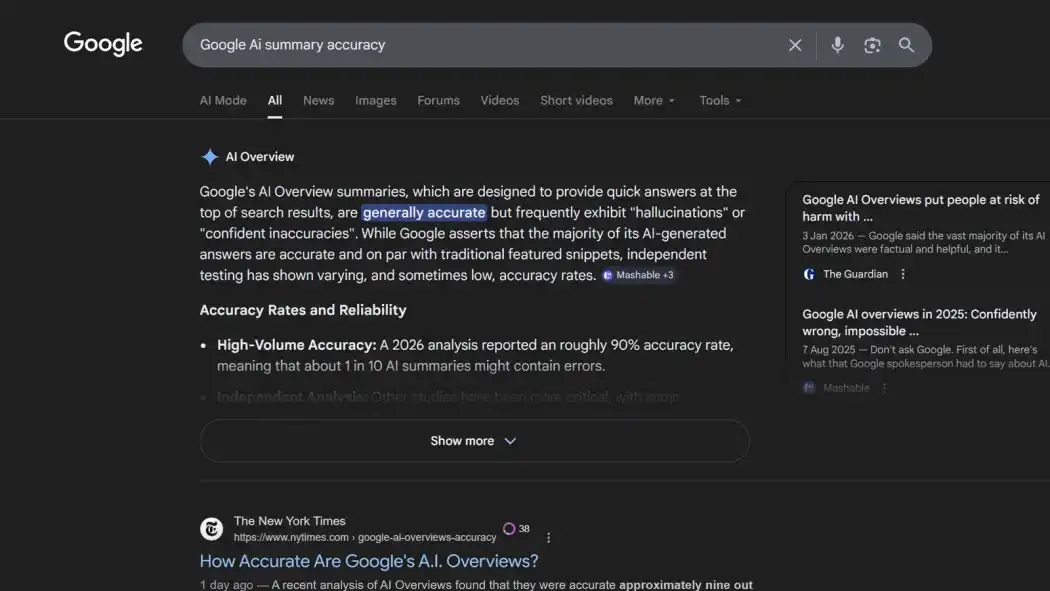
Google is delivering misinformation to users on an unprecedented scale, and most people are completely unaware.

According to The New York Times, AI startup Oumi, commissioned by the publication, used the industry-standard test SimpleQA developed by OpenAI to evaluate the accuracy of Google's AI Overviews feature. The test covered 4,326 search queries, conducting one round in October last year (powered by Gemini 2) and another in February this year (upgraded to Gemini 3). The results showed that Gemini 2's accuracy was about 85%, which improved to 91% with Gemini 3.

91% sounds good, but it's a different story when considering Google's scale. Google processes approximately 5 trillion search queries annually. Calculating with a 9% error rate, AI Overviews generates over 57 million inaccurate answers per hour, nearly 1 million per minute.

Correct Answers, Wrong Sources

More alarming than the accuracy rate is the issue of "unanchored" citation sources.

Oumi's data shows that in the Gemini 2 era, 37% of correct answers had "unsupported citations," meaning the links attached to the AI summaries did not support the information provided. After upgrading to Gemini 3, this proportion increased instead of decreasing, jumping to 56%. In other words, while the model gives correct answers, it's increasingly failing to "show its work."

Oumi CEO Manos Koukoumidis pointedly questioned: "Even if the answer is correct, how do you know it's correct? How do you verify it?"

The problem is exacerbated by AI Overviews' heavy reliance on low-quality sources. Oumi found that Facebook and Reddit are the second and fourth most cited sources for AI Overviews, respectively. In inaccurate answers, Facebook was cited 7% of the time, higher than the 5% in accurate answers.

BBC Journalist's Fake Article "Poisoned" Results Within 24 Hours

Another serious flaw of AI Overviews is its susceptibility to manipulation.

A BBC journalist tested the system with a deliberately fabricated false article. In less than 24 hours, Google's AI Overview presented the false information from the article as fact to users.

This means anyone who understands how the system works could potentially "poison" AI search results by publishing false content and boosting its traffic. Google spokesperson Ned Adriance responded by saying the search AI feature is built on the same ranking and security mechanisms that block spam, and claimed that "most examples in the test are unrealistic queries that people wouldn't actually search for."

Google's Rebuttal: The Test Itself Is Flawed

Google raised several objections to Oumi's research. A Google spokesperson called the study "seriously flawed," citing reasons including: the SimpleQA benchmark itself contains inaccurate information; Oumi used its own AI model HallOumi to judge another AI's performance, potentially introducing additional errors; and the test content doesn't reflect real user search behavior.

Google's internal tests also showed that when Gemini 3 operates independently outside the Google Search framework, it produces false outputs at a rate as high as 28%. But Google emphasized that AI Overviews leverages the search ranking system to improve accuracy, performing better than the model itself.

However, as PCMag's commentary pointed out the logical paradox: If your defense is that "the report pointing out our AI's inaccuracies itself uses potentially inaccurate AI," this probably doesn't enhance users' confidence in your product's accuracy.


Questions liées

QWhat is the accuracy rate of Google's AI Overviews feature according to the Oumi study?

AThe accuracy rate of Google's AI Overviews was found to be approximately 91% when powered by Gemini 3, an improvement from about 85% with Gemini 2.

QHow many inaccurate answers does the article estimate Google's AI Overviews produces per hour?

ABased on Google's annual volume of 5 trillion searches and a 9% error rate, the AI Overviews feature is estimated to produce over 57 million inaccurate answers per hour.

QWhat is the 'unsubstantiated citation' problem identified in the report?

AThe 'unsubstantiated citation' problem refers to instances where the AI Overviews provides a correct answer, but the attached source links do not actually support the information given. This issue increased from 37% with Gemini 2 to 56% with Gemini 3.

QWhich low-quality websites are frequently used as sources by AI Overviews, according to the Oumi data?

AAccording to Oumi's data, Facebook and Reddit are the second and fourth most cited sources by AI Overviews, with Facebook being cited more frequently in inaccurate answers.

QHow did Google respond to the findings of the Oumi study?

AGoogle criticized the study, calling it 'seriously flawed.' Their spokesperson argued that the SimpleQA benchmark itself contains inaccuracies, that using an AI (HallOumi) to judge another AI introduces errors, and that the test queries do not reflect real user search behavior.

Lectures associées

Liste des altcoins les plus populaires selon les recherches des dernières heures publiée !

La plateforme CoinGecko a publié une liste des cryptomonnaies les plus recherchées par les utilisateurs au cours des dernières heures. Le jeton Pudgy Penguins ($PENGU) est en tête, suivi de Catecoin (CATE) et de Bless ($BLESS). Sur les 24 dernières heures, CATE a enregistré une hausse de prix impressionnante de 126,2%, tandis que $BLESS a augmenté de 86,1% et $PENGU de 3,9%. What IF (IF) a également progressé de 41,9%. Le classement complet des actifs les plus consultés sur CoinGecko, avec leur capitalisation boursière, est le suivant : 1. Pudgy Penguins ($PENGU) – 389,13 millions de dollars 2. Catecoin (CATE) – 19,62 millions de dollars 3. Bless ($BLESS) – 32,72 millions de dollars 4. Aerodrome Finance (AERO) – 385,03 millions de dollars 5. Hyperliquid (HYPE) – 11,43 milliards de dollars 6. Ethereum (ETH) – 224,17 milliards de dollars 7. Chainlink (LINK) – 6,17 milliards de dollars 8. Aave (AAVE) – 1,42 milliard de dollars 9. What IF (IF) – 31,24 millions de dollars 10. Polkadot (DOT) – 1,34 milliard de dollars 11. Bitcoin (BTC) – 1,27 trillion de dollars 12. Virtual Protocol (VIRTUAL) – 366,19 millions de dollars 13. Algorand (ALGO) – 758,15 millions de dollars 14. Cash Cat (CASHCAT) – 41,81 millions de dollars 15. Solana (SOL) – 42,38 milliards de dollars. *Ceci ne constitue pas un conseil en investissement.

cryptonews.ruIl y a 1 h

Liste des altcoins les plus populaires selon les recherches des dernières heures publiée !

cryptonews.ruIl y a 1 h

Les retraits de Bitcoin se poursuivent : 8 ans de stockage en portefeuille froid Coldcard se sont terminés par un solde nul

Le portefeuille matériel Coldcard a été compromis, entraînant une nouvelle vague de retraits depuis les appareils vulnérables. Selon Galaxy Research, environ 1 367,05 BTC (88,6 millions de dollars) ont été dérobés à partir de 4 585 adresses. Le problème ne réside pas dans le firmware, qui a été corrigé, mais dans les phrases seed générées entre mars 2021 et les mises à jour correctives. Ces phrases, créées en raison d'une erreur de programmation ayant conduit à l'utilisation d'un générateur de nombres aléatoires logiciel (Yasmarang) au lieu du générateur matériel STM32, sont prévisibles et vulnérables à une attaque par force brute hors ligne. Les propriétaires concernés doivent impérativement générer une nouvelle phrase seed sur un firmware corrigé et transférer leurs actifs, sous peine de rester exposés. L'histoire d'un investisseur de 39 ans illustre l'impact dévastateur : après avoir accumulé 2 BTC (130 000 dollars) sur huit ans via un travail physique, en les conservant comme protection contre l'hyperinflation dans son pays, il a tout perdu en quelques minutes. Son cas montre que même les stratégies de conservation à long terme les plus prudentes ("cold storage") ne sont pas infaillibles. D'un point de vue historique, cet incident rappelle les faiblesses passées des générateurs de nombres aléatoires dans la cryptographie. Il remet en question l'idée reçue selon laquelle le stockage hors ligne garantit automatiquement une sécurité absolue. La communauté espère que le fabricant pourra aider à récupérer les fonds volés.

cryptonews.ruIl y a 3 h

Les retraits de Bitcoin se poursuivent : 8 ans de stockage en portefeuille froid Coldcard se sont terminés par un solde nul

cryptonews.ruIl y a 3 h

Trading

Spot
活动图片




