Stole $2 Million from pump.fun, Sentenced to 6 Years in Prison, He Chose to 'Self-Destruct'

marsbitPublié le 2026-03-06Dernière mise à jour le 2026-03-06

Résumé

In May 2024, pump.fun was exploited for approximately $2 million worth of SOL and meme coins. The attacker, Jarett Dunn (also known as Stacc), a former employee, was later sentenced to six years in prison. Two days prior to the sentencing, he leaked internal Telegram chats from his time at the company, claiming to be a whistleblower exposing misconduct. However, the leaked messages did not reveal deliberate malicious activities such as market manipulation or fee misconduct by pump.fun. Instead, Dunn highlighted issues like the team's failure to implement KYC/AML measures for live streaming features, which he had warned about, and what he perceived as irresponsible attitudes toward known "Ruggers" (developers who abandon projects after fundraising). Some messages also illustrated the company's early-stage disorganization, including rushed contracts under investor pressure. Dunn, a talented programmer diagnosed with paranoid schizophrenia at age 20, had joined pump.fun just six weeks before the attack. His mother had recently died, and he had been off medication for months. After the exploit, he was arrested near pump.fun’s London office and underwent mental health treatment. He later attempted to withdraw his guilty plea and expressed homelessness in social media posts. The leak included private phone numbers of pump.fun co-founders, raising privacy concerns. The overall narrative portrays a troubled individual whose actions were influenced by personal trauma and mental hea...

In May 2024, pump.fun was hacked, with the attacker stealing approximately $2 million worth of SOL and a large number of meme coins. At the time, the attacker claimed they would airdrop these funds randomly to players on Solana, once dubbed the "Robin Hood of the crypto world."

Jarett Dunn (online alias Stacc), the attacker, is a former pump.fun employee. Last December, he was sentenced to 6 years in prison by a judge in London.
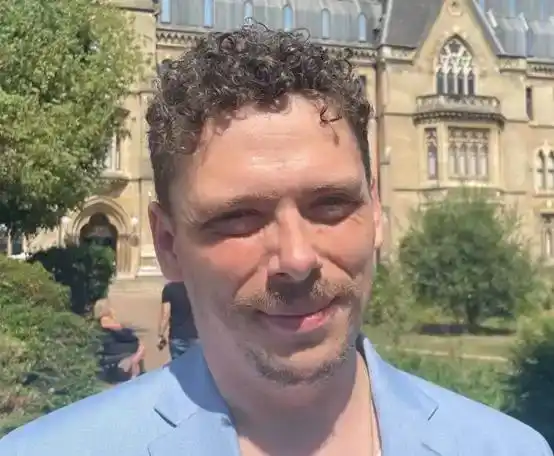
Two days ago, he exposed a large number of Telegram chat records from his time at pump.fun.

So I spent a lot of time going through these chat logs one by one. Honestly, after reading them, I was confused because these records did not contain the kind of intentional malicious content I had imagined, such as the pump.fun team manipulating liquidity or secretly collecting user fees. There was also no content suggesting major personal moral issues with founder alon or other team members.

But in Jarett Dunn's tweet, he called himself a whistleblower and viewed his exposure as a form of "righteous self-destruction." Someone expressed the same doubt in his comments, to which he replied:
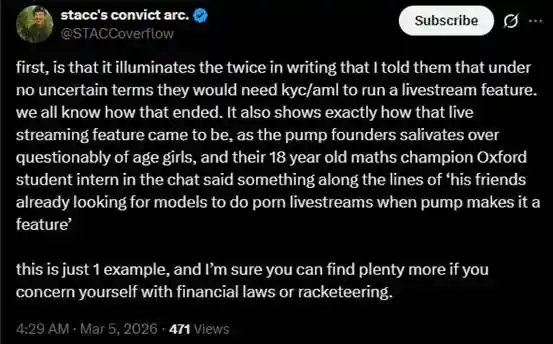
"These records show that I told them twice they must complete the KYC/AML process to enable livestreaming on the platform, (but they ignored it) and then we all know how things ended up (referring to the chaotic and unrestrained livestreaming scene on pump.fun in its early days)."

If this accusation has some merit, the next one is a bit more of a leap:

"An employee said something like this in the group: his friend was already looking for models to do porn as soon as pump.fun's livestreaming went live."

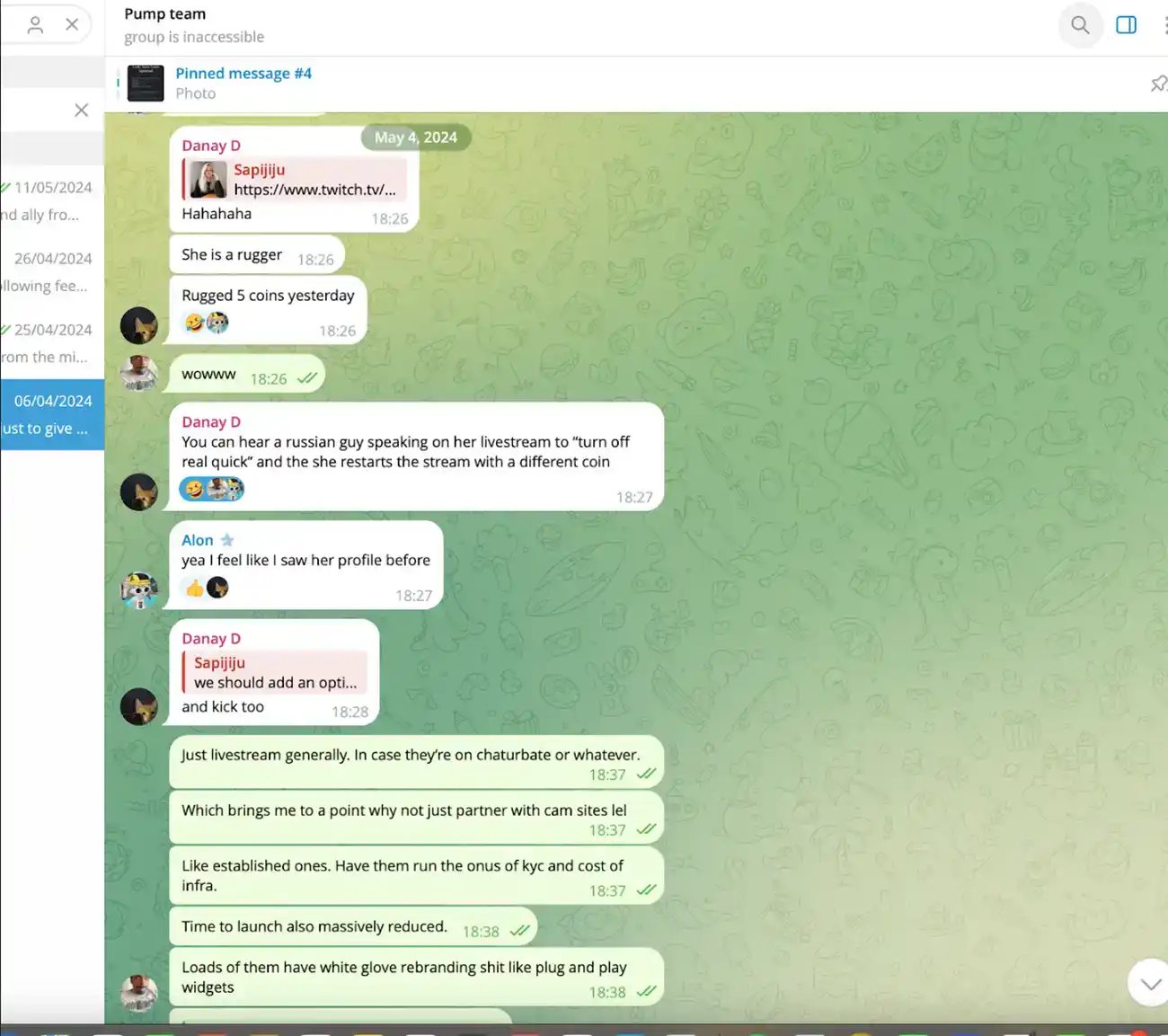
The chat record corresponding to this accusation is as follows. First, pump.fun co-founder Sapijiju shared a Twitch streamer in the pump.fun company group, saying another Twitch streamer had launched a token through pump.fun. An employee stated that this streamer was a Rugger (someone who performs a rug pull) and had rugged 5 tokens the day before.
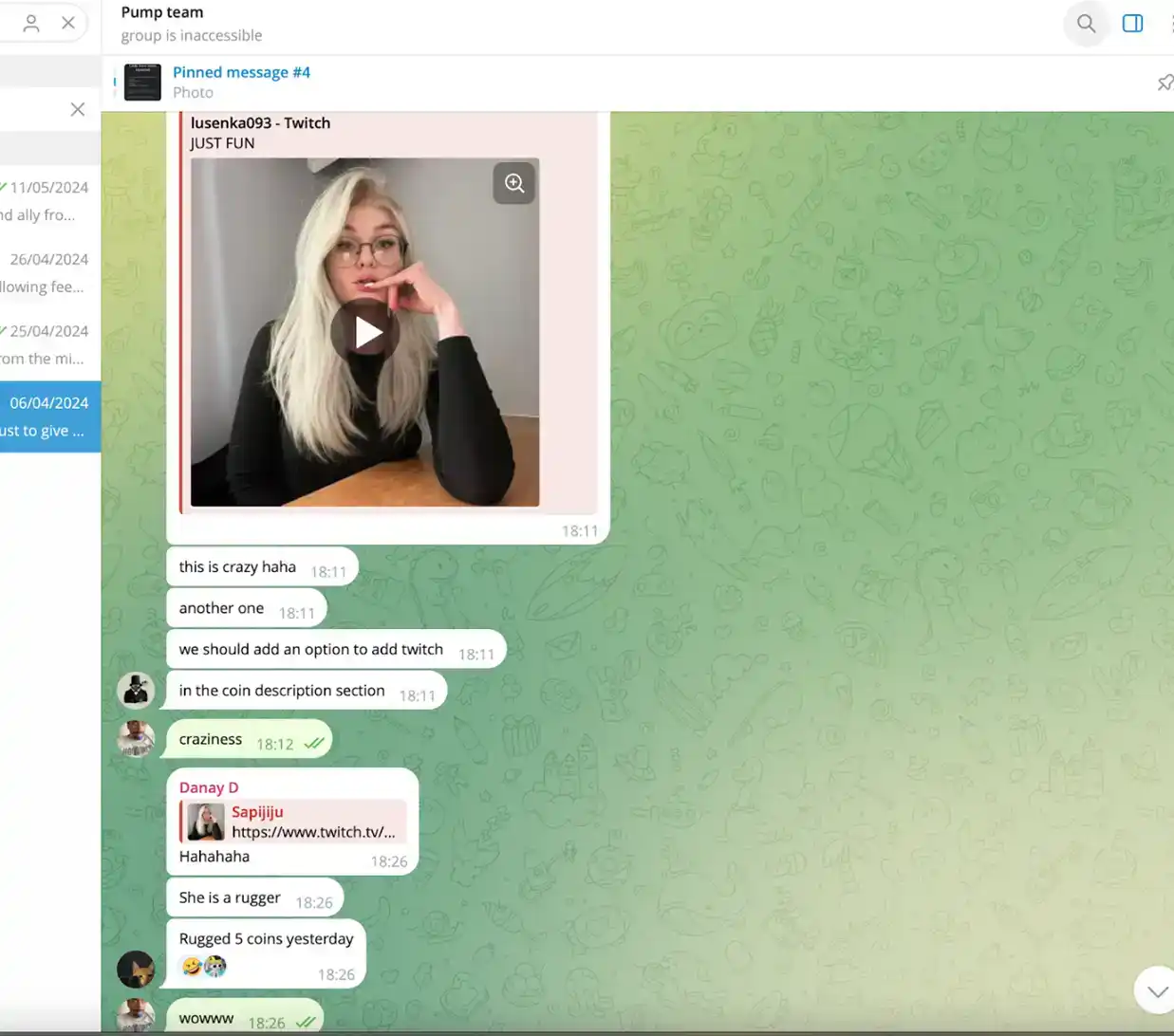
Then this employee said his friend was looking for "models" (to do the same thing). In context, this seems more like a joke. However, Jarett Dunn's suggestion was indeed interspersed, where he took the opportunity to express that partnering with a livestreaming platform would be better, as it would avoid KYC responsibilities and significantly shorten the time needed for pump.fun to launch its livestreaming feature.
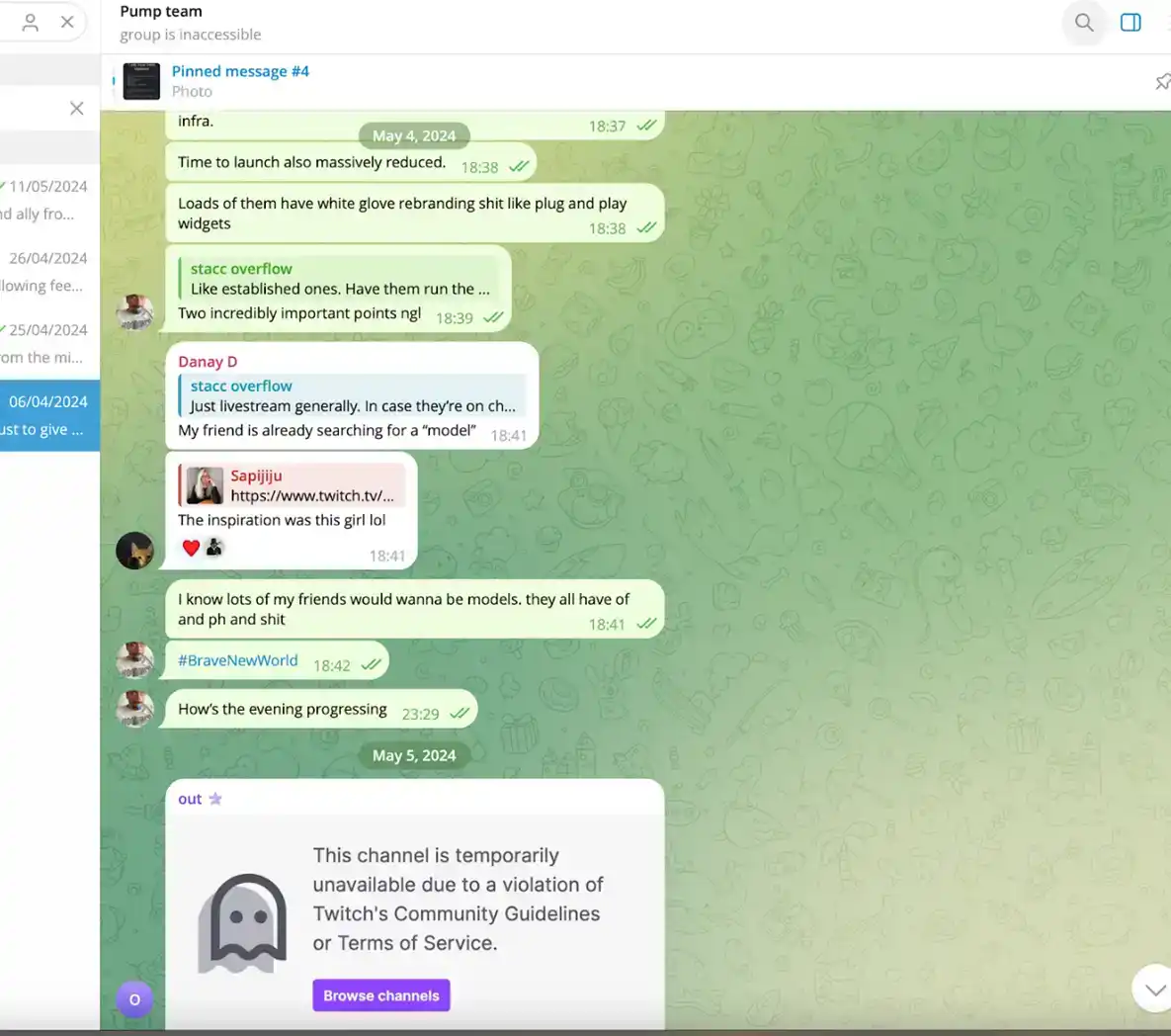
The more significant accusation here should be that the entire team, knowing this was a serial Rugger, still maintained a casual, joking attitude. alon, as a co-founder, stated in the records that he "felt like he had seen her profile before," and then nothing more came of it.
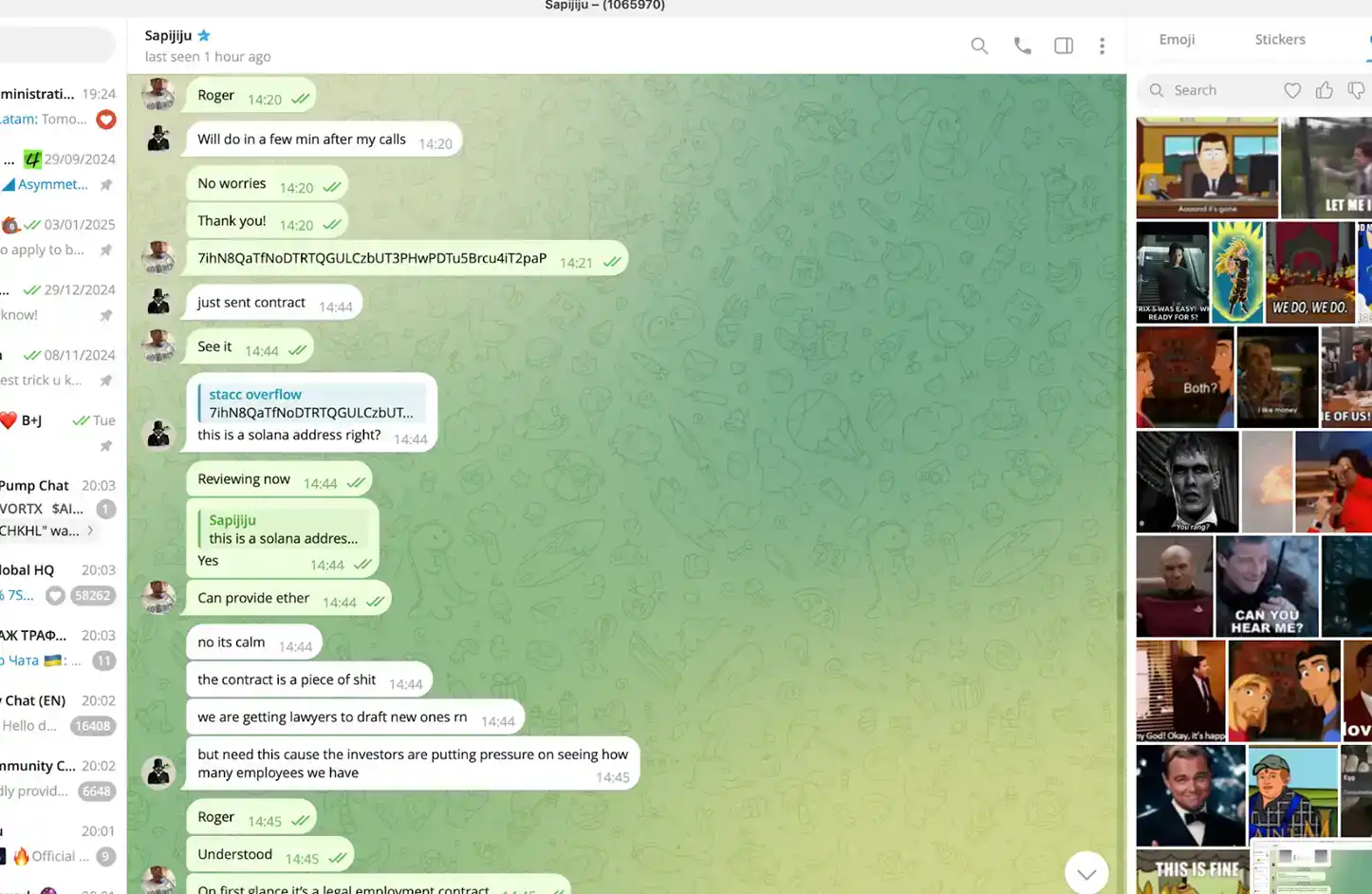
Some other records show the early "makeshift" nature of pump.fun. For example, creating a contract they themselves felt was "a piece of shit" just to handle investor pressure (needing to show investors how many employees the company had), while also looking for lawyers to draft a new one. For a then "young" pump.fun, it's hard to call this a black mark:
The most "explosive" part of the records disclosed by Jarett Dunn might be the release of the phone numbers associated with the Telegram accounts of alon and Sapijiju. Since this involves privacy, screenshots of this part will not be included in this article.

So, what kind of deep grudge is this? From the records, I cannot find the beginning of the enmity between Jarett Dunn and pump.fun, but he is a talented programmer who was also diagnosed with paranoid schizophrenia at the age of 20.

Two years ago, when he attacked pump.fun, his mother had recently passed away. At this time, he had only been with pump.fun for 6 weeks.

Four days after the attack, he was arrested at a hotel located just 90 meters from pump.fun's office in London; he was staying there. After his arrest, he was immediately deemed unfit for questioning by the police and sent to a hospital for a two-week mental health treatment, having been off his medication for months.

At his sentencing hearing two months after pleading guilty, he tried to withdraw his plea, a sudden change that made his legal team quit.

In September 2023, he wrote in a tweet, "I'm homeless, planning to sleep in the park, fighting the bugs I created with 5G."

Yet in the records, pump.fun reimbursed his flight tickets for him to fly from Canada to the UK. Was he happy and fulfilled back then?

Faced with such a complex, life-troubled programmer, I can only sigh at the vicissitudes of life.


Questions liées

QWho was the individual responsible for the $2 million hack of pump.fun and what was his sentence?

AJarett Dunn (also known as Stacc), a former pump.fun employee, was responsible for the hack. He was sentenced to 6 years in prison by a judge in London.

QWhat was the main reason Jarett Dunn gave for his 'whistleblower' act of leaking internal chats?

AHe claimed that he had twice warned the pump.fun team that they needed to complete KYC/AML procedures before launching a live-streaming feature, but they ignored him, which he implied led to the platform's early chaos.

QWhat personal circumstances were mentioned that may have contributed to Jarett Dunn's actions?

AHe was diagnosed with paranoid schizophrenia at age 20, his mother had recently passed away just before the attack, and he had been off his prescribed medication for several months.

QAccording to the article, what was the nature of the most 'explosive' information leaked by Dunn?

AThe most sensitive information leaked was the personal phone numbers associated with the Telegram accounts of pump.fun's co-founders, Alon and Sapijiju.

QHow did the author of the article characterize the internal chat logs that were leaked?

AThe author was initially confused because the logs did not contain evidence of intentional malicious acts like market manipulation or stealing user fees. Instead, they showed a 'ragtag' or immature early-stage startup culture with some questionable jokes and attitudes, but not major ethical scandals.

Lectures associées

La Banque d'Italie ne voit pas d'avantages systémiques des stablecoins dans les transferts

L'étude de la Banque d'Italie conclut que les stablecoins n'offrent pas d'avantage systémique durable en termes de coût et de rapidité pour les transferts d'argent. Les avantages potentiels sont annulés par les frais de conversion vers et depuis les monnaies fiduciaires et par l'efficacité des infrastructures de paiement locales. La recherche a comparé des transferts de 200 USDC sur 10 couloirs bilatéraux (Italie vers Brésil, Argentine, Japon, Émirats Arabes Unis, Afrique du Sud). Le coût total des transferts en stablecoins variait de 0,3% à près de 9%. Les délais étaient inférieurs à 20 minutes dans les pays dotés de systèmes de paiement instantané, mais pouvaient atteindre 1 à 2 jours ouvrables ailleurs. Les principaux coûts et retards sont liés au change de devises et à la qualité de l'infrastructure locale, plutôt qu'aux frais de blockchain. Bien que souvent moins chers que la moyenne mondiale des transferts (6,65%), les stablecoins n'étaient plus avantageux que dans 3 cas sur 7 par rapport au service Wise. Les auteurs estiment que l'utilité serait plus forte si les stablecoins pouvaient être dépensés directement, sans reconversion. Ils notent également qu'une réglementation trop restrictive complique l'usage pour les clients tout en n'éliminant pas la demande. Le marché des stablecoins a enregistré en juillet sa plus forte baisse mensuelle depuis l'effondrement de Terra, perdant plus de 10 milliards de dollars.

cryptonews.ruIl y a 1 h

La Banque d'Italie ne voit pas d'avantages systémiques des stablecoins dans les transferts

cryptonews.ruIl y a 1 h

Le « boom du Bitcoin » en plein essor : Une nouvelle déclaration de Saylor suscite des spéculations sur des achats

Michael Saylor, président exécutif de MicroStrategy (MSTR), a relancé les spéculations sur un nouvel achat de bitcoins par la société en publiant le message « Bitcoin Drive engaged » le 2 août, accompagné de son tableau de suivi habituel. Cette pratique précède généralement les annonces officielles du trésor. Le rapport affiché montrait que les réserves de MicroStrategy s'élevaient à 843 775 BTC, d'une valeur marchande d'environ 53,25 milliards de dollars, avec un prix d'acquisition moyen de 75 653 dollars et une perte non réalisée de 10,58 milliards de dollars. Cependant, le registre public en temps réel de la société indique deux ventes récentes totalisant 3 588 BTC, ramenant le stock de 847 363 à 843 775 BTC. Ces ventes, déclarées à la SEC, visaient à financer des dividendes d'actions privilégiées et à reconstituer les réserves en dollars, qui s'élèvent désormais à environ 3,75 milliards de dollars. La société a subi une perte opérationnelle de 8,33 milliards de dollars au deuxième trimestre 2026, en grande partie due à une perte non réalisée sur ses actifs numériques. La direction pourrait vendre jusqu'à 1,25 milliard de dollars de bitcoins supplémentaires pour ses obligations en cash. L'annonce attendue lundi révélera si le message « Bitcoin Drive » signale une reprise des achats d'accumulation, alors que MicroStrategy équilibre son énorme stock de bitcoins avec ses engagements financiers croissants.

cryptonews.ruIl y a 1 h

Le « boom du Bitcoin » en plein essor : Une nouvelle déclaration de Saylor suscite des spéculations sur des achats

cryptonews.ruIl y a 1 h

Le motif « Tête et Épaules inversé » sur le graphique du Bitcoin annonce une montée vers 67 200 $

Malgré un léger recul début août, les graphiques de prix, notamment celui du Bitcoin, forment un modèle de renversement baissier. Actuellement, le BTC oscille autour de 63 200 $, formant l'épaule droite de la classique figure inversée "tête et épaules". L'analyste Axel Kibard de TechCharts voit là la seule réelle raison d'optimisme à court terme pour les haussiers ce mois-ci. La question principale est de savoir si les acheteurs auront la force de pousser le Bitcoin vers le niveau clé de 67 000 $. Parallèlement, dans la paire ETH/BTC, un fond de renversement similaire a déjà été franchi à la hausse. L'Ethereum, en tendance haussière, se dirige vers un objectif technique de 0,0312, indiquant que les grands capitaux préfèrent actuellement investir dans l'ETH plutôt que dans le Bitcoin, ce qui draine la liquidité et les volumes nécessaires à une reprise rapide du BTC. Face au dollar, l'Ethereum teste prudemment le niveau de support à 1 875 $, une résistance qui, si elle est maintenue, pourrait ouvrir la voie vers 2 163 $. Cette force relative de l'ETH est un signal positif pour le marché, mais la situation reste tendue pour les détenteurs de Bitcoin. Soit le BTC suit l'exemple de l'ETH et monte rapidement au-dessus de 67 200 $ pour confirmer le renversement, soit le modèle échoue. Selon Kibard, si une attaque de la ligne de cou (neckline) n'intervient pas dans les prochains jours, les baissiers reprendront le contrôle et pousseront le Bitcoin vers des niveaux de support solides à 60 000 $, voire 58 000 $.

cryptonews.ruIl y a 1 h

Le motif « Tête et Épaules inversé » sur le graphique du Bitcoin annonce une montée vers 67 200 $

cryptonews.ruIl y a 1 h

Les actions des entreprises d'IA se négocient comme des « mèmes cryptos », tandis que le Bitcoin reste stable – Revue de la semaine

Cette semaine, l'attention financière s'est largement détournée du Bitcoin, relativement stable autour de 64 000 $, pour se concentrer sur une volatilité extrême dans le secteur des actions liées à l'intelligence artificielle (IA). Les marchés asiatiques, notamment en Corée du Sud, ont subi des chutes sévères, en partie déclenchées par la liquidation forcée du fonds « Situational Awareness » de Leopold Aschenbrenner, entraînant des pertes massives. Le secteur des semi-conducteurs et de l'IA montre des signes de surchauffe, suscitant des débats sur un éventuel ralentissement. Dans le domaine des cryptomonnaies, l'ambiance reste difficile. Plusieurs plateformes d'échange (BitMEX, BitMart) ont annoncé leur fermeture, tandis que d'autres entreprises comme Coinbase et Uphold procèdent à des réductions de personnel. MicroStrategy continue sa stratégie d'accumulation de bitcoins et de rachat de ses propres actions. Les discussions portent également sur les risques potentiels pour des écosystèmes comme Solana si des applications populaires (Pump.fun, Trade.xyz) décidaient de lancer leur propre blockchain. Par ailleurs, une faille de sécurité majeure concernant le portefeuille matériel Coldcard a été mise en lumière, rappelant les risques du self-custody. Enfin, le projet d'IA décentralisée Bittensor (TAO) a attiré l'attention de certains investisseurs de capital-risque, mais des mises en garde sont émises contre un possible engouement spéculatif similaire à celui pour les memecoins. La semaine a été marquée par des interventions macroéconomiques, comme celle de la Japon pour soutenir le yen, et par les anticipations concernant la politique de la Fed.

cryptonews.ruIl y a 2 h

Les actions des entreprises d'IA se négocient comme des « mèmes cryptos », tandis que le Bitcoin reste stable – Revue de la semaine

cryptonews.ruIl y a 2 h

Trading

Spot
活动图片




