Ripple CEO Brad Garlinghouse has been honored as the 2026 Business Leader of the Year by the Harvard Business School Association of Northern California, giving one of crypto’s most prominent executives a high-profile recognition from the Bay Area business establishment. The award places Ripple’s payments and digital-asset strategy in a broader conversation about financial infrastructure, regulation and institutional adoption.
The event was held Tuesday, April 21, at the Julia Morgan Ballroom in San Francisco, with more than 250 entrepreneurs, investors, business leaders and HBS alumni in attendance, according to the association’s post shared on LinkedIn. Ripple said the evening included a fireside conversation between Garlinghouse and Ripple co-founder and executive chairman Chris Larsen, focused on more than a decade of building the company and what comes next.
Harvard Honors Ripple CEO
HBSANC framed the recognition around Garlinghouse’s role in payments infrastructure, digital assets and Bay Area business leadership. The association said it was “proud to honor Brad Garlinghouse” and described Ripple’s mission as enabling “faster, more efficient global money movement.” In its event materials, the group highlighted Ripple’s push to move, store, exchange and manage value across borders in seconds rather than days, while reducing costs and improving transparency.
Garlinghouse’s tenure at Ripple has been defined not only by product expansion, but also by the company’s long-running fight for regulatory clarity in the United States.
HBSANC described him as a central voice in the debate over digital-asset regulation and pointed to Ripple’s legal victory against the Securities and Exchange Commission as part of the backdrop for the award. The association said his leadership during that period reflected “resilience” and “steadfast conviction,” language that tracks closely with how Ripple and XRP supporters have viewed the company’s posture through the SEC case.
The award also ties Garlinghouse’s current profile back to a longer Silicon Valley career. Before joining Ripple, he held senior roles at Yahoo, where he worked on products including Yahoo Mail and Messenger, later served as president of consumer applications at AOL and was CEO of Hightail. HBSANC also referenced his widely circulated “Peanut Butter Manifesto,” the Yahoo strategy memo that became shorthand in Silicon Valley for focus and product discipline.
Notably, Harvard’s own investment arm has also disclosed crypto exposure through SEC 13F filings: Harvard Management Company cut its iShares Bitcoin Trust position by roughly 21% in the fourth quarter of 2025, but still held more than $265 million in IBIT, its largest publicly disclosed holding, while opening a new Ethereum ETF position of nearly 4 million shares valued at about $86.8 million.
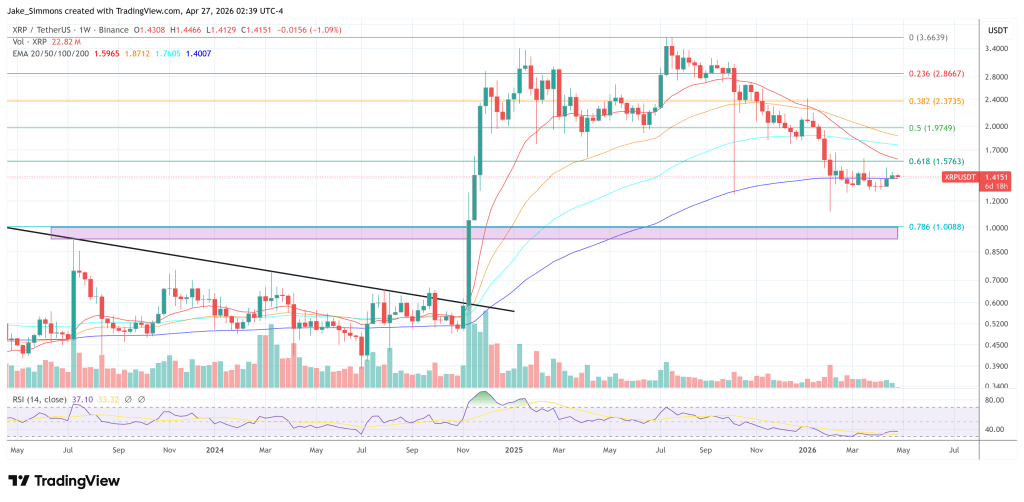
At press time, XRP traded at $1.4151.