Reviewing Arthur Hayes' 2025: All Hype Calls Ultimately Lead to Cashing Out

marsbitPublié le 2026-01-29Dernière mise à jour le 2026-01-29

Résumé

Arthur Hayes, the founder of BitMEX and a prominent crypto influencer, had a highly profitable yet controversial 2025. While his public calls, such as predicting "$1 million Bitcoin" and "$10,000 ETH," attracted retail traders, his on-chain actions often contradicted his bullish narratives, resulting in gains for him and losses for followers. His strategies fell into three main categories: 1. **"Pump and Dump" of VC Coins**: Hayes frequently promoted tokens like Hyperliquid (HYPE), where he held early, low-cost shares. He would build hype with ambitious predictions, then sell near peaks. For instance, he sold HYPE just before a price drop, citing "unlock risks," only to buy back months later. 2. **Failed Revival of "Old Narratives"**: Attempts to boost outdated sectors like DeSci (e.g., BIO) and metaverse projects (e.g., WILD) largely failed. His investments in these areas saw significant losses, with some tokens dropping over 85%. 3. **The ZEC "Smokescreen"**: Hayes aggressively promoted Zcash (ZEC), claiming a "$10,000 target," while simultaneously selling ETH and other assets to fund ZEC purchases. This move allowed him to shift transparent assets (ETH) into privacy-focused ZEC, obscuring his true position. He later sold ETH again to reinvest in other areas, using ZEC’s volatility to divert market attention. Hayes operates as a pragmatic trader, not a steadfast "HODLer." His public analyses are valuable for macro insights, but his on-chain activity reveals a pattern o...

Original author: angelilu, Foresight News

Looking back at 2025, Arthur Hayes remains the big winner who is both loved and hated.

As the founder of BitMEX and the KOL in the crypto circle who is best at writing "essays," every "hype call" he made in 2025 could stir up retail trading enthusiasm. But looking back at 2025, you will suddenly realize that if you got on board every time he made a call, the result would be that he made money, and you lost.
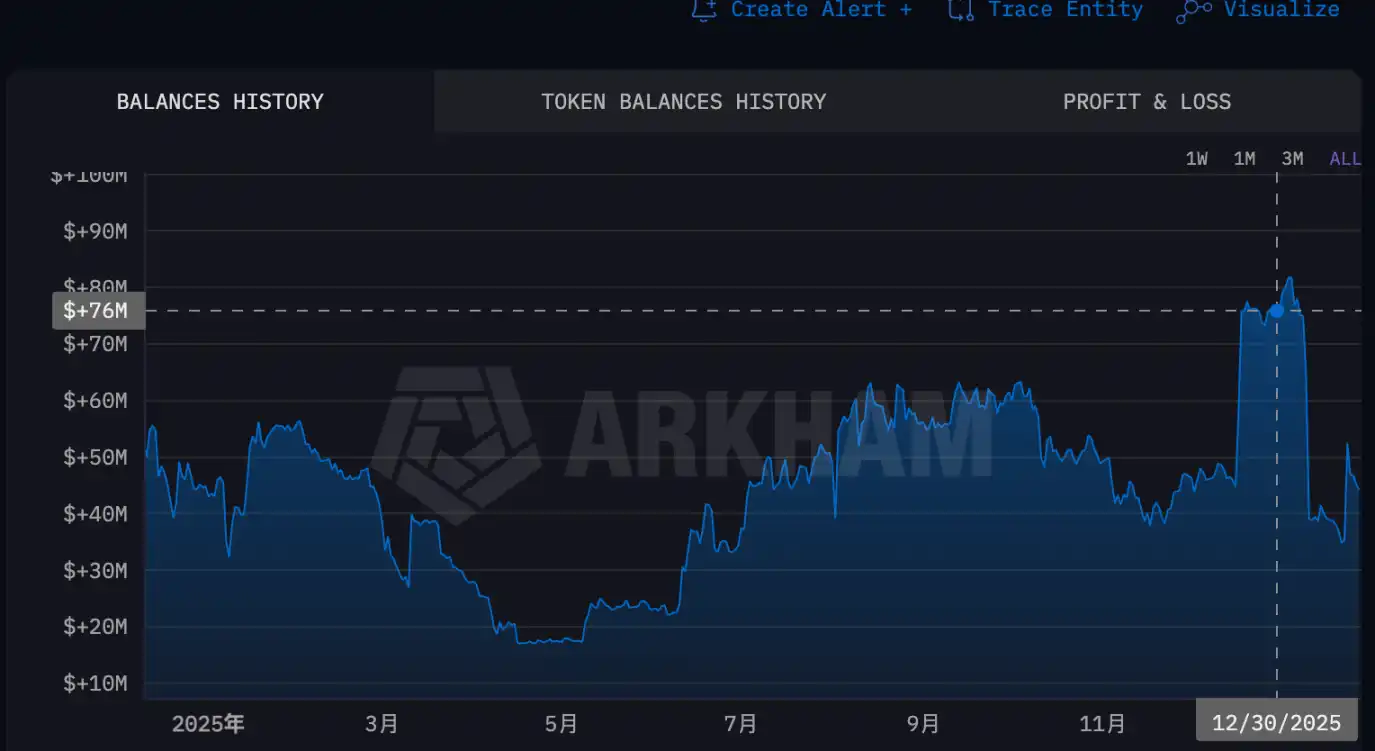
He shouted "Bitcoin to one million dollars" and "ETH to $10,000" on Twitter, but on-chain, Arthur Hayes would always inadvertently sell the assets he once favored. If we lay out all his operations from last year, you will find an extremely calm, even冷酷 (cold-blooded), trading record of a top trader.

We can break down his operations into three categories.

VC Coins: "Publicly Hype, Privately Dump"

Hayes' most controversial operations usually occur with projects where he obtained early筹码 (chips/allocations). This is actually a completely asymmetrical game: perhaps he made 10x when selling at $50, while your losses were just beginning when buying at $60.

The most typical script happened with Hyperliquid (HYPE). As an early investor who obtained extremely low-cost筹码 (chips), his operating logic is very simple and crude:

Step one: Use influence to hype at high prices, building grand narratives (e.g., "HYPE 100x in three years");

Step two: Wait until the token unlocks or liquidity is sufficient, then decisively clear the position.
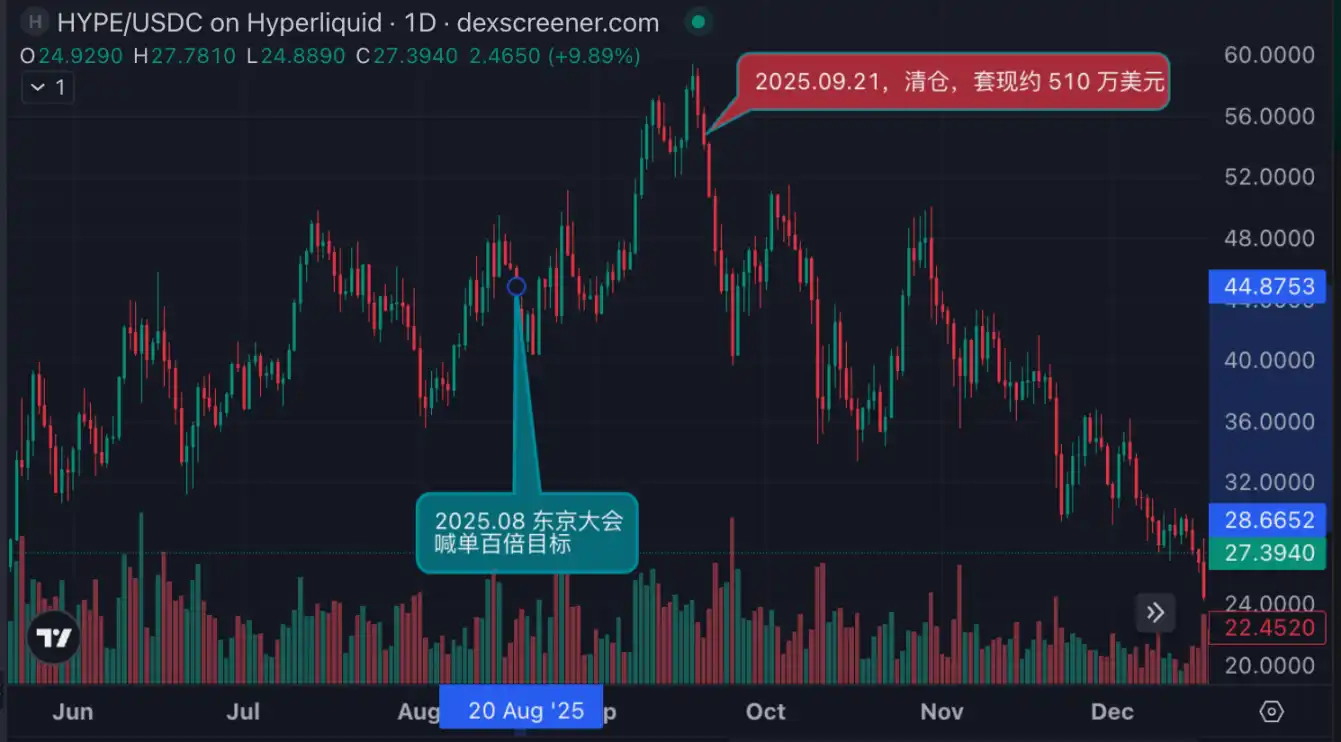
For example, last August, Hayes predicted at a conference in Tokyo that HYPE would have hundred-fold growth and高调 (high-profile) bought in. Just one month later, he cleared his position before HYPE fell and made millions of dollars in profit, giving the reason "to avoid unlocking risks."
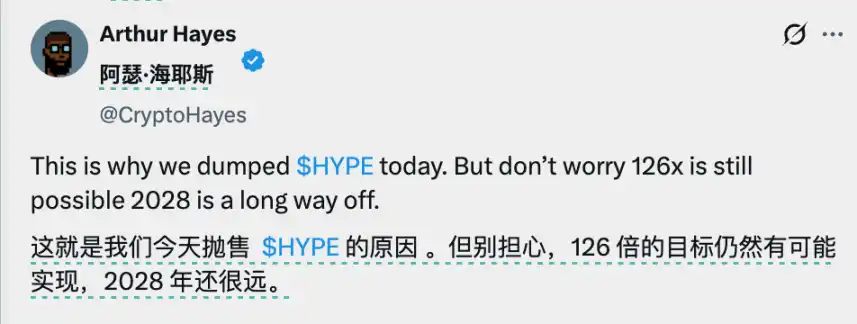
But HYPE was not completely abandoned by him. In mid-January 2026, Hayes bought about $499,000 worth of HYPE again after three months.

The same story happened repeatedly, including with ETHFI, ATH, etc., all experiencing similar scripts.

But imagine, if you were Arthur Hayes, what would you do? To achieve profit with large capital, this seems to be the standard playbook: first, put forward market analysis that is足以自圆其说 (sufficient to justify itself),征服 (conquering) the audience with logic; when believers flock in, the market will naturally confirm his prophecy.

And for whales, the only window to quietly exit is when the crowd is bustling and liquidity is most abundant.

The "Old Narratives" That Couldn't Be Hype

After reviewing Hayes' successful hype narratives, we found that Hayes also had times when he failed. Especially when he tried to "revive" some old or niche sectors.

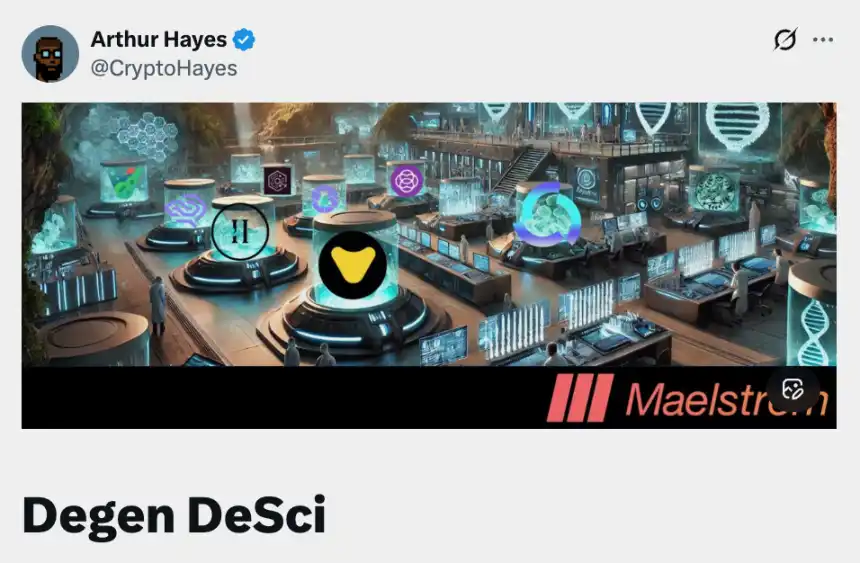
In early 2025, his family fund Maelstrom wrote a long and profound article "Degen DeSci," strongly bullish on the DeSci (Decentralized Science) sector. He listed a bunch of coins, BIO, GROW...

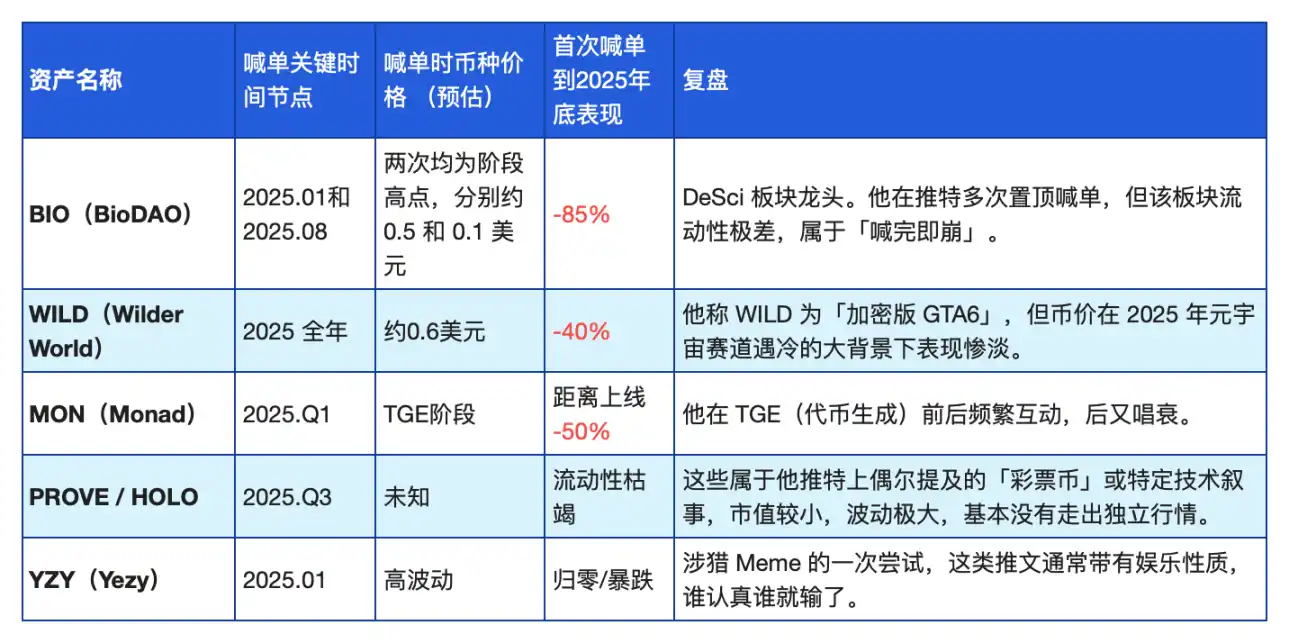
The result is clear for all to see: the DeSci sector almost全军覆没 (was completely wiped out), with many tokens falling more than 85% from their highs. Hayes built a position of $1.1 million worth of BIO again in August and finally deposited 7.66 million BIO into Binance in late November, with a potential loss of $640,000 (-58%).
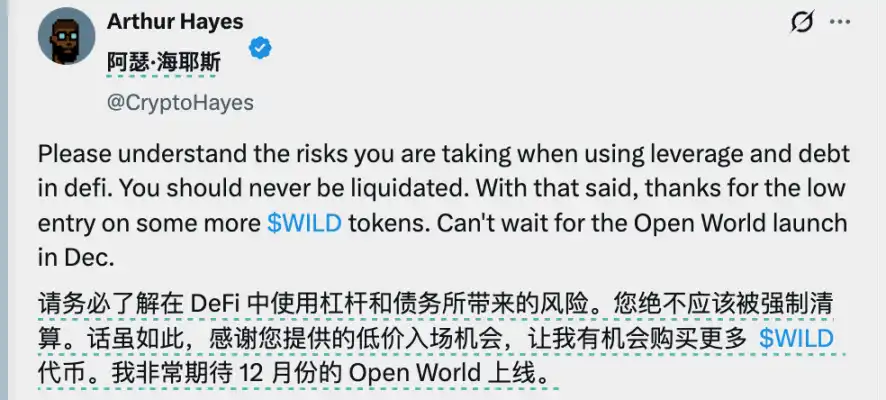
Then there's Wilder World (WILD), which he called the "Crypto version of GTA6." He hyped it for a whole year, and finally the price sank along with the metaverse concept.
Most of the tokens Hayes hyped had热度 (heat/hype) at specific stages. A summary is shown in the chart:
ZEC's "Smoke Screen"

This might be Hayes' most brilliant and intriguing operation in 2025.

On the surface, Hayes疯狂 (crazily) hyped Zcash (ZEC), stating that he initially bought millions of dollars worth after hearing the suggestion from Silicon Valley big shot Naval at a private dinner during Token 2049. In November last year, he shouted the slogan "target $10,000."

Hayes even initiated a withdrawal movement, calling on everyone to withdraw their coins to the chain to lock up liquidity.
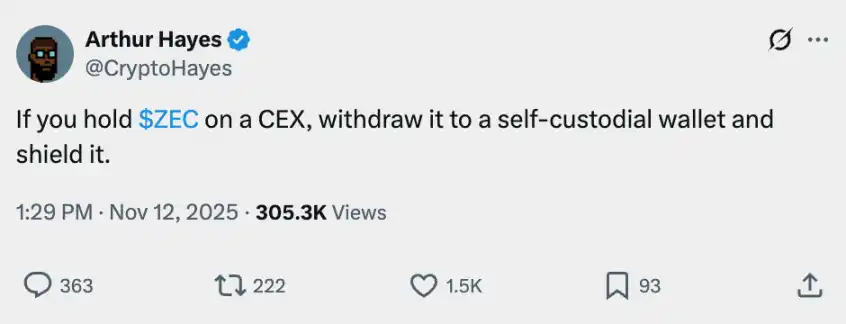
Many people watched his wallet to see if he was secretly selling ZEC. The result: he didn't sell; he was even adding to his position.

Perhaps the real purpose of Hayes creating this ZEC frenzy was: to sell ETH and exchange it for anything that was rising fast at the time.

Hayes had actually already taken a "knife" to ETH several times before this. Although he高喊 (shouted loudly) in 2025 that ETH would rise to $10,000, he experienced several "反复横跳" (back-and-forth jumps). He sold about $13.34 million worth of ETH and other tokens on August 2nd but expressed regret on August 9th for taking profits and had to buy back.

By November 15, 2025, just when he was vigorously hyping ZEC, Lookonchain monitored him transferring millions of dollars worth of ETH and ENA to Binance. On the same day, Hayes publicly declared on Twitter that he had "Aped more ZEC." On-chain analyst EmberCN also分析指出 (analyzed and pointed out) that this selling was极大概率 (most likely) to supply "ammunition" for adding to the ZEC position.

Due to ZEC's privacy features, his transparent ETH was sold and exchanged for opaque assets. On the chain, we can only see him "exiting" (selling ETH) but cannot quantify the scale of his "entering" (buying ZEC).

But in the last two weeks of 2025, Hayes sold another 1,871 ETH (about $5.53 million) and went back to buy the DeFi assets he had abandoned a month earlier.

This is a very冷酷 (cold) signal: in his logic, Ethereum is the "cash reserve" in his investment组合 (portfolio). He sells it when he needs money to buy new narratives (ZEC), and he still sells it when he needs money to bottom-fish old sectors (DeFi).

In the end, you will find that he used ZEC's price increase to attract the attention of the entire market, and then quietly completed his position rotation while everyone was discussing the "privacy renaissance." It wasn't until early 2026, when ZEC plummeted due to internal team strife, that everyone realized that although Hayes's holdings had shrunk, he successfully exited the top of ETH, which performed even worse during that phase.

How to Understand Arthur Hayes?

After reviewing this year, you will find that Hayes,正如 (just as) written in his X background picture, is not a "believer" HODLer but an extremely精明 (shrewd) businessman.
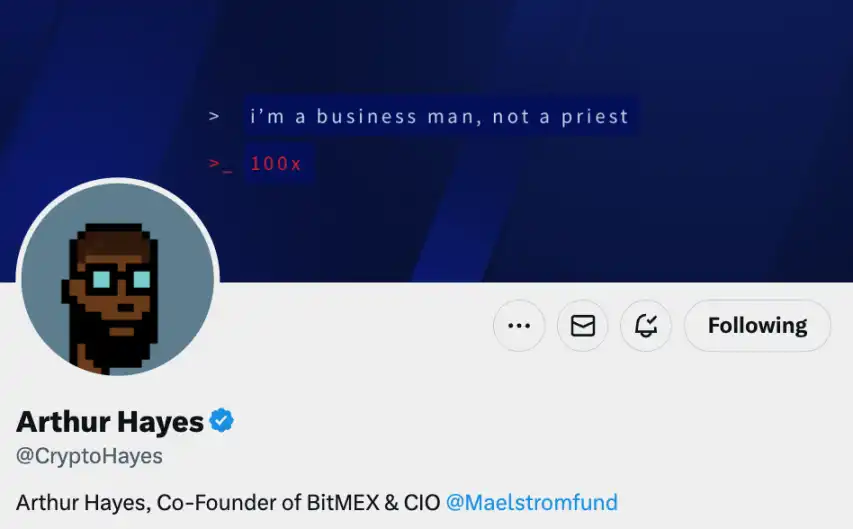
He uses words to build dreams to attract liquidity; he uses on-chain operations to harvest profits to avoid risks; he dares to quickly admit mistakes when he is wrong (e.g., abandoning ETH) to preserve capital.

So, his articles are still worth reading because his macro judgments have been verified. But before you press the "buy" button, please take one more step: don't listen to what he says, go see what his on-chain wallet is doing.

After all, in this残酷 (cruel) market, his loyalty to "volatility" is far higher than his belief in any single project. And volatility is precisely the money transferred from the pockets of retail traders to the pockets of traders.


Questions liées

QWhat was the main criticism of Arthur Hayes' actions in 2025 according to the article?

AThe main criticism was that Hayes' public endorsements ('calling orders') were often a strategy to create market hype and liquidity, allowing him to profitably sell his positions at high prices, while retail investors who followed his advice frequently ended up losing money.

QDescribe Hayes' typical strategy with VC coins like Hyperliquid (HYPE).

AHis strategy involved two steps: first, using his influence to endorse the coin at high prices and build a grand narrative (e.g., 'HYPE will grow 100x in three years'); second, liquidating his position for substantial profits once the token was unlocked or liquidity was sufficient, often just before a price drop.

QWhich investment narrative promoted by Hayes in 2025 failed significantly, and what was the result?

AHis promotion of the DeSci (Decentralized Science) narrative failed significantly. Coins in this sector, such as BIO, plummeted by over 85% from their highs. Hayes' investment in BIO resulted in a loss of approximately $640,000, a 58% decrease.

QWhat was the suspected real purpose behind Hayes' strong public endorsement of Zcash (ZEC)?

AThe suspected real purpose was to create a market frenzy around ZEC to attract attention and liquidity, which allowed him to discreetly sell his transparent assets like ETH and convert them into the more opaque ZEC. This move helped him rotate his portfolio away from underperforming assets like ETH.

QHow does the article suggest investors should interpret Hayes' public statements and actions?

AThe article advises investors to read his macro analyses but to verify his on-chain wallet activities before making investment decisions. It emphasizes that his loyalty is to 'volatility' and profit, not to any specific project's long-term success, making his actions more those of a shrewd trader than a faithful holder.

Lectures associées

Des TPU aux agents auto-évolutifs : comment Jeff Dean envisage la prochaine étape de l'IA

Lors d’une intervention à la YC Startup School 2026, Jeff Dean a partagé sa vision de l’évolution de l’IA au-delà des simples modèles de grande taille. Il souligne que la prochaine étape ne consiste pas seulement à créer des modèles plus puissants, mais à les intégrer dans des systèmes capables de fonctionner de manière autonome, d’apprendre par essais et erreurs, et d’exécuter des tâches complexes sur de longues périodes. Dean insiste sur l’importance de l’ingénierie du contexte, des outils spécialisés et des boucles de rétroaction pour permettre aux agents IA d’agir efficacement, comme des ingénieurs juniors. Il met en lumière les défis techniques sous-jacents, tels que la latence, la consommation énergétique et le coût du déplacement des données, qui conditionnent la faisabilité des applications pratiques. Pour les startups, il conseille de se concentrer sur des problèmes où les modèles génériques actuels échouent (taux de succès proche de 0–1%), en exploitant des données propriétaires, des évaluateurs spécialisés ou des flux de travail métier. Il anticipe également une automatisation croissante de la recherche scientifique et du développement de l’IA elle-même, accélérant le cycle hypothèse-expérience-évaluation. Enfin, Dean rappelle que la clé reste de bien définir les problèmes, de remettre en cause les hypothèses établies et de privilégier les solutions qui auront un impact réel, tout en travaillant avec des équipes complémentaires et collaboratives.

marsbitIl y a 35 mins

Des TPU aux agents auto-évolutifs : comment Jeff Dean envisage la prochaine étape de l'IA

marsbitIl y a 35 mins

De la Corée aux États-Unis : grâce à l'IA, les cols bleus sont de plus en plus recherchés

Grâce à l'IA, les métiers manuels spécialisés connaissent une valorisation historique sur le marché du travail mondial, remettant en cause l'attrait traditionnel des diplômes universitaires. Aux États-Unis, les inscriptions dans les écoles professionnelles ont bondi de 11,4% en 2025, tandis que les licenciements liés à l'IA ont atteint un niveau record. Cette double pression - remplacement de certains emplois de bureau par l'IA et demande explosive de main-d'œuvre pour les infrastructures et data centers - pousse la nouvelle génération vers des carrières comme électricien, soudeur ou plombier. En Corée du Sud, les diplômés de lycées techniques spécialisés dans les semi-conducteurs sont recrutés à plus de 96%, avec des rémunérations très attractives chez des géants comme Samsung. Le phénomène est accentué par une vague de départs à la retraite et un déficit structurel de travailleurs qualifiés, créant une véritable pénurie. Des entreprises et banques comme JPMorgan, Meta ou Lowe's investissent massivement dans la formation. Si les salaires médians de ces métiers rivalisent désormais avec ceux de nombreux diplômés universitaires, des préjugés persistants sur la valeur des formations professionnelles constituent le principal défi pour combler l'écart entre la demande du marché et les perceptions sociales.

marsbitIl y a 36 mins

De la Corée aux États-Unis : grâce à l'IA, les cols bleus sont de plus en plus recherchés

marsbitIl y a 36 mins

Qualcomm : la fièvre de l'IA retombe, quand le marché du téléphone mobile sortira-t-il de la morosité ?

Qualcomm a publié ses résultats financiers du troisième trimestre de l'année fiscale 2026 (se terminant en juin 2026). Les revenus ont atteint 9,95 milliards de dollars, en baisse de 4% sur un an, dépassant les attentes du marché. Cependant, la rentabilité a été mise sous pression : la marge brute a chuté à 53,1% en raison de l'augmentation des coûts de production des semi-conducteurs et de la hausse des prix de la mémoire. Le segment smartphone, cœur de métier de Qualcomm, a subi un net recul de 19,6% à 5,09 milliards de dollars. Ce déclin s'explique par la faiblesse du marché des smartphones Android (hors Apple) et par une tendance des fabricants à privilégier d'anciennes plateformes pour réduire les coûts. À l'inverse, le secteur automobile a connu une croissance forte de 61%, porté par les systèmes de cockpit numérique. Face à la morosité de son marché traditionnel, Qualcomm mise sur l'IA pour son avenir. Sa stratégie couvre à la fois l'IA de périphérie (smartphones, PC, véhicules) et les centres de données. Dans ce dernier domaine, la société a dévoilé un plan ambitieux incluant des accélérateurs d'IA, des CPU, des puces sur mesure et des produits de connectivité, visant un marché potentiel de 1000 milliards de dollars. Des partenariats ont déjà été conclus avec Microsoft et Meta. Cependant, ces perspectives de croissance ne se sont pas encore concrétisées dans les chiffres. Les prévisions pour le prochain trimestre restent prudentes, reflétant la faiblesse persistante de la demande pour les terminaux et la pression sur les coûts. Après un pic lié à l'enthousiasme pour l'IA, l'action de Qualcomm est retombée, les investisseurs attendant désormais des preuves tangibles de la réussite de son virage stratégique, tout en surveillant la possible stabilisation de son activité historique.

marsbitIl y a 39 mins

Qualcomm : la fièvre de l'IA retombe, quand le marché du téléphone mobile sortira-t-il de la morosité ?

marsbitIl y a 39 mins

Trading

Spot
活动图片




