Reviewing Arthur Hayes' 2025: All Hype Calls Ultimately Lead to Cashing Out

marsbitPublié le 2026-01-29Dernière mise à jour le 2026-01-29

Résumé

Arthur Hayes, the founder of BitMEX and a prominent crypto influencer, had a highly profitable yet controversial 2025. While his public calls, such as predicting "$1 million Bitcoin" and "$10,000 ETH," attracted retail traders, his on-chain actions often contradicted his bullish narratives, resulting in gains for him and losses for followers. His strategies fell into three main categories: 1. **"Pump and Dump" of VC Coins**: Hayes frequently promoted tokens like Hyperliquid (HYPE), where he held early, low-cost shares. He would build hype with ambitious predictions, then sell near peaks. For instance, he sold HYPE just before a price drop, citing "unlock risks," only to buy back months later. 2. **Failed Revival of "Old Narratives"**: Attempts to boost outdated sectors like DeSci (e.g., BIO) and metaverse projects (e.g., WILD) largely failed. His investments in these areas saw significant losses, with some tokens dropping over 85%. 3. **The ZEC "Smokescreen"**: Hayes aggressively promoted Zcash (ZEC), claiming a "$10,000 target," while simultaneously selling ETH and other assets to fund ZEC purchases. This move allowed him to shift transparent assets (ETH) into privacy-focused ZEC, obscuring his true position. He later sold ETH again to reinvest in other areas, using ZEC’s volatility to divert market attention. Hayes operates as a pragmatic trader, not a steadfast "HODLer." His public analyses are valuable for macro insights, but his on-chain activity reveals a pattern o...

Original author: angelilu, Foresight News

Looking back at 2025, Arthur Hayes remains the big winner who is both loved and hated.

As the founder of BitMEX and the KOL in the crypto circle who is best at writing "essays," every "hype call" he made in 2025 could stir up retail trading enthusiasm. But looking back at 2025, you will suddenly realize that if you got on board every time he made a call, the result would be that he made money, and you lost.
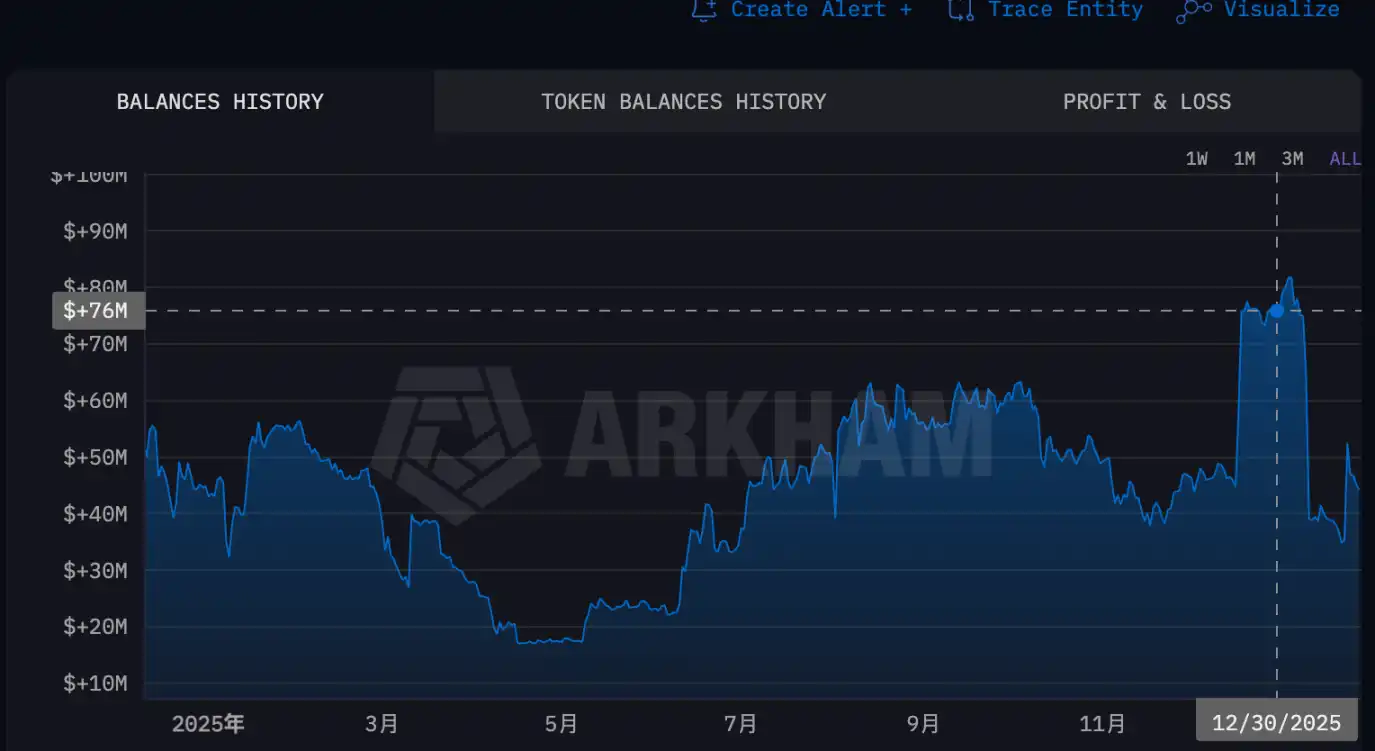
He shouted "Bitcoin to one million dollars" and "ETH to $10,000" on Twitter, but on-chain, Arthur Hayes would always inadvertently sell the assets he once favored. If we lay out all his operations from last year, you will find an extremely calm, even冷酷 (cold-blooded), trading record of a top trader.

We can break down his operations into three categories.

VC Coins: "Publicly Hype, Privately Dump"

Hayes' most controversial operations usually occur with projects where he obtained early筹码 (chips/allocations). This is actually a completely asymmetrical game: perhaps he made 10x when selling at $50, while your losses were just beginning when buying at $60.

The most typical script happened with Hyperliquid (HYPE). As an early investor who obtained extremely low-cost筹码 (chips), his operating logic is very simple and crude:

Step one: Use influence to hype at high prices, building grand narratives (e.g., "HYPE 100x in three years");

Step two: Wait until the token unlocks or liquidity is sufficient, then decisively clear the position.
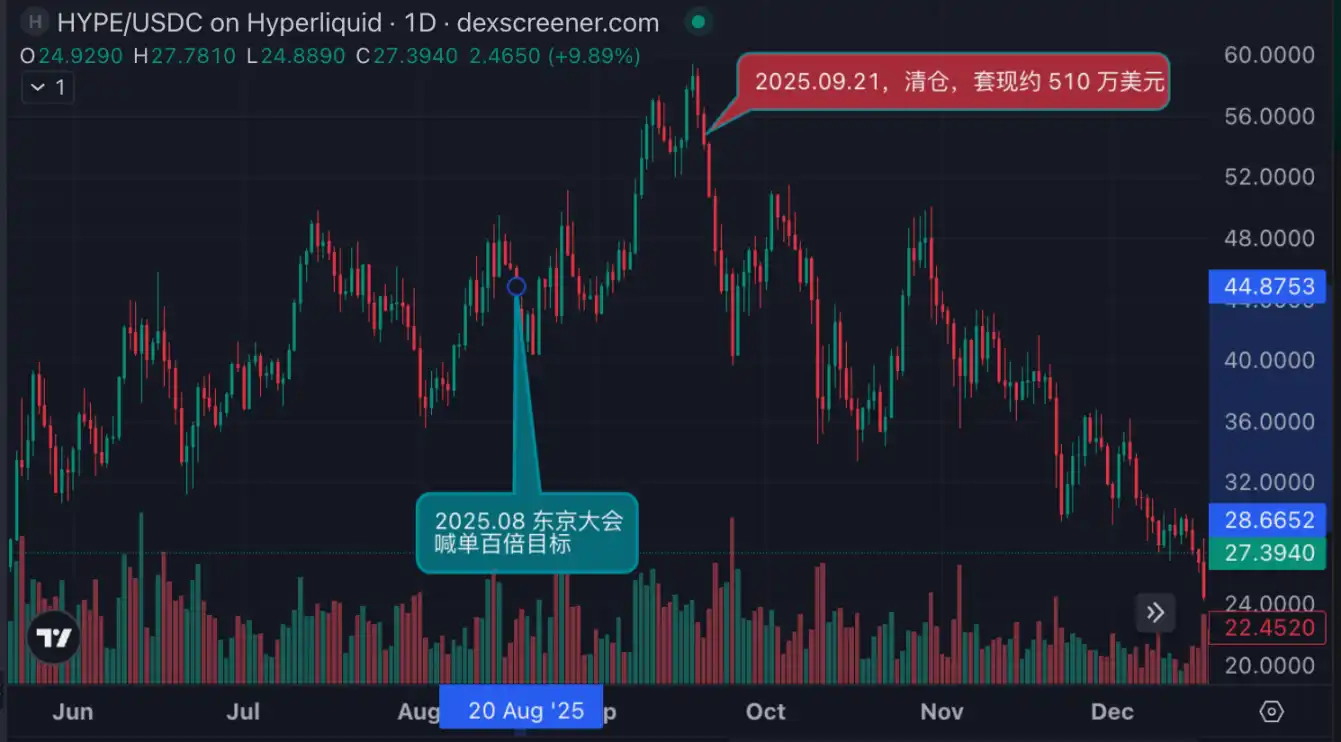
For example, last August, Hayes predicted at a conference in Tokyo that HYPE would have hundred-fold growth and高调 (high-profile) bought in. Just one month later, he cleared his position before HYPE fell and made millions of dollars in profit, giving the reason "to avoid unlocking risks."
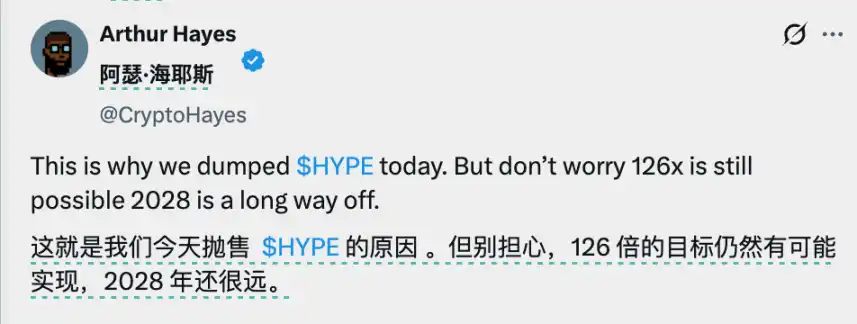
But HYPE was not completely abandoned by him. In mid-January 2026, Hayes bought about $499,000 worth of HYPE again after three months.

The same story happened repeatedly, including with ETHFI, ATH, etc., all experiencing similar scripts.

But imagine, if you were Arthur Hayes, what would you do? To achieve profit with large capital, this seems to be the standard playbook: first, put forward market analysis that is足以自圆其说 (sufficient to justify itself),征服 (conquering) the audience with logic; when believers flock in, the market will naturally confirm his prophecy.

And for whales, the only window to quietly exit is when the crowd is bustling and liquidity is most abundant.

The "Old Narratives" That Couldn't Be Hype

After reviewing Hayes' successful hype narratives, we found that Hayes also had times when he failed. Especially when he tried to "revive" some old or niche sectors.

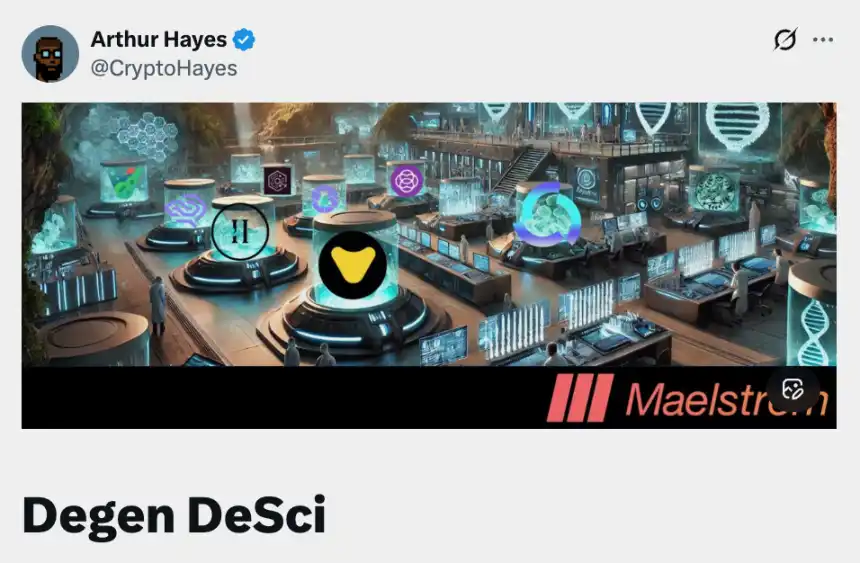
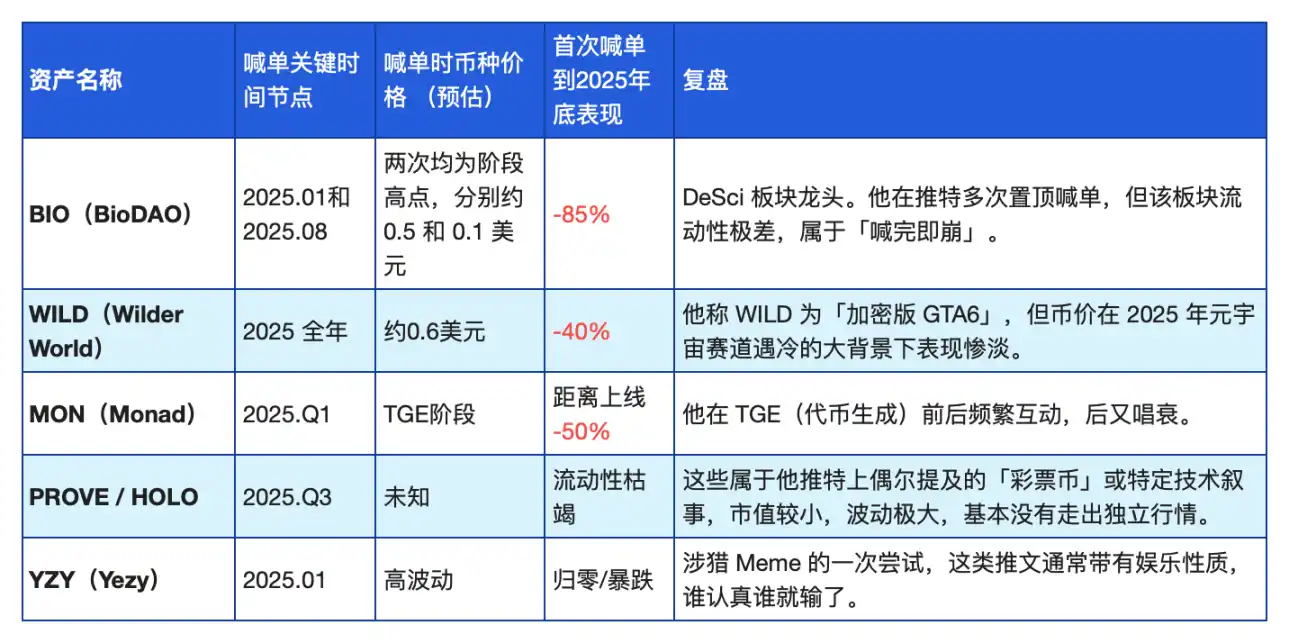
In early 2025, his family fund Maelstrom wrote a long and profound article "Degen DeSci," strongly bullish on the DeSci (Decentralized Science) sector. He listed a bunch of coins, BIO, GROW...

The result is clear for all to see: the DeSci sector almost全军覆没 (was completely wiped out), with many tokens falling more than 85% from their highs. Hayes built a position of $1.1 million worth of BIO again in August and finally deposited 7.66 million BIO into Binance in late November, with a potential loss of $640,000 (-58%).
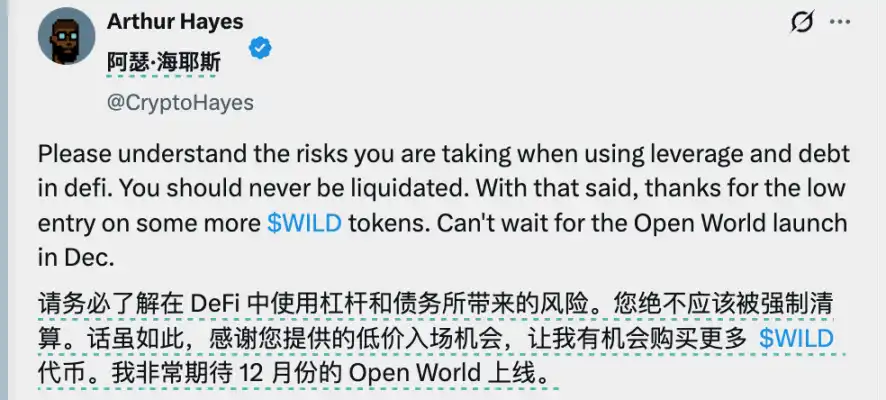
Then there's Wilder World (WILD), which he called the "Crypto version of GTA6." He hyped it for a whole year, and finally the price sank along with the metaverse concept.
Most of the tokens Hayes hyped had热度 (heat/hype) at specific stages. A summary is shown in the chart:
ZEC's "Smoke Screen"

This might be Hayes' most brilliant and intriguing operation in 2025.

On the surface, Hayes疯狂 (crazily) hyped Zcash (ZEC), stating that he initially bought millions of dollars worth after hearing the suggestion from Silicon Valley big shot Naval at a private dinner during Token 2049. In November last year, he shouted the slogan "target $10,000."

Hayes even initiated a withdrawal movement, calling on everyone to withdraw their coins to the chain to lock up liquidity.
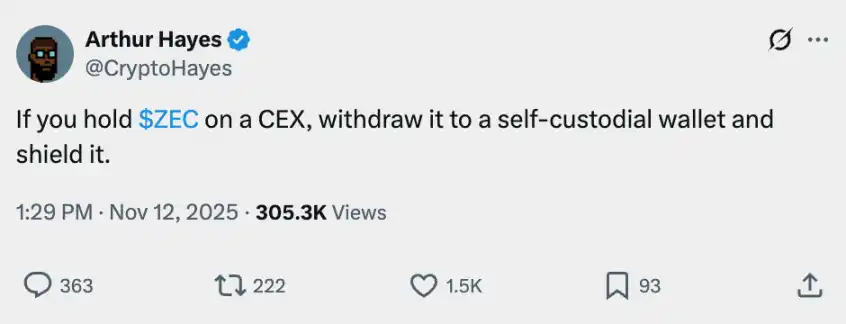
Many people watched his wallet to see if he was secretly selling ZEC. The result: he didn't sell; he was even adding to his position.

Perhaps the real purpose of Hayes creating this ZEC frenzy was: to sell ETH and exchange it for anything that was rising fast at the time.

Hayes had actually already taken a "knife" to ETH several times before this. Although he高喊 (shouted loudly) in 2025 that ETH would rise to $10,000, he experienced several "反复横跳" (back-and-forth jumps). He sold about $13.34 million worth of ETH and other tokens on August 2nd but expressed regret on August 9th for taking profits and had to buy back.

By November 15, 2025, just when he was vigorously hyping ZEC, Lookonchain monitored him transferring millions of dollars worth of ETH and ENA to Binance. On the same day, Hayes publicly declared on Twitter that he had "Aped more ZEC." On-chain analyst EmberCN also分析指出 (analyzed and pointed out) that this selling was极大概率 (most likely) to supply "ammunition" for adding to the ZEC position.
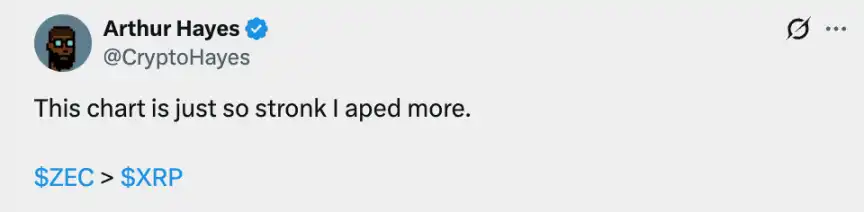
Due to ZEC's privacy features, his transparent ETH was sold and exchanged for opaque assets. On the chain, we can only see him "exiting" (selling ETH) but cannot quantify the scale of his "entering" (buying ZEC).

But in the last two weeks of 2025, Hayes sold another 1,871 ETH (about $5.53 million) and went back to buy the DeFi assets he had abandoned a month earlier.

This is a very冷酷 (cold) signal: in his logic, Ethereum is the "cash reserve" in his investment组合 (portfolio). He sells it when he needs money to buy new narratives (ZEC), and he still sells it when he needs money to bottom-fish old sectors (DeFi).

In the end, you will find that he used ZEC's price increase to attract the attention of the entire market, and then quietly completed his position rotation while everyone was discussing the "privacy renaissance." It wasn't until early 2026, when ZEC plummeted due to internal team strife, that everyone realized that although Hayes's holdings had shrunk, he successfully exited the top of ETH, which performed even worse during that phase.

How to Understand Arthur Hayes?

After reviewing this year, you will find that Hayes,正如 (just as) written in his X background picture, is not a "believer" HODLer but an extremely精明 (shrewd) businessman.
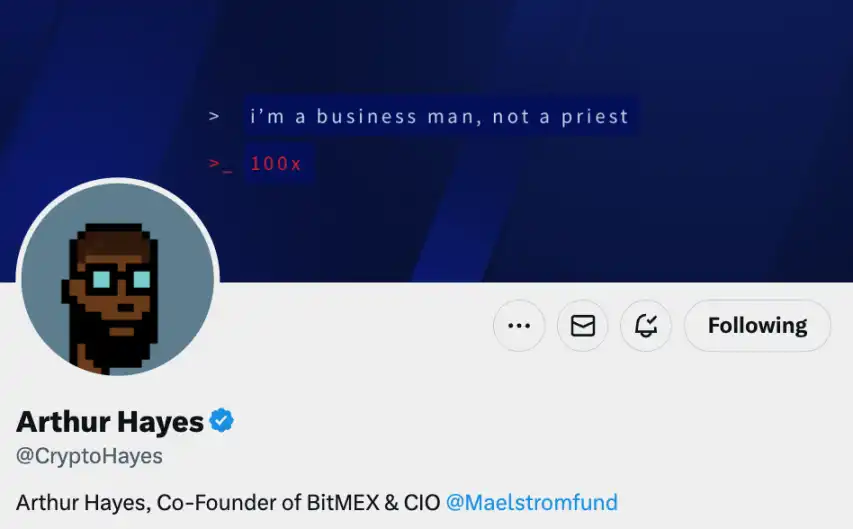
He uses words to build dreams to attract liquidity; he uses on-chain operations to harvest profits to avoid risks; he dares to quickly admit mistakes when he is wrong (e.g., abandoning ETH) to preserve capital.

So, his articles are still worth reading because his macro judgments have been verified. But before you press the "buy" button, please take one more step: don't listen to what he says, go see what his on-chain wallet is doing.

After all, in this残酷 (cruel) market, his loyalty to "volatility" is far higher than his belief in any single project. And volatility is precisely the money transferred from the pockets of retail traders to the pockets of traders.


Questions liées

QWhat was the main criticism of Arthur Hayes' actions in 2025 according to the article?

AThe main criticism was that Hayes' public endorsements ('calling orders') were often a strategy to create market hype and liquidity, allowing him to profitably sell his positions at high prices, while retail investors who followed his advice frequently ended up losing money.

QDescribe Hayes' typical strategy with VC coins like Hyperliquid (HYPE).

AHis strategy involved two steps: first, using his influence to endorse the coin at high prices and build a grand narrative (e.g., 'HYPE will grow 100x in three years'); second, liquidating his position for substantial profits once the token was unlocked or liquidity was sufficient, often just before a price drop.

QWhich investment narrative promoted by Hayes in 2025 failed significantly, and what was the result?

AHis promotion of the DeSci (Decentralized Science) narrative failed significantly. Coins in this sector, such as BIO, plummeted by over 85% from their highs. Hayes' investment in BIO resulted in a loss of approximately $640,000, a 58% decrease.

QWhat was the suspected real purpose behind Hayes' strong public endorsement of Zcash (ZEC)?

AThe suspected real purpose was to create a market frenzy around ZEC to attract attention and liquidity, which allowed him to discreetly sell his transparent assets like ETH and convert them into the more opaque ZEC. This move helped him rotate his portfolio away from underperforming assets like ETH.

QHow does the article suggest investors should interpret Hayes' public statements and actions?

AThe article advises investors to read his macro analyses but to verify his on-chain wallet activities before making investment decisions. It emphasizes that his loyalty is to 'volatility' and profit, not to any specific project's long-term success, making his actions more those of a shrewd trader than a faithful holder.

Lectures associées

Envoyer un message pour transférer des fonds ? Telegram prévoit d'intégrer un portefeuille crypto à ses 1 milliard d'utilisateurs cet été

L'été prochain, Telegram intégrera nativement un portefeuille crypto non-custodial, baptisé Gram, directement dans son application, accessible à plus d'un milliard d'utilisateurs. L'annonce faite par le fondateur Pavel Durov promet des transferts instantanés et sans frais de cryptomonnaies. Contrairement au bot @wallet existant, qui est géré par un tiers, ce nouveau portefeuille sera développé et contrôlé par Telegram, les utilisateurs conservant la maîtrise de leurs clés privées. La nouvelle a entraîné une hausse d'environ 8% du cours de GRAM (anciennement Toncoin). Toutefois, des questions techniques et un calendrier précis manquent, notamment sur la gestion des actifs au-delà du Gram et la mise en œuvre de la promesse de transactions sans frais. Cette initiative s'inscrit dans la stratégie "Make TON Great Again" de Durov, marquant le retour de Telegram sur le projet TON après son règlement avec la SEC en 2020. Cette stratégie contraste avec celles d'autres super-applications comme X Money de Musk (approche monétaire traditionnelle) ou Meta (exploration des stablecoins). Telegram parie ainsi sur la voie crypto-native, avec pour atouts sa base d'utilisateurs massive et son affinité avec la communauté blockchain, mais devra relever les défis de l'éducation des utilisateurs et de la régulation.

marsbitIl y a 33 mins

Envoyer un message pour transférer des fonds ? Telegram prévoit d'intégrer un portefeuille crypto à ses 1 milliard d'utilisateurs cet été

marsbitIl y a 33 mins

Finit le bon vieux temps ? Que traversent réellement les VC crypto ?

Le paysage du capital-risque (VC) spécialisé dans la cryptographie est en train de subir une transformation fondamentale. Des fonds majeurs comme Paradigm, qui a levé 1,2 milliard de dollars, et Framework Ventures élargissent désormais leurs investissements à l'IA, à la robotique et à d'autres technologies, éloignant la cryptographie du centre de leur stratégie. Ce changement reflète un schéma historique où les fonds spécialisés, ayant bâti un avantage informationnel initial, voient cet avantage disparaître une fois que la technologie se banalise et que les grands capitaux traditionnels entrent sur le marché. Le secteur évolue vers une structure en « haltère » : d'un côté, les grandes plates-formes de capital-risque généralistes (comme a16z, Sequoia) qui peuvent intégrer la cryptographie comme un segment vertical ; de l'autre, de petits fonds spécialisés nichés sur des fronts d'innovation très spécifiques. Les fonds de taille moyenne, purement axés sur la cryptographie, sont coincés dans une « zone de mort », leur taille ne leur permettant ni de générer des rendements suffisants uniquement avec des investissements en phase initiale, ni de rivaliser avec les géants pour les tours de table de croissance. Même les fonds qui affirment rester dans la cryptographie redéfinissent leur périmètre, se concentrant désormais sur l'infrastructure financière (stablecoins, marchés de prédiction) plutôt que sur une vision plus large. Cette évolution est également poussée par les investisseurs (LP) qui, après des pertes dans la cryptomonnaie, réorientent massivement leurs capitaux vers l'IA, forçant les gestionnaires de fonds à suivre cette tendance. Pour les startups cryptographiques, cela signifie qu'elles devront désormais rivaliser avec des projets d'autres secteurs, notamment l'IA, pour attirer l'attention des grands fonds généralistes. Parallèlement, les investissements à long terme dans les infrastructures de base, autrefois portés par des fonds spécialisés, pourraient se raréfier. À l'avenir, la cryptographie ne sera plus considérée comme une classe d'actifs à part entière mais comme une infrastructure sous-jacente, intégrée à divers produits financiers. Les fonds spécialisés survivront probablement dans des niches de pointe, tandis que le financement de croissance sera dominé par les acteurs généralistes.

Foresight NewsIl y a 1 h

Finit le bon vieux temps ? Que traversent réellement les VC crypto ?

Foresight NewsIl y a 1 h

À mesure que le consensus s'accélère, sur quoi parient les jeunes investisseurs ?

Dans le paysage actuel des investissements technologiques, la rapidité d’évolution des consensus oblige les jeunes investisseurs à s’adapter. L’IA quitte désormais l’écran pour s’intégrer au monde physique, avec un accent croissant sur l’intelligence embarquée, les robots et les systèmes industriels. Le défi n’est plus seulement de démontrer des capacités techniques, mais d’assurer une livraison fiable et scalable dans des environnements réels. Parallèlement, la valeur des grands modèles linguistiques ne se limite pas à leur performance initiale ; elle réside dans leur capacité à s’insérer durablement dans les flux de travail, créant ainsi une « roue de l’intelligence » auto-renforçante grâce aux données et retours utilisateurs. Face aux limites des données humaines, des approches comme l’apprentissage par renforcement et les modèles scientifiques fondamentaux émergent comme des pistes pour dépasser ces contraintes. Enfin, dans les domaines de pointe comme l’aérospatiale commerciale, l’informatique quantique ou l’énergie avancée, le capital doit faire preuve de patience. Ces secteurs requièrent des cycles de validation longs, une maîtrise des chaînes d’approvisionnement et une résilience face à l’incertitude. Les investisseurs doivent donc anticiper les besoins futurs et soutenir des équipes capables de naviguer dans ces écosystèmes complexes, en misant sur le long terme plutôt que sur des rendements immédiats.

marsbitIl y a 1 h

À mesure que le consensus s'accélère, sur quoi parient les jeunes investisseurs ?

marsbitIl y a 1 h

Trading

Spot
活动图片




