Reflections and Confusions of a Crypto VC

marsbitPublié le 2026-04-13Dernière mise à jour le 2026-04-13

Résumé

An encrypted VC's reflection on the current crypto investment landscape, which is undergoing a significant reset. Token exits, once the primary driver of outsized returns, are being redefined in real-time, with no established valuation framework yet emerging. Key market shifts include: the rise of tokens like HYPE, which demonstrated that token prices can be backed by real, on-chain revenue, forcing a reassessment of governance tokens with weak fundamentals; a massive supply shock from meme coins (e.g., PUMP) fragmenting liquidity; and the diversion of retail speculative capital into prediction markets, stock perps, and leveraged ETFs. Major questions VCs are now grappling with: whether they are underwriting equity, tokens, or a hybrid; what constitutes best practices for on-chain value accrual beyond potentially toxic token buybacks; and whether the "crypto premium" will vanish entirely, compressing token valuations to traditional equity multiples and potentially crashing Layer 1 valuations by over 95%. The author argues the pendulum has swung too far towards quantitative DeFi metrics and that qualitative factors like culture, innovation, and security remain crucial for non-DeFi projects. The conclusion is that token return expectations have compressed significantly, pushing later-stage investors towards "Web2.5" companies with tangible revenue. Crypto VCs must now prove their value beyond capital by offering strong branding and value-add to founders to survive.

Author:Catrina

Compiled by: Jiahuan, ChainCatcher

Crypto venture capital is at a watershed moment. Over the past three cycles, token exits have been the primary driver of outsized returns, but they are now undergoing a major reset. The definition of token value is being rewritten in real-time, yet a standard industry valuation framework has yet to emerge.

What Exactly Happened?

This time, the crypto market structure has been completely upended by multiple unprecedented forces hitting simultaneously:

1. The emergence of HYPE awakened the token market, proving that token prices can have real revenue backing, with over 97% of its eight to nine-figure revenue generated on-chain.

This has thoroughly disenchanted the market with governance tokens that rely on narrative hype and lack fundamental value—think of the L1s and "governance tokens" that existed primarily to navigate the ambiguity of securities laws (which made direct revenue distribution unfeasible). HYPE almost overnight reset market expectations: revenue is now scrutinized more strictly and has become the basic ante to play.

2. Chain reaction backlash on other token projects

Before 2025, if you had on-chain revenue, you were considered a security; after HYPE, if you ask most hedge funds, they'll tell you that if you don't have on-chain revenue, you'll go to zero. This has left most projects, especially non-DeFi ones, in a dilemma, scrambling to adapt.

3. PUMP brought a staggering supply shock to the system.

The supply explosion from meme coin mania fundamentally disrupted market structure by分散 attention and liquidity. On Solana alone, the number of newly generated tokens surged from about 2-4 thousand per year to a peak of 40-50 thousand. This effectively split an already not-growing-much liquidity cake into about one-twentieth. Chasing the same alpha, the same buyer demographic has shifted its attention and capital to speculating on meme coins rather than holding altcoins.

4. Accelerated diversion of retail speculative capital.

Prediction markets, stock perps, and leveraged ETF trading are now directly competing for the same pool of capital that would have flowed into altcoins. Meanwhile, the maturation of tokenization technology enables leveraged trading of blue-chip stocks, which don't carry the same risk of going to zero as most altcoins, are much more heavily regulated, and are more transparent with less information asymmetry risk.

The result is a大幅 compression of the token lifecycle: the time from peak to trough has shortened dramatically, retail willingness to "hold" tokens has plummeted, replaced by faster capital rotation.

Big Questions Every VC is Asking Themselves and Their Peers

1. Are we underwriting equity, tokens, or a combination of both?

The biggest challenge here is that we have no new playbook for value accrual in token projects—even the most successful ones like Aave still face controversy between the DAO and equity.

2. What is the best practice for on-chain value accrual?

The most common is token buybacks, but that doesn't mean it's right. We have long been against the prevailing trend of token buybacks: it's toxic and puts founders with real revenue in a bind.

The incentive is completely wrong: stock buybacks happen after a company has finished investing in growth, while crypto buybacks are increasingly demanded immediately, driven by retail/public perception (a completely fickle and irrational thing).

You could burn $10 million that could have been reinvested for nothing, and the very next day that value could be wiped out by some random market maker getting liquidated.

Public companies buy back stock when it's undervalued. Token buybacks get front-run at every turn, so they are often executed at local highs.

Especially if you are a B2B business generating off-chain revenue, this is a fool's errand. In my view, there is absolutely no reason to do buybacks just to please retail when your revenue is under $20 million, rather than reinvesting the capital into growth.

I really like this report from fourpillars, which shows that even nine-figure buybacks did almost nothing to help projects set a long-term price floor.
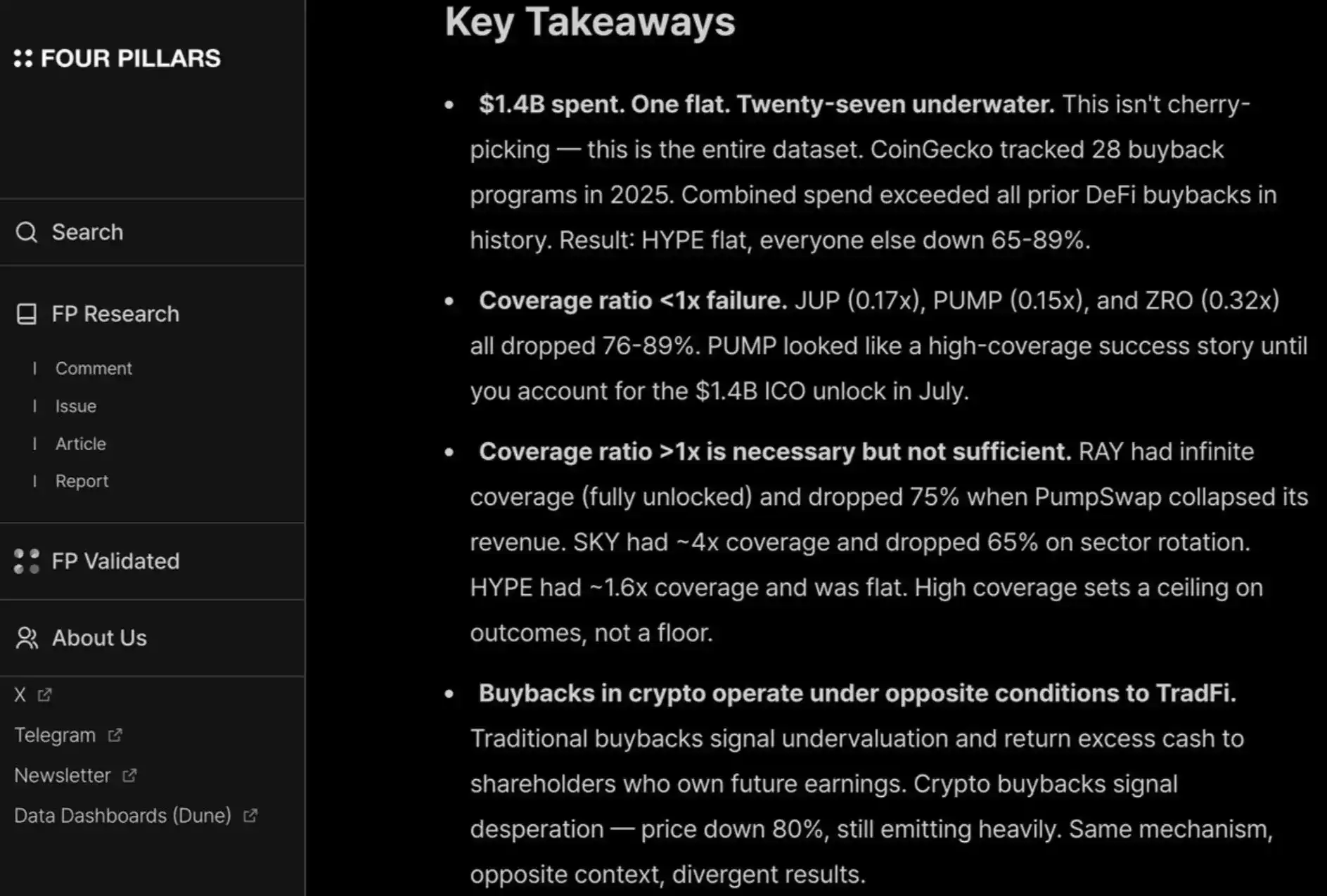
On top of that, to keep retail and hedge funds happy, you must conduct buybacks consistently and transparently, like HYPE does. Any failure to do so is punished, as seen with PUMP's P/E ratio (based on fully diluted valuation) being only 6x because the public "doesn't trust" them—despite the fact that they have verifiably burned $1.4 billion in revenue that could have gone to the treasury.

Here is further reading on "on-chain value accrual mechanisms that work without burning"

3. Will the "crypto premium" disappear entirely?

This would mean that in the future, all projects will be valued based on multiples similar to public stocks (roughly 2 to 30x revenue). Take a moment to think about what this means—if true, we would see most L1公链 prices fall further by over 95% from current levels, with exceptions like TRON, HYPE, and other revenue-generating DeFi projects. And this is even without considering token vesting.

Personally, I don't think it will be like this—HYPE set an extremely exceptional expectation, making many investors impatient with "day one revenue/user traction" for early-stage startups. For sustaining innovations like payments and DeFi companies, yes, this is a reasonable expectation.

But disruptive innovation takes time to build, launch, grow, and then see revenue scale exponentially.

In the past two cycles, we had excessive patience and blind optimism for so-called "disruptive technologies"—new L1s, esoteric concepts like Flashbots/MEV raising all the way to rounds 8-9, and now the pendulum has swung too far the other way, only willing to back DeFi projects.

The pendulum will swing back. While evaluating DeFi projects based on "quantitative" fundamentals is indeed a net positive for the industry's maturation, for non-DeFi categories, "qualitative" fundamentals also need to be considered: culture, technological innovation, disruptive concepts, security, decentralization, brand equity, and industry connectivity. And these traits are not simply reflected in TVL and on-chain buybacks.

What to Do Now?

Return expectations for token projects have been significantly compressed, while equity businesses have not seen a commensurate decline. This divergence is particularly evident in early-stage versus growth-stage projects.

Early-stage investors underwriting projects that might exit via tokens have become much more price-sensitive. At the same time, appetite for equity businesses has increased, especially given the good M&A environment. This is completely different from the 2022-2024 situation, where token exits were the preferred liquidity path, underpinned by the assumption that the token valuation premium would persist.

Later-stage investors, those with the strongest brand equity and added value in the crypto-native context, are increasingly moving away from purely "crypto-native" deals. Instead, they are pivoting to support more "Web2.5" companies, whose underwriting is anchored by revenue traction.

This puts them on unfamiliar turf, competing head-on with firms like Ribbit, Founders Fund—institutions that have deeper backgrounds in traditional fintech, stronger portfolio synergies, and better visibility into early-stage deal flow outside of crypto.

The crypto VC space is entering a period of value verification. The right to survive depends on VCs finding their own PMF (Product-Market Fit) among founders, where the "product" is a combination of capital, brand identity, and added value.

For the highest quality deals, VCs need to pitch themselves to founders to win the right to be on the cap table, especially as some of the most successful cases in recent years required almost no institutional capital (e.g., Axiom) or none at all (e.g., HYPE). If capital is the only thing a VC provides, it will almost certainly be淘汰.

Those VCs qualified to remain in the game need to be very clear about what they offer in terms of brand identity (this is what prompts the best founders to engage in the first place) and added value (which ultimately determines their right to win the deal).


Questions liées

QWhat are the main factors that have fundamentally disrupted the crypto market structure according to the article?

AThe crypto market structure has been disrupted by four main factors: 1) The emergence of HYPE, which proved token prices can be supported by real on-chain revenue, resetting market expectations. 2) The resulting backlash on other token projects, creating a dilemma for projects without on-chain revenue. 3) The massive supply shock from the memecoin frenzy (PUMP), which fragmented liquidity. 4) The accelerated diversion of retail speculative capital into alternative products like prediction markets, stock perps, and leveraged ETFs.

QWhat is the author's primary criticism of the prevalent token buyback trend in crypto?

AThe author criticizes token buybacks as being 'toxic' and creating a dilemma for founders with real revenue. The motivation is wrong: stock buybacks happen after a company has invested in growth, while crypto buybacks are demanded immediately due to fickle and irrational public/retail sentiment. They are often executed at local highs due to front-running and can be ineffective, especially for B2B businesses with off-chain revenue. The author argues there's no reason to do buybacks just to please retail instead of reinvesting in growth when revenue is under $20 million.

QDoes the author believe the 'crypto premium' will disappear entirely, leading to all projects being valued like public stocks?

ANo, the author does not believe the 'crypto premium' will disappear entirely. While they acknowledge that HYPE has set an extreme expectation making investors impatient for early revenue, they argue that disruptive innovation needs time to build and grow before seeing exponential revenue. The pendulum will swing back. For non-DeFi categories, 'qualitative' fundamentals like culture, technological innovation, disruptive concepts, security, decentralization, brand equity, and industry connectivity must also be considered, not just quantitative metrics like TVL and on-chain buybacks.

QHow has the investment landscape changed for early-stage and later-stage crypto VCs according to the reflection?

AReturn expectations for token projects have compressed significantly, while equity businesses have not seen the same level of decline. Early-stage investors have become much more price-sensitive when underwriting projects with potential token exits. Conversely, the appetite for equity businesses has increased, especially with a good M&A environment. Later-stage investors, strong in crypto-native brand equity, are increasingly moving away from pure 'crypto-native' deals and instead supporting more 'Web2.5' companies underwritten by revenue traction, putting them in direct competition with traditional fintech-focused funds.

QWhat does the author suggest is required for a crypto VC to survive and earn the right to be on a cap table in the current environment?

AThe author states that survival depends on a VC finding its own Product-Market Fit (PMF) with founders, where the 'product' is a combination of capital, brand identity, and value-add. For the best deals, VCs need to sell themselves to founders to win a place on the cap table, especially as successful projects may need little to no institutional capital. If capital is the only thing a VC provides, it will likely be eliminated. Those who remain must be very clear about what they offer in terms of brand identity (which attracts top founders) and value-add (which wins the deal).

Lectures associées

Après trois trimestres consécutifs de baisse, le marché des cryptomonnaies pourra-t-il connaître une fenêtre de stabilisation au troisième trimestre ?

Le marché des cryptomonnaies a enregistré son pire trimestre depuis 2022, avec une capitalisation totale chutant de 12,6% à 2 100 milliards de dollars. Tous les indicateurs clés (volume des échanges, valeur des stablecoins) montrent une sortie nette de capitaux. Le Bitcoin a perdu 14,2% et l'Ethereum 25,4% sur le trimestre, rompant sa corrélation antérieure avec les actions technologiques. Les ETF spot américains sur le Bitcoin ont subi des rachats massifs, avec une sortie nette de 4,67 milliards de dollars au Q2, indiquant une pression de vente continue. Le resserrement de la politique de la Fed et les ventes d'entreprises comme Strategy ont accentué la déleveragisation du secteur. L'attention du marché se porte désormais presque exclusivement sur la réunion de la Fed fin juillet. Une position accommodante pourrait stabiliser le Bitcoin entre 68 000 et 84 000 dollars, tandis qu'un ton hawkish pourrait le faire osciller autour de 50 000-56 000 dollars. Parallèlement, la progression du *CLARITY Act*, une loi cruciale pour la clarté réglementaire, est au point mort au Sénat, réduisant les chances d'adoption en 2026 et maintenant une prime de risque élevée sur l'ensemble du secteur. Malgré ce contexte difficile, quelques secteurs résistent : les marchés de prédiction ont vu leur volume nominal augmenter de 48,7% et les biens collectionnables tokenisés ont progressé d'environ 143%. La tokenisation d'actifs du monde réel (RWA) continue également sa croissance régulière, portée par des fondamentaux indépendants du cycle crypto. Les bases d'un effondrement extrême semblent absentes, mais le marché est désormais guidé par les politiques monétaires, les prix et les attentes de taux, plutôt que par le simple récit haussier. La fin des sorties massives des ETF et le retour des achats des détenteurs à long terme pourraient indiquer une phase de stabilisation potentielle.

marsbitIl y a 10 h

Après trois trimestres consécutifs de baisse, le marché des cryptomonnaies pourra-t-il connaître une fenêtre de stabilisation au troisième trimestre ?

marsbitIl y a 10 h

The SpaceX Trade, Unlocked: SPCXON Débarque sur WEEX

En juin 2026, SpaceX a réalisé la plus grande introduction en bourse de l'histoire, mais l'accès à l'action a été limité pour de nombreux investisseurs en raison de restrictions régionales et de frictions liées aux courtiers. La plateforme WEEX propose désormais une solution via SPCXON/USDT, un instrument tokenisé sur le marché au comptant qui permet d'obtenir une exposition au cours de SpaceX en utilisant l'USDT, sans nécessiter de compte de courtage américain. SPCXON est un produit tokenisé construit sur l'infrastructure d'Ondo, conçu pour refléter l'économie de la détention d'actions SpaceX pour les traders éligibles en dehors des États-Unis, avec des dividendes réinvestis. Le cas d'investissement repose sur la croissance des revenus de Starlink et les progrès de Starship, malgré un valorisation déjà élevée et des risques liés à un flottant public réduit et à des déblocages d'actions internes à venir. Il est important de noter que SPCXON offre une exposition, et non la propriété directe d'actions ou de droits de vote. Son prix peut évoluer avec une prime ou une décote par rapport à la valeur liquidative. WEEX propose également d'autres produits tokenisés comme MSTRON et MUON dans un compte unifié, permettant une rotation entre crypto-monnaies et actions traditionnelles sans transfert de fonds. La plateforme souligne ainsi comment les barrières entre la finance traditionnelle et les actifs numériques s'estompent.

TheNewsCryptoIl y a 10 h

The SpaceX Trade, Unlocked: SPCXON Débarque sur WEEX

TheNewsCryptoIl y a 10 h

BIT Trading Moment : Le BTC reste sous la pression de l'EMA 200 hebdomadaire, un rejet pourrait relancer la baisse, les actions de stockage et de semi-conducteurs qui ont bondi cette nuit ont baissé en séance de nuit

**Résumé des marchés : Bitcoin sous pression, actions technologiques en réajustement** Le marché crypto poursuit son rebond, avec Bitcoin évoluant autour de 66 000 $. Il fait face à une résistance clé vers 68 000 $, niveau correspondant au coût moyen des investisseurs sur cinq mois. Les traders surveillent les moyennes mobiles clés (200 MA à ~63 333 $ et 200 EMA à ~68 328 $ en hebdomadaire). Une rupture au-dessus de 68 000 $ ouvrirait la voie à une hausse, tandis qu'un échec pourrait entraîner un retest des 63 000 $. L'analyse suggère que la dynamique actuelle ressemble à un rebond estival à faible liquidité plutôt qu'au début d'un véritable marché haussier. Sur le marché actions américain, après une forte séance mardi portée par les semi-conducteurs et les titres du stockage (Micron, AMD, Intel...), les contrats à terme indiquent une ouverture en baisse. Les secteurs ayant récemment bondi, comme les semi-conducteurs et le stockage, reculent en séance de nuit. Certaines valeurs se démarquent néanmoins, comme Super Micro Computer (SMCI), en hausse après des résultats et des perspectives robustes liées à la demande de serveurs IA. Des vents contraires persistent : les prix du pétrole (Brent >91$) et les rendements des obligations d'État américaines grimpent, ravivant les craintes inflationnistes. En Asie, les marchés ont suivi le rebond technologique américain, mais de manière hésitante. La tension reste forte sur le yen japonais, qui atteint son plus bas niveau depuis des décennies. **Points clés à surveiller :** * **Crypto :** Niveaux techniques de Bitcoin (68k$/63k$), flux des ETF spot. * **Actions :** Saison des résultats (Tesla, Alphabet, Intel...), activité d'AMD sur l'IA. * **Économie :** Données américaines sur l'emploi, décision de la BCE, tensions géopolitiques et prix de l'énergie.

marsbitIl y a 10 h

BIT Trading Moment : Le BTC reste sous la pression de l'EMA 200 hebdomadaire, un rejet pourrait relancer la baisse, les actions de stockage et de semi-conducteurs qui ont bondi cette nuit ont baissé en séance de nuit

marsbitIl y a 10 h

Gate Research Institute : La vague de « Wall Streetisation » des produits financiers cryptographiques, concurrence ou fusion ?

Le titre de l'article est : "Gate Institute : La vague de 'Wall Street-isation' des produits financiers cryptos, est-ce une compétition ou une fusion ?" Résumé en français (environ 1400 caractères) : Il y a dix-sept ans, Bitcoin fut créé avec une vision décentralisée et anti-establishment financier. Aujourd'hui, paradoxalement, son adoption massive passe souvent par des ETF émis par des géants comme BlackRock. Cet article analyse cette "Wall Street-isation" apparente des actifs cryptos : les institutions traditionnelles s'emparent-elles du pouvoir d'émission, de tarification, de garde et de distribution ? La réalité est plus nuancée. C'est une convergence à double sens. D'un côté, les plateformes cryptos comme Gate.io étendent leurs services aux actions traditionnelles (états-uniennes, hongkongaises, sud-coréennes), aux CFD et aux produits tokenisés, offrant un compte unifié. De l'autre, des courtiers traditionnels comme Robinhood intègrent les cryptomonnaies et explorent la tokenisation d'actions sur blockchain. Cette fusion vise à créer le "super-compte" financier de demain, où actions, cryptos, ETF et obligations tokenisées (RWA) coexistent dans une même interface, comblant les faiblesses de chaque écosystème. Les RWA, notamment les obligations d'État tokenisées, agissent comme une couche intermédiaire unificatrice. En conclusion, Wall Street n'a pas conquis la crypto, et la crypto n'a pas contourné Wall Street. Ils construisent ensemble une nouvelle forme de marché des capitaux, plus efficace et mondial, où l'idéal décentralisé persiste dans les protocoles, tandis qu'une expérience utilisateur unifiée émerge à l'interface.

marsbitIl y a 10 h

Gate Research Institute : La vague de « Wall Streetisation » des produits financiers cryptographiques, concurrence ou fusion ?

marsbitIl y a 10 h

Trading

Spot
活动图片




