Qubic Sets April 1 Start Date For Dogecoin Attack

bitcoinistPublié le 2026-03-23Dernière mise à jour le 2026-03-23

Résumé

Qubic has announced it will launch its Dogecoin mining initiative on April 1, 2026, as part of a broader strategy to integrate external proof-of-work into its decentralized compute network. The project aims to use Dogecoin ASIC mining to strengthen QUBIC tokenomics by selling mined DOGE to buy and burn QUBIC, making it deflationary. The effort also serves as a real-world stress test for Qubic’s Oracle Machines, which validate mining shares through a Byzantine fault-tolerant system. This follows Qubic’s earlier controversial campaign against Monero, which was later reassessed as a 34% attack rather than a 51% takeover. Unlike the Monero operation, Dogecoin mining will run concurrently with Qubic’s AI training workloads, without displacing them.

Qubic says it will begin its Dogecoin push on April 1, marking the next phase of a mining strategy that first drew attention through its campaign against Monero. The big question is whether Qubic can turn Dogecoin mining into a live demonstration of its broader thesis: that external proof-of-work can be absorbed into a decentralized compute network and used to strengthen Qubic’s own token economics.

In a series of posts over the weekend, Qubic framed the rollout as both a product launch and a stress test. “Every Dogecoin share mined through the Qubic network gets validated by Oracle Machines: independent computors spread across the network who each verify the share separately. Up to 13 oracle commits per transaction. If the result passes the quorum’s Byzantine fault tolerance threshold (agreement from 451 of 676 computors), it’s validated on-chain.”

Qubic To Launch Dogecoin Mining Offensive On April 1

The team added that Oracle Machines went live on mainnet on February 11 and described Dogecoin mining as “the first real-world external use case built on top of this system.” Those claims line up with Qubic’s March technical updates, which said Dogecoin mining is on track for an April 1 mainnet launch and positioned it as a real-world stress test for the network’s outsourced-computing stack.

Dogecoin ASICs will be able to mine Qubic and receive higher rewards, while mined DOGE will be sold to buy QUBIC on the open market. Part of that purchased supply, it said, would be recycled into mining incentives, while “the rest will be burned,” with the explicit goal of making QUBIC deflationary. Qubic’s official Dogecoin mining explainer similarly says the community is still finalizing how mining revenue will be split between ASIC miners, computors, and broader network incentives.

That makes the April 1 launch more than a simple mining integration. Qubic has been arguing for months that Dogecoin changes its operating model because ASIC-based Scrypt mining can run in parallel with the network’s CPU- and GPU-based AI training, rather than alternating between workloads as it previously did with Monero.

“ASIC miners handle Dogecoin. CPUs and GPUs continue training Aigarth. Both contribute to the network. Neither displaces the other,” Qubic wrote in its March 3 explainer. “The same validation framework can serve price feeds, cross-chain data, and any external information that smart contracts need to act on.”

The backdrop is Qubic’s much more controversial Monero campaign. In August 2025, the project published a post titled “Qubic Performs 51% Monero Network Takeover Demonstration,” claiming it had reached majority hashrate and reorganized the chain. But that version did not hold up cleanly under later scrutiny.

Later independent analyses placed Qubic’s effective share closer to 28% to 35%. Even Sergey Ivancheglo ultimately conceded the operation “should be rebranded into ‘34% attack,’” a nod to the fact that the maneuver looked more like selfish mining than outright majority control.

Dogecoin was not a sudden pivot. By mid-August 2025, after the Monero episode, Qubic’s community had already chosen Dogecoin as its next target for “the following mining season,” with Ivancheglo indicating the transition would take months of development. Qubic’s January and March 2026 updates show that timeline now converging on launch: planning began in January, testing advanced through March, and the dispatcher is already live for test tasks.

At press time, DOGE traded at $0.09.
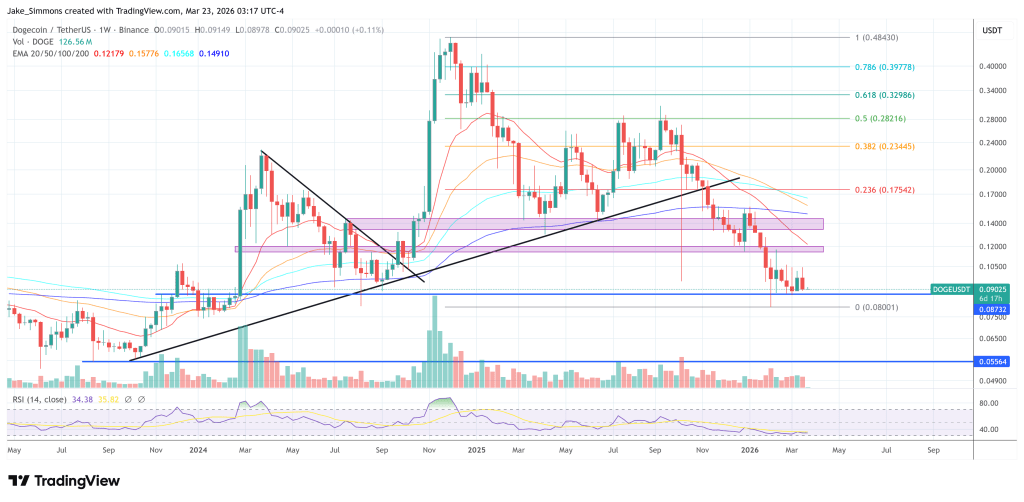
DOGE hovers above key support area, 1-week chart | Source: DOGEUSDT on TradingView.com

Questions liées

QWhat is the start date for Qubic's Dogecoin mining initiative and what is the broader goal of this strategy?

AQubic will begin its Dogecoin push on April 1. The broader goal is to demonstrate that external proof-of-work can be absorbed into a decentralized compute network to strengthen Qubic's own token economics.

QHow does the Qubic network validate Dogecoin shares, and what is the threshold for validation?

ADogecoin shares are validated by Oracle Machines, which are independent computors spread across the network. Validation requires agreement from 451 out of 676 computors to meet the Byzantine fault tolerance threshold.

QWhat will happen to the Dogecoin (DOGE) mined through the Qubic network, and how does this relate to QUBIC tokens?

AMined DOGE will be sold to buy QUBIC on the open market. Part of the purchased QUBIC will be recycled into mining incentives, and the rest will be burned to make QUBIC deflationary.

QHow does Qubic's approach to Dogecoin mining differ from its previous campaign against Monero?

AUnlike the Monero campaign, which alternated workloads, Dogecoin mining with ASICs can run in parallel with Qubic's CPU- and GPU-based AI training, allowing both to contribute without displacing each other.

QWhat was the outcome of Qubic's Monero campaign, and how did independent analyses view it?

AQubic initially claimed a 51% network takeover, but independent analyses later placed its effective hashrate share at 28% to 35%, leading to it being rebranded as a '34% attack' rather than a majority control.

Lectures associées

Bitwise : Optimiste quant à la performance du Bitcoin au second semestre, l'IA et la régulation vont déclencher une nouvelle saison des altcoins

Lors d'un récent épisode du Milk Road Show, les dirigeants de Bitwise, Matt Hougan (CIO) et Ryan Rasmussen (responsable de la recherche), ont partagé une vision extrêmement optimiste pour le Bitcoin et l'écosystème crypto. Ils estiment que l'objectif de 1 million de dollars par Bitcoin pourrait être « trop conservateur », le décrivant comme un pari « deux en un » : une réserve de valeur numérique (or digital) assortie d'une option d'appel hors de la monnaie pour devenir un actif de règlement international, une idée renforcée par l'instabilité géopolitique récente. Ils reconnaissent que le premier trimestre 2026 a été médiocre avec des baisses généralisées, mais soulignent que les flux d'actualités positifs (lancements de ETF par Morgan Stanley et Goldman Sachs, nouveau cadre réglementaire) sont tournés vers l'avenir et justifient l'optimisme actuel. Un point de données clé est l'explosion des actifs du monde réel tokenisés (RWA), passant de moins de 2 milliards il y a quelques années à près de 30 milliards de dollars aujourd'hui. Enfin, Hougan prédit un « nouvel altseason » pour 2026, catalysé par la combinaison de trois facteurs : le nouveau cadre réglementaire clair de la SEC pour les jetons, l'émergence de blockchains performantes et les capacités de l'IA. Cela permettra, selon lui, une nouvelle vague d'innovation et de projets légitimes, bien différente de l'ère ICO. Bitwise mise également sur cette diversification en annonçant un ETF Avalanche (AVAX), citant son architecture unique et sa croissance dans le secteur RWA.

marsbitIl y a 1 h

Bitwise : Optimiste quant à la performance du Bitcoin au second semestre, l'IA et la régulation vont déclencher une nouvelle saison des altcoins

marsbitIl y a 1 h

Trading

Spot
Futures
活动图片