Pricing Mechanism Failure: Bitcoin Lost in Conflicting Narratives

marsbitPublié le 2026-02-05Dernière mise à jour le 2026-02-05

Résumé

Bitcoin's identity crisis is causing its pricing mechanism to fail, as it simultaneously tries to function as four conflicting assets: an inflation hedge, a tech stock, digital gold, and an institutional reserve asset. This confusion was starkly exposed on January 29, 2026, when Bitcoin crashed 15% amid contradictory market events—falling both when it should have risen (as a safe haven during a stock market crash) and when it should have fallen (as a risk asset on hawkish signals). The article argues that Bitcoin's price is no longer driven by fundamentals like adoption or scarcity, but by institutional algorithmic trading and correlation assumptions with equities. Its volatility now moves in lockstep with stock market volatility (correlation of 0.88 with VIX), amplifying portfolio losses instead of providing diversification. Four potential resolution paths are outlined: Bitcoin could solidify as a strategic reserve asset (pushing price to $150K), normalize as a risk asset ($80K-$110K), become a true inflation hedge ($110K-$140K), or fail as a diversifier ($40K-$60K). The market's direction will be determined by key indicators like correlation shifts, government adoption announcements, on-chain activity, and volatility decoupling from stocks. Until Bitcoin’s identity is clearly defined, it will remain prone to reflexive price swings disconnected from utility.

Original Author: Luis Flavio Nunes

Original Compilation: Deep Tide TechFlow

Guide: On January 29, 2026, Bitcoin plummeted 15% in a single day, falling from $96,000 to $80,000. The strangeness lies in this: when the stock market crashed, it should have risen as a safe-haven asset, but it fell; when the Fed sent hawkish signals, it should have fallen as a risk asset, but it also fell. Bitcoin collapsed in both opposing events.

This article points out that Bitcoin is simultaneously playing four conflicting identities: inflation hedge, tech stock, digital gold, and institutional reserve asset. When these four identities vie for control, the result is chaos.

The author proposes four possible resolution paths and analyzes which path would push Bitcoin to $150,000.

Full Text Below:

On January 29, 2026, Bitcoin plummeted 15% in a single day, falling from $96,000 to $80,000. What is striking is not the crash itself, but that Bitcoin fell during the simultaneous occurrence of two opposing events.

The stock market crashed. This should have helped Bitcoin as a safe-haven asset.

The Fed signaled a tightening policy. This should have hit Bitcoin as a risk asset.

Bitcoin collapsed in both events. It moved with stocks when it should have moved opposite to them. It fell on hawkish news when digital gold should have risen. The fundamental logic of the market's understanding of what Bitcoin actually is was broken.

Four Incompatible Identities

Bitcoin is simultaneously trading as four different assets. Each identity demands different price behavior. When all four identities vie for control, the result is chaos.

Identity One: Inflation Hedge

Bitcoin has a fixed supply of 21 million coins. When governments print money and devalue currency, Bitcoin should rise. This was the original promise. Digital scarcity triumphs over government printing presses.

The data tells a different story. In 2025, when inflation panic dominated the markets, gold rose 64%. Bitcoin fell 26%. When the Consumer Price Index (CPI) showed unexpected increases, Bitcoin sometimes rose. When Core Personal Consumption Expenditures (Core PCE) showed inflation, Bitcoin sometimes fell. The reaction was random, not consistent.

If Bitcoin were truly an inflation hedge, it should react the same way to all inflation signals. Instead, it reacts to some signals and ignores others. This suggests Bitcoin is reacting to something else, perhaps energy prices that affect mining costs and consumer inflation.

Identity Two: Tech Stock

Bitcoin moves in sync with the Nasdaq. The 30-day correlation reached 0.68. When tech stocks fall due to growth concerns, Bitcoin falls. When the Fed hints at tightening and tech stocks sell off, Bitcoin sells off harder.

If Bitcoin were a tech stock, investors might as well buy the Nasdaq index directly. Tech stocks don't pay dividends, but they generate revenue and profits. Bitcoin generates neither. A pure tech bet through actual tech stocks makes more sense.

The problem goes deeper. Bitcoin was supposed to be uncorrelated with traditional markets. That was the whole value proposition. If Bitcoin is just a leveraged Nasdaq bet, then it has no place in a portfolio already holding stocks.

Identity Three: Digital Gold

In late January, when investors fled risk, gold soared to $5,500. Bitcoin crashed to $80,000. At the exact moment digital gold should have proven its value, the two assets moved in opposite directions.

Bitcoin's correlation with gold turned negative in 2026. Precisely negative 0.27. When gold rose 3.5% on hawkish Fed news, Bitcoin fell 15%. The Bitcoin-to-gold ratio hit a record low of 16.68x.

If Bitcoin is digital gold, it failed the most basic test. Gold works as a crisis hedge because it moves away from risk assets when panic rises. Bitcoin moves with risk assets, proving it is not gold in any meaningful sense.

Identity Four: Institutional Reserve Asset

Some companies and governments hold Bitcoin as a strategic reserve. Japan's Metaplanet holds 35,100 Bitcoins. The U.S. government integrates seized Bitcoin into its strategic reserves. This narrative suggests Bitcoin will become a core holding for pension funds and central banks.

The behavior doesn't match the story. Institutional investors are not holding through volatility. They are running basis trades, selling volatility, and treating Bitcoin as a trading tool. ETF flows mainly show arbitrage activity, not long-term conviction buying.

If institutions truly saw Bitcoin as a reserve asset like gold, they would accumulate during crashes and never sell. Instead, they sell during crashes and buy during rallies. This is trader behavior, not reserve manager behavior.

Valuation Paradox

Each identity implies a different fair value for Bitcoin.

If Bitcoin is an inflation hedge, based on gold's performance under similar monetary conditions, the price should be $120,000 to $150,000.

If Bitcoin is a tech stock, based on correlation with the Nasdaq and lack of cash flow, the price should be $50,000 to $70,000.

If Bitcoin is digital gold, based on gold's 65-year value trajectory applied to digital scarcity, the price should exceed $150,000.

If Bitcoin is an institutional reserve asset, the price should track government and corporate adoption rates, suggesting $100,000 to $120,000 by year-end.

The current price of $80,000 satisfies none of these frameworks. It is in the middle, pleasing no model and validating no thesis. This isn't the market finding equilibrium. This is a market that cannot agree on what it is pricing.

When Wall Street Can't Define What It Owns

Robbie Mitchnick manages digital asset strategy at BlackRock, the world's largest asset manager. In March 2025, he said something remarkable:

"Bitcoin fundamentally looks like digital gold. But some days it doesn't trade like it. Tariffs were announced, and it fell like a stock, which confused me because I don't understand why tariffs would affect Bitcoin. The answer is they don't."

Even Bitcoin's primary institutional advocates admit confusion. If BlackRock doesn't understand what Bitcoin is, how can retail investors be expected to know?

This confusion creates a mechanical problem. When institutions cannot classify an asset, they default to correlation-based risk models. These models assume historical correlations persist. When correlations shift suddenly, as in January, institutions must rebalance their portfolios. Rebalancing during a crash means forced selling. Forced selling creates a cascading effect.

Think of it like a ship's autopilot. The autopilot steers based on past wind patterns. When the wind suddenly changes direction, the autopilot overcorrects, causing violent swings. Human judgment could smooth the course, but the autopilot only knows historical patterns. Bitcoin's identity crisis is the changing wind, and institutional algorithms are the autopilot overcorrecting in the storm.
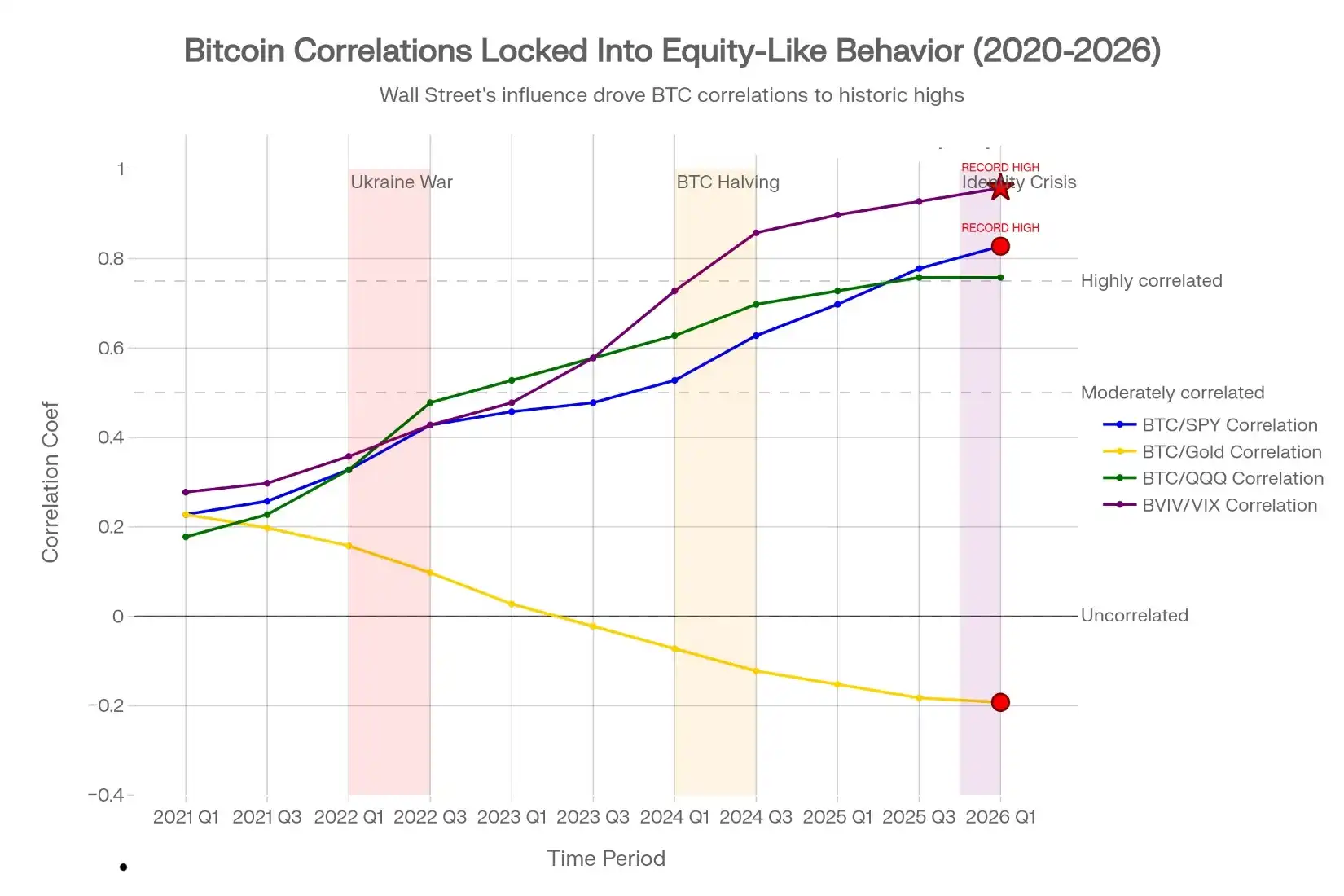
The Death of Diversification: Bitcoin's correlation with stocks surged from 0.15 (2021) to 0.75 (January 2026), a five-year shift driven entirely by institutional risk management, not Bitcoin adoption or fundamentals. A more destructive metric: Bitcoin volatility now correlates with stock volatility at 0.88 (purple line), the highest level ever recorded. This proves Bitcoin is traded mechanically based on stocks, not its own utility. Investors buying Bitcoin as a hedge are actually buying a leveraged, volatile stock bet that amplifies losses during crashes rather than offsetting them.

Volatility Homogenization

Bitcoin's volatility now moves in sync with stock market volatility. The correlation between Bitcoin volatility and the VIX stock volatility index reached 0.88 in January 2026. This is the highest reading ever recorded.

In 2020, this correlation was 0.2. Bitcoin volatility was independent. By 2026, it had become identical to stock volatility.

This is because institutional traders sell volatility across all asset classes simultaneously. When the VIX rises above certain levels, algorithms automatically sell Bitcoin, stocks, and commodities to reduce portfolio volatility. This mechanical selling has nothing to do with Bitcoin fundamentals. It is pure risk management, applied equally across all assets.

The result is that Bitcoin has lost independent price discovery. Its price is no longer driven by adoption, usage, or scarcity. It is driven by correlation assumptions and volatility control algorithms.

The data proves this. In January 2026, even as the price rebounded to $96,000, Bitcoin's daily active addresses were declining. Trading volume was falling even as institutional adoption was supposedly accelerating. The Lightning Network, which processes actual Bitcoin payments, grew 266% year-over-year. Yet the price fell.

Usage is up. Price is down. This proves that what drives the price is positioning and correlation, not fundamentals.

Reflexivity Trap

George Soros described reflexivity as a feedback loop where price movements themselves drive further movements, independent of fundamentals.

Bitcoin is caught in reflexivity.

Institutions assume a 0.75 correlation between Bitcoin and stocks. Option traders build hedges based on this assumption. When stocks move 2%, algorithms trigger a 2% move in Bitcoin. This creates a self-fulfilling prophecy. Bitcoin moves with stocks, so traders think it's a stock. Retail investors adopt this view and trade accordingly. Actual Bitcoin fundamentals become irrelevant. The price is completely detached from utility.

This is not temporary confusion. It is structural. Until institutions agree on what Bitcoin is, the reflexivity loop will persist. Every rally will contain the seeds of the next crash because the market cannot agree on why the rally is happening.

What Retail Investors Actually Own

Most retail investors think they own diversification when they buy Bitcoin. They believe Bitcoin protects against inflation and reduces stock exposure. The math proves otherwise.

Take a simple example. An investor holds $100,000 in stocks and allocates $5,000 to Bitcoin, expecting diversification.

When stocks fall 10%, the portfolio loses $9,000. But Bitcoin, with a 0.75 correlation, falls 15%. The Bitcoin position loses $750. Total loss: $9,750.

Without Bitcoin, the loss would have been $9,000. Bitcoin made the portfolio worse, not better. This correlation means Bitcoin amplifies stock losses rather than offsetting them.

True diversification requires negative correlation. Bonds are negatively correlated with stocks during risk-off periods. Gold is negatively correlated during crises. Bitcoin is positively correlated, making it useless as a hedge.

The Inevitable Resolution

Bitcoin cannot sustain four conflicting identities. The market will force a resolution in 2026 through one of four paths.

Path One: Strategic Reserve

Governments and corporations treat Bitcoin like gold reserves. They buy and never sell. Price volatility becomes irrelevant because holders measure success in decades, not quarters. Institutions stop trading Bitcoin and start hoarding it. Price finds equilibrium based on slow, steady accumulation. This path leads to $120,000 to $150,000 by year-end.

Path Two: Risk Asset Normalization

Institutions formally classify Bitcoin as a commodity derivative or stock analogue. They build risk models that account for extreme volatility. They accept that Bitcoin is not a hedge but a leveraged bet on monetary expansion. Position sizing adjusts accordingly. Correlations become predictable because everyone agrees on what Bitcoin is. Price trades in an $80,000 to $110,000 range with lower volatility.

Path Three: Inflation Hedge Acceptance

After resolving which inflation metric matters, the market agrees Bitcoin reacts to monetary debasement, not consumer price changes. Correlation with stocks falls to 0.3 or 0.4. Bitcoin becomes a true alternative to gold. This path leads to $110,000 to $140,000 as portfolio managers allocate for inflation protection.

Path Four: Diversification Failure

Institutions realize Bitcoin cannot diversify a stock portfolio. A 0.75 correlation is too high to justify an allocation. Capital flows reverse as portfolio managers exit. Retail investors understand Bitcoin is not a hedge. Price falls to $40,000 to $60,000 as the strategic allocation story collapses.

The most likely outcome is a slow resolution in 2026. Bitcoin will gradually shift from a risk asset to a reserve asset, with periodic corrections as institutions recalibrate. Price will consolidate between $80,000 and $110,000 until one path dominates.

What to Watch

Four indicators will show which path Bitcoin takes.

  • Correlation Inflection: If Bitcoin stops moving with stocks and correlation drops below 0.5, it becomes a hedge again. This favors Path Three.
  • Government Announcements: If a major government formally allocates Bitcoin to reserves, Path One accelerates. Watch for announcements from the U.S., E.U., or Japan.
  • On-Chain Metrics: If daily active addresses and transaction volume reverse upward while price is flat or falling, fundamentals are improving even as speculation decreases. This indicates long-term strength.
  • Volatility Normalization: If the correlation between Bitcoin volatility and stock volatility drops below 0.60, institutional volatility selling is easing. This allows true price discovery to return.

These indicators don't require capital to track. They provide better insight than price charts.

Conclusion

Bitcoin's fall to $80,000 was no accident. It was Bitcoin confronting a question it has avoided since institutional money arrived: What am I?

Until there is a clear answer to this question, every rally will contain the seeds of the next crash. Bitcoin will move with stocks when it should diverge. It will fall on news that should help it. It will rise on developments that shouldn't matter.

This is not temporary confusion. It is a structural identity crisis that defines the entire 2026 narrative.

Investors buying Bitcoin as an inflation hedge will be disappointed during inflation panics. Investors buying it for diversification will be disappointed when it amplifies stock losses. Investors buying it as digital gold will be disappointed when it trades like a tech stock.

The only investors who will succeed are those who understand Bitcoin is currently none of these things. It is a positioning-driven, correlation-dependent, volatility-controlled instrument that has temporarily lost its connection to its fundamental purpose.

The crash exposed this truth. The recovery will depend on Bitcoin's ability to answer what it is before institutions decide the answer for it.


Questions liées

QWhat are the four conflicting identities that Bitcoin is simultaneously trying to embody according to the article?

AThe four conflicting identities are: 1) Inflation hedge, 2) Tech stock, 3) Digital gold, and 4) Institutional reserve asset.

QWhy did the author describe Bitcoin's price drop on January 29, 2026, as particularly significant?

AIt was significant because Bitcoin crashed in response to two opposing events simultaneously: a stock market crash (where it should have risen as a safe-haven asset) and a hawkish signal from the Fed (where it should have fallen as a risk asset). This broke the fundamental logic of how the market understood Bitcoin.

QWhat is the article's main argument for why Bitcoin's price action has become chaotic and disconnected from its fundamentals?

AThe main argument is that institutional algorithms and risk models, which trade Bitcoin based on its high correlation to stocks and volatility control mechanisms, have taken over price discovery. This creates a reflexive loop where price movements are driven by positioning and correlation assumptions rather than adoption, utility, or scarcity.

QWhat does the 'volatility homogenization' phenomenon refer to in the context of Bitcoin's trading behavior?

AVolatility homogenization refers to the phenomenon where Bitcoin's volatility has become highly correlated (0.88) with stock market volatility (VIX). This means algorithms automatically sell Bitcoin along with stocks when volatility spikes to manage portfolio risk, making its price movements mechanical and detached from its own fundamentals.

QAccording to the author, what are the four possible paths for a resolution to Bitcoin's identity crisis, and which one would push its price toward $150,000?

AThe four paths are: 1) Strategic Reserve (price target $120K-$150K), 2) Risk Asset Normalization ($80K-$110K), 3) Inflation Hedge Acceptance ($110K-$140K), and 4) Diversification Failure ($40K-$60K). The path that would push the price toward $150,000 is Path One, the Strategic Reserve path, where governments and corporations treat it like gold and accumulate it long-term without selling.

Lectures associées

Trading

Spot
Futures

Articles tendance

Qu'est ce que BITCOIN

Comprendre HarryPotterObamaSonic10Inu (ERC-20) et sa position dans l'espace crypto Ces dernières années, le marché des cryptomonnaies a connu une augmentation de la popularité des monnaies mèmes, suscitant l'intérêt non seulement des traders, mais aussi de ceux qui recherchent un engagement communautaire et une valeur divertissante. Parmi ces jetons uniques, HarryPotterObamaSonic10Inu (ERC-20) est un projet intrigant qui mêle des références culturelles à l'univers des cryptomonnaies. Cet article explore les aspects clés de HarryPotterObamaSonic10Inu, en examinant ses mécanismes, son ethos axé sur la communauté, et son engagement avec le paysage crypto plus large. Qu'est-ce que HarryPotterObamaSonic10Inu (ERC-20) ? Comme son nom l'indique, HarryPotterObamaSonic10Inu est une monnaie mème construite sur la blockchain Ethereum, classée selon la norme ERC-20. Contrairement aux cryptomonnaies traditionnelles qui peuvent mettre l'accent sur l'utilité pratique ou le potentiel d'investissement, ce jeton prospère grâce à sa valeur divertissante et à la force de sa communauté. Le projet vise à favoriser un environnement où des utilisateurs engagés peuvent se rassembler, partager des idées et participer à des activités inspirées par divers phénomènes culturels. Une caractéristique notable de HarryPotterObamaSonic10Inu est son absence de taxe sur les transactions. Cet élément attrayant vise à encourager le trading et l'implication de la communauté, sans frais supplémentaires pouvant décourager les petits traders. L'offre totale de la monnaie est fixée à un milliard de jetons, un chiffre qui marque son intention de maintenir une circulation substantielle au sein de la communauté. Créateur de HarryPotterObamaSonic10Inu (ERC-20) Les origines de HarryPotterObamaSonic10Inu sont quelque peu obscures ; les détails concernant le créateur restent inconnus. Le développement de ce jeton ne comporte pas d'équipe identifiable ou de plan explicite, ce qui n'est pas rare dans le secteur des monnaies mèmes. Au lieu de cela, le projet a émergé de manière organique, son progrès s'appuyant fortement sur l'enthousiasme et la participation de sa communauté. Investisseurs de HarryPotterObamaSonic10Inu (ERC-20) En ce qui concerne les investissements externes et le soutien, HarryPotterObamaSonic10Inu reste également ambigu. Le jeton ne mentionne aucune fondation d'investissement connue ou un soutien organisationnel significatif. Au lieu de cela, le cœur battant du projet est sa communauté de base, qui informe sa croissance et sa durabilité par des actions collectives et un engagement dans l'espace crypto. Comment fonctionne HarryPotterObamaSonic10Inu (ERC-20) ? En tant que monnaie mème, HarryPotterObamaSonic10Inu opère principalement en dehors des cadres traditionnels qui régissent souvent la valeur des actifs. Plusieurs aspects distinctifs définissent comment le projet fonctionne : Transactions sans taxe : Sans frais de taxe sur les transactions, les utilisateurs peuvent acheter et vendre librement le jeton sans se préoccuper de frais cachés. Engagement communautaire : Le projet prospère grâce à l'interaction communautaire, exploitant les plateformes de médias sociaux pour créer du bruit et faciliter l'implication. Les discussions, le partage de contenu et l'engagement sont des éléments cruciaux qui aident à étendre sa portée et à favoriser la loyauté parmi les supporters. Pas d'utilité pratique : Il est important de noter que HarryPotterObamaSonic10Inu n'offre pas d'utilité concrète au sein de l'écosystème financier. Au contraire, il est classé comme un jeton principalement pour des activités de divertissement et communautaires. Référence culturelle : Le jeton intègre habilement des éléments de la culture populaire pour susciter l'intérêt, s'adressant à la fois aux amateurs de mèmes et aux suiveurs de crypto. HarryPotterObamaSonic10Inu illustre comment les monnaies mèmes fonctionnent différemment des projets de cryptomonnaies plus traditionnels, entrant sur le marché en tant que constructions sociales innovantes plutôt qu'actifs utilitaires. Chronologie de HarryPotterObamaSonic10Inu (ERC-20) L'histoire de HarryPotterObamaSonic10Inu est jalonnée de plusieurs étapes notables : Création : Le jeton est né d'un mème viral, captivant l'imagination de nombreux passionnés de crypto. Les dates de création spécifiques ne sont pas disponibles, soulignant son ascension organique. Listing sur les échanges : HarryPotterObamaSonic10Inu a fait son apparition sur divers échanges, permettant un accès et un trading plus faciles par la communauté. Initiatives d'engagement communautaire : Activités en cours visant à améliorer l'interaction communautaire, y compris des concours, des campagnes sur les réseaux sociaux, et la génération de contenu par des fans et des défenseurs. Plans d'expansion futurs : La feuille de route du projet comprend le lancement d'une collection NFT, de marchandises, et d'un site eCommerce lié à ses thèmes culturels, engageant davantage la communauté et tentant d'ajouter plus de dimensions à son écosystème. Points clés concernant HarryPotterObamaSonic10Inu (ERC-20) Nature axée sur la communauté : Le projet privilégie l'apport collectif et la créativité, garantissant que l'implication des utilisateurs est au cœur de son développement. Classification de monnaie mème : Il représente l'apogée de la cryptomonnaie basée sur le divertissement, se distinguant des véhicules d'investissement traditionnels. Pas d'affiliation directe avec Bitcoin : Malgré la similitude dans le nom du ticker, HarryPotterObamaSonic10Inu est distinct et n'a aucun lien avec Bitcoin ou d'autres cryptomonnaies établies. Focus sur la collaboration : HarryPotterObamaSonic10Inu est conçu pour créer un espace de collaboration et de partage d'histoires parmi ses détenteurs, offrant une voie pour la créativité et le lien communautaire. Perspectives d'avenir : L'ambition de s'étendre au-delà de son concept initial vers des NFT et des marchandises dessine un chemin pour le projet afin de potentiellement entrer dans des avenues plus grand public au sein de la culture numérique. Alors que les monnaies mèmes continuent de captiver l'imagination de la communauté des cryptomonnaies, HarryPotterObamaSonic10Inu (ERC-20) se distingue par ses liens culturels et son approche centrée sur la communauté. Bien qu'il ne corresponde pas au modèle typique d'un jeton axé sur l'utilité, son essence réside dans la joie et la camaraderie cultivées parmi ses supporters, soulignant la nature en évolution des cryptomonnaies dans un âge de plus en plus numérique. À mesure que le projet continue de se développer, il sera important de surveiller comment les dynamiques communautaires influencent sa trajectoire dans le paysage toujours changeant de la technologie blockchain.

1.4k vues totalesPublié le 2024.04.01Mis à jour le 2024.12.03

Qu'est ce que BITCOIN

Comment acheter BTC

Bienvenue sur HTX.com ! Nous vous permettons d'acheter Bitcoin (BTC) de manière simple et pratique. Suivez notre guide étape par étape pour commencer votre parcours crypto.Étape 1 : Création de votre compte HTXUtilisez votre adresse e-mail ou votre numéro de téléphone pour ouvrir un compte sur HTX gratuitement. L'inscription se fait en toute simplicité et débloque toutes les fonctionnalités.Créer mon compteÉtape 2 : Choix du mode de paiement (rubrique Acheter des cryptosCarte de crédit/débit : utilisez votre carte Visa ou Mastercard pour acheter instantanément Bitcoin (BTC).Solde :utilisez les fonds du solde de votre compte HTX pour trader en toute simplicité.Prestataire tiers :pour accroître la commodité d'utilisation, nous avons ajouté des modes de paiement populaires tels que Google Pay et Apple Pay.P2P :tradez directement avec d'autres utilisateurs sur HTX.OTC (de gré à gré) : nous offrons des services personnalisés et des taux de change compétitifs aux traders.Étape 3 : stockage de vos Bitcoin (BTC)Après avoir acheté vos Bitcoin (BTC), stockez-les sur votre compte HTX. Vous pouvez également les envoyer ailleurs via un transfert sur la blockchain ou les utiliser pour trader d'autres cryptos.Étape 4 : tradez des Bitcoin (BTC)Tradez facilement Bitcoin (BTC) sur le marché Spot de HTX. Il vous suffit d'accéder à votre compte, de sélectionner la paire de trading, d'exécuter vos trades et de les suivre en temps réel. Nous offrons une expérience conviviale aux débutants comme aux traders chevronnés.

5.1k vues totalesPublié le 2024.12.12Mis à jour le 2025.03.21

Comment acheter BTC

Qu'est ce que $BITCOIN

OR DÉMATÉRIEL ($BITCOIN) : Une Analyse Complète Introduction à OR DÉMATÉRIEL ($BITCOIN) OR DÉMATÉRIEL ($BITCOIN) est un projet basé sur la blockchain opérant sur le réseau Solana, qui vise à combiner les caractéristiques des métaux précieux traditionnels avec l'innovation des technologies décentralisées. Bien qu'il partage un nom avec Bitcoin, souvent appelé “or numérique” en raison de sa perception en tant que réserve de valeur, OR DÉMATÉRIEL est un jeton distinct conçu pour créer un écosystème unique au sein du paysage Web3. Son objectif est de se positionner comme un actif numérique alternatif viable, bien que les spécificités concernant ses applications et fonctionnalités soient encore en développement. Qu'est-ce qu'OR DÉMATÉRIEL ($BITCOIN) ? OR DÉMATÉRIEL ($BITCOIN) est un jeton de cryptomonnaie explicitement conçu pour une utilisation sur la blockchain Solana. Contrairement à Bitcoin, qui joue un rôle de stockage de valeur largement reconnu, ce jeton semble se concentrer sur des applications et caractéristiques plus larges. Les aspects notables incluent : Infrastructure Blockchain : Le jeton est construit sur la blockchain Solana, connue pour sa capacité à gérer des transactions rapides et peu coûteuses. Dynamique de l'Offre : OR DÉMATÉRIEL a une offre maximale plafonnée à 100 quadrillions de jetons (100P $BITCOIN), bien que les détails concernant son offre en circulation soient actuellement non divulgués. Utilité : Bien que les fonctionnalités précises ne soient pas explicitement décrites, il y a des indications que le jeton pourrait être utilisé pour diverses applications, impliquant potentiellement des applications décentralisées (dApps) ou des stratégies de tokenisation d'actifs. Qui est le Créateur d'OR DÉMATÉRIEL ($BITCOIN) ? À l'heure actuelle, l'identité des créateurs et de l'équipe de développement derrière OR DÉMATÉRIEL ($BITCOIN) reste inconnue. Cette situation est typique parmi de nombreux projets innovants dans l'espace blockchain, en particulier ceux alignés avec la finance décentralisée et les phénomènes de meme coin. Bien qu'une telle anonymité puisse favoriser une culture axée sur la communauté, elle intensifie les préoccupations concernant la gouvernance et la responsabilité. Qui sont les Investisseurs d'OR DÉMATÉRIEL ($BITCOIN) ? Les informations disponibles indiquent qu'OR DÉMATÉRIEL ($BITCOIN) n'a pas de bailleurs de fonds institutionnels connus ou d'investissements en capital-risque notables. Le projet semble fonctionner sur un modèle peer-to-peer axé sur le soutien et l'adoption de la communauté plutôt que sur des voies de financement traditionnelles. Son activité et sa liquidité se situent principalement sur des échanges décentralisés (DEX), tels que PumpSwap, plutôt que sur des plateformes de trading centralisées établies, soulignant davantage son approche de base. Comment fonctionne OR DÉMATÉRIEL ($BITCOIN) Les mécanismes opérationnels d'OR DÉMATÉRIEL ($BITCOIN) peuvent être élaborés en fonction de sa conception blockchain et des attributs du réseau : Mécanisme de Consensus : En s'appuyant sur le mécanisme de preuve d'historique (PoH) unique de Solana combiné à un modèle de preuve d'enjeu (PoS), le projet assure une validation efficace des transactions contribuant à la haute performance du réseau. Tokenomics : Bien que des mécanismes déflationnistes spécifiques n'aient pas été largement détaillés, l'immense offre maximale de jetons implique qu'elle pourrait répondre à des microtransactions ou à des cas d'utilisation de niche qui restent à définir. Interopérabilité : Il existe un potentiel d'intégration avec l'écosystème plus large de Solana, y compris diverses plateformes de finance décentralisée (DeFi). Cependant, les détails concernant des intégrations spécifiques restent non spécifiés. Chronologie des Événements Clés Voici une chronologie qui met en évidence des jalons significatifs concernant OR DÉMATÉRIEL ($BITCOIN) : 2023 : Le déploiement initial du jeton a lieu sur la blockchain Solana, marqué par son adresse de contrat. 2024 : OR DÉMATÉRIEL gagne en visibilité en devenant disponible à la négociation sur des échanges décentralisés comme PumpSwap, permettant aux utilisateurs de l'échanger contre SOL. 2025 : Le projet connaît une activité de trading sporadique et un intérêt potentiel pour des engagements dirigés par la communauté, bien qu'aucun partenariat notable ou avancée technique n'ait été documenté jusqu'à présent. Analyse Critique Forces Scalabilité : L'infrastructure sous-jacente de Solana prend en charge des volumes de transactions élevés, ce qui pourrait améliorer l'utilité de $BITCOIN dans divers scénarios de transaction. Accessibilité : Le potentiel faible prix de négociation par jeton pourrait attirer les investisseurs de détail, facilitant une participation plus large grâce aux opportunités de propriété fractionnée. Risques Manque de Transparence : L'absence de bailleurs de fonds, de développeurs ou de processus d'audit connus publiquement peut susciter du scepticisme quant à la durabilité et à la fiabilité du projet. Volatilité du Marché : L'activité de trading dépend fortement du comportement spéculatif, ce qui peut entraîner une volatilité des prix significative et une incertitude pour les investisseurs. Conclusion OR DÉMATÉRIEL ($BITCOIN) émerge comme un projet intrigant mais ambigu au sein de l'écosystème Solana en rapide évolution. Bien qu'il tente de tirer parti du récit de “l'or numérique”, son éloignement du rôle établi de Bitcoin en tant que réserve de valeur souligne la nécessité d'une différenciation plus claire de son utilité prévue et de sa structure de gouvernance. L'acceptation et l'adoption futures dépendront probablement de la résolution de l'opacité actuelle et de la définition plus explicite de ses stratégies opérationnelles et économiques. Remarque : Ce rapport englobe des informations synthétisées disponibles jusqu'en octobre 2023, et des développements peuvent avoir eu lieu au-delà de la période de recherche.

83 vues totalesPublié le 2025.05.13Mis à jour le 2025.05.13

Qu'est ce que $BITCOIN

Discussions

Bienvenue dans la Communauté HTX. Ici, vous pouvez vous tenir informé(e) des derniers développements de la plateforme et accéder à des analyses de marché professionnelles. Les opinions des utilisateurs sur le prix de BTC (BTC) sont présentées ci-dessous.

活动图片