Prediction Market Leaders Are Frantically Competing for Top-Tier Sports IPs

Odaily星球日报Publié le 2026-01-28Dernière mise à jour le 2026-01-28

Résumé

Prediction market platforms are aggressively securing exclusive partnerships with major sports leagues, as seen in Polymarket's recent multi-year deal with Major League Soccer (MLS). This follows similar agreements with the NHL and UFC. While these "official exclusive prediction market" designations don’t legally prevent other platforms from offering markets on these leagues (due to the current ambiguous regulatory landscape for prediction markets compared to sports betting), they provide significant advantages. The core benefits include access to official, high-quality data for more accurate odds and faster settlements, brand authorization for marketing, and collaborative integrity monitoring to prevent market manipulation. With sports-related markets dominating trading volume on leading platforms like Kalshi (over 90%) and Polymarket (43%), competition for these lucrative partnerships is intensifying. This trend mirrors the established sports betting industry, where data and brand deals are crucial for service quality. While the top players battle for mainstream sports, data suggests emerging platforms may find opportunity in niche markets, such as crypto-native events, to differentiate themselves.

Original | Odaily Planet Daily (@OdailyChina)

Author | Azuma (@azuma_eth)

On January 27 local time in the United States, the commercial department of Major League Soccer (MLS), Soccer United Marketing (SUM), announced a multi-year cooperation agreement with the prediction market platform Polymarket. According to the agreement, Polymarket will become the official exclusive prediction market partner for the MLS league, MLS All-Star Game, MLS Cup Final, and the Leagues Cup. Meanwhile, MLS will require Polymarket to use the league's official data and third-party integrity monitoring systems, and it is not allowed to set up betting items that the league deems easily manipulated or potentially involving insider information.

This is not the first time a sports league has partnered with a prediction market. As early as last October, the National Hockey League (NHL) reached multi-year licensing agreements with both Kalshi and Polymarket; later, in November last year, Polymarket also reached an agreement with the Ultimate Fighting Championship (UFC), becoming UFC's official exclusive prediction market partner.

What does "official exclusive prediction market" mean? Does this mean that other unauthorized platforms will no longer be able to offer related markets in the future? What impact will this have on future competition? Although there are currently limited mature cases of prediction markets cooperating with sports events, and the observable samples are few, we can find similar answers to the above questions from the sports betting market, which has extremely similar service effects.

  • Odaily Note: For the similarities in services and differences in regulation between prediction markets and sports betting, as well as the regulatory博弈 surrounding prediction markets, please refer to our article from two weeks ago: "Prediction Markets Are Being Chased by the Old Order for Moving a Trillion-Dollar Cake of the Betting Industry."

Exclusive Authorization Market Licensing

First, let's answer the most critical question — Does the existence of exclusive authorization mean that other unauthorized platforms will no longer be able to offer related markets in the future?

The current situation in sports betting is that since the U.S. Supreme Court overturned the federal law "Professional and Amateur Sports Protection Act" (PASPA), which had prohibited commercial sports betting, on May 14, 2018, U.S. states have gained the autonomy to decide whether to legalize sports betting within their jurisdictions. In other words, the legality of betting services depends on state-level licensing, not commercial authorization from the leagues — in reality, when betting companies set up markets or provide betting services for various legal sports events, they do not need to obtain commercial authorization from the league operators.

However, in a few states like Tennessee, state-level sports betting regulatory agencies require betting companies to use the league's official data when providing in-play betting services, unless it can be proven that the data is not applicable or unavailable. This makes official authorization affect the scope of services of betting companies at a factual level — only by obtaining data authorization can they provide the most complete betting services.

But this logic does not directly apply to prediction markets at present. Due to the unclear (and objectively more lenient) regulatory system for prediction markets, before the final results of the appellate court or even the Supreme Court are determined, Polymarket and Kalshi are not obliged to follow similar requirements in betting regulations.

Therefore, although Polymarket has now obtained exclusive authorization from MLS, at least at this stage, it does not mean that other platforms like Kalshi are no longer allowed to set up MLS-related markets.

If Not Necessary, What Is the Significance of Authorization?

Although it is not "necessary to have authorization to open markets," in actual commercial operations, there are indeed a large number of commercial cooperation and authorization agreements between major sports leagues and betting companies. For example, the NFL has signed a long-term cooperation agreement with Genius Sports, authorizing real-time event data to betting companies through Genius as the sole official data provider, including rosters, match reports, technical statistics, etc.

For betting companies, the main significance of authorization is that they can directly obtain official data and brand authorization from the operators of sports events through commercial agreements to improve their service quality and user experience. If it is an exclusive authorization, an additional layer of exclusivity can be added on this basis.

The most core significance naturally lies in the quality and completeness of the data. Compared with data scraping through third-party channels, the official data obtained based on authorization agreements will definitely be more accurate, timely, and complete, which has a direct impact on improving the accuracy of betting odds, accelerating settlement efficiency, and expanding betting categories. As for brand and trademark authorization, it can allow betting companies to be more flexible in promoting related markets — they can use the logos of leagues, teams, and players while avoiding infringement risks.

Conversely, for sports events, reaching authorization agreements directly with betting companies also helps reduce the possibility of market manipulation (which may sound a bit abstract...). Both parties can standardize the betting range and share abnormal betting data to promptly detect potential manipulation possibilities. For example, in the cooperation between Polymarket and MLS, it has been clearly stated that markets that are easily manipulated by individuals, such as red and yellow card decisions, or those that may involve insider information, such as coach dismissals and player transfers, are not allowed.

Given the high overlap in service effects between prediction markets and sports betting, the significance of authorization agreements for the sports betting market will also take effect in prediction markets.

Head-on Clash of the Leaders, the Unconventional Second Tier

Sports betting has long been verified as a business with a huge scale and certain growth, and in prediction markets, sports events have gradually become the category with the highest transaction volume proportion.

Dovey Wan (@DoveyWan), founder of Primitive Ventures, yesterday posted the proportion of turnover of various types of events on several major prediction markets. Among them, the betting scale proportion of sports events on Kalshi has exceeded 90%, and the proportion of sports events on Polymarket has also reached 43% — obviously, sports events have become the core traffic source for these two leading prediction markets.
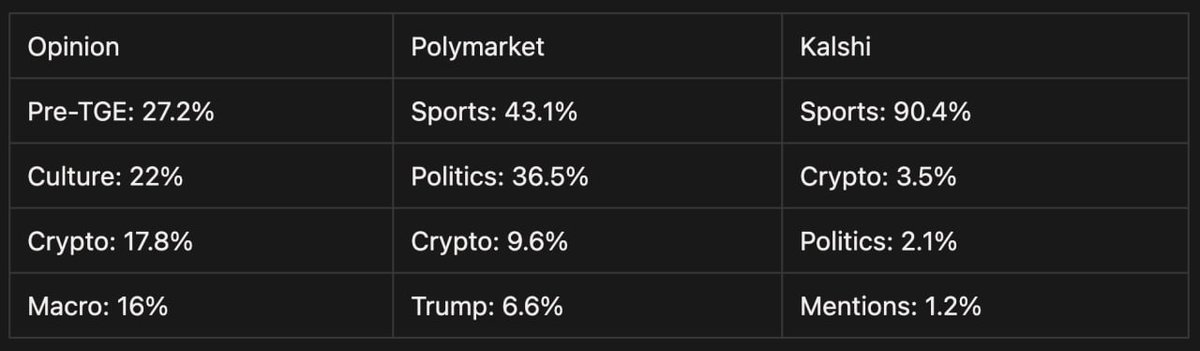
In the face of the huge存量规模 and visible增量空间, market competition is inevitable. Currently, among the four major U.S. sports leagues, only the NHL has stepped in and signed authorization agreements with Kalshi and Polymarket respectively, while the NFL, NBA, and MLB are still in a wait-and-see stage. It is expected that after Polymarket has successively seized the exclusive authorization of UFC and MLS, Kalshi and Polymarket, the two leaders with compliance and capital advantages, are likely to engage in more intense competition for the authorization of various top-tier sports events in the future, and there will inevitably be more exclusive agreements.

But the data also reveals another interesting phenomenon — perhaps due to cultural differences and user habits, emerging prediction markets on the other side of the world are moving towards截然不同的差异化道路. As shown in the previous figure, the proportion of event turnover围绕ing原生加密市场 events on Opinion is much higher than that on Kalshi and Polymarket. While the leaders are clashing head-on over the huge cake of sports events, choosing to take an unconventional path may be an opportunity for second-tier projects to catch up on a curve.


Questions liées

QWhat is the significance of the partnership between MLS's Soccer United Marketing (SUM) and Polymarket?

AThe partnership makes Polymarket the official exclusive prediction market partner for MLS, MLS All-Star Game, MLS Cup, and Leagues Cup, allowing it to use official league data and integrity monitoring systems while restricting markets prone to manipulation or insider information.

QDoes an exclusive prediction market partnership like Polymarket's with MLS prevent other platforms from offering related markets?

ANo, it does not necessarily prevent other platforms from offering markets, as prediction markets currently operate under a less clear regulatory framework compared to sports betting, and authorization isn't legally required to open markets in most cases.

QWhat are the key benefits for a prediction market platform in securing an official data授权 from a sports league?

AOfficial data授权 provides more accurate, timely, and complete data, improving odds accuracy, settlement efficiency, and market variety. It also includes brand授权 for marketing and helps mitigate manipulation through regulated markets and shared monitoring.

QAccording to the data shared by Dovey Wan, what is the proportion of sports-related event volume on Kalshi and Polymarket?

ASports-related event volume accounts for over 90% on Kalshi and 43% on Polymarket, making it a core traffic source for these leading prediction markets.

QHow might the competition for top sports IP affect the prediction market landscape, particularly for second-tier projects?

AThe intense competition for exclusive sports授权 between giants like Kalshi and Polymarket may push second-tier projects to pursue差异化 strategies, such as focusing on crypto-native markets, as seen with Opinion's higher volume in that area.

Lectures associées

La veille du coup d’envoi, les chiffres sur la chaîne : 1,6 milliard déjà échangé avant le début de la Coupe du monde

À la veille du coup d'envoi de la Coupe du Monde 2026, le seul contrat « Vainqueur de la Coupe du Monde » sur la plateforme de marchés de prédiction Polymarket a déjà atteint un volume de transactions cumulé d'environ **16 milliards de dollars**, et ce sans qu'un seul match n'ait été joué. Cette activité illustre la montée en puissance des marchés de prédiction décentralisés, dont le volume sectoriel a été multiplié par quatre entre 2024 et 2025. Ces plateformes proposent des centaines de contrats couvrant le vainqueur, le meilleur buteur, et chaque match individuel. Leur fonctionnement repose sur des blockchains (comme Polygon), des jetons conditionnels (ERC-1155), et des oracles décentralisés (comme Chainlink) pour le règlement automatisé. Avant le tournoi, le secteur a connu des évolutions structurelles significatives : adoption d'un stablecoin régulé (USDC) pour les règlements, intégration d'oracles fiables, et surtout, la reconnaissance officielle par la FIFA, qui a nommé pour la première fois un partenaire officiel dans la catégorie « marché de prédiction ». Ainsi, si les entreprises de la cryptomonnaie ne figurent pas parmi les sponsors principaux traditionnels, elles se sont immiscées dans les couches infrastructurelles de l'événement : couche de règlement, couche de prédiction et partenariats officiels. Le marché parallèle de la Coupe du Monde sur la blockchain est déjà pleinement actif.

marsbitIl y a 2 mins

La veille du coup d’envoi, les chiffres sur la chaîne : 1,6 milliard déjà échangé avant le début de la Coupe du monde

marsbitIl y a 2 mins

De l'introduction en bourse de SpaceX à l'avenir de la Crypto : Quels secteurs cryptographiques hériteront du récit du billion de dollars ?

L'IPO planifiée de SpaceX, visant une valorisation de 1,77 trillion de dollars, illustre un changement dans la logique de valorisation des capitaux, se concentrant sur les infrastructures et les écosystèmes futurs plutôt que sur les simples applications. Cet article explore les retombées potentielles pour le marché de la cryptographie. **1. L'IA entre dans sa seconde phase : la valorisation des infrastructures** Le récit dominant de l'IA évolue des applications grand public vers les ressources sous-jacentes. À l'instar de la valorisation par le marché des capacités de calcul, les projets crypto liés à l'IA pourraient être réévalués. Des protocoles comme TAO (mise en réseau), RENDER et AKT (réseaux de calcul GPU) pourraient gagner en importance en tant que fournisseurs d'infrastructure fondamentale, bénéficiant d'une valorisation à plus long terme que les applications. **2. La tokenisation d'actifs du monde réel (RWA) pourrait atteindre un point d'inflexion** La difficulté d'accès aux actifs de croissance future comme SpaceX crée une opportunité pour la tokenisation. Au-delà des obligations d'État, les RWA pourraient s'étendre aux actions et aux actifs privés, créant un marché mondial de liquidités 24h/24. Cette évolution pourrait restructurer la propriété d'actifs elle-même, bénéficiant d'abord aux infrastructures comme ONDO (émission), LINK (oracles de données) et les réseaux RWA. **3. La formation d'une nouvelle logique infrastructurelle** Comme Starlink (valeur réseau), les infrastructures crypto sous-jacentes deviennent cruciales. Les stablecoins évoluent d'un moyen d'échange vers une infrastructure financière essentielle pour les paiements transfrontaliers, les titres tokenisés et l'économie de l'IA. Les réseaux de paiement et les projets DePIN (réseaux physiques décentralisés), qui construisent des infrastructures réelles via des incitations tokenisées, pourraient également être réévalués. En conclusion, l'événement SpaceX signale un passage de la spéculation sur les récits à l'investissement dans les infrastructures et les flux de trésorerie. Pour le prochain cycle crypto, les infrastructures d'IA, les RWA, les stablecoins et les réseaux DePIN pourraient représenter la logique fondamentale à long terme, ceux qui construisent les systèmes sous-jacents capturant souvent la plus grande valeur.

marsbitIl y a 23 mins

De l'introduction en bourse de SpaceX à l'avenir de la Crypto : Quels secteurs cryptographiques hériteront du récit du billion de dollars ?

marsbitIl y a 23 mins

Le cercle des cryptomonnaies frappé de plein fouet ! Le Bitcoin franchit la barre des 60 000 dollars, l'Ethereum s'effondre de plus de 10 %, Strategy pris pour cible par les vendeurs à découvert

Le marché des cryptomonnaies subit une correction sévère. Le Bitcoin a chuté sous les 60 000 USD, atteignant son plus bas niveau depuis octobre 2024, avec une perte hebdomadaire de 16%. La vente d'une partie des actifs Bitcoin par MicroStrategy, suivie de données sur l'emploi américain plus solides que prévu, a déclenché cette baisse. L'action MicroStrategy (MSTR) a plongé de 24% sur la semaine, attirant une forte activité de vente à découvert. Plusieurs facteurs convergent : des capitaux se détournent vers les actions technologiques et l'IA, tandis que les perspectives d'adoption d'une loi régulant le secteur aux États-Unis s'éloignent. Le récit du Bitcoin, entre "or numérique" et actif à risque, est mis à mal alors que les marchés actions atteignent des records. Bien que les ETF Bitcoin aient connu un léger influx après 13 jours de sorties, leurs actifs totaux ont significativement diminué. Le marché des options montre un pessimisme marqué envers MicroStrategy, avec un volume de puts bien supérieur à celui des calls. La pression s'accentue également sur ses obligations prioritaires (STRC), dont la crédibilité a été ébranlée. La hausse des rendements des Treasuries, alimentant les craintes de resserrement monétaire, ajoute une pression supplémentaire sur l'ensemble de la classe d'actifs. Malgré le pessimisme ambiant, certains acteurs voient dans ce repli une opportunité d'achat, notant que le Bitcoin teste sa moyenne mobile clé de 200 semaines.

华尔街日报Il y a 1 h

Le cercle des cryptomonnaies frappé de plein fouet ! Le Bitcoin franchit la barre des 60 000 dollars, l'Ethereum s'effondre de plus de 10 %, Strategy pris pour cible par les vendeurs à découvert

华尔街日报Il y a 1 h

Trading

Spot
Futures
活动图片