Prediction Market Leaders Are Frantically Competing for Top-Tier Sports IPs

Odaily星球日报Publié le 2026-01-28Dernière mise à jour le 2026-01-28

Résumé

Prediction market platforms are aggressively securing exclusive partnerships with major sports leagues, as seen in Polymarket's recent multi-year deal with Major League Soccer (MLS). This follows similar agreements with the NHL and UFC. While these "official exclusive prediction market" designations don’t legally prevent other platforms from offering markets on these leagues (due to the current ambiguous regulatory landscape for prediction markets compared to sports betting), they provide significant advantages. The core benefits include access to official, high-quality data for more accurate odds and faster settlements, brand authorization for marketing, and collaborative integrity monitoring to prevent market manipulation. With sports-related markets dominating trading volume on leading platforms like Kalshi (over 90%) and Polymarket (43%), competition for these lucrative partnerships is intensifying. This trend mirrors the established sports betting industry, where data and brand deals are crucial for service quality. While the top players battle for mainstream sports, data suggests emerging platforms may find opportunity in niche markets, such as crypto-native events, to differentiate themselves.

Original | Odaily Planet Daily (@OdailyChina)

Author | Azuma (@azuma_eth)

On January 27 local time in the United States, the commercial department of Major League Soccer (MLS), Soccer United Marketing (SUM), announced a multi-year cooperation agreement with the prediction market platform Polymarket. According to the agreement, Polymarket will become the official exclusive prediction market partner for the MLS league, MLS All-Star Game, MLS Cup Final, and the Leagues Cup. Meanwhile, MLS will require Polymarket to use the league's official data and third-party integrity monitoring systems, and it is not allowed to set up betting items that the league deems easily manipulated or potentially involving insider information.

This is not the first time a sports league has partnered with a prediction market. As early as last October, the National Hockey League (NHL) reached multi-year licensing agreements with both Kalshi and Polymarket; later, in November last year, Polymarket also reached an agreement with the Ultimate Fighting Championship (UFC), becoming UFC's official exclusive prediction market partner.

What does "official exclusive prediction market" mean? Does this mean that other unauthorized platforms will no longer be able to offer related markets in the future? What impact will this have on future competition? Although there are currently limited mature cases of prediction markets cooperating with sports events, and the observable samples are few, we can find similar answers to the above questions from the sports betting market, which has extremely similar service effects.

  • Odaily Note: For the similarities in services and differences in regulation between prediction markets and sports betting, as well as the regulatory博弈 surrounding prediction markets, please refer to our article from two weeks ago: "Prediction Markets Are Being Chased by the Old Order for Moving a Trillion-Dollar Cake of the Betting Industry."

Exclusive Authorization Market Licensing

First, let's answer the most critical question — Does the existence of exclusive authorization mean that other unauthorized platforms will no longer be able to offer related markets in the future?

The current situation in sports betting is that since the U.S. Supreme Court overturned the federal law "Professional and Amateur Sports Protection Act" (PASPA), which had prohibited commercial sports betting, on May 14, 2018, U.S. states have gained the autonomy to decide whether to legalize sports betting within their jurisdictions. In other words, the legality of betting services depends on state-level licensing, not commercial authorization from the leagues — in reality, when betting companies set up markets or provide betting services for various legal sports events, they do not need to obtain commercial authorization from the league operators.

However, in a few states like Tennessee, state-level sports betting regulatory agencies require betting companies to use the league's official data when providing in-play betting services, unless it can be proven that the data is not applicable or unavailable. This makes official authorization affect the scope of services of betting companies at a factual level — only by obtaining data authorization can they provide the most complete betting services.

But this logic does not directly apply to prediction markets at present. Due to the unclear (and objectively more lenient) regulatory system for prediction markets, before the final results of the appellate court or even the Supreme Court are determined, Polymarket and Kalshi are not obliged to follow similar requirements in betting regulations.

Therefore, although Polymarket has now obtained exclusive authorization from MLS, at least at this stage, it does not mean that other platforms like Kalshi are no longer allowed to set up MLS-related markets.

If Not Necessary, What Is the Significance of Authorization?

Although it is not "necessary to have authorization to open markets," in actual commercial operations, there are indeed a large number of commercial cooperation and authorization agreements between major sports leagues and betting companies. For example, the NFL has signed a long-term cooperation agreement with Genius Sports, authorizing real-time event data to betting companies through Genius as the sole official data provider, including rosters, match reports, technical statistics, etc.

For betting companies, the main significance of authorization is that they can directly obtain official data and brand authorization from the operators of sports events through commercial agreements to improve their service quality and user experience. If it is an exclusive authorization, an additional layer of exclusivity can be added on this basis.

The most core significance naturally lies in the quality and completeness of the data. Compared with data scraping through third-party channels, the official data obtained based on authorization agreements will definitely be more accurate, timely, and complete, which has a direct impact on improving the accuracy of betting odds, accelerating settlement efficiency, and expanding betting categories. As for brand and trademark authorization, it can allow betting companies to be more flexible in promoting related markets — they can use the logos of leagues, teams, and players while avoiding infringement risks.

Conversely, for sports events, reaching authorization agreements directly with betting companies also helps reduce the possibility of market manipulation (which may sound a bit abstract...). Both parties can standardize the betting range and share abnormal betting data to promptly detect potential manipulation possibilities. For example, in the cooperation between Polymarket and MLS, it has been clearly stated that markets that are easily manipulated by individuals, such as red and yellow card decisions, or those that may involve insider information, such as coach dismissals and player transfers, are not allowed.

Given the high overlap in service effects between prediction markets and sports betting, the significance of authorization agreements for the sports betting market will also take effect in prediction markets.

Head-on Clash of the Leaders, the Unconventional Second Tier

Sports betting has long been verified as a business with a huge scale and certain growth, and in prediction markets, sports events have gradually become the category with the highest transaction volume proportion.

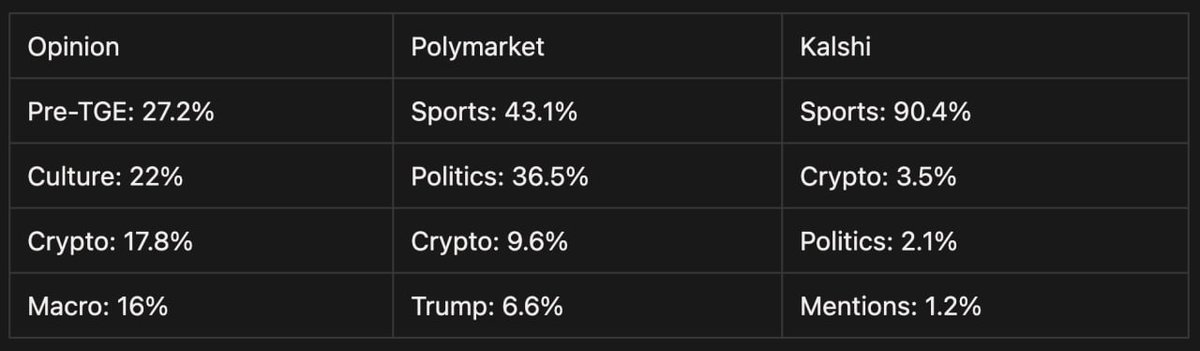
Dovey Wan (@DoveyWan), founder of Primitive Ventures, yesterday posted the proportion of turnover of various types of events on several major prediction markets. Among them, the betting scale proportion of sports events on Kalshi has exceeded 90%, and the proportion of sports events on Polymarket has also reached 43% — obviously, sports events have become the core traffic source for these two leading prediction markets.
In the face of the huge存量规模 and visible增量空间, market competition is inevitable. Currently, among the four major U.S. sports leagues, only the NHL has stepped in and signed authorization agreements with Kalshi and Polymarket respectively, while the NFL, NBA, and MLB are still in a wait-and-see stage. It is expected that after Polymarket has successively seized the exclusive authorization of UFC and MLS, Kalshi and Polymarket, the two leaders with compliance and capital advantages, are likely to engage in more intense competition for the authorization of various top-tier sports events in the future, and there will inevitably be more exclusive agreements.

But the data also reveals another interesting phenomenon — perhaps due to cultural differences and user habits, emerging prediction markets on the other side of the world are moving towards截然不同的差异化道路. As shown in the previous figure, the proportion of event turnover围绕ing原生加密市场 events on Opinion is much higher than that on Kalshi and Polymarket. While the leaders are clashing head-on over the huge cake of sports events, choosing to take an unconventional path may be an opportunity for second-tier projects to catch up on a curve.


Questions liées

QWhat is the significance of the partnership between MLS's Soccer United Marketing (SUM) and Polymarket?

AThe partnership makes Polymarket the official exclusive prediction market partner for MLS, MLS All-Star Game, MLS Cup, and Leagues Cup, allowing it to use official league data and integrity monitoring systems while restricting markets prone to manipulation or insider information.

QDoes an exclusive prediction market partnership like Polymarket's with MLS prevent other platforms from offering related markets?

ANo, it does not necessarily prevent other platforms from offering markets, as prediction markets currently operate under a less clear regulatory framework compared to sports betting, and authorization isn't legally required to open markets in most cases.

QWhat are the key benefits for a prediction market platform in securing an official data授权 from a sports league?

AOfficial data授权 provides more accurate, timely, and complete data, improving odds accuracy, settlement efficiency, and market variety. It also includes brand授权 for marketing and helps mitigate manipulation through regulated markets and shared monitoring.

QAccording to the data shared by Dovey Wan, what is the proportion of sports-related event volume on Kalshi and Polymarket?

ASports-related event volume accounts for over 90% on Kalshi and 43% on Polymarket, making it a core traffic source for these leading prediction markets.

QHow might the competition for top sports IP affect the prediction market landscape, particularly for second-tier projects?

AThe intense competition for exclusive sports授权 between giants like Kalshi and Polymarket may push second-tier projects to pursue差异化 strategies, such as focusing on crypto-native markets, as seen with Opinion's higher volume in that area.

Lectures associées

Arthur Hayes dernier article : Ignorez la guerre et l'inflation, la bulle de l'IA est la plus grande opportunité

L'auteur, Arthur Hayes, co-fondateur de BitMEX, soutient que la bulle de l'IA représente la plus grande opportunité d'investissement actuelle, surpassant les préoccupations liées à la guerre et à l'inflation. Il affirme que les dépenses d'investissement (CAPEX) massives des États-Unis et de la Chine dans l'IA, motivées par le nationalisme et la course à la suprématie technologique, entraînent une création monétaire et un assouplissement des conditions financières sans précédent. Cette liquidité accrue en dollars et en yuan profitera aux actifs comme le Bitcoin et les cryptomonnaies. Hayes estime que cette frénésie de dépenses durera jusqu'à ce qu'une introduction en bourse ou une fusion trop importante fasse prendre conscience au marché de la surévaluation, ou jusqu'aux élections américaines de 2028, où un retournement politique anti-inflationniste pourrait survenir. Parallèlement, les conflits géopolitiques (comme une guerre USA-Iran) pousseront de nombreux pays à délaisser les actifs financiers libellés en dollars (comme les Treasuries) pour investir dans des infrastructures physiques et des matières premières afin d'assurer leur sécurité. Pour éviter un effondrement des marchés américains, les autorités devront maintenir des conditions financières très accommodantes, alimentant davantage de liquidités. Il conclut que cette combinaison de liquidités abondantes et d'inflation rend le Bitcoin extrêmement attractif, prévoyant une hausse significative (potentiellement jusqu'à 126 000 dollars). Il recommande d'adopter une posture de risque élevé, de se concentrer sur le Bitcoin et d'explorer également certaines "altcoins" (cryptomonnaies alternatives) comme le sien, $NEAR, porté par le thème de la vie privée.

marsbitIl y a 1 h

Arthur Hayes dernier article : Ignorez la guerre et l'inflation, la bulle de l'IA est la plus grande opportunité

marsbitIl y a 1 h

OpenAI lance une nouvelle entreprise en investissant 27 milliards de yuans pour accélérer le déploiement de l'IA

Le 11 mai, OpenAI a annoncé la création d'une nouvelle entreprise, "OpenAI Deployment Company", avec un investissement initial de plus de 40 milliards de dollars (environ 272 milliards de yuans), visant à aider les entreprises à construire et déployer l'IA. La société, contrôlée par OpenAI, regroupe 19 investisseurs, cabinets de conseil et intégrateurs de systèmes, dirigée par TPG avec des partenaires fondateurs comme Advent International, Bain Capital et Brookfield. OpenAI prévoit également d'acquérir la société de conseil en IA Toromo, ajoutant environ 150 ingénieurs et "experts en déploiement". L'objectif est de combler l'écart entre les capacités de l'IA et leur intégration opérationnelle dans les entreprises. OpenAI souligne que la prochaine phase de concurrence dépendra de l'efficacité du déploiement de l'IA dans les scénarios commerciaux réels. La société augmente ses investissements dans le calcul et l'IA, prévoyant 500 milliards de dollars de dépenses en calcul cette année et visant 6 000 milliards de dollars d'ici 2030. Fin mars, OpenAI a finalisé un tour de table de 1 220 milliards de dollars, portant sa valorisation post-investissement à 8 520 milliards de dollars. Les investisseurs incluent Amazon, NVIDIA, SoftBank, et Microsoft. OpenAI développe également de nouveaux modèles avancés et envisagerait une introduction en bourse d'ici 2027, avec une valorisation potentielle d'environ 1 000 milliards de dollars.

marsbitIl y a 1 h

OpenAI lance une nouvelle entreprise en investissant 27 milliards de yuans pour accélérer le déploiement de l'IA

marsbitIl y a 1 h

La nature des licenciements liés à l'IA : Pourquoi l'adoption de l'IA accentue l'anxiété des entreprises ?

L'auteur, confronté à une possible inclusion dans un plan de licenciement de son entreprise, analyse la vague actuelle de « licenciements liés à l'IA ». Il constate que si l'utilisation d'outils d'IA comme Claude a explosé dans les entreprises, entraînant une production de code jusqu'à 5 fois supérieure, cela ne s'est pas traduit par une croissance équivalente des revenus ou des produits finaux. Le problème fondamental réside dans la confusion entre les intrants (le code généré), les extrants (les fonctionnalités) et les résultats commerciaux (la valeur perçue et payée par les clients). L'IA, facturée à l'usage (token), augmente massivement le coût des intrants sans garantie d'amélioration des résultats. Deux freins majeurs empêchent de convertir cette productivité artificielle en valeur réelle : la mauvaise qualité de nombreuses idées, auparavant filtrées par la rareté des ressources de développement, et la lenteur paralysante des processus d'alignement et de coordination entre les équipes ("alignment hell"). Dans ce contexte, les licenciements répondent à deux logiques immédiates : 1) compenser financièrement les énormes dépenses en services d'IA en réduisant la masse salariale, et 2) simplifier l'organisation en supprimant des équipes, réduisant ainsi la « taxe d'alignement » et les blocages internes. Ainsi, même si l'IA ne remplace pas directement les postes un par un, elle provoque ces licenciements en créant un déséquilibre économique (coûts accrus sans revenus supplémentaires) et en exacerbant les inefficacités organisationnelles. La vague continuera tant que les entreprises n'auront pas appris à transformer la productivité de l'IA en résultats tangibles et à adapter leur gestion et leur coordination à cette nouvelle vitesse d'exécution.

marsbitIl y a 2 h

La nature des licenciements liés à l'IA : Pourquoi l'adoption de l'IA accentue l'anxiété des entreprises ?

marsbitIl y a 2 h

Trading

Spot
Futures
活动图片