Only 60% Real Win Rate: Data Reveals the Truth Behind ICO Predictions on Polymarket

marsbitPublié le 2026-01-31Dernière mise à jour le 2026-01-31

Résumé

Polymarket's TokenSale markets have processed nearly $250 million in volume, boasting impressive accuracy rates—100% for fundraising amounts and over 90% for fully diluted valuations (FDV). However, an analysis of 231 prediction markets across 29 token sales reveals these figures are misleading. The platform functions more as a sentiment indicator, often acting as a contrarian signal. Key findings show that the true prediction accuracy one week before market close is only 66.7%, meaning the crowd is wrong one-third of the time, with errors consistently skewing toward over-optimism. FDV predictions averaged a 35% overestimation. Analysis of 24-hour post-launch volatility showed an average price swing of ±23%, with 75% of tokens facing sell-offs. Only 62.5% of 24-hour FDV predictions were accurate. The 100% accuracy claim is meaningless because markets close after results are known. High trading volume on Polymarket often serves as a reverse indicator—more optimism typically leads to greater inaccuracy. Tokens with conservative predictions (e.g., Monad, Football.fun) saw smaller declines. Actionable signals: High volume (>$50M) and high optimism (>50% FDV overestimation) are bearish. Low volume (<$5M) and accurate predictions (within 20% of actual FDV) are relatively bullish. In a market where most tokens fall below ICO price, "less bad" is the best outcome. Polymarket’s token sales market is essentially a hype meter—extreme confidence often signals maximum investor pain.

Author: @WazzCrypto, Legion

Compiled by: Frank, PANews

Observations on Prediction Markets in the Token World

Polymarket's Token Sale market has processed nearly $250 million in trading volume. The platform's advertised accuracy data is impressive: 100% accuracy in fundraising amount predictions and over 90% for FDV (Fully Diluted Valuation). However, a deeper analysis reveals that these numbers are misleading. The real signal is not what the crowd predicts, but how wrong they are.

By analyzing 231 prediction markets across 29 token sale events and cross-referencing Polymarket's historical probability data with actual token performance on CoinGecko, we found that "prediction markets are not reliable forecasting tools. Instead, they are actually sentiment indicators, and often a contrarian signal.

Key Finding: One week before market close, the real prediction accuracy was only 66.7%. At critical moments, the crowd is wrong one-third of the time, and incorrect predictions often show systematic over-optimism.

24-Hour Volatility Issue: Using CoinGecko's hourly data, we found that Polymarket's markets for "FDV above X 24 hours after launch" are essentially bets on extreme volatility. The average 24-hour price change was ±23% (e.g., Best performer: Monad +54.8%; Worst performer: Trove -38.7%). 75% of tokens faced selling pressure within 24 hours of launch. In this context, Polymarket's accuracy for 24-hour FDV predictions was only 62.5%.

The Fallacy of Accuracy: The Market is Wrong One-Third of the Time

When we track how market probabilities evolve over time, rather than just looking at static data at settlement, a completely different picture emerges. The fundraising amount prediction markets appear "100% accurate" because the final figures are inevitably leaked gradually as the sale progresses. Insiders and observers update prices accordingly; this is merely ex-post price discovery.
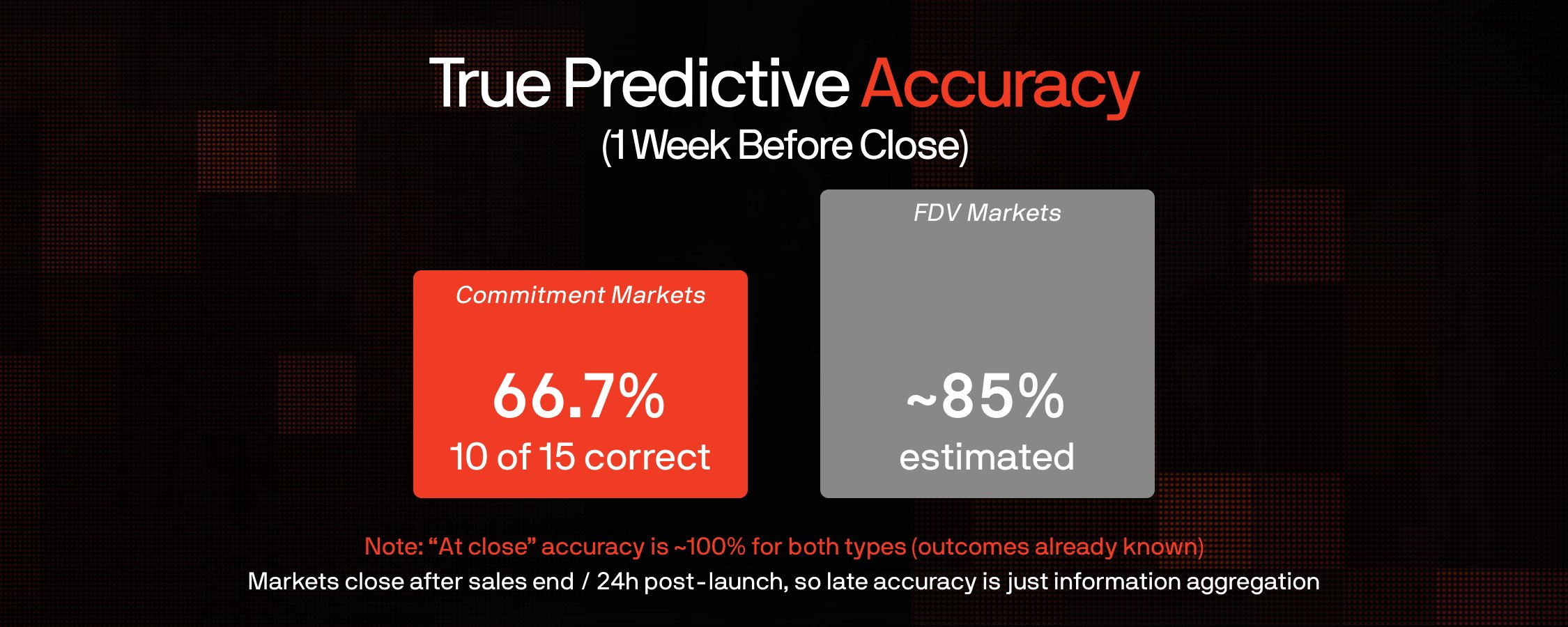
Key Insight: The reason fundraising and FDV markets tend towards 100% accuracy at close is because they settle *after* the outcome is largely certain. Fundraising markets close after the sale ends; FDV markets close 24 hours after launch. The only meaningful predictive metric is the accuracy one week before close, when genuine uncertainty exists. The 66.7% accuracy rate for fundraising predictions shows that, at the critical moment, the market is wrong 1/3 of the time.

Crowd Predictions Err on the Side of Excessive Optimism

We reviewed every prediction market where "crowd confidence exceeded 60% but ultimately failed to materialize." In every case, the error was consistent: over-optimism. The crowd consistently believed the raise would be higher and the valuation more expensive than reality.
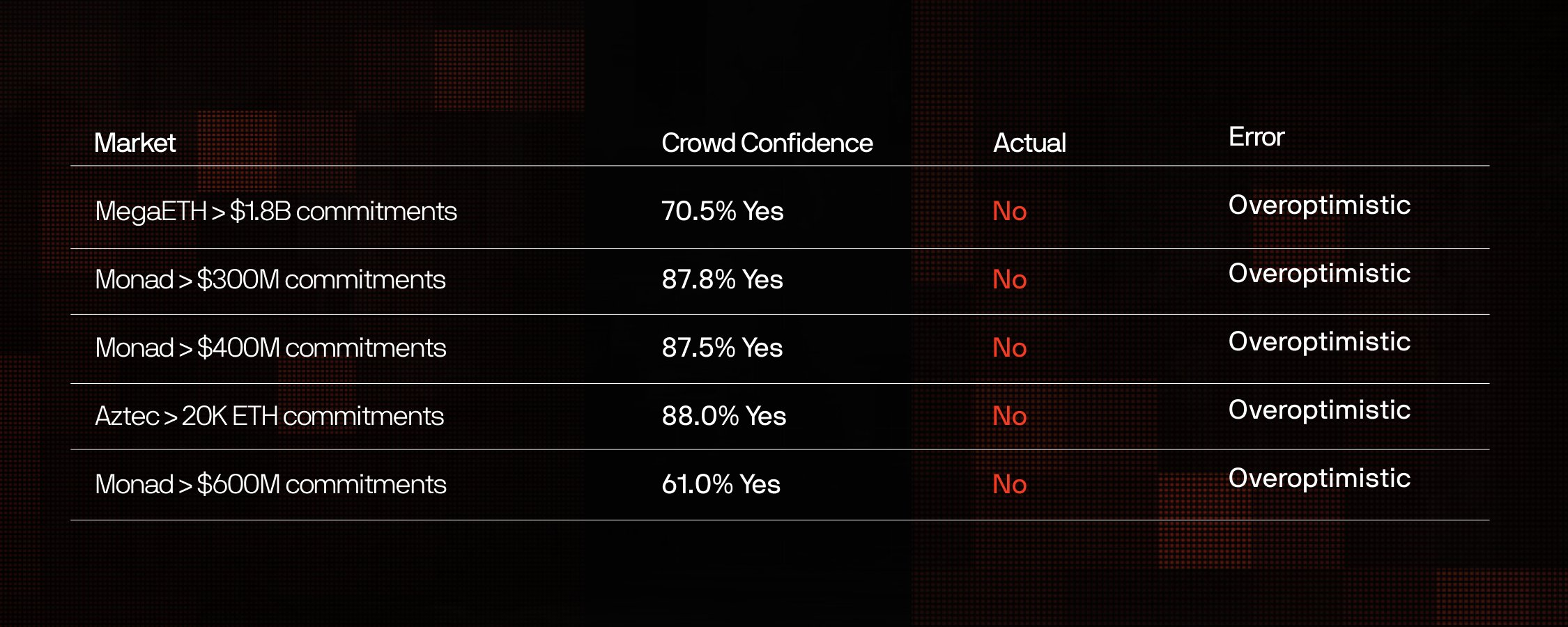
This systematic bias suggests the participants in these markets are optimistic speculators, attracted to token sales precisely because they are bullish.

Over-Optimism vs. Token Performance (Based on ICO Data)

Methodology: This analysis only includes markets for projects that conducted a public ICO and have issued a token, using Polymarket odds from one week before market close.

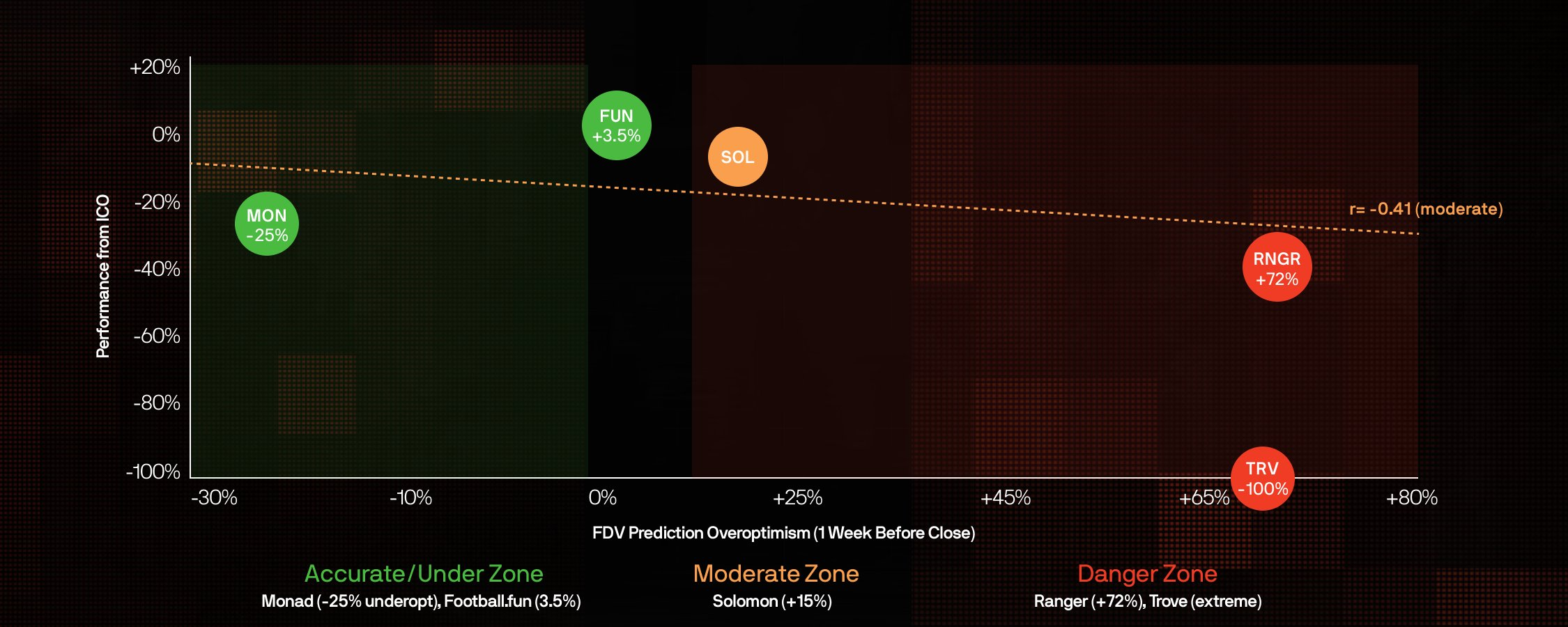
Degree of Over-Optimism = (Polymarket Predicted FDV - Actual 24h FDV) / Actual 24h FDV.

The Y-axis shows price performance from ICO to current.

The data shows a moderate negative correlation (r=-0.41) between the degree of over-optimism and ICO returns. Monad was "underestimated/pessimistic" by the market (-25%), yet its price is still down 24% from ICO. Ranger was the most "over-optimistic" (+72%) and is currently down 32% from its ICO price. Only Football.fun remains above its ICO price (+1%).
Token Performance Ranking: 40% Launch Below Valuation

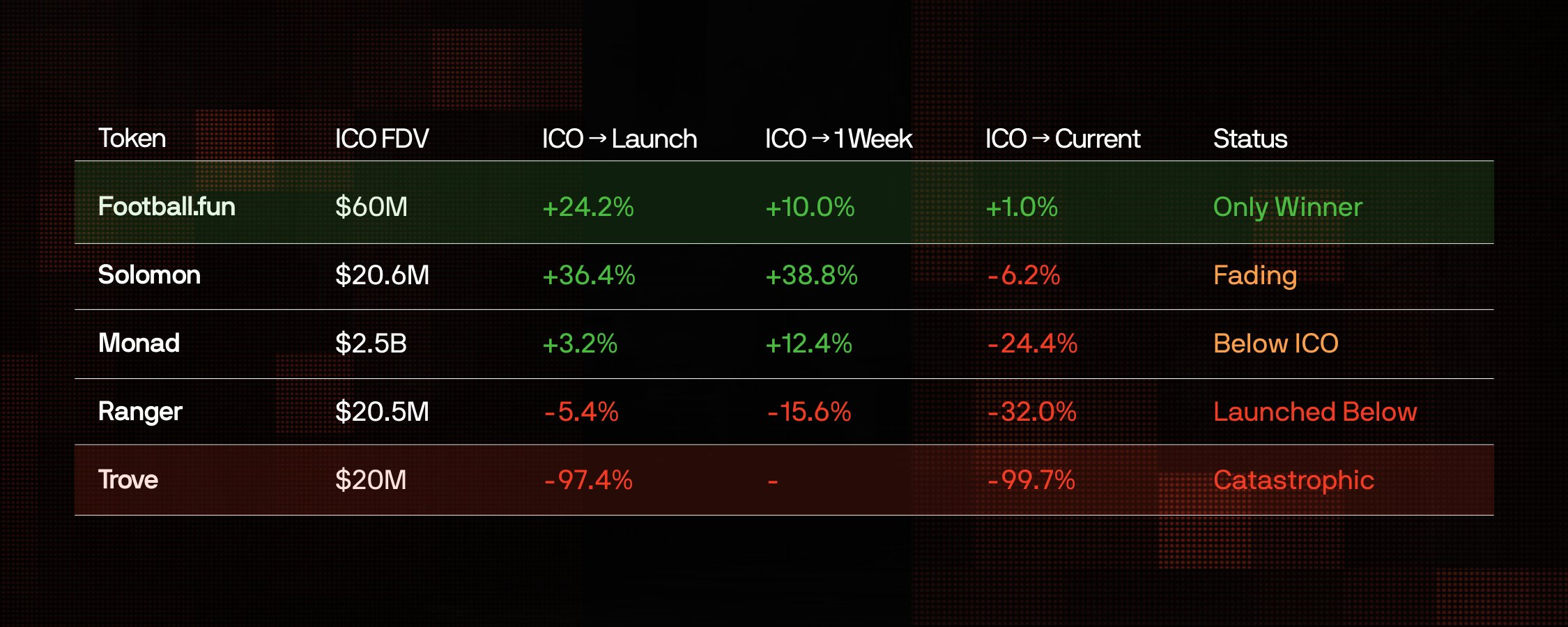
The table below, using historical Polymarket odds from one week before close, reveals the true prediction accuracy. The pattern is clear: extreme over-optimism预示 disaster, and high trading volume on Polymarket, even when predictions are correct, is often a contrarian signal.
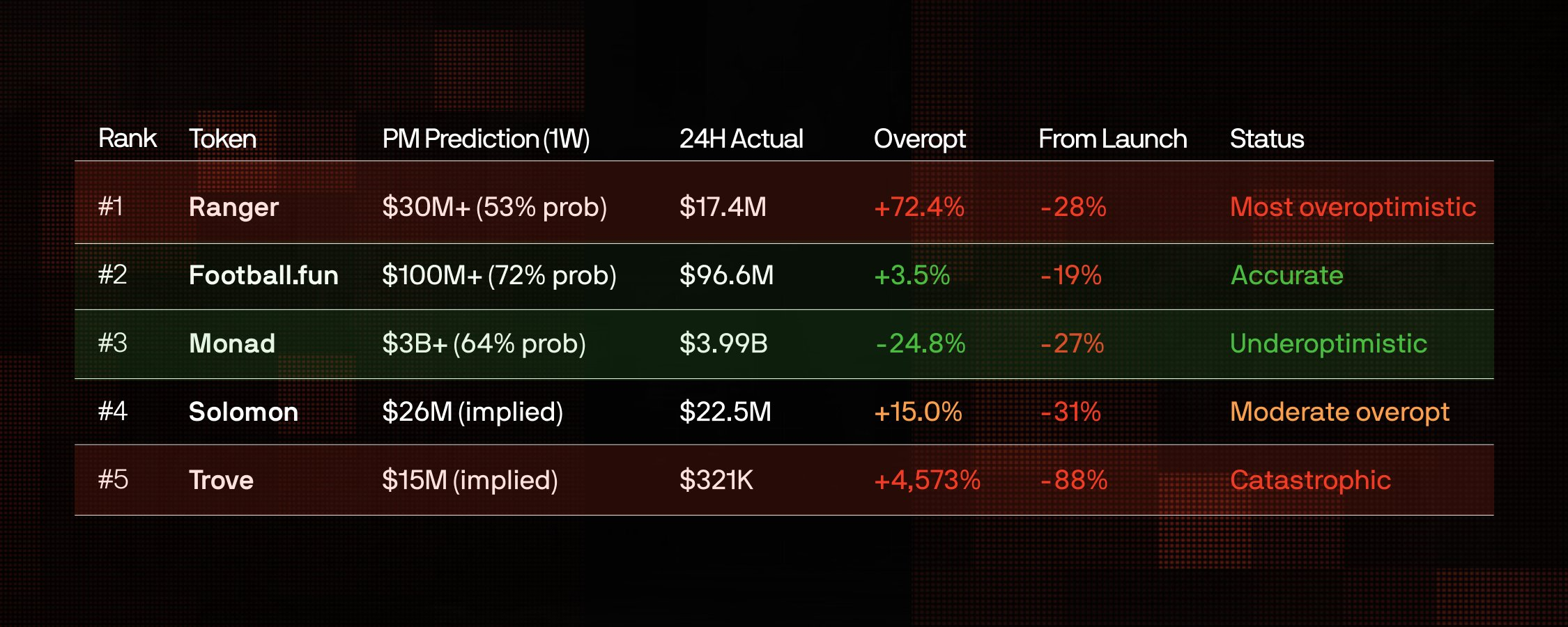
Key Finding: Among tokens with ICO data, 40% launched at a price below their ICO valuation. The average return from ICO to current is -32.2%. Only Football.fun is trading above its ICO price.
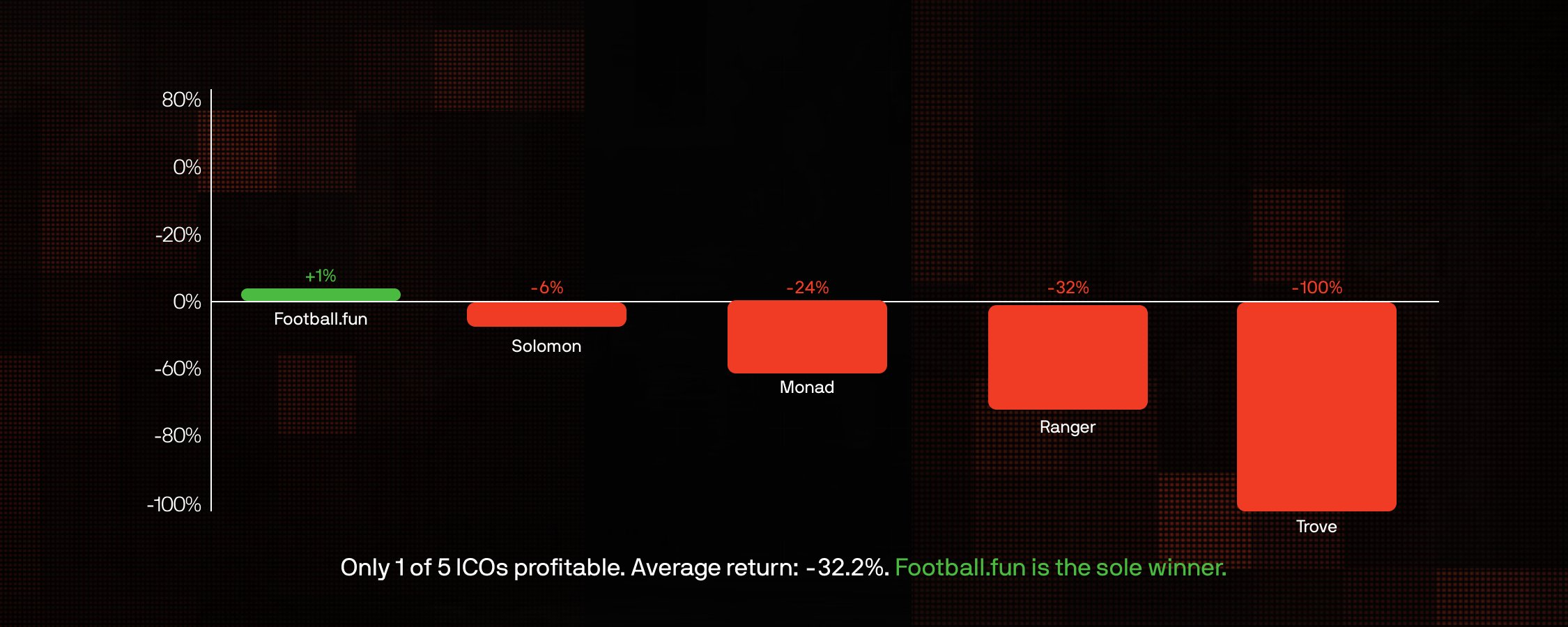
The pattern is brutal: Even tokens that launched above their ICO valuation (e.g., Monad, Solomon) eventually fell below the issue price. Football.fun is the only winner among the 5 ICO tokens in this dataset, currently just 1% above its ICO price.
Core Conclusions:

After analyzing 231 markets, $241.5 million in trading volume, and 8 tokens with verified 24-hour FDV data, several conclusions are clear:

  1. "100% Accuracy" is meaningless. Markets close for settlement *after* the outcome is known (fundraising markets post-sale, FDV markets 24 hours later), so late-stage accuracy unsurprisingly nears 100%. But the real predictive accuracy one week before close is only 66.7%. At the critical moment, the crowd guesses wrong 1/3 of the time.

  2. Systematic Over-Optimism. Among the top 15 markets, 5 markets showed over 60% confidence in thresholds that were never reached. FDV was overestimated by an average of +35%.

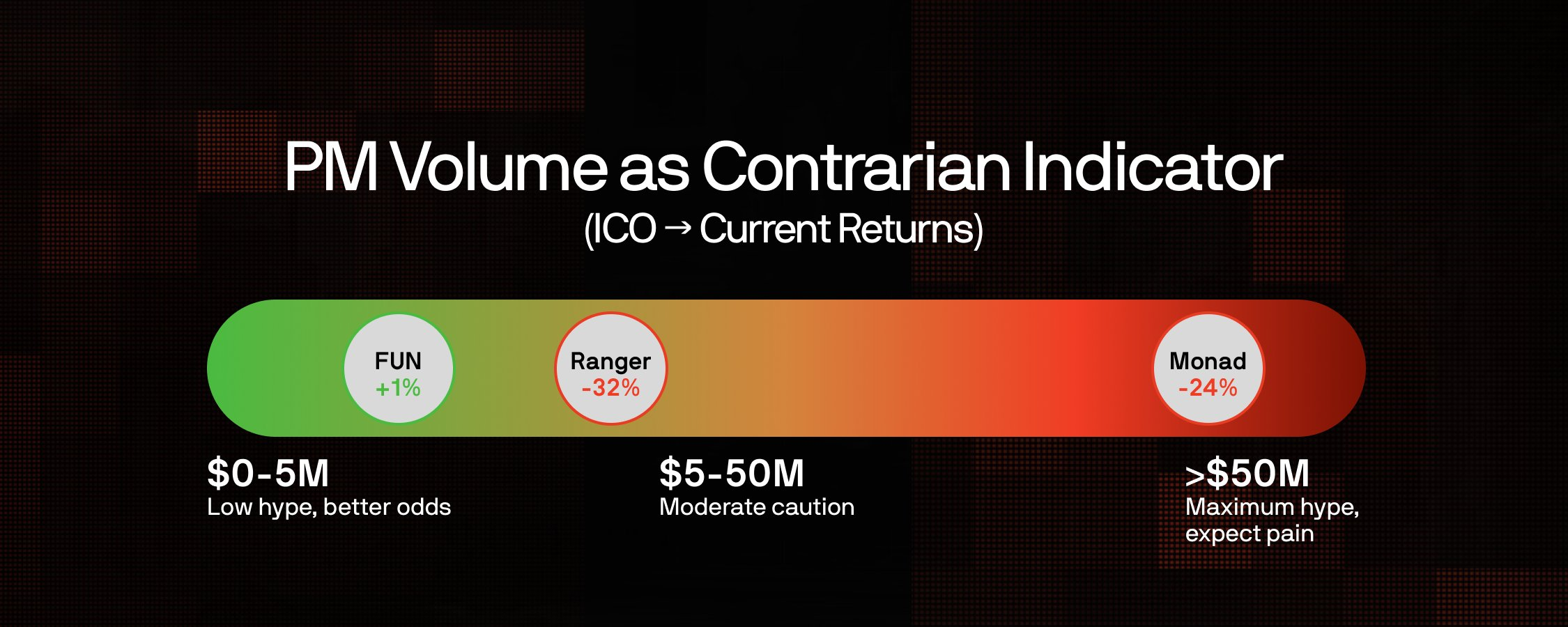
  3. High prediction market volume is a contrarian signal. Monad ($89M) and MegaETH ($67M) had the highest degrees of over-optimism. The more money the crowd bets, the more confident they are, and the more wrong they tend to be.

  4. Conservative Predictions = Better Outcomes. Tokens with relatively accurate predictions (Monad, Football.fun) fell less. Low hype and accurate predictions appear to be bullish signals.

Trading Signals:

Based on the analysis, we can distill actionable signals for evaluating future token sales. These are not absolute guarantees but represent patterns that held consistently within the dataset.
Bearish Signals:

  • Polymarket trading volume > $50 Million

  • FDV Over-Optimism degree > 50%

  • All FDV prediction thresholds are likely to fail

  • Fundraising amount Over-Optimism degree > 30%

Bullish Signals (Relatively)

  • Polymarket trading volume < $5 Million

  • FDV prediction偏差 within 20%

  • Multiple FDV prediction thresholds are met

  • Crowd expectations are relatively conservative

This asymmetry is important. Bearish signals are strong indicators of poor outcomes. Bullish signals are weaker, only suggesting the token might perform "less badly" than over-hyped alternatives. In a market where all tokens are down from their all-time highs (ATH), "losing less" is the best-case scenario.

Summary

Polymarket's token sale section is effectively a Hype Meter. The signal is not in the prediction itself, but in how much it deviates. When the crowd piles money into bets for higher valuations, caution is warranted. Historically, "extreme confidence" from the masses has often meant "maximum pain" for investors.


Questions liées

QWhat is the actual prediction accuracy rate of Polymarket's ICO markets one week before closing, according to the analysis?

AThe actual prediction accuracy rate one week before closing is 66.7%, meaning the crowd is wrong one-third of the time.

QWhat systematic bias was identified in the predictions where the crowd had over 60% confidence but was ultimately wrong?

AThe systematic bias identified was consistent over-optimism. The crowd consistently predicted higher fundraising amounts and more expensive valuations than what occurred in reality.

QWhat percentage of tokens analyzed experienced selling pressure within 24 hours of their launch?

A75% of the tokens analyzed experienced selling pressure (were sold off) within 24 hours of their launch.

QAccording to the article, what is a key 'Bearish Signal' for a token sale based on Polymarket data?

AA key bearish signal is Polymarket trading volume exceeding $50 million, which often indicates extreme over-optimism that historically leads to poor outcomes.

QThe article suggests that Polymarket's TokenSale markets are not reliable prediction tools but are instead a measure of what?

AThey are not reliable prediction tools but are instead indicators of market sentiment, or 'Hype Meters,' and often act as a contrarian signal.

Lectures associées

L'affaire de divorce de Chey Tae-won finalisée : Révélations sur les lignes cachées de succession derrière le conglomérat de mille milliards de SK Hynix

L'affaire de divorce de Chey Tae-won, président du groupe SK, s'est conclue par un jugement historique, mettant en lumière les complexités successorales derrière le géant SK Hynix, dont la valorisation a dépassé 1 000 billions de wons. Contrairement aux scénarios traditionnels de succession des chaebols sud-coréens, qui privilégient l'aîné masculin, les trois enfants de Chey Tae-won suivent des trajectoires distinctes et modernes. L'aînée, Chey Yun-jeong, considérée comme la successeure la plus probable, occupe un poste de direction au sein de SK Inc. et dirige des projets stratégiques dans la biopharmacie, alliant formation scientifique et compétences en consulting. La seconde fille, Chey Min-jeong, ancienne officière de marine et ex-employée de SK Hynix aux États-Unis, a fondé une startup dans la santé numérique et épousé un ancien officier du Corps des Marines américain, incarnant les dimensions géopolitiques de l'industrie des semi-conducteurs. Le fils cadet, Chey In-geon, bien que suivant un parcours académique et professionnel classique (Brown University, McKinsey), reste discret et ne détient aucun rôle opérationnel visible au sein du groupe. Leur héritage est marqué par le divorce très médiatisé et coûteux de leurs parents, mais aussi par la transformation de SK Hynix en un acteur mondial de l'ère de l'IA. La succession ne se résume plus à une simple transmission d'actions ou de titre ; elle exige des héritiers qu'ils prouvent leurs compétences dans un paysage où la technologie, la politique internationale et l'innovation disruptive redéfinissent les règles du pouvoir.

marsbitIl y a 12 h

L'affaire de divorce de Chey Tae-won finalisée : Révélations sur les lignes cachées de succession derrière le conglomérat de mille milliards de SK Hynix

marsbitIl y a 12 h

2 mois pour passer de 8,8 à 68 milliards d'euros d'évaluation ! La plus grande plateforme de transit d'IA, OpenRouter, sur le point d'être rachetée

**Résumé en français :** Stripe, le géant du paiement en ligne, négocierait l'acquisition d'OpenRouter, une place de marché et couche d'IA de type "routeur" ou "agrégateur", pour près de 100 milliards de dollars. Cette valorisation représente une multiplication par près de sept par rapport à l'évaluation d'OpenRouter il y a deux mois (13 milliards de dollars). Fondée en 2023 par Alex Atallah (cofondateur d'OpenSea), OpenRouter agit comme un intermédiaire crucial pour les développeurs d'applications d'IA. Sa plateforme permet d'accéder via une seule API à plus de 400 grands modèles de langage (comme GPT, Claude, et de nombreux modèles open source) et choisit automatiquement le modèle le plus adapté à chaque tâche en fonction du coût, des performances et de la vitesse. Cela permet aux applications en aval de réduire leurs factures de "réflexion" (inference) sans que l'utilisateur final ne voie la différence. Pour Stripe, cette acquisition stratégique s'inscrit dans une volonté de devenir l'infrastructure de paiement et de gestion de la consommation pour l'économie de l'IA. Fin 2025, Stripe avait déjà acquis Metronome, une plateforme de facturation à l'usage pour l'IA. En combinant OpenRouter (choix du modèle) et Metronome (facturation précise), Stripe cherche à offrir une solution intégrée pour le routage, la mesure et le paiement de la consommation d'IA, consolidant ainsi son rôle de "caisse" et de "centre de régulation" de cette nouvelle économie.

链捕手Il y a 12 h

2 mois pour passer de 8,8 à 68 milliards d'euros d'évaluation ! La plus grande plateforme de transit d'IA, OpenRouter, sur le point d'être rachetée

链捕手Il y a 12 h

D'OpenSea à OpenRouter : le scénario de la « sortie en haut de cycle » d'Alex Atallah se répète ?

**OpenRouter, la plateforme d'agrégation de modèles d'IA fondée par Alex Atallah, pourrait être rachetée par Stripe pour près de 100 milliards de dollars**, selon le Wall Street Journal. Cette transaction potentielle, si elle se concrétise, marquerait le deuxième succès d'Atallah à construire une entreprise valorisée à des dizaines de milliards, après avoir cofondé la place de marché NFT OpenSea. OpenRouter, décrit comme le "Stripe de l'IA", sert de point d'accès unifié à plus de 400 modèles d'IA pour environ 10 millions d'utilisateurs. Sa croissance a été fulgurante, passant d'une valorisation de 1,3 milliard de dollars en mars 2026 à une évaluation potentielle de 100 milliards aujourd'hui. L'article souligne un parallèle avec le parcours d'Atallah chez OpenSea, qu'il a quittée avant le refroidissement du marché NFT. Aujourd'hui, face à une concurrence croissante dans l'agrégation de modèles d'IA et à une activité essentiellement basée sur des frais de plateforme (5-5,5%), la vente à un géant comme Stripe pourrait apparaître comme un choix stratégique pour "sortir au sommet". La valeur réelle d'OpenRouter pour un acquéreur résiderait moins dans ses revenus actuels que dans les vastes quantités de données d'utilisation réelle de l'IA qu'elle a accumulées. Ces informations sur les performances, les préférences des développeurs et la dynamique du marché sont un atout unique. La transaction, si elle aboutit, pose la question : s'agit-il d'une juste reconnaissance de la valeur des infrastructures d'IA ou d'un possible signal de sommet pour le secteur ?

链捕手Il y a 12 h

D'OpenSea à OpenRouter : le scénario de la « sortie en haut de cycle » d'Alex Atallah se répète ?

链捕手Il y a 12 h

Trading

Spot
活动图片




