Is Crypto Over? Don't Give Up, Liquidity Relief Is Coming

marsbitPublié le 2026-02-02Dernière mise à jour le 2026-02-02

Résumé

The article "Is Crypto Over? Don't Give Up, Liquidity is Coming" by Raoul Pal addresses the current downturn in the crypto market, arguing it is not a sign of the industry's demise but a temporary liquidity crisis. Pal refutes the narrative that crypto has permanently decoupled from other assets by showing that Bitcoin's price chart is nearly identical to that of the SaaS index, indicating a shared, external factor: a shortage of U.S. dollar liquidity. He explains this was caused by a combination of events, including the draining of the Reverse Repo facility, the rebuilding of the Treasury General Account (TGA) without monetary offset, and government shutdowns. This liquidity drain negatively impacted risk assets like crypto and tech stocks, while gold absorbed the marginal liquidity. The key takeaway is that this period of illiquidity is ending. The impending resolution of the U.S. government shutdown is seen as the final obstacle. Once cleared, a significant injection of liquidity is expected from sources like the easing of the SLR rule, TGA drawdowns, fiscal stimulus, and eventual rate cuts. Pal, alongside analysis from Stanley Druckenmiller, suggests the new Fed leadership under a potential Warsh chairmanship would be focused on cutting rates to keep the economy hot, aligning with a pro-growth strategy from the administration. The author admits a mistake in not prioritizing U.S. liquidity as the dominant short-term driver over global liquidity but remains highly bulli...

Original Author:Raoul Pal, CEO of Real Vision and GMI

Compiled by: CryptoLeo(@LeoAndCrypto)

This morning, Raoul Pal, CEO of Real Vision and GMI (Raoul Pal's investment bible), published an article titled "False Narratives....and Other Thoughts". Through data comparison and macro analysis, he explained the recent downturn and crisis in the crypto industry, indicating that the industry winter will soon pass, and everyone needs to be patient and not lose confidence in the industry. Odaily Planet Daily translates it as follows:

These were the insights I wrote for GMI over the weekend, hoping to give you some confidence. I would usually keep this content for GMI and Pro Macro discussions, but I know you all need this to ease your tense nerves.

Mainstream Narrative: Is Crypto Over?

The mainstream view is that Bitcoin and cryptocurrencies have crashed, this cycle is over, everything is finished, and it can't be like before. Cryptocurrencies have decoupled from other assets, this is CZ's fault, it's BlackRock's fault, etc. This is undoubtedly an attractive narrative trap, especially when mainstream coin prices are plummeting daily.

But yesterday, a GMI hedge fund client sent me a message asking if they should buy the dip in SaaS stocks, or, as everyone is saying now, if Claude Code has already killed the SaaS industry.

So I started researching SaaS, and in the process, I found conclusions that debunked both the mainstream narrative about Bitcoin and the narrative about the SaaS industry. The charts for SaaS and BTC look exactly the same?
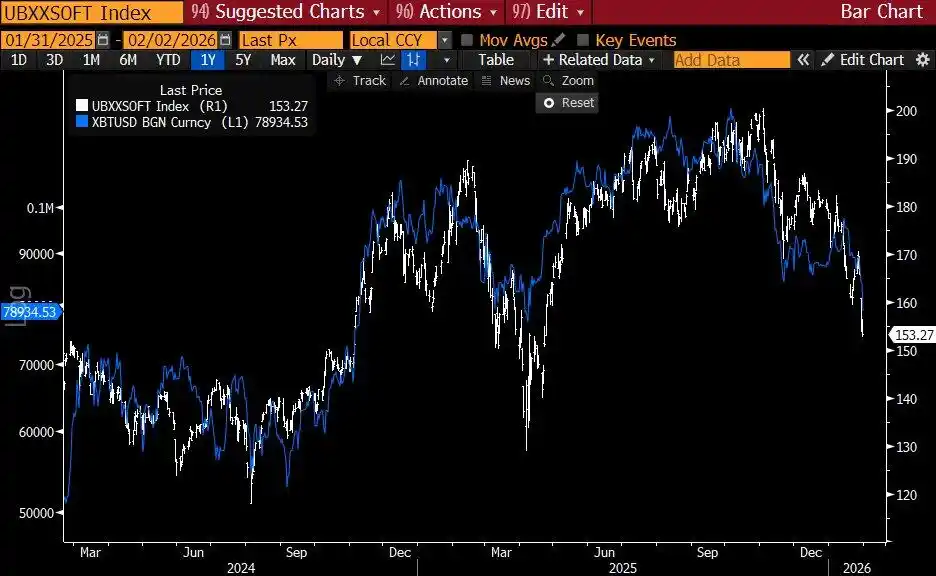
UBS SaaS Index vs. Bitcoin Trend

This indicates there is another factor that everyone is ignoring affecting this trend.

This factor is: Due to two shutdowns and issues with the US financial system's underlying mechanisms (the reverse repo mechanism's liquidity was only fully replenished in 2024), US liquidity has been constrained. Therefore, the TGA (Treasury General Account) rebuilding in July and August had no corresponding monetary offset measures, leading to a reduction in liquidity.
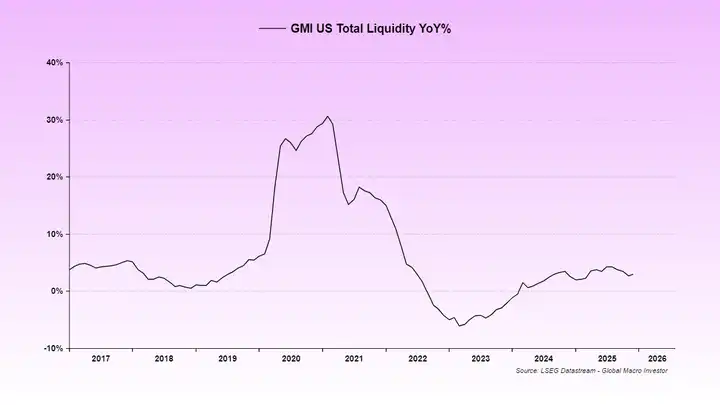
So far, the low liquidity is the reason the ISM Manufacturing Index has remained low.
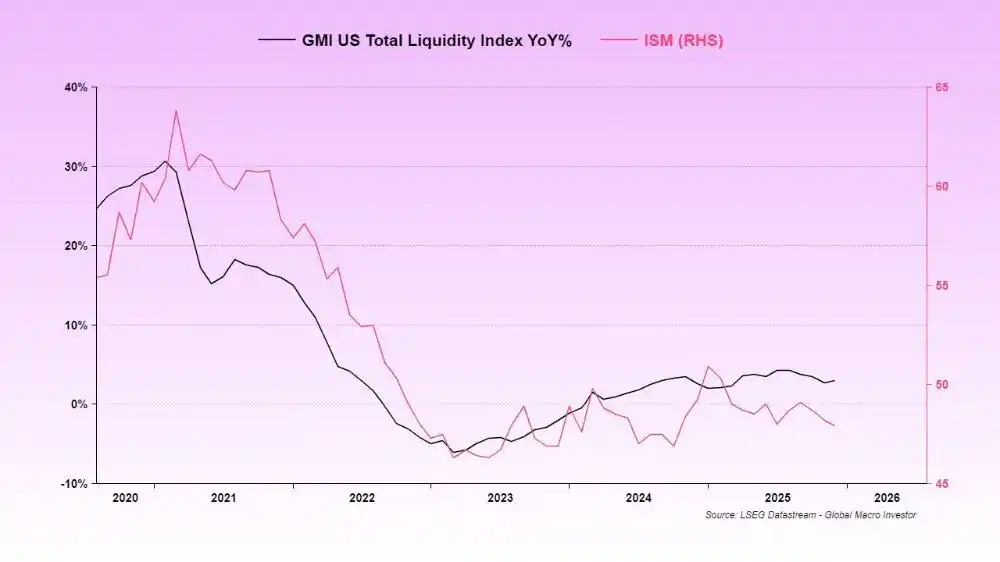
We usually use the Global Total Liquidity indicator because it has the highest long-term correlation with BTC and the Nasdaq, but at this stage, US Total Liquidity seems more important because the US is the primary provider of global liquidity.

In this cycle, the GMI Global Total Liquidity index is leading the US Total Liquidity index and is about to rebound (and thus will also drive the ISM index).
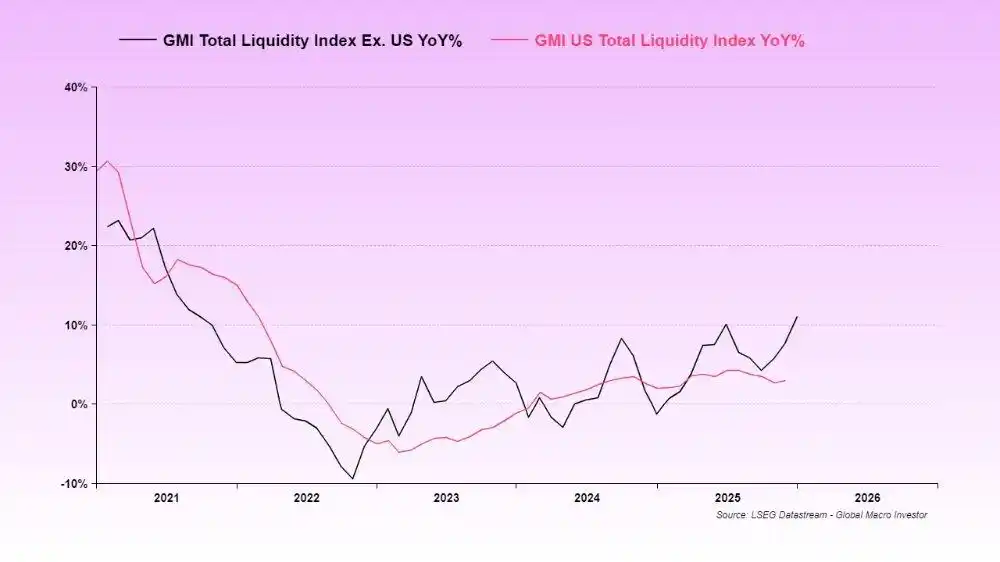
This is precisely what is impacting SaaS and BTC. Both assets are among the longest-duration assets in existence and have fallen due to the temporary withdrawal of liquidity.

The rise in gold has essentially sucked out the marginal liquidity from the system that might have flowed into the Bitcoin and SaaS markets. There isn't enough liquidity to support these assets, so high-risk assets are getting hit and falling. There's really no way around it.
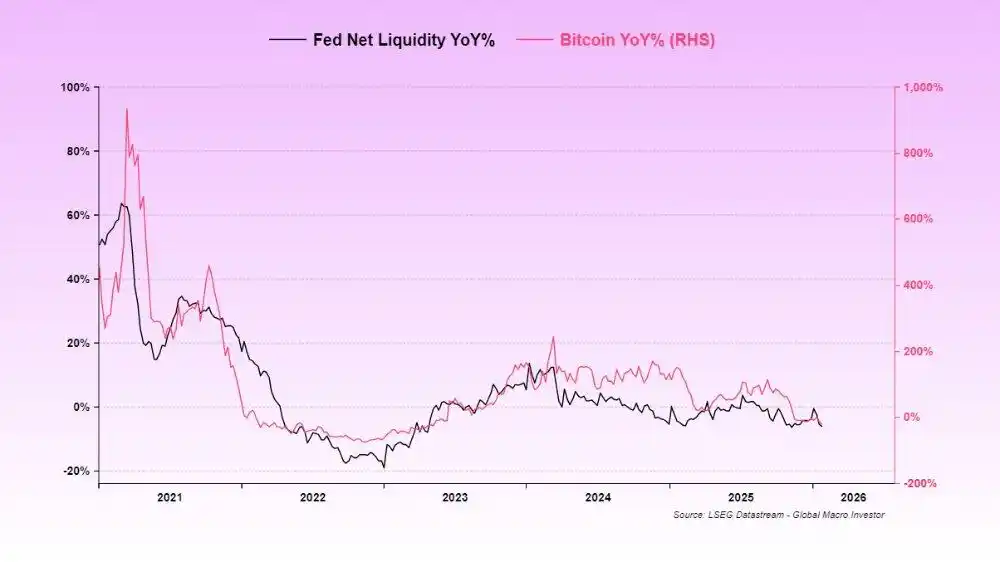
Now, the US government is facing another shutdown. The Treasury Department has taken preventive measures: after the last government shutdown, no TGA funds were used; instead, the balance was increased (i.e., further liquidity drain). This is the crisis we are facing now. It has caused violent price swings, and our beloved crypto is still lacking liquidity.

However, all signs indicate that this government shutdown will be resolved this week, which will clear the last liquidity obstacle.

Odaily Note: US House Speaker Johnson said in an interview on NBC News' "Meet the Press" on Sunday that he believes he has secured Republican support votes to ensure the shutdown of some government agencies ends by Tuesday.

I have mentioned the risk of this government shutdown many times before, but it will be over soon, and then we can continue to deal with the upcoming liquidity injection, which includes measures from eSLR, some TGA回流 (TGA回流: TGA runoff/return of funds?), fiscal stimulus, rate cuts, all related to the mid-term elections.

Odaily Note: US regulators are easing leverage ratio requirements through legislation to alleviate capital pressure on several major banks like Bank of America (BAC.US).

In a full trading cycle, time is often more important than price. Price can be hit hard, but as time passes and the cycle evolves, everything gets resolved and eventually settles.

This is why I have always emphasized "patience". Events need to unfold. Focusing solely on profit and loss ratios will only affect your mental health, not your investment portfolio.

The Fed's False Narrative

Regarding the issue of rate cuts, there is also a false narrative that Kevin Warsh is a hawk. This is complete nonsense; these statements are mainly from over 18 years ago.

Warsh's job and mission were to execute the strategies of the Greenspan era. Both Trump and Besant have said (not detailed here, but the main direction is rate cuts) to keep the economy hot, assuming that the productivity gains from AI will suppress core CPI rises (just like the 1995-2000 era).

Odaily Note: Greenspan is one of the longest-serving Chairs in Fed history. His advocated monetary policy (controlling inflation + promoting maximum employment) was highly flexible but practically prioritized fighting inflation, while also actively injecting liquidity during crises.

He doesn't like the balance sheet, but the system is reserve-constrained, so he is unlikely to change its current practices, otherwise it would destroy the credit market.

Warsh will cut rates and do nothing else. He will not interfere with Trump and Besant's actions to manage liquidity through banks. Fed Governor Milan will likely forcefully push for a full eSLR cut to accelerate this process.

If you don't believe me, believe Druck ↓
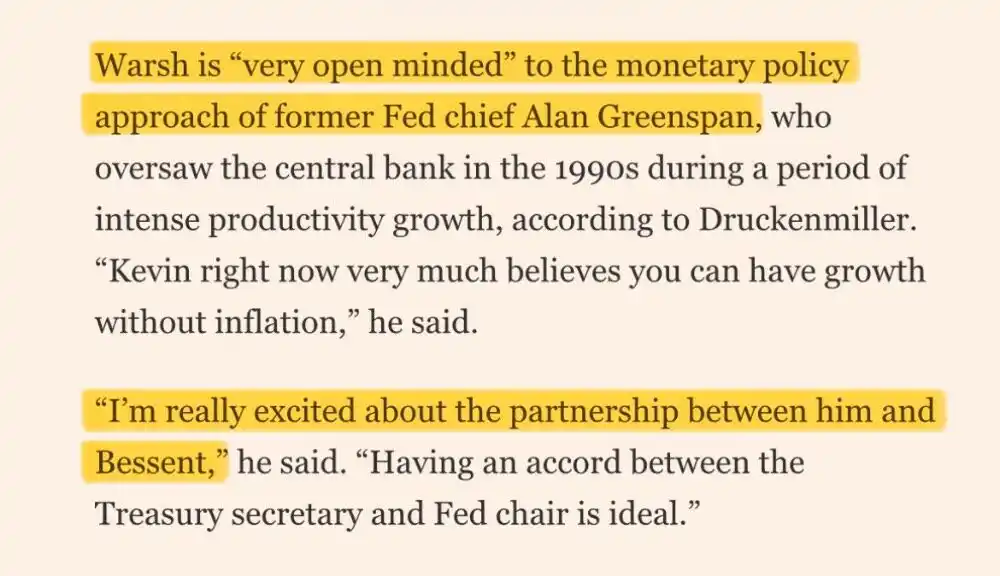
The above shows "investment guru" Stanley Druckenmiller's content on Warsh's monetary policy philosophy and his agreement with Besant upon becoming Fed Chair.

I know how difficult it is to hear optimistic narratives when the crypto market looks so dark. My SUI holdings are terrible, we don't know what or who to believe anymore. First, we have been through this many times before. When BTC falls 30%, altcoins can fall even 70%. But if they are high-quality alts, they bounce back faster too.

Mea Culpa (My Mistake)

GMI's mistake was not considering US liquidity as the current driving factor; usually, Global Total Liquidity dominates the entire cycle. But now the situation is clear, anything is possible.

The two are not unrelated. We just couldn't predict the combination of events (reverse repo draining liquidity > TGA rebuilding > government shutdown > gold rising > another shutdown), or we failed to anticipate their impact.

It's almost over, soon we can get back to normal work.

We cannot guarantee that every single link is error-free (now we have a deeper understanding), and we are still very bullish on the 2026 outlook because we understand the strategy of Trump/Besant/Warsh. These three have repeatedly told us: we just need to listen and be patient. In full-cycle investing, time is more important than price.

If you are not a cycle investor and don't have such strong risk tolerance, that's completely fine. Everyone has their own style, but Julien (GMI Head of Macro Research) and I are not good at swing trading (we don't care about intra-cycle fluctuations), but we are proven and have a track record in full-cycle investing, leading the industry for the past 21 years. (Warning: We also make mistakes, like in 2009). Now is not the time to give up. Good luck, and let's achieve greater results in 2026.

Liquidity relief is on the way!

Questions liées

QAccording to Raoul Pal, what is the main factor causing the recent downturn in both the crypto and SaaS markets?

AThe main factor is the suppression of US liquidity due to two government shutdowns and issues with the US financial system's plumbing (the reverse repo mechanism), combined with TGA (Treasury General Account) rebuilding in July and August without monetary offset measures, which drained liquidity.

QWhat does Raoul Pal predict will happen once the current US government shutdown is resolved?

AHe predicts that resolving the shutdown will clear the final liquidity hurdle, allowing for a return to normalcy and the arrival of incoming liquidity injections from measures like eSLR, TGA drawdowns, fiscal stimulus, and rate cuts.

QHow does the article describe the relationship between the performance of Bitcoin and the UBS SaaS Index?

AThe article shows that the performance of Bitcoin and the UBS SaaS Index charts are identical, indicating they are both being affected by the same factor: the withdrawal of US liquidity.

QWhat is the 'false narrative' that Raoul Pal identifies regarding the potential new Fed Chair, Kevin Warsh?

AThe false narrative is that Kevin Warsh is a hawk. Pal argues this is nonsense and that Warsh's role would be to execute a Greenspan-era strategy of keeping the economy hot, cutting rates, and not interfering with liquidity management by the administration and banks.

QWhat key investment principle does Raoul Pal emphasize for navigating the current market cycle?

AHe emphasizes that 'time is more important than price' in a full cycle investment. He advises patience, stating that events need to play out and that focusing solely on profit and loss ratios affects mental health, not the investment portfolio.

Lectures associées

Après trois trimestres consécutifs de baisse, le marché des cryptomonnaies pourra-t-il connaître une fenêtre de stabilisation au troisième trimestre ?

Le marché des cryptomonnaies a enregistré son pire trimestre depuis 2022, avec une capitalisation totale chutant de 12,6% à 2 100 milliards de dollars. Tous les indicateurs clés (volume des échanges, valeur des stablecoins) montrent une sortie nette de capitaux. Le Bitcoin a perdu 14,2% et l'Ethereum 25,4% sur le trimestre, rompant sa corrélation antérieure avec les actions technologiques. Les ETF spot américains sur le Bitcoin ont subi des rachats massifs, avec une sortie nette de 4,67 milliards de dollars au Q2, indiquant une pression de vente continue. Le resserrement de la politique de la Fed et les ventes d'entreprises comme Strategy ont accentué la déleveragisation du secteur. L'attention du marché se porte désormais presque exclusivement sur la réunion de la Fed fin juillet. Une position accommodante pourrait stabiliser le Bitcoin entre 68 000 et 84 000 dollars, tandis qu'un ton hawkish pourrait le faire osciller autour de 50 000-56 000 dollars. Parallèlement, la progression du *CLARITY Act*, une loi cruciale pour la clarté réglementaire, est au point mort au Sénat, réduisant les chances d'adoption en 2026 et maintenant une prime de risque élevée sur l'ensemble du secteur. Malgré ce contexte difficile, quelques secteurs résistent : les marchés de prédiction ont vu leur volume nominal augmenter de 48,7% et les biens collectionnables tokenisés ont progressé d'environ 143%. La tokenisation d'actifs du monde réel (RWA) continue également sa croissance régulière, portée par des fondamentaux indépendants du cycle crypto. Les bases d'un effondrement extrême semblent absentes, mais le marché est désormais guidé par les politiques monétaires, les prix et les attentes de taux, plutôt que par le simple récit haussier. La fin des sorties massives des ETF et le retour des achats des détenteurs à long terme pourraient indiquer une phase de stabilisation potentielle.

marsbitIl y a 4 h

Après trois trimestres consécutifs de baisse, le marché des cryptomonnaies pourra-t-il connaître une fenêtre de stabilisation au troisième trimestre ?

marsbitIl y a 4 h

The SpaceX Trade, Unlocked: SPCXON Débarque sur WEEX

En juin 2026, SpaceX a réalisé la plus grande introduction en bourse de l'histoire, mais l'accès à l'action a été limité pour de nombreux investisseurs en raison de restrictions régionales et de frictions liées aux courtiers. La plateforme WEEX propose désormais une solution via SPCXON/USDT, un instrument tokenisé sur le marché au comptant qui permet d'obtenir une exposition au cours de SpaceX en utilisant l'USDT, sans nécessiter de compte de courtage américain. SPCXON est un produit tokenisé construit sur l'infrastructure d'Ondo, conçu pour refléter l'économie de la détention d'actions SpaceX pour les traders éligibles en dehors des États-Unis, avec des dividendes réinvestis. Le cas d'investissement repose sur la croissance des revenus de Starlink et les progrès de Starship, malgré un valorisation déjà élevée et des risques liés à un flottant public réduit et à des déblocages d'actions internes à venir. Il est important de noter que SPCXON offre une exposition, et non la propriété directe d'actions ou de droits de vote. Son prix peut évoluer avec une prime ou une décote par rapport à la valeur liquidative. WEEX propose également d'autres produits tokenisés comme MSTRON et MUON dans un compte unifié, permettant une rotation entre crypto-monnaies et actions traditionnelles sans transfert de fonds. La plateforme souligne ainsi comment les barrières entre la finance traditionnelle et les actifs numériques s'estompent.

TheNewsCryptoIl y a 5 h

The SpaceX Trade, Unlocked: SPCXON Débarque sur WEEX

TheNewsCryptoIl y a 5 h

BIT Trading Moment : Le BTC reste sous la pression de l'EMA 200 hebdomadaire, un rejet pourrait relancer la baisse, les actions de stockage et de semi-conducteurs qui ont bondi cette nuit ont baissé en séance de nuit

**Résumé des marchés : Bitcoin sous pression, actions technologiques en réajustement** Le marché crypto poursuit son rebond, avec Bitcoin évoluant autour de 66 000 $. Il fait face à une résistance clé vers 68 000 $, niveau correspondant au coût moyen des investisseurs sur cinq mois. Les traders surveillent les moyennes mobiles clés (200 MA à ~63 333 $ et 200 EMA à ~68 328 $ en hebdomadaire). Une rupture au-dessus de 68 000 $ ouvrirait la voie à une hausse, tandis qu'un échec pourrait entraîner un retest des 63 000 $. L'analyse suggère que la dynamique actuelle ressemble à un rebond estival à faible liquidité plutôt qu'au début d'un véritable marché haussier. Sur le marché actions américain, après une forte séance mardi portée par les semi-conducteurs et les titres du stockage (Micron, AMD, Intel...), les contrats à terme indiquent une ouverture en baisse. Les secteurs ayant récemment bondi, comme les semi-conducteurs et le stockage, reculent en séance de nuit. Certaines valeurs se démarquent néanmoins, comme Super Micro Computer (SMCI), en hausse après des résultats et des perspectives robustes liées à la demande de serveurs IA. Des vents contraires persistent : les prix du pétrole (Brent >91$) et les rendements des obligations d'État américaines grimpent, ravivant les craintes inflationnistes. En Asie, les marchés ont suivi le rebond technologique américain, mais de manière hésitante. La tension reste forte sur le yen japonais, qui atteint son plus bas niveau depuis des décennies. **Points clés à surveiller :** * **Crypto :** Niveaux techniques de Bitcoin (68k$/63k$), flux des ETF spot. * **Actions :** Saison des résultats (Tesla, Alphabet, Intel...), activité d'AMD sur l'IA. * **Économie :** Données américaines sur l'emploi, décision de la BCE, tensions géopolitiques et prix de l'énergie.

marsbitIl y a 5 h

BIT Trading Moment : Le BTC reste sous la pression de l'EMA 200 hebdomadaire, un rejet pourrait relancer la baisse, les actions de stockage et de semi-conducteurs qui ont bondi cette nuit ont baissé en séance de nuit

marsbitIl y a 5 h

Gate Research Institute : La vague de « Wall Streetisation » des produits financiers cryptographiques, concurrence ou fusion ?

Le titre de l'article est : "Gate Institute : La vague de 'Wall Street-isation' des produits financiers cryptos, est-ce une compétition ou une fusion ?" Résumé en français (environ 1400 caractères) : Il y a dix-sept ans, Bitcoin fut créé avec une vision décentralisée et anti-establishment financier. Aujourd'hui, paradoxalement, son adoption massive passe souvent par des ETF émis par des géants comme BlackRock. Cet article analyse cette "Wall Street-isation" apparente des actifs cryptos : les institutions traditionnelles s'emparent-elles du pouvoir d'émission, de tarification, de garde et de distribution ? La réalité est plus nuancée. C'est une convergence à double sens. D'un côté, les plateformes cryptos comme Gate.io étendent leurs services aux actions traditionnelles (états-uniennes, hongkongaises, sud-coréennes), aux CFD et aux produits tokenisés, offrant un compte unifié. De l'autre, des courtiers traditionnels comme Robinhood intègrent les cryptomonnaies et explorent la tokenisation d'actions sur blockchain. Cette fusion vise à créer le "super-compte" financier de demain, où actions, cryptos, ETF et obligations tokenisées (RWA) coexistent dans une même interface, comblant les faiblesses de chaque écosystème. Les RWA, notamment les obligations d'État tokenisées, agissent comme une couche intermédiaire unificatrice. En conclusion, Wall Street n'a pas conquis la crypto, et la crypto n'a pas contourné Wall Street. Ils construisent ensemble une nouvelle forme de marché des capitaux, plus efficace et mondial, où l'idéal décentralisé persiste dans les protocoles, tandis qu'une expérience utilisateur unifiée émerge à l'interface.

marsbitIl y a 5 h

Gate Research Institute : La vague de « Wall Streetisation » des produits financiers cryptographiques, concurrence ou fusion ?

marsbitIl y a 5 h

Trading

Spot
活动图片





