Is Crypto Over? Don't Give Up, Liquidity Relief Is Coming

Odaily星球日报Publié le 2026-02-02Dernière mise à jour le 2026-02-02

Résumé

The article "False Narratives....and Other Thoughts" by Raoul Pal addresses the current downturn in the crypto market, arguing against the mainstream narrative that the crypto cycle is over. Pal explains that the recent price decline in Bitcoin and other cryptocurrencies is not an isolated event but is correlated with a similar drop in SaaS stocks, as shown by comparative charts. He identifies the root cause as a temporary liquidity squeeze in the U.S. financial system, exacerbated by government shutdowns, TGA (Treasury General Account) rebuilding without monetary offset, and gold absorbing marginal liquidity that would otherwise support risk assets like crypto. Pal emphasizes that this liquidity crunch is temporary. He anticipates a resolution to the government shutdown soon, which will remove the last major obstacle to liquidity recovery. Following this, he expects a return of liquidity through measures such as eSLR adjustments, TGA drawdowns, fiscal stimulus, and eventual rate cuts. He advises investors to be patient, stressing that in a full market cycle, time is more critical than price movements. The article also corrects a misperception about potential Fed Chair Kevin Warsh, arguing he is not a hawk and would likely support rate cuts aligned with strategies to boost economic growth. Despite current market conditions, Pal remains highly optimistic about the crypto market's prospects through 2026, driven by anticipated pro-growth policies.

Original Author:Raoul Pal, CEO of Real Vision and GMI

Compiled by:CryptoLeo(@LeoAndCrypto)

This morning, Raoul Pal, CEO of Real Vision and GMI (Raoul Pal's investment bible), published an article titled "False Narratives....and Other Thoughts". Through data comparison and macro analysis, he explained the recent downturn and crisis in the crypto industry, indicating that the industry winter will soon pass, and everyone needs to be patient and not lose confidence in the industry. Odaily Planet Daily translates it as follows:

These were the insights I wrote for GMI over the weekend, hoping to bring you some confidence. I would have kept this content for GMI and Pro Macro discussions, but I know you all need this to ease your tense nerves.

Mainstream Narrative: Is Crypto Over?

The mainstream view is that Bitcoin and cryptocurrencies have crashed, this cycle is over, everything is finished, and it can't be like before. Cryptocurrencies have decoupled from other assets, this is CZ's fault, it's BlackRock's fault, etc. This is undoubtedly an attractive narrative trap, especially when mainstream coin prices are plummeting every day.

But yesterday, a GMI hedge fund client sent me a message asking if they should buy the dip in SaaS stocks, or, as everyone is saying, if Claude Code has already killed the SaaS industry.

So I started researching SaaS, and in the process, I found conclusions that debunk both the mainstream narrative about Bitcoin and the narrative about the SaaS industry. The charts for SaaS and BTC look exactly the same?
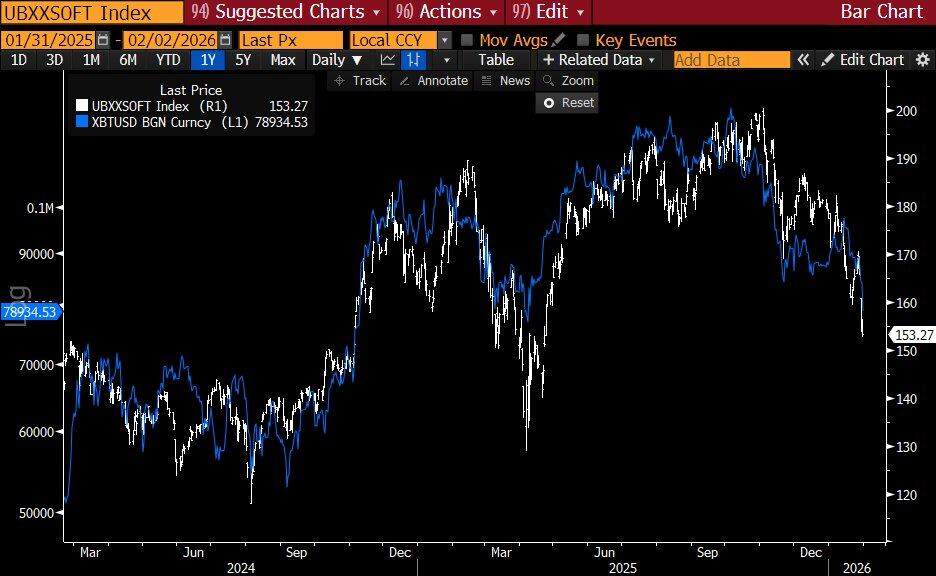
UBS SaaS Index vs. Bitcoin Trend

Indicating there is another factor that everyone is ignoring affecting this trend.

This factor is: Due to two shutdowns and issues with the US financial system's infrastructure (the reverse repo mechanism's liquidity was only fully replenished in 2024), US liquidity has been constrained. Therefore, the TGA (Treasury General Account) rebuilding in July and August had no corresponding monetary offset measures, leading to a reduction in liquidity.
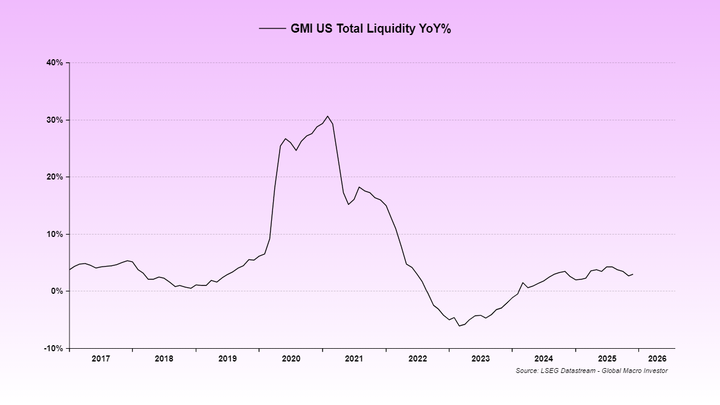
So far, the low liquidity is the reason the ISM Manufacturing Index has remained low.
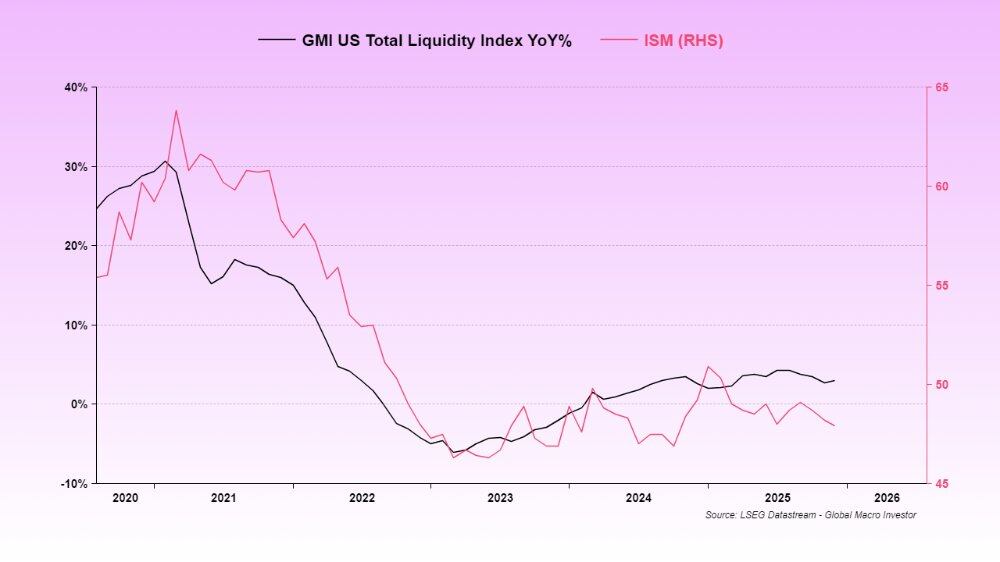
We usually use the Global Total Liquidity indicator because it has the highest long-term correlation with BTC and the Nasdaq, but at this stage, US Total Liquidity seems more important because the US is the main provider of global liquidity.

In this cycle, the GMI Global Total Liquidity Index leads the US Total Liquidity Index and is about to rebound (thus also driving the ISM index).
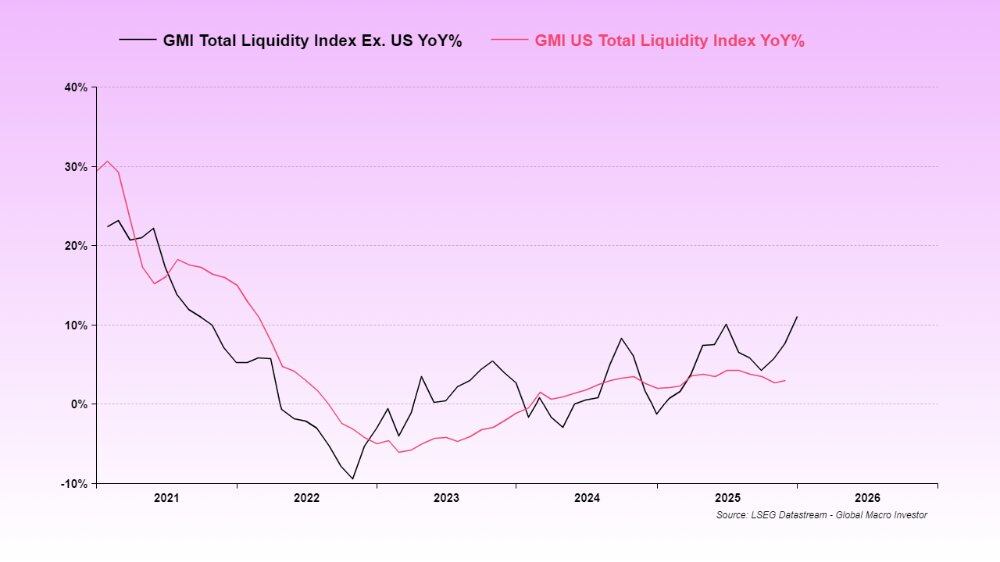
This is exactly what is affecting SaaS and BTC. Both assets are among the longest-duration assets in existence and have fallen due to the temporary withdrawal of liquidity.

Gold's rise has essentially sucked out the marginal liquidity from the system that might have flowed into the Bitcoin and SaaS markets. There isn't enough liquidity to support these assets, so high-risk assets are getting hit and falling. There's really no way around it.
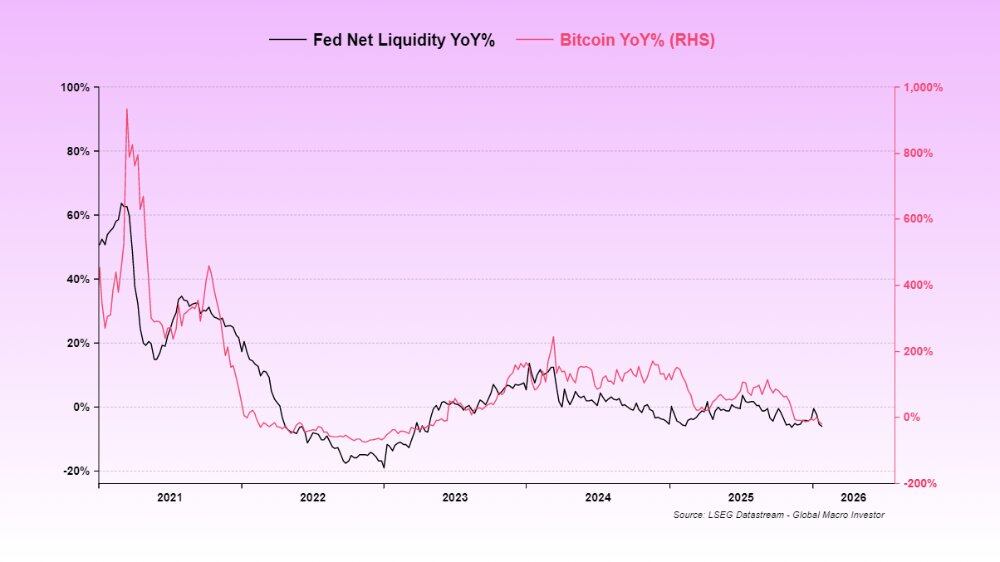
Now, the US government is happening again, and the Treasury Department has taken preventive measures: after the last government shutdown, no TGA funds were used, and instead, the asset scale was increased (i.e., further loss of liquidity). This is the crisis we are facing now. It has caused violent price fluctuations, and our beloved cryptocurrency still lacks liquidity.

However,种种迹象表明,this government shutdown will be resolved this week, which will clear the last liquidity obstacle.

Odaily Note: US House Speaker Johnson said in an interview on NBC News' "Meet the Press" on Sunday that he believes he has secured Republican support votes to ensure the shutdown of some government agencies ends by Tuesday.

I have mentioned the risks of this government shutdown many times before, but it will soon be over, and then we can continue to deal with the upcoming liquidity injection, which includes measures from eSLR, partial TGA回流 (TGA回流 likely means TGA runoff or drawdown, context suggests funds returning to system), fiscal stimulus, interest rate cuts, etc., all related to the mid-term elections.

Odaily Note: US regulators' bill to relax leverage ratio requirements to ease capital pressure on several major banks like Bank of America (BAC.US).

In a full trading cycle, time is often more important than price. Price can be hit hard, but as time passes and the cycle evolves, everything will be resolved and eventually settle.

This is why I have always emphasized "patience". Events need to develop. Focusing solely on profit and loss ratios will only affect your mental health, not your investment portfolio.

The Fed's False Narrative

Regarding interest rate cuts, another false narrative is that Kevin Warsh is a hawk. This is complete nonsense; these statements are mainly from over 18 years ago.

Warsh's job and mission were to execute the strategies of the Greenspan era. Both Trump and Besant have said (details not discussed here, but the main direction is rate cuts) to keep the economy hot and assume that the productivity gains from AI will suppress core CPI increases (just like the 1995-2000 era).

Odaily Note: Greenspan is one of the longest-serving chairs in Fed history. His advocated monetary policy (controlling inflation + promoting maximum employment) was highly flexible but practically more anti-inflation prioritized, while also actively injecting liquidity during crises.

He doesn't like the balance sheet, but the system is reserve-constrained, so he likely won't change its current practices, otherwise it would destroy the credit market.

Warsh will cut rates and do nothing else. He will not interfere with Trump and Besant's actions to manage liquidity through banks. Fed Governor Milan will likely forcefully push for a full eSLR cut to accelerate this process.

If you don't believe me, believe Druck ↓
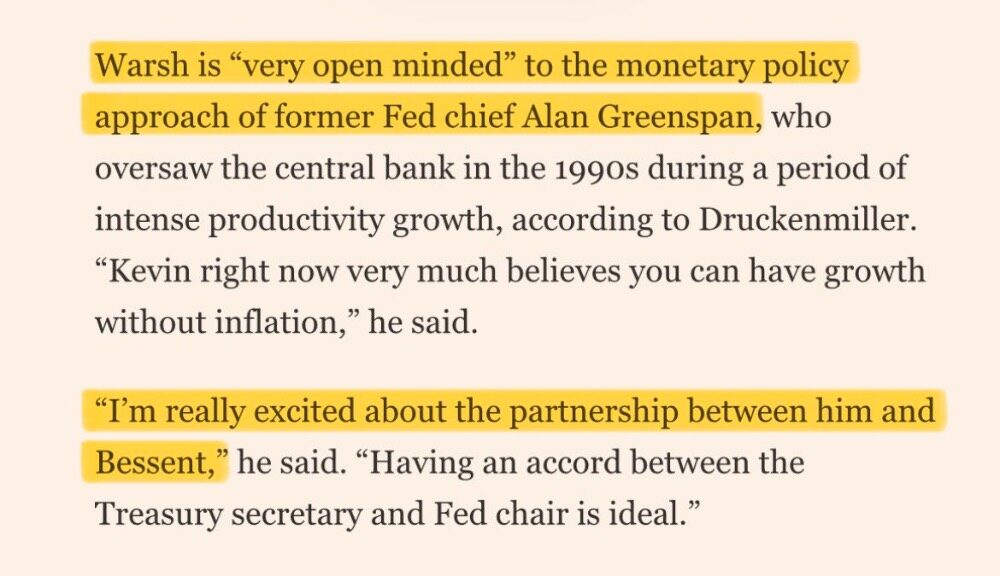
The above shows "investment guru" Stanley Druckenmiller's content on Warsh's monetary policy philosophy and his agreement with Besant upon becoming Fed Chair.

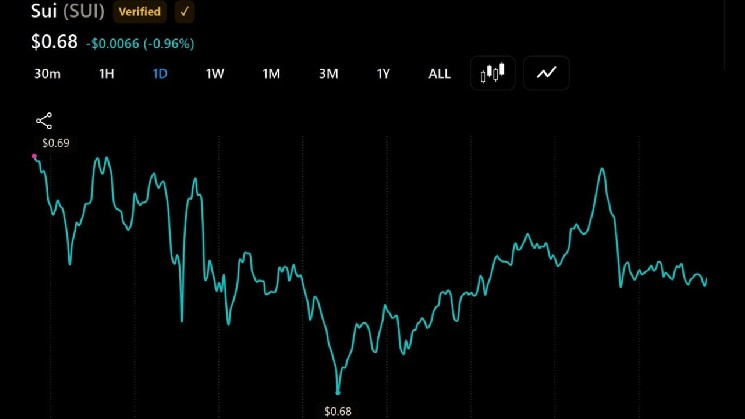
I know how difficult it is to hear optimistic narratives when the crypto market looks so dark. My SUI holdings are terrible, we don't know what or who to believe anymore. First, we have been through this many times before. When BTC falls 30%, altcoins can fall even 70%. But if they are high-quality alts, their rebound is also faster.

Mea Culpa (My Mistake)

GMI's mistake was not considering US liquidity as the current driving factor; usually, Global Total Liquidity dominates the entire cycle. But now the situation is clear, anything is possible.

The two are not unrelated. We just couldn't predict the combination punch of a series of events (reverse repo draining liquidity > TGA rebuilding > government shutdown > gold rising > another shutdown), or we failed to anticipate its impact.

It's almost over, and soon we can get back to normal work.

We cannot guarantee that every link is error-free (now with a deeper understanding), and we are still very bullish on the 2026 outlook because we understand the Trump/Besant/Warsh strategy. These three have repeatedly told us: we just need to listen and be patient. In full-cycle investing, time is more important than price.

If you are not a cycle investor and don't have such strong risk tolerance, that's completely fine. Everyone has their own style, but Julien (GMI Head of Macro Research) and I are not good at swing trading (we don't care about intra-cycle fluctuations), but we are proven and have a verifiable track record in full-cycle investing, leading the industry for the past 21 years. (Warning: We also make mistakes, like in 2009). Now is not the time to give up. Good luck, and let's achieve greater results in 2026.

Liquidity relief is on the way!

Questions liées

QWhat is the main reason for the recent downturn in the crypto market according to Raoul Pal?

AThe main reason is the suppression of U.S. liquidity due to two government shutdowns and issues with the U.S. financial plumbing system, which was not fully offset by monetary measures, leading to a reduction in liquidity available for risk assets like crypto and SaaS stocks.

QWhat specific event does Raoul Pal point to as the catalyst that will soon resolve the liquidity crisis?

AHe points to the resolution of the current U.S. government shutdown, which is expected to be resolved imminently, as the event that will clear the final liquidity hurdle.

QHow does Raoul Pal characterize the relationship between time and price in a full market cycle?

AHe states that in a full cycle, time is more important than price. Price can be hit hard, but as time passes and the cycle plays out, things get resolved and eventually work themselves out.

QWhat was the key mistake that GMI made in its analysis, as admitted in the article?

AThe key mistake was not identifying U.S. liquidity as the current driving factor, as it is now more dominant than global aggregate liquidity in this part of the cycle, and failing to predict the combined impact of a series of events (RRP drain, TGA rebuild, shutdown, gold rally, another shutdown).

QWhat is the overall outlook for the crypto market in 2026 according to the author's conclusion?

AThe overall outlook for 2026 is very bullish, based on an understanding of the anticipated strategies of Trump, Besant, and a potential Fed Chair Warsh, which are expected to involve liquidity injections, fiscal stimulus, and rate cuts.

Lectures associées

La narration du BTC en tant qu'« or numérique » a-t-elle échoué ?

**Résumé en français :** L'article aborde la récente chute brutale du Bitcoin (plus de 50% depuis son pic de 2025) pour explorer la solidité de son récit de "l'or numérique". L'auteur développe trois points principaux. **1. La nature de l'actif Bitcoin :** Il est présenté comme une catégorie d'actif nouvelle et potentiellement supérieure à l'or physique en raison de son plafond fixe (21 millions), de sa facilité de transfert et de sa traçabilité sur la blockchain. L'auteur souligne son stade encore précoce (taux de pénétration ~3-4%), similaire à Internet dans les années 2000, ce qui explique une volatilité extrême. **2. Comprendre la correction actuelle :** Cette chute est interprétée comme une vente cyclique prévisible post-halving (2024), amplifiée par un "grand transfert" historique. L'arrivée des ETF a permis aux investisseurs institutionnels d'entrer, incitant les premiers détenteurs (miners, early adopters) à réaliser leurs bénéfices. L'auteur note que l'amplitude des baisses historiques diminue (93% → ~50%), signe d'une maturation et d'une diversification des détenteurs. **3. Perspective à long terme :** Le potentiel est évalué par rapport à la capitalisation boursière de l'or (~20 000 Md$). Même si le Bitcoin n'en captait que 30 à 50%, sa valorisation actuelle (~1 400 Md$) laisse une marge de hausse significative. Le véritable risque n'est pas la disparition du Bitcoin, mais une mauvaise gestion de portefeuille (effet de levier, allocation excessive) ou un manque de conviction qui empêcherait de supporter les fortes volatilités. **Conclusion :** L'auteur compare cette phase à la chute d'Amazon après la bulle internet. La question n'est pas de savoir si le Bitcoin va augmenter, mais si l'investisseur a la structure et la conviction pour survivre aux turbulences. La divergence actuelle entre la performance de l'or et celle du Bitcoin refléterait moins un échec du récit qu'une période nécessaire de transition et de consolidation vers un actif de placement mature.

marsbitIl y a 10 h

La narration du BTC en tant qu'« or numérique » a-t-elle échoué ?

marsbitIl y a 10 h

Le récit du Bitcoin en tant qu'« or numérique » a-t-il échoué ?

L'auteur Jason propose un cadre de réflexion sur le bitcoin, en abordant trois points essentiels. Il voit le bitcoin comme un nouvel actif, une forme de « digital gold » supérieur sur le long terme : offre fixe à 21 millions d'unités, transferabilité facile et vérifiabilité totale via la blockchain. Comparant sa pénétration actuelle (3-4%) à celle d'internet ou du e-commerce à leurs débuts, il souligne son potentiel de croissance, tout en rappelant sa très grande volatilité inhérente à ce stade précoce. Concernant la récente forte baisse (de 126 000 $ à environ 61 000 $), il l'interprète comme une vente cyclique attendue après le pic post-réduction de moitié (« halving ») de 2024, et surtout comme un « grand transfert » historique des premiers détenteurs vers les nouveaux investisseurs institutionnels via les ETF. Il note que l'amplitude des corrections historiques diminue (de -93% en 2011 à -50% actuellement), signe d'une maturité croissante de l'actif. Sur le long terme, en comparant la capitalisation du bitcoin (environ 7% de celle de l'or), il estime que son potentiel de hausse reste important si le récit d'« or numérique » se réalise, même partiellement. Il met cependant en garde : le risque principal n'est pas que le bitcoin échoue, mais une mauvaise gestion du portefeuille (position trop importante, effet de levier) ou un manque de compréhension profonde de l'actif, qui pourraient forcer une sortie prématurée lors des fortes corrections. La clé, comme pour Amazon après l'éclatement de la bulle internet, est de « survivre » assez longtemps pour bénéficier de la tendance à long terme.

链捕手Il y a 10 h

Le récit du Bitcoin en tant qu'« or numérique » a-t-il échoué ?

链捕手Il y a 10 h

Du code à la cognition : un guide de dix mille mots sur l'évolution du cerveau robotique

Auteur: Matt White, CTO AI mondial de la Linux Foundation. Compilé par: Felix, PANews. Cette longue exploration retrace l'évolution de l'intelligence des robots, des systèmes classiques codés à la main aux approches modernes fondées sur l'IA. **L'ère pré-LLM** était dominée par une pile logicielle modulaire (perception, estimation d'état, planification, contrôle) et des arbres de comportement, prévisible mais peu adaptable. **L'apprentissage automatique** a ensuite révolutionné la perception (réseaux neuronaux) et le contrôle (apprentissage par renforcement, imitation), mais chaque compétence restait étroite et spécifique. **L'avènement des LLM** a introduit un planificateur en langage naturel, capable de décomposer une instruction en séquences d'actions atomiques exécutées par des contrôleurs existants (ex: SayCan de Google). Le saut suivant fut les **modèles Vision-Langage-Action (VLA)**, comme RT-2 de DeepMind ou OpenVLA. Ces réseaux de neurones unifiés fusionnent flux visuel et instruction linguistique pour générer directement des commandes motrices, couplant raisonnement et action. Les architectures les plus performantes, comme le GR00T de NVIDIA ou Helix de Figure AI, adoptent une **stratégie à "deux cerveaux"** : un système 2 lent (VLA, ~7-9 Hz) pour la réflexion et un système 1 rapide (~200 Hz) pour l'exécution réactive, avec parfois un système 0 réflexe pour l'équilibre. Les calculs critiques s'exécutent localement (ex: sur module NVIDIA Jetson) pour la latence et la fiabilité. **L'essor des modèles open-source** (OpenVLA, GR00T N1.7, π0) est crucial, permettant aux startups de raffiner des bases pré-entraînées avec leurs propres données, accélérant le développement et favorisant l'audit de sécurité. Cependant, des défis persistent : récupération après erreur, efficacité des données, généralisation entre corps robotiques, planification à long terme et raisonnement physique/spatial. C'est là qu'interviennent les **modèles du monde (World Models)**, comme NVIDIA Cosmos ou Meta V-JEPA 2. Ces réseaux prédisent les conséquences futures d'une action (simulant une vidéo). Ils permettent au robot d'évaluer mentalement plusieurs scénarios avant d'agir, améliorant la reprise, la généralisation et la planification. Différentes approches architecturales coexistent (diffusion de pixels, JEPA, modèles à actions latentes). L'acquisition de **données** (téléopération) reste un gouffre clé. La simulation (Isaac Sim) permet un entraînement massif. Les coûts matériels chutent rapidement (ex: robots humanoïdes à ~2500$). Les modes de défaillance des robots pilotés par LLM peuvent être étranges, nécessitant des contraintes de sécurité. En conclusion, l'intelligence robotique migre progressivement du code des ingénieurs vers des modèles apprenant le monde lui-même. Nous en sommes à une phase de progression constante (analogue à GPT-2 pour l'IA physique), promettant à terme des robots bien plus généraux et adaptatifs. La question évolue de "que peuvent-ils faire ?" vers "que devrions-nous leur faire faire ?".

marsbitIl y a 10 h

Du code à la cognition : un guide de dix mille mots sur l'évolution du cerveau robotique

marsbitIl y a 10 h

Trading

Spot
Futures
活动图片