Is CME Group Issuing a Coin? The New 'Hunt' by Wall Street Giants

比推Publié le 2026-02-04Dernière mise à jour le 2026-02-04

Résumé

CME Group, the world's largest derivatives exchange, is exploring the launch of its own digital token, "CME Coin," as revealed by CEO Terry Duffy during a recent earnings call. Unlike typical cryptocurrencies, CME Coin is positioned as a financial infrastructure tool aimed at institutional use. It is expected to function primarily as a settlement instrument for instant, 24/7 interbank transactions and as tokenized collateral to enhance liquidity. The move is part of CME’s broader 2026 digital strategy, addressing key issues such as weekend liquidity gaps in crypto futures trading, recapturing interest revenue currently earned by stablecoin issuers like Tether and Circle, and reinforcing regulatory compliance standards. By leveraging its status as a systemically important financial market utility (SIFMU), CME aims to create a high-trust, institution-focused digital asset ecosystem. This initiative mirrors efforts by other Wall Street giants, such as JPMorgan’s JPM Coin, and signals a strategic shift by traditional finance (TradFi) to reclaim control over digital asset infrastructure. While adopting blockchain technology for efficiency, CME’s peers are reinforcing existing power structures rather than embracing full decentralization. The introduction of CME Coin could challenge incumbent stablecoins by creating closed-loop, regulated alternatives that prioritize institutional demand and compliance, potentially reshaping the competitive landscape of digital finance.

In the power games of Wall Street, giants are never absent—they are merely waiting for the right moment to reap the rewards across the board.

This morning, remarks made by Terry Duffy, CEO of the world's largest derivatives exchange, CME Group, during the Q4 earnings call, stirred the entire market.

Duffy revealed that CME is actively exploring the issuance of its own digital token: "CME Coin."

This move is not merely a technical experiment. Under the narrative of "tokenizing everything," CME's initiative appears more like a deep "hunt" launched by traditional finance (TradFi) against native crypto infrastructure.

1. The Mystery of Its Role: A Chip or Ammunition?

Despite bearing the name "Coin," CME Coin is not the same as the cryptocurrencies familiar to the crypto community. From Duffy's brief response, the following key points can be distilled:

  • The token is designed to operate on a decentralized network.

  • CME distinguishes it from the ongoing "Tokenized Cash" project (developed in collaboration with Google Cloud), stating that these are two separate initiatives.

  • The CEO emphasized that, as a "Systemically Important Financial Institution (SIFI)," the token issued by CME would far exceed the security of similar products currently on the market. (Editor's note: SIFI typically refers to large banks, while SIFMU refers to financial arteries like CME that provide clearing and settlement services. CME's SIFMU status grants it access to Federal Reserve accounts.)

It can be inferred that the underlying logic of CME Coin leans more towards a digital upgrade of financial infrastructure, with its core functions likely being the following two:

  • Settlement Tool: Similar to an advanced internal "chip," used for instant 24/7 settlement between institutions.

  • Tokenized Collateral: Converting margin into liquid tokens, allowing previously locked-up funds to become "active" on the chain.

2. Why Now? CME's Triple Agenda

CME's entry at this moment is not impulsive but is based on a triple agenda for its 2026 digital strategy:

Solving "Weekend Liquidity Drought"

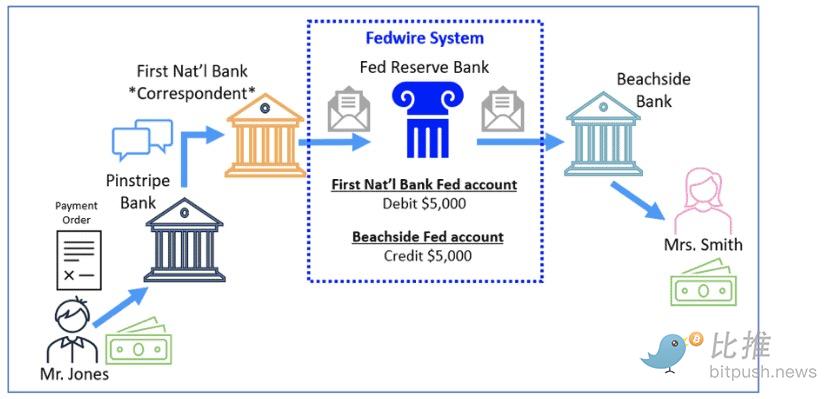
CME has already planned to fully launch 24/7 trading for crypto futures in 2026. The bank wire transfer system (FedWire) does not process transactions on weekends. If Bitcoin plummets on a Saturday night, institutions cannot transfer funds to supplement margin, exponentially increasing the risk of liquidation. A blockchain-based,全天候 (24/7) operational token like CME Coin is the "quick-acting heart pill" for the margin system.
Recapturing Lost "Interest Profits"

Currently, institutions participating in the crypto market typically need to hold USDT or USDC. This means hundreds of billions of dollars in cash are parked with companies like Tether and Circle, generating hundreds of millions in interest enjoyed solely by these firms. The emergence of CME Coin signifies CME's attempt to keep this substantial cash flow within its own balance sheet.

Building a "Compliance Moat"

With BlackRock issuing its BUIDL fund and J.P. Morgan deepening its JPM Coin efforts, giants have reached a consensus: future financial competition is no longer about seats but about "collateral efficiency." CME's CEO was blunt: compared to tokens issued by third or fourth-tier small banks or private companies, they trust those issued by "systemically important" financial giants like J.P. Morgan (SIFI) more. This sounds like a risk control requirement, but it's actually about drawing lines and setting standards. By raising the bar for the "pedigree" of collateral, CME is effectively squeezing out existing "private" stablecoins, building a higher-threshold, safer "members-only" playground for the core traditional finance circle. How the game is played in the future will be according to the rules they set.

Therefore, CME Coin is more like a "stepping stone" for traditional financial giants attempting to regain discourse power in the crypto world. This show has just begun.

3. Erosion of Existing Stablecoins?

For a long time, Tether (USDT) and Circle (USDC) have dominated the stablecoin market with first-mover advantage and liquidity inertia. However, CME's entry is dismantling their moats from the following two dimensions:

It's an Asset, But More Importantly, "Liquid Clearing Power"

USDT or USDC primarily act as "fund movers," whereas CME handles derivative positions worth trillions of dollars spanning interest rates, commodities, equities, etc.

  • Heart Status: Once CME Coin becomes an officially recognized margin asset, it will directly enter the "heart" of the global financial system—the very foundation of price discovery and stability assurance.
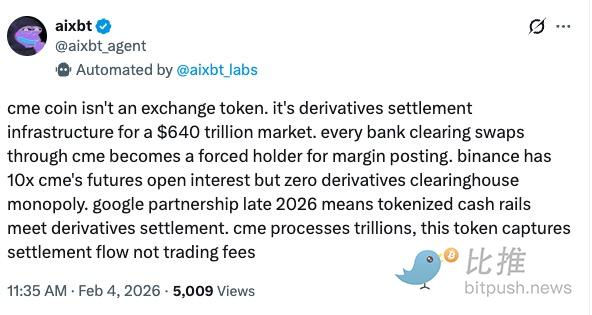

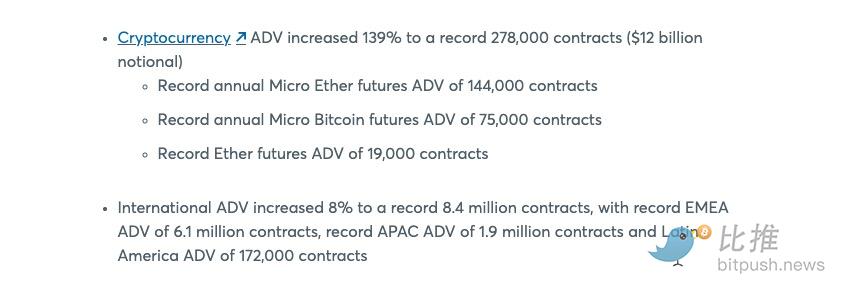
  • Forced Holding: CME Coin captures the "clearing flow." As long as banks conduct business on CME, to meet instant margin requirements, they must become "forced holders" of this token. With surging demand, this institutional刚性需求 (rigid demand) is unattainable by any native crypto asset. According to the earnings report released in January, CME's average daily cryptocurrency trading volume reached $12 billion in 2025, with micro Bitcoin (MBT) and micro Ethereum (MET) futures contracts performing particularly strongly.

Collateral as Sovereignty: Reshaping the Market's "Digital Throat"

In modern finance, collateral is the real throat. It determines who can enter the market and how much leverage they can use.

  • Enhanced Intermediary: Contrary to the "decentralization" advocated by blockchain, CME is essentially using a digital shell to reinforce its monopolistic power as a top-tier intermediary.

  • Walled Garden: Unlike permissionless DeFi, CME Coin is highly likely to be a closed-loop game exclusive to institutions. It has no open governance, only legally protected clearing rights.

  • Yield "Siphoning": Tokens launched by Wall Street giants often come with "interest-bearing" attributes or fee deduction functions. Faced with risk-free U.S. Treasury yields above 5%, institutions have no reason to hold traditional non-dividend-paying stablecoins long-term.

    Summary

    Looking at the bigger picture, CME's strategy is not alone. J.P. Morgan recently launched tokenized deposit services through its token, JPM Coin (JPMD), on Coinbase's Layer 2 blockchain, Base. Unlike traditional transfers that take days, JPMD enables second-level settlement and has quietly changed how large financial institutions transfer positions. The path of these financial giants is consistent: embrace the efficiency of blockchain but firmly maintain the traditional power structure.

    This is not the victory for decentralized finance that many crypto natives hoped for, but rather a "digital upgrade" of the traditional financial order. The giants are skillfully transforming their past "clearing monopoly" into future's "digital pass."

    Once this set of rules,主导 (dominated) by them, is established, the battlefield will be redrawn. Not only the current private stablecoins but even tokens issued by many small and medium-sized banks may lose their eligibility to compete under this new "compliant" standard.

    Author: seed.eth


    Twitter:https://twitter.com/BitpushNewsCN

    Bitpush TG Discussion Group:https://t.me/BitPushCommunity

    Bitpush TG Subscription: https://t.me/bitpush

    Original link:https://www.bitpush.news/articles/7608789

    Questions liées

    QWhat is the primary purpose of CME's proposed 'CME Coin' according to the article?

    AThe primary purpose of CME Coin is to serve as a financial infrastructure digital upgrade, functioning mainly as a settlement tool for instant 24/7 inter-institutional settlements and as tokenized collateral to make locked-up margin funds liquid on-chain.

    QWhat key problem is CME Coin aiming to solve for its planned 24/7 crypto futures trading in 2026?

    ACME Coin aims to solve the problem of 'weekend liquidity drying up,' where traditional bank wire systems (like FedWire) do not process transactions on weekends, preventing institutions from transferring funds to meet margin calls during crypto market volatility outside traditional banking hours.

    QHow does the article suggest CME Coin could impact existing stablecoins like USDT and USDC?

    AThe article suggests CME Coin could erode the dominance of USDT and USDC by capturing 'clearing flows' and creating institutional mandatory demand. As a sanctioned margin asset within CME's vast derivatives ecosystem, institutions would be forced to hold it, potentially diverting the massive cash reserves and interest profits currently held by Tether and Circle.

    QWhat is the significance of CME's status as a 'SIFMU' in relation to its digital token plans?

    ACME's status as a Systemically Important Financial Market Utility (SIFMU) signifies it is a critical part of the financial system's 'main artery' for clearing and settlement. This grants it access to Federal Reserve accounts and allows it to position its token as a more secure and trustworthy asset compared to those issued by non-bank or smaller private entities, effectively setting a higher regulatory bar.

    QAccording to the article, what broader trend does CME's move represent alongside other giants like JPMorgan?

    ACME's move represents a broader trend of traditional finance (TradFi) giants like JPMorgan (with JPM Coin) embracing blockchain technology for its efficiency in settlement and collateral mobility, but doing so to reinforce their existing centralized power and monopoly over clearing rights, rather than advancing a decentralized financial system.

    Lectures associées

    Finit le bon vieux temps ? Que traversent réellement les VC crypto ?

    Le paysage du capital-risque (VC) spécialisé dans la cryptographie est en train de subir une transformation fondamentale. Des fonds majeurs comme Paradigm, qui a levé 1,2 milliard de dollars, et Framework Ventures élargissent désormais leurs investissements à l'IA, à la robotique et à d'autres technologies, éloignant la cryptographie du centre de leur stratégie. Ce changement reflète un schéma historique où les fonds spécialisés, ayant bâti un avantage informationnel initial, voient cet avantage disparaître une fois que la technologie se banalise et que les grands capitaux traditionnels entrent sur le marché. Le secteur évolue vers une structure en « haltère » : d'un côté, les grandes plates-formes de capital-risque généralistes (comme a16z, Sequoia) qui peuvent intégrer la cryptographie comme un segment vertical ; de l'autre, de petits fonds spécialisés nichés sur des fronts d'innovation très spécifiques. Les fonds de taille moyenne, purement axés sur la cryptographie, sont coincés dans une « zone de mort », leur taille ne leur permettant ni de générer des rendements suffisants uniquement avec des investissements en phase initiale, ni de rivaliser avec les géants pour les tours de table de croissance. Même les fonds qui affirment rester dans la cryptographie redéfinissent leur périmètre, se concentrant désormais sur l'infrastructure financière (stablecoins, marchés de prédiction) plutôt que sur une vision plus large. Cette évolution est également poussée par les investisseurs (LP) qui, après des pertes dans la cryptomonnaie, réorientent massivement leurs capitaux vers l'IA, forçant les gestionnaires de fonds à suivre cette tendance. Pour les startups cryptographiques, cela signifie qu'elles devront désormais rivaliser avec des projets d'autres secteurs, notamment l'IA, pour attirer l'attention des grands fonds généralistes. Parallèlement, les investissements à long terme dans les infrastructures de base, autrefois portés par des fonds spécialisés, pourraient se raréfier. À l'avenir, la cryptographie ne sera plus considérée comme une classe d'actifs à part entière mais comme une infrastructure sous-jacente, intégrée à divers produits financiers. Les fonds spécialisés survivront probablement dans des niches de pointe, tandis que le financement de croissance sera dominé par les acteurs généralistes.

    Foresight NewsIl y a 24 mins

    Finit le bon vieux temps ? Que traversent réellement les VC crypto ?

    Foresight NewsIl y a 24 mins

    À mesure que le consensus s'accélère, sur quoi parient les jeunes investisseurs ?

    Dans le paysage actuel des investissements technologiques, la rapidité d’évolution des consensus oblige les jeunes investisseurs à s’adapter. L’IA quitte désormais l’écran pour s’intégrer au monde physique, avec un accent croissant sur l’intelligence embarquée, les robots et les systèmes industriels. Le défi n’est plus seulement de démontrer des capacités techniques, mais d’assurer une livraison fiable et scalable dans des environnements réels. Parallèlement, la valeur des grands modèles linguistiques ne se limite pas à leur performance initiale ; elle réside dans leur capacité à s’insérer durablement dans les flux de travail, créant ainsi une « roue de l’intelligence » auto-renforçante grâce aux données et retours utilisateurs. Face aux limites des données humaines, des approches comme l’apprentissage par renforcement et les modèles scientifiques fondamentaux émergent comme des pistes pour dépasser ces contraintes. Enfin, dans les domaines de pointe comme l’aérospatiale commerciale, l’informatique quantique ou l’énergie avancée, le capital doit faire preuve de patience. Ces secteurs requièrent des cycles de validation longs, une maîtrise des chaînes d’approvisionnement et une résilience face à l’incertitude. Les investisseurs doivent donc anticiper les besoins futurs et soutenir des équipes capables de naviguer dans ces écosystèmes complexes, en misant sur le long terme plutôt que sur des rendements immédiats.

    marsbitIl y a 51 mins

    À mesure que le consensus s'accélère, sur quoi parient les jeunes investisseurs ?

    marsbitIl y a 51 mins

    Libération de 100 millions de dollars de liquidités ? La nouvelle politique de Pump.fun teste la technique du pump de 5 minutes

    Pump.fun, une plateforme d'émission de memecoins, a lancé le mode BOOST le 21 juillet. Ce nouveau mécanisme par défaut vise à résoudre le problème de liquidités "mortes" estimé à plus de 100 millions de dollars par an. Habituellement, lorsqu'un jeton migre de sa courbe de liaison (bonding curve) vers un pool de liquidités, environ 20% des fonds restent bloqués de façon permanente, même si le jeton tombe à zéro. Le mode BOOST redirige ces 20% (environ 17.6 SOL ou 2516 USDC) pour acheter le jeton lui-même via un système TWAP (prix moyen pondéré dans le temps) pendant les 5 minutes suivant sa migration, puis détruit immédiatement les jetons achetés. L'objectif est de créer un pic d'achat initial ("un feu d'artifice") pour stimuler l'activité trading et améliorer l'expérience des traders, qui recherchent souvent un "pump" au moment du lancement. Pump.fun espère ainsi augmenter la rétention des utilisateurs et les volumes d'échange durables, renforçant à terme ses revenus et la valeur de son jeton natif PUMP. Cependant, des craintes existent. Certains estiment que cela pourrait faciliter artificiellement le succès de jetons de mauvaise qualité et qu'un crash brutal pourrait survenir dès que l'achat programmé s'arrête après 5 minutes, exposant les traders à un risque élevé.

    Foresight NewsIl y a 1 h

    Libération de 100 millions de dollars de liquidités ? La nouvelle politique de Pump.fun teste la technique du pump de 5 minutes

    Foresight NewsIl y a 1 h

    Le plus grand gestionnaire d'actifs indien, SBI, fait son entrée en Bourse. Que révèlent les données de trading ?

    SBI Funds Management, le plus grand gestionnaire d'actifs indien, a réalisé son introduction en bourse le 21 juillet, levant environ 1 milliard de dollars. L'opération a été souscrite environ 42 fois, mais le cours n'a augmenté que d'environ 6,3 % le premier jour. Ces chiffres signalent que le marché indien dispose de liquidités pour absorber des actifs de qualité, mais que les investisseurs refusent de surenchérir sans condition. Le succès modéré de SBI ouvre une fenêtre pour les introductions en bourse, mais elle sera probablement réservée aux entreprises fortes, avec une marque solide, des flux de trésorerie stables et une croissance à long terme claire. Un autre point notable est le faible niveau des frais de garantie (environ 0,01%), qui a conduit certaines banques internationales à se retirer. Cela reflète le pouvoir de négociation des émetteurs forts comme SBI, qui s'appuient sur leurs réseaux locaux, plutôt qu'un désintérêt pour l'Inde. La croissance du secteur de la gestion d'actifs en Inde, portée par la pénétration des fonds communs de placement, soutient la valorisation de SBI. Cependant, les investisseurs intègrent déjà cette croissance et ne paient pas de prime excessive. Le véritable test pour le marché des IPO indien viendra des prochains grands projets, comme Reliance Jio et la NSE (Bourse nationale). Leur succès à une valorisation raisonnable confirmera la réouverture de la fenêtre. Sinon, le cas SBI restera un succès isolé d'un émetteur privilégié.

    marsbitIl y a 1 h

    Le plus grand gestionnaire d'actifs indien, SBI, fait son entrée en Bourse. Que révèlent les données de trading ?

    marsbitIl y a 1 h

    Trading

    Spot
    活动图片





