Is altseason finally brewing? Only if THESE 2 indicators flip first

ambcryptoPublié le 2026-02-03Dernière mise à jour le 2026-02-03

Résumé

Hopes for an altcoin season in 2026 are building as investors look beyond Bitcoin, but conditions for a full altcoin rally are not yet firmly in place. Two key indicators need to flip first. The latest ISM Manufacturing PMI reached 52.6%, its highest in nearly 40 months, pushing U.S. manufacturing into expansion territory. Historically, altcoin rallies followed periods when ISM moved decisively higher, particularly above the 55 mark, as seen in 2017 and 2021. While current levels are below that threshold, a potential turning point may be emerging. However, Ethereum (ETH), a known harbinger of altseason, has closed in the red for 12 of the last 15 months, showing a prolonged stretch of weakness with uneven gains and frequent drawdowns. Sustained altseasons have almost always followed a clear and consistent uptrend in Ethereum. Furthermore, the Altcoin Season Index from CoinGlass was at 39, below the level that usually indicates a rotation away from Bitcoin. At the same time, Bitcoin dominance (BTC.D) remained high near 60% on the daily chart. Altseasons typically begin with a clear decline in BTC dominance as investors move down the risk curve, a shift that has not yet occurred. Overall, while altseason expectations are growing, they may be premature. Early macro signals are improving, but the market lacks a trigger for a true altseason, and capital remains firmly in Bitcoin.

Hopes for an altcoin season in 2026 are starting to build, with investors beginning to look beyond Bitcoin.

That said, it may still be too soon to call it. While expectations are rising, the conditions needed for a full altcoin rally are not firmly in place yet.

Altseason within sight?

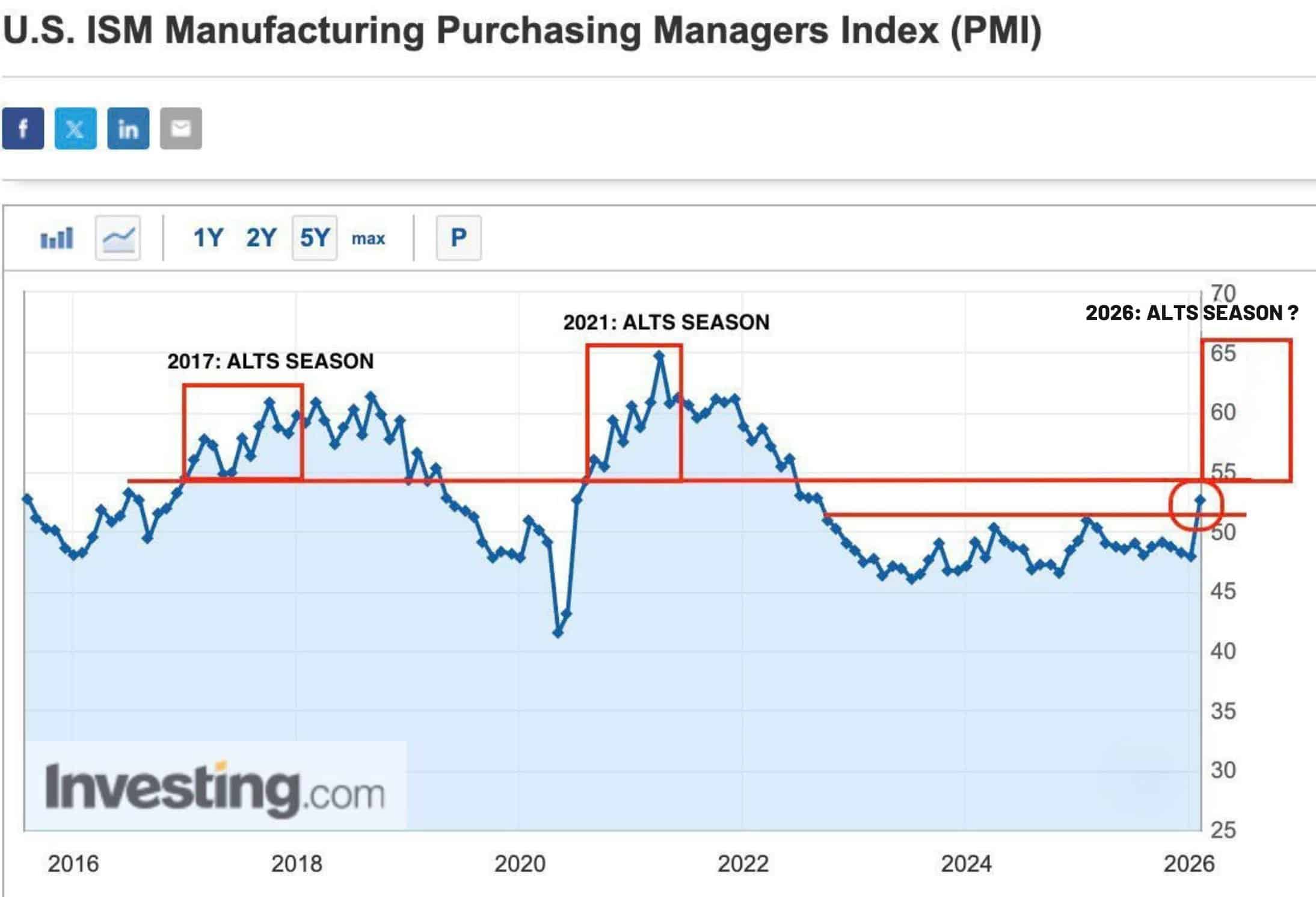
The latest ISM Manufacturing PMI came in at 52.6%, its highest reading in nearly 40 months. This pushed U.S. manufacturing back into expansion territory.

Source: X

Past altcoin rallies have tended to follow periods when ISM moved decisively higher. In both 2017 and 2021, altseasons took shape only after PMI readings climbed above the 55 mark.

While current levels remain below that threshold, it looks like a potential turning point may be in order.

But that’s not all…

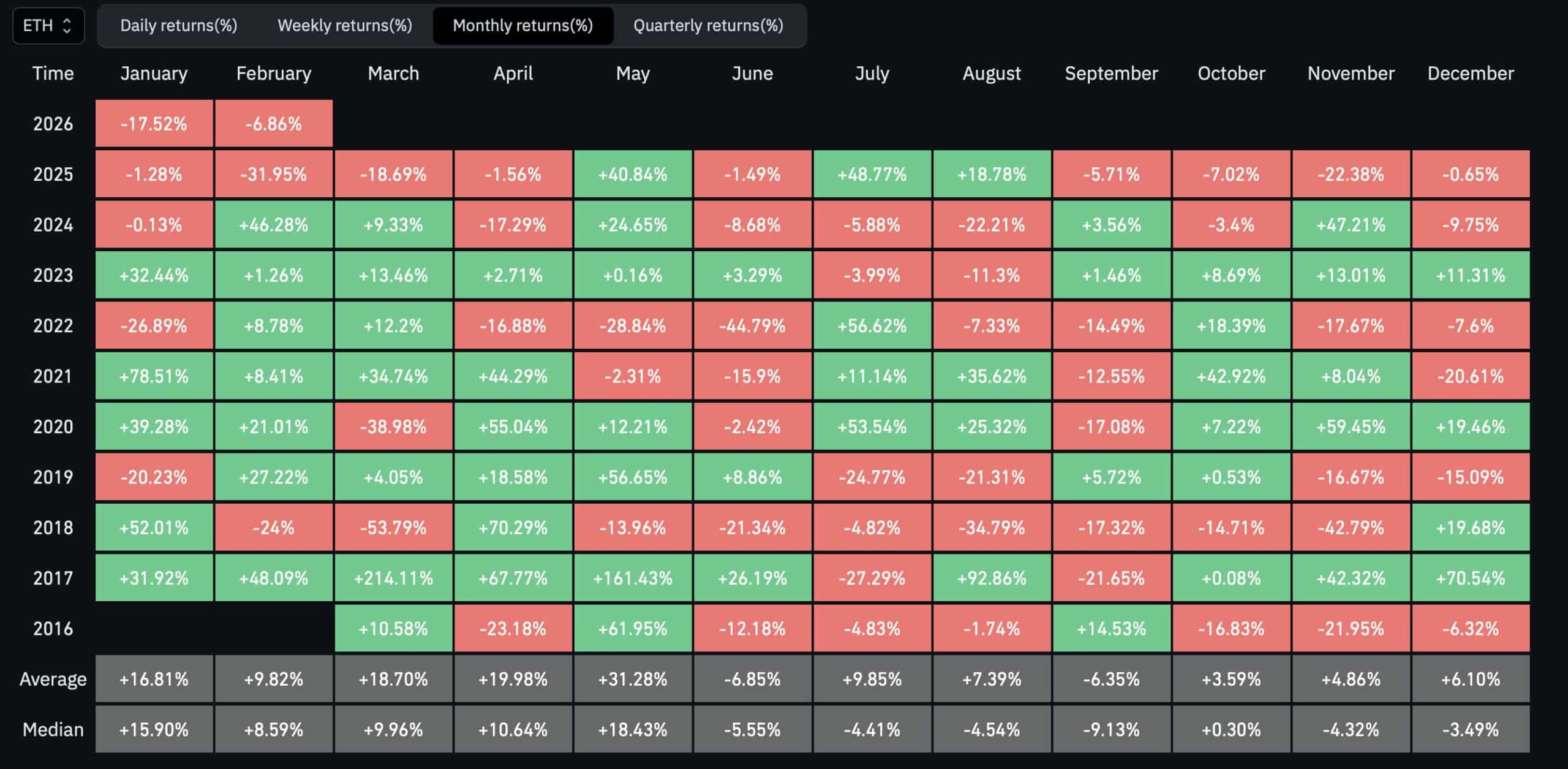
Ethereum [ETH] – famously known as a harbinger of altseason – has closed in the red in 12 of the last 15 months with a prolonged stretch of weakness.

Source: X

The monthly returns chart makes this slowdown obvious, showing uneven gains with frequent drawdowns across 2024 and into early 2026. Even during brief comebacks, follow-through has been limited.

This is important. Sustained altseasons have almost always followed a clear and consistent uptrend in Ethereum.

Altcoin signs look weak

Source: CoinGlass

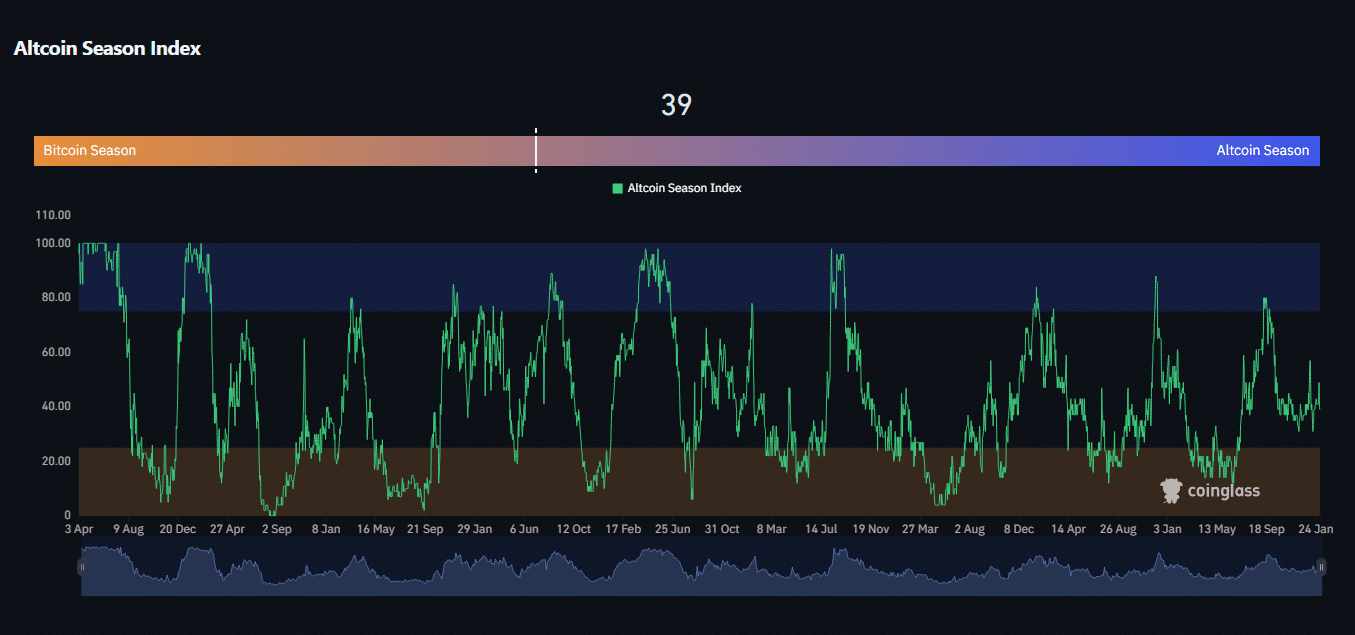
CoinGlass’ Altcoin Season Index was at 39 at the time of writing, below the level that usually indicates a rotation away from Bitcoin [BTC]. Despite growing macro optimism, capital has yet to flow into altcoins on a larger scale.

Source: TradingView

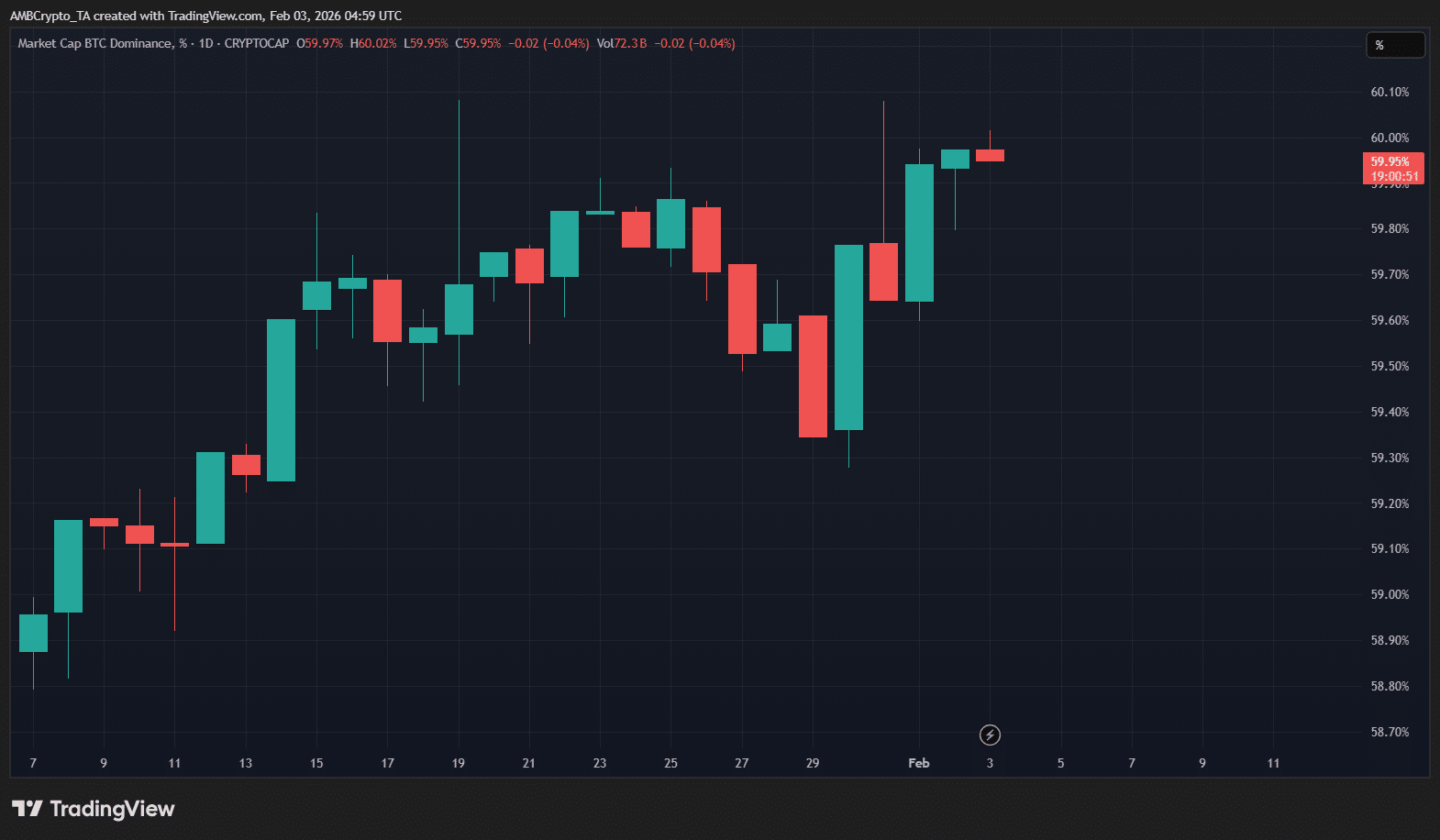
At the same time, BTC.D was close to 60% on the daily chart.

Altseasons usually started with a clear decline in BTC dominance, with investors moving down the risk curve. For now, that shift has not yet happened.

Overall, while altseason expectations are beginning to fire up, they may very well be premature. Only time will tell.


Final Thoughts

  • Early macro signals are improving, but the market lacks a trigger for a true altseason.
  • With altcoin season index at 39, capital is still firmly in Bitcoin.
Next: White House talks expose stablecoin rewards as fault line in U.S. crypto legislation
Share
  • Share
  • Tweet

Questions liées

QWhat are the two key indicators that need to flip for an altseason to begin according to the article?

AThe two key indicators are the ISM Manufacturing PMI rising above the 55 mark and a clear decline in Bitcoin dominance (BTC.D) as capital flows into altcoins.

QWhat was the current reading of the Altcoin Season Index mentioned in the article, and what does it indicate?

AThe Altcoin Season Index was at 39 at the time of writing, indicating that capital is still firmly in Bitcoin and below the level that usually signals a rotation into altcoins.

QHow has Ethereum's performance been described in relation to predicting altseasons?

AEthereum has closed in the red in 12 of the last 15 months with prolonged weakness, and sustained altseasons have almost always followed a clear and consistent uptrend in Ethereum's price.

QWhat significant level did the latest ISM Manufacturing PMI reach, and why is this important for altcoins?

AThe latest ISM Manufacturing PMI came in at 52.6%, its highest reading in nearly 40 months, pushing U.S. manufacturing into expansion territory. Past altcoin rallies have followed periods when ISM moved decisively higher, particularly above 55.

QWhat is the current state of Bitcoin dominance (BTC.D) and its implication for an altseason?

ABTC.D was close to 60% on the daily chart, indicating that the shift of investors moving down the risk curve into altcoins has not yet happened, which is necessary for an altseason to start.

Lectures associées

Attirer les capitaux mondiaux, l’Asie vit un nouveau « super cycle »

Les investisseurs se tournent vers l'Asie, voyant dans la région le prochain moteur de la croissance boursière mondiale, porté par une vague d'investissements dans l'IA. Morgan Stanley anticipe un « super-cycle » asiatique, avec des dépenses en capital fixes devant passer d'environ 11 000 milliards de dollars en 2025 à 16 000 milliards en 2030, soit une croissance annuelle de 7%. Le cœur de ce cycle est l'expansion massive des infrastructures liées à l'IA (puces, serveurs, centres de données, énergie). L'Asie, au centre des chaînes d'approvisionnement, en bénéficiera pleinement. La Chine développe son écosystème de puces et de plateformes cloud pour une plus grande autonomie. Parallèlement, ses exportations pourraient évoluer des véhicules électriques vers la robotique, notamment les robots humanoïdes, reproduisant une trajectoire de croissance similaire. Deux autres moteurs se conjuguent : la sécurité énergétique, avec d'importants besoins en infrastructures renouvelables et en stockage, et l'augmentation structurelle des dépenses de défense dans la région. La Chine, la Corée du Sud et le Japon, dotés d'industries manufacturières et technologiques solides, sont bien positionnés pour capter ces investissements. Cependant, des risques persistent : surcapacités potentielles, pression sur les marges, restrictions technologiques persistantes et impacts de l'IA sur l'emploi. La divergence des anticipations des marchés pourrait également accroître la volatilité.

marsbitIl y a 7 mins

Attirer les capitaux mondiaux, l’Asie vit un nouveau « super cycle »

marsbitIl y a 7 mins

Le marché obligataire japonais passe en masse à la technologie « blockchain »

En août 2025, une transaction de pensions livrées (repo) sur bons du Trésor américain a été réglée de manière atomique et en temps réel sur une blockchain en deh des heures de marché, par des institutions majeures comme Bank of America et Citadel Securities. Cela a marqué un tournant pour l'infrastructure financière. En avril 2026, le Japon a lancé un projet pilote pour migrer les obligations d'État japonaises (JGB), une garantie clé de 9 000 milliards de dollars en Asie, vers le Canton Network. Cette initiative vise à remédier aux inefficacités du système actuel, où le transfert de garanties est lent, limité aux heures d'ouverture de Tokyo, et immobilise des milliards. La pression vient des États-Unis, où des acteurs comme la DTCC utilisent déjà Canton pour tokeniser les Treasuries, les rendant disponibles 24h/24. Pour éviter de perdre son statut de garantie privilégiée, le Japon doit moderniser son système. Canton Network a été choisi car son architecture permet un règlement atomique, respecte les exigences juridiques de confidentialité (comme la loi japonaise sur le transfert d'écritures) et synchronise les données avec les registres officiels. Il devient ainsi le réseau de référence pour le mouvement transfrontalier des principales garanties souveraines. Le règlement tokenisé 24h/24 change la donne : il permet de répondre directement aux appels de marge avec des obligations, réduisant les ventes forcées en période de stress. Il élimine aussi le risque de crédit dans les repo grâce au règlement atomique (l'actif et le cash échangés simultanément). Enfin, l'intégration de dépôts bancaires tokenisés, et non de stablecoins privés, résout le problème du règlement en cash pour les institutions. En somme, Canton est en passe de devenir une infrastructure essentielle, comme SWIFT, pour le mouvement des garanties souveraines. Cette évolution représente une révolution d'efficacité pour les marchés financiers, même si elle renforce le rôle des acteurs traditionnels plutôt que de les déloger.

marsbitIl y a 1 h

Le marché obligataire japonais passe en masse à la technologie « blockchain »

marsbitIl y a 1 h

Rapport hebdomadaire sur le financement | 14 événements de financement publics, Kalshi achève un nouveau tour de financement de 10 milliards de dollars avec une valorisation de 220 milliards de dollars, dirigé par Coatue Management

**Résumé des levées de fonds hebdomadaires (4-10 mai) : 14 événements, plus de 1.049 milliard de dollars levés** **Points clés par secteur :** * **DeFi (4 deals) :** L'assureur-réassureur OnRe a levé 5 millions de dollars. Le protocole de crédit Saturn Credit a obtenu 2 millions. La plateforme de trading institutionnelle Ekiden a levé 2 millions. Coinbase a investi stratégiquement dans Centrifuge (infrastructure de tokenisation RWA). * **Infrastructure & Outils (4 deals) :** OpenTrade (produits de rendement pour stablecoins) a levé 17 millions. La plateforme RWA Balcony a levé 12,7 millions. Antier Solutions a levé 3 millions pour son infrastructure blockchain d'entreprise. Coinbase investit également dans Kemet pour intégrer ses produits dérivés. * **Marchés de prédiction (3 deals) :** Le leader Kalshi a réalisé un tour de table de 1 milliard de dollars (évaluation : 22 milliards). Les plateformes AI Elastics et Sportix ont levé respectivement 2 et 3,2 millions. * **Finance Centralisée (1 deal) :** La plateforme de trading AI Stockcoin.ai a bouclé un tour d'amorçage mené par Amber Group. * **Autres applications Web3 (2 deals) :** SC Ventures (Standard Chartered) a investi stratégiquement dans le market-maker crypto GSR. La société de réserve bitcoin Capital B a levé 1,1 million d'euros. * **Fonds d'investissement :** Haun Ventures a levé 1 milliard pour un nouveau fonds. Multi Investment a levé ~616 millions. Le fonds de Global Millennial a levé 100 millions pour cibler les opportunités pré-IPO dans la DeFi et l'IA.

marsbitIl y a 1 h

Rapport hebdomadaire sur le financement | 14 événements de financement publics, Kalshi achève un nouveau tour de financement de 10 milliards de dollars avec une valorisation de 220 milliards de dollars, dirigé par Coatue Management

marsbitIl y a 1 h

Trading

Spot
Futures
活动图片