
Investors Are Now Hunting for AI Projects on Bilibili and Xiaohongshu

marsbitPublié le 2026-06-12Dernière mise à jour le 2026-06-12

Résumé

Investors Turn to Bilibili and Xiaohongshu to Source AI Projects The AI hardware boom is in full swing in 2025, with a surge in smart wearables like AI glasses, rings, toys, and companion robots. This frenzy has investors scrambling, not just sifting through business plans, but actively hunting for promising "under-the-radar" projects on youth and tech-enthusiast content platforms like Bilibili and Xiaohongshu. The logic is straightforward: for consumer-facing AI hardware, genuine user demand and potential pitfalls are often revealed earlier in public discussions, comments, and critiques on these communities than in formal pitches. As one industry insider notes, these products must ultimately be tested and understood by real people. This shift highlights a crucial challenge in the sector: user education. The success of AI hardware depends on moving beyond mere efficiency gains to fulfilling higher-order needs like "unleashing personal creativity." Products must convince users they are natural, unobtrusive additions to daily life. Early hype, as seen with devices like the Rabbit R1, often fades if the product fails to clearly solve real-world problems, leading to high return rates and market rejection. The market is now entering a shakeout phase. 2026 is seen as a year of commercial validation. Some projects have already stalled or been canceled due to market resistance, lack of differentiation, or financial woes. However, the long-term opportunity remains vast, with forec...

Author: Investment Community

"In the AI era, all hardware is worth remaking from scratch."

This statement might have sounded somewhat radical in 2024, but in 2025, its credibility has surged significantly—as we are witnessing, the wave of AI hardware entrepreneurship is rising, with financings following one after another. Across the ocean, the smart ring Oura Health has seen its latest valuation soar to a staggering 70 billion yuan.

This frenzy is sweeping up FOMO-stricken investors. This time, aside from sifting through thousands of pitch deck emails, they have strikingly turned their deal-sourcing gaze towards content communities densely populated by tech geeks and young people.

The underlying logic is rather simple: compared to spec sheets and roadshows, the real demand for a consumer-grade AI smart hardware product is often first exposed by whether it can be understood, discussed, and questioned in the public sphere.

Ultimately, all tech products aimed at the masses must go through the test of the crowd.

AI Hardware Explosion, Investors Scramble for Under-the-Radar Projects

We are experiencing a banner year for AI hardware.

Since 2025, extending from the wearable device track, more segmented smart hardware products such as AI glasses, AI toys, AI recording cards, AI rings, AI earphones, companion robots, and Agent Boxes have collectively seen an explosion.

Amid the fervor, certain details reveal the excitement in the investment circle: in the latter half of 2025, we frequently saw several top-tier institutions posting job openings to recruit AI/smart hardware investors, with the job descriptions almost invariably requiring the candidates to be based in Shenzhen, the hardware capital.

Good projects almost require 'repeated visits' and intense competition, especially those still under the radar with valuations not yet sky-high. Investors have even started approaching potential founders who haven't yet left their jobs. For instance, cafes near DJI are packed with VCs and FAs trying to 'persuade people to start a business.'
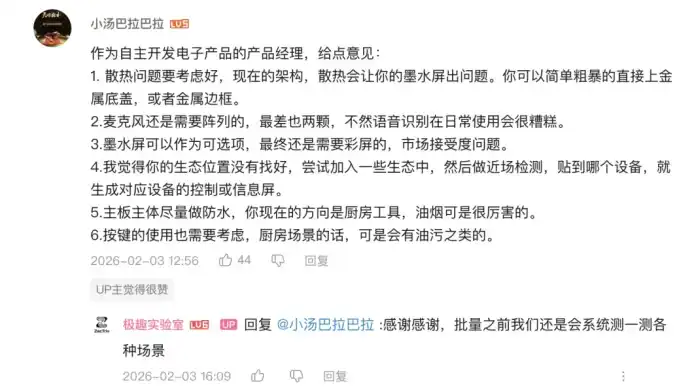
(Comment section of an AI sticky note product pre-sale video)

"After this content was posted, many technical discussion threads appeared in the bullet comments and comment section, and more users began sharing their similar needs: some mentioned frequently attending cross-border exhibitions, others talked about communication barriers when collaborating remotely with overseas teams, and some shared experiences where translation tools were inconvenient when accompanying foreign relatives for medical treatment or handling foreign affairs."

"These feedbacks not only helped us expand the direction for creator content but also directly influenced our thinking about the product line," Wu Zhen said.
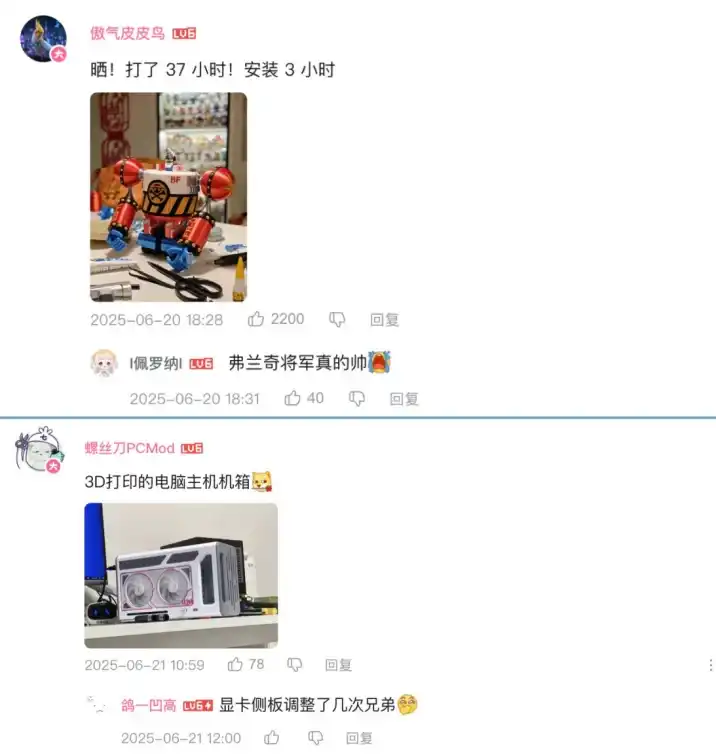
(Comment section of UP主影视飓风's video)

Enthusiasts Gather

Remember January 2024, at CES.

A little orange square box called Rabbit R1, touted as 'the world's first AI hardware device,' stirred a frenzy in the tech world. The market hailed it as the iPhone of the AI era, selling 100,000 units upon launch.

But what followed was not success. On the contrary, skepticism soon arose with comments like 'actually using it is not as good as a phone.' At the time, the high-flying Rabbit R1 failed to adequately explain to users: what exactly can Rabbit R1 do now and in the future? What real user problems does this innovation actually solve?

Even today, user education remains the most critical challenge for AI smart hardware—when AI enters consumer electronics, the product consumption logic is no longer limited to 'improving life efficiency' but also includes higher-dimensional needs like 'unleashing personal creativity' and 'liberating the mind.' In this context, whoever can make users understand, discuss, and pay in real-life scenarios truly crosses the threshold from a tech product to a consumer good.

But this is not easy. Regarding user education for AI glasses, INMO's CMO Wu Zhen told us frankly: This is not simply about conveying product information; it also requires overcoming a psychological barrier. Users must first complete a 'virtual try-on' in their minds, confirming that integrating this device into daily life feels natural and not awkward, before they can proceed to the next step.

In Wu Zhen's view, the process of psychologically preparing users for AI smart hardware might be longer than for most consumer electronics categories. "The day users naturally put on AI glasses to go out without reminding themselves 'I need to use AI glasses today,' this behavioral change might be more convincing than many data points."

Shakeout Begins, Battle for Attention Heats Up

While the frenzy peaks, a shakeout is underway.

There is now market consensus that 2026 will be the year of commercial validation for AI hardware. This also means that trend-chasers and狂热资本 will face rationality and冷静.

A winnowing process is unfolding: At the end of 2025, the AI wearable device Friend AI Necklace stalled after encountering severe market resistance; after its peak appearance in 2024, Rabbit R1, unable to keep up with product expectations amid negative feedback, saw abnormally high return rates, severely damaging its reputation, and ultimately陷入欠薪与现金流枯竭的困境 (fell into困境 of salary arrears and cash flow depletion).

Meanwhile, savvy players are also开始审慎调整和优化决策 (beginning to prudently adjust and optimize decisions). In February 2026, market rumors emerged that the Doubao AI glasses project was suspended; at least within the visible cycle, this product line is no longer considered a direction to pursue. Earlier, in January, smartphone manufacturer vivo halted its AI glasses project, citing the difficulty of achieving differentiation at present.

Such developments are a reflection of industry differentiation.

Nevertheless, it is undeniable that in this trillion-dollar-value赛道 (track), entrepreneurs still possess enormous确定性机会 (deterministic opportunities). According to AICC predictions, by 2030, the global AI-related hardware market will easily surpass several trillion dollars. In China, the industry expects the market size for consumer-grade AI hardware (excluding phones and cars) to突破 (break through) 1.27 trillion yuan in 2026 and reach 2.56 trillion yuan by 2030.

Currently, opportunities for exit and entry coexist. OpenAI just announced it will launch its first AI hardware device in the second half of the year, and Meta plans to double the annual production capacity of its AI smart glasses to 20 million units by the end of 2026. The latest scene domestically: a batch of AI smart terminals from京东 (JD.com), including AI desk lamps, AI cooking machines, AI mattresses, and AI wheelchairs, are酝酿上新售卖 (being酝酿 for launch and sale).

People remain convinced that the battle for入口之争 (portals) behind AI smart hardware will not stop. The AI era is still an era of用户主权 (user sovereignty).

The热浪 (heat wave) will push everyone forward. But when attention, product power, and user perception begin to compete on the same table, the final battle is just beginning.


Questions liées

QWhat new strategy are venture capitalists adopting to find promising AI hardware projects?

AVenture capitalists are increasingly looking for promising AI hardware projects on youth-focused content communities like Bilibili and Xiaohongshu. They analyze user discussions, comments, and product reviews to gauge genuine market demand and real-world product understanding before these ventures become widely known or receive high valuations.

QWhy is user education considered crucial for AI consumer hardware adoption?

AUser education is crucial because the value proposition of AI hardware often involves higher-level needs like 'unleashing personal creativity' or 'liberating the brain,' not just efficiency. Consumers need to understand and visualize how these devices fit into their daily lives without being intrusive. This mental acceptance and natural integration into routines are considered more important than just product specifications for driving adoption.

QWhat are some examples of AI consumer hardware that faced significant market challenges?

AExamples of AI consumer hardware that faced significant market challenges include the Rabbit R1, which suffered from high return rates and negative feedback regarding its practical utility, leading to cash flow problems. The Friend AI Necklace also encountered severe market resistance and stalled development.

QWhat is the predicted market size for consumer AI hardware in China by 2030?

AIndustry predictions estimate that the market size for consumer AI hardware (excluding smartphones and cars) in China will reach 2.56 trillion yuan by 2030. It is projected to first exceed 1.27 trillion yuan by 2026.

QWhy are some companies adjusting their strategies in the AI hardware market in 2026?

ACompanies are adjusting their strategies because 2026 is widely seen as the 'commercial validation year' for AI hardware. The market is entering a phase of rationalization and consolidation. Projects that fail to demonstrate clear product differentiation, genuine user value, or sustainable business models are being paused or canceled, as seen with Doubao's AI glasses and vivo's AI glasses project, indicating an industry-wide shakeout.

Lectures associées

La répartition de la valeur des stablecoins

L'article analyse la répartition de valeur dans l'écosystème des stablecoins, en le divisant en quatre couches : 1. **Couche d'émission** : (ex. : Tether, Circle) - Émettent les stablecoins, détiennent les actifs de réserve et capturent la marge d'intérêt. 2. **Couche d'infrastructure** : (ex. : Bridge, BVNK) - Relient les stablecoins au système financier traditionnel (connexions bancaires, conformité, gestion des entrées/sorties en fiat). C'est le travail le plus complexe et essentiel pour une adoption large. 3. **Couche d'acquisition/distribution** : (ex. : Stripe, Coinbase) - Intègrent les stablecoins dans les systèmes marchands et logiciels d'entreprise. 4. **Couche applicative** : Les utilisateurs finaux. Actuellement, la couche d'émission génère les profits les plus importants. L'auteur souligne que la **couche d'infrastructure**, bien que cruciale, est souvent sous-estimée. Son rôle de "trait d'union" entre la blockchain et le monde réel (règlement, conformité, intégration aux flux de trésorerie des entreprises) est difficile mais constitue un avantage concurrentiel durable. Des acquisitions comme celle de Bridge par Stripe ou de BVNK par Mastercard montrent l'importance stratégique de ce segment. Bien que cette couche nécessite d'importants investissements initiaux et fasse face à une pression de la part des autres couches, elle pourrait acquérir un fort pouvoir de négociation une fois que les stablecoins deviendront un canal de paiement par défaut pour les entreprises.

marsbitIl y a 4 h

La répartition de la valeur des stablecoins

marsbitIl y a 4 h

Pourquoi Nvidia emprunte-t-elle 200 milliards de dollars si elle n'a pas besoin d'argent ?

Résumé de l'article : Nvidia, qui dispose d'une trésorerie abondante (flux de trésorerie libre d'environ 48,6 milliards de dollars pour son dernier trimestre), prévoit d'émettre des obligations (notes senior) pour au moins 20 milliards de dollars. Contrairement à une lecture simpliste sur un besoin de liquidités, cette opération s'analyse plutôt comme une optimisation active de la structure financière. L'entreprise profite de sa solide notation de crédit (AA) et de conditions de marché favorables pour lever des fonds à long terme (jusqu'à 30 ans) à un coût faible. Cette dette servira à financer des investissements à long cycle comme les infrastructures de datacenters IA, la R&D, les paiements anticipés à la chaîne d'approvisionnement et les investissements stratégiques. Cette approche permet à Nvidia de poursuivre son expansion dans l'écosystème IA sans diluer les actionnaires (alternative à une augmentation de capital), tout en maintenant parallèlement un retour aux actionnaires via un important programme de rachats d'actions et une augmentation du dividende. Elle reflète une évolution vers une gestion du capital plus mature, typique des grandes plateformes technologiques, et s'inscrit dans une tendance où les géants de la tech utilisent la dette pour financer le cycle d'investissements lourds de l'IA. La réussite de cette stratégie dépendra de la capacité future de Nvidia à générer des rendements supérieurs au coût de sa dette et à maintenir sa forte génération de flux de trésorerie.

marsbitIl y a 4 h

Pourquoi Nvidia emprunte-t-elle 200 milliards de dollars si elle n'a pas besoin d'argent ?

marsbitIl y a 4 h

Liberland révoque son secrétaire à la technologie après une tentative présumée de prise de contrôle de la blockchain et du site web

Le congrès de Liberland a voté le renvoi du secrétaire à la Technologie, Dorian Stern Vukotić, selon une résolution officielle de ce projet de micronation. Il est accusé d'avoir supprimé les protections multisignatures sur le compte administrateur Sudo, tenté de détourner le domaine Liberland.org, bloqué le président Vít Jedlička du vote et lancé des jetons non autorisés. Cette affaire sert d'étude de cas sur les risques de gouvernance dans la blockchain, qui dépassent les simples contrats intelligents. Elle implique le contrôle des permissions, des noms de domaine, des droits de vote et des comptes administrateurs. Ceci rappelle que pour de nombreux projets crypto, la décentralisation réelle doit être vérifiée au-delà des déclarations, car un petit nombre d'acteurs peut contrôler des fonctions clés. L'article précise que Liberland est un projet de micronation et non un État souverain largement reconnu. Pour les observateurs, il est conseillé de suivre les enregistrements sur l'explorateur blockchain, les votes ultérieurs et les éventuelles mises à jour juridiques ou liées au registre des domaines. Dans le contexte plus large, cette histoire s'inscrit dans une tendance où l'infrastructure, la sécurité et la gouvernance deviennent aussi importantes que l'évolution des prix. Elle illustre la nécessité pour les traders de comprendre les systèmes et les risques sous-jacents. Le traitement éditorial doit se baser sur les sources vérifiées, expliquer les risques pratiques et éviter les conclusions prématurées, en présentant cela comme un signal d'information à suivre.

bitcoinistIl y a 5 h

Liberland révoque son secrétaire à la technologie après une tentative présumée de prise de contrôle de la blockchain et du site web

bitcoinistIl y a 5 h

Comment bien mener une recherche : cultiver les compétences qui peuvent être réellement « pratiquées délibérément »

Personne ne vous a jamais vraiment appris à faire de la recherche. On vous donne un bureau, un problème choisi par d'autres, et des instructions vagues pour "produire quelque chose de nouveau". Ainsi, la plupart des gens rétroconçoient le métier à partir de ce qu'ils voient (articles, posts), apprenant à *sembler* chercheurs plutôt qu'à en *devenir*. Les véritables compétences en recherche sont un empilement de micro-compétences, presque toutes cultivables par la pratique délibérée. **Choisir ses propres problèmes.** Nous absorbons souvent des problèmes (du superviseur, des tendances) sans en comprendre le raisonnement sous-jacent, nous plaçant en retard face à des concurrents nombreux. John Schulman recommande de choisir un résultat que l'on souhaite réellement atteindre et de raisonner à rebours pour concevoir les expériences. Cette approche mène à l'originalité. Le "bon goût" est un muscle : prédire les résultats d'expériences, deviner les conclusions d'articles à partir des méthodes, noter quelles avancées resteront pertinentes, puis vérifier. **Améliorer ses sources.** S'alimenter aux mêmes sources (arXiv, discussions) génère les mêmes idées que tout le monde. Les archives anciennes sont sous-estimées : les idées clés (MoE, LSTM) sont souvent des réinventions. Lire des textes fondateurs comme "The Bitter Lesson" de Sutton ou le discours de Shannon sur la pensée créative est crucial. La **largeur** (neurosciences, conception de mécanismes, statistiques, architecture matérielle) est aussi importante que la profondeur. Lisez les **articles eux-mêmes**, surtout les annexes et les sections sur les limites. **Tout noter.** L'écriture révèle les failles des idées qui semblaient matures. C'est le mécanisme de défense le moins cher contre l'auto-tromperie, un point souligné par Feynman. Darwin notait systématiquement les faits contredisant sa théorie, craignant que sa mémoire ne les efface. Tenez un journal : hypothèses, paramètres, attentes, résultats, connaissances révisées. Relire ses notes d'il y a un mois est une leçon d'humilité sans égale.

marsbitIl y a 6 h

Comment bien mener une recherche : cultiver les compétences qui peuvent être réellement « pratiquées délibérément »

marsbitIl y a 6 h

Trading

Spot
Futures

Articles tendance

Comment acheter ERA

Bienvenue sur HTX.com ! Nous vous permettons d'acheter Caldera (ERA) de manière simple et pratique. Suivez notre guide étape par étape pour commencer votre parcours crypto.Étape 1 : Création de votre compte HTXUtilisez votre adresse e-mail ou votre numéro de téléphone pour ouvrir un compte sur HTX gratuitement. L'inscription se fait en toute simplicité et débloque toutes les fonctionnalités.Créer mon compteÉtape 2 : Choix du mode de paiement (rubrique Acheter des cryptosCarte de crédit/débit : utilisez votre carte Visa ou Mastercard pour acheter instantanément Caldera (ERA).Solde :utilisez les fonds du solde de votre compte HTX pour trader en toute simplicité.Prestataire tiers :pour accroître la commodité d'utilisation, nous avons ajouté des modes de paiement populaires tels que Google Pay et Apple Pay.P2P :tradez directement avec d'autres utilisateurs sur HTX.OTC (de gré à gré) : nous offrons des services personnalisés et des taux de change compétitifs aux traders.Étape 3 : stockage de vos Caldera (ERA)Après avoir acheté vos Caldera (ERA), stockez-les sur votre compte HTX. Vous pouvez également les envoyer ailleurs via un transfert sur la blockchain ou les utiliser pour trader d'autres cryptos.Étape 4 : tradez des Caldera (ERA)Tradez facilement Caldera (ERA) sur le marché Spot de HTX. Il vous suffit d'accéder à votre compte, de sélectionner la paire de trading, d'exécuter vos trades et de les suivre en temps réel. Nous offrons une expérience conviviale aux débutants comme aux traders chevronnés.

566 vues totalesPublié le 2025.07.17Mis à jour le 2026.06.02

Comment acheter ERA

Discussions

Bienvenue dans la Communauté HTX. Ici, vous pouvez vous tenir informé(e) des derniers développements de la plateforme et accéder à des analyses de marché professionnelles. Les opinions des utilisateurs sur le prix de ERA (ERA) sont présentées ci-dessous.

活动图片