How to Make Web3 Products Inherently Viral? Four Years of User Growth Lessons from an Entrepreneur

比推Publié le 2025-12-30Dernière mise à jour le 2025-12-30

Résumé

The author, a Web3 founder with four years of experience, shares seven key lessons learned from building consumer-facing crypto products after previously working on failed infrastructure projects. Key insights include: 1. Target younger users (ages 13-21) who are more open to adopting new technologies. 2. Design products with built-in virality to reduce marketing costs, as crypto users expect incentives and trust is low. 3. Implement user-requested features quickly (within 2-3 days) to build trust and prevent churn to competitors. 4. Choose simple, memorable product names for easier word-of-mouth sharing. 5. Engage with users directly through cold DMs despite low response rates, focusing on acquiring 10-20 dedicated early users. 6. Iterate rapidly based on user behavior rather than just feedback, prioritizing what they actually pay for. 7. Simplify websites and onboarding to minimize cognitive load and clicks, ensuring the core value is immediately apparent. The author emphasizes that speed, user-centric design, and marketing are more critical than technical perfection in consumer crypto.

Author: Rishabh Gupta

Compiled by: Jiahuan, ChainCatcher

Original title:7 Painful Lessons from 4 Years of Web3 Entrepreneurship


As a budding founder, I spent years pouring my heart into three infrastructure-layer projects that ultimately failed. In 2025, I started building a consumer product that people actually want to use. Here, I share my hard-earned insights on user acquisition and fundraising.

I've been in this industry for about 4 years.

In 2023, when "account abstraction" was the hottest topic in the circle, I started developing in the EVM ecosystem. At that time, everyone was building SDKs (Software Development Kits) for account abstract wallets. Rollup scaling solutions were also hot—Optimism, Arbitrum, and various RaaS (Rollup as a Service) dominated.

As a math enthusiast, I was deeply attracted to ZK (Zero-Knowledge proofs), believing it would change the world (I firmly believe it will, eventually).

I mistakenly believed that: Complexity == Credibility.

When VCs asked about application scenarios, I would confidently list zkML (Zero-Knowledge Machine Learning), zk identity, zk voting—but even today, no one is really using these areas. I mistook amazing technology for a useful product.

Over time, I began to believe that the more complex an idea was, the greater its chance of success.

VCs also told me that in the crypto space, building infrastructure was the only path to success.

It took me nearly 2 years and over 500 rejections to realize this wasn't for me.

Entering the Solana Ecosystem

This was a completely new ecosystem for me—here, people care about application scenarios. Even meme coins are okay, because revenue matters.

Speed matters. Distribution matters.

Having built consumer applications on Solana for 7 months, here are my insights:

1. Build for Young Users Willing to Try New Things

Try to develop for young people who are naturally receptive to new products.

In the consumer crypto space, this usually means people trading in the "trenches" or young users aged 13-21.

A 2024 study by the Consumer Technology Association showed that 86% of Gen Z (11-26 years old) consider technology core to life—a higher percentage than any older generation. They own more devices and are more willing to spend on tech products.

They are more willing to try new apps, experiment with new features, and change habits.

Users over 25 are generally less willing to adopt new workflows unless there is a very strong incentive.

(Note: If you're in the institutional business, this may not apply.)

Research shows that social activity peaks around age 20-21. This means products built for young people are inherently more shareable.
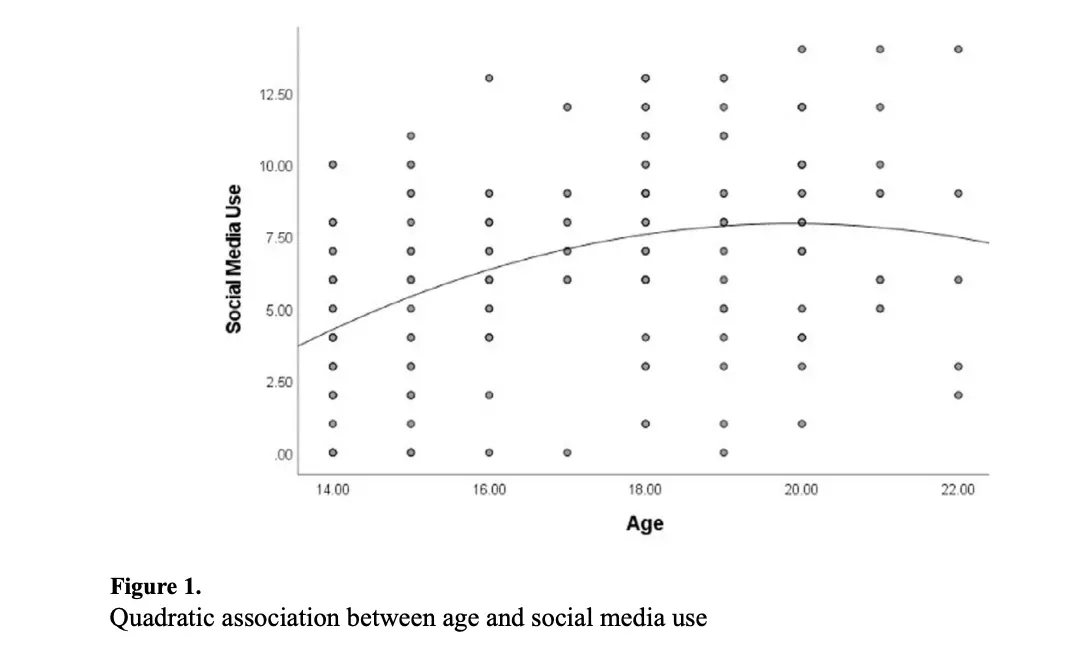
2. Make the Product Inherently "Viral" to Reduce Marketing Costs

If you don't have a huge marketing or advertising budget, the product itself must be the traffic channel.

In crypto, shareability is especially important because:

  • KOL marketing is very expensive.

  • Trust is extremely low.

  • Everyone expects rewards or incentives.
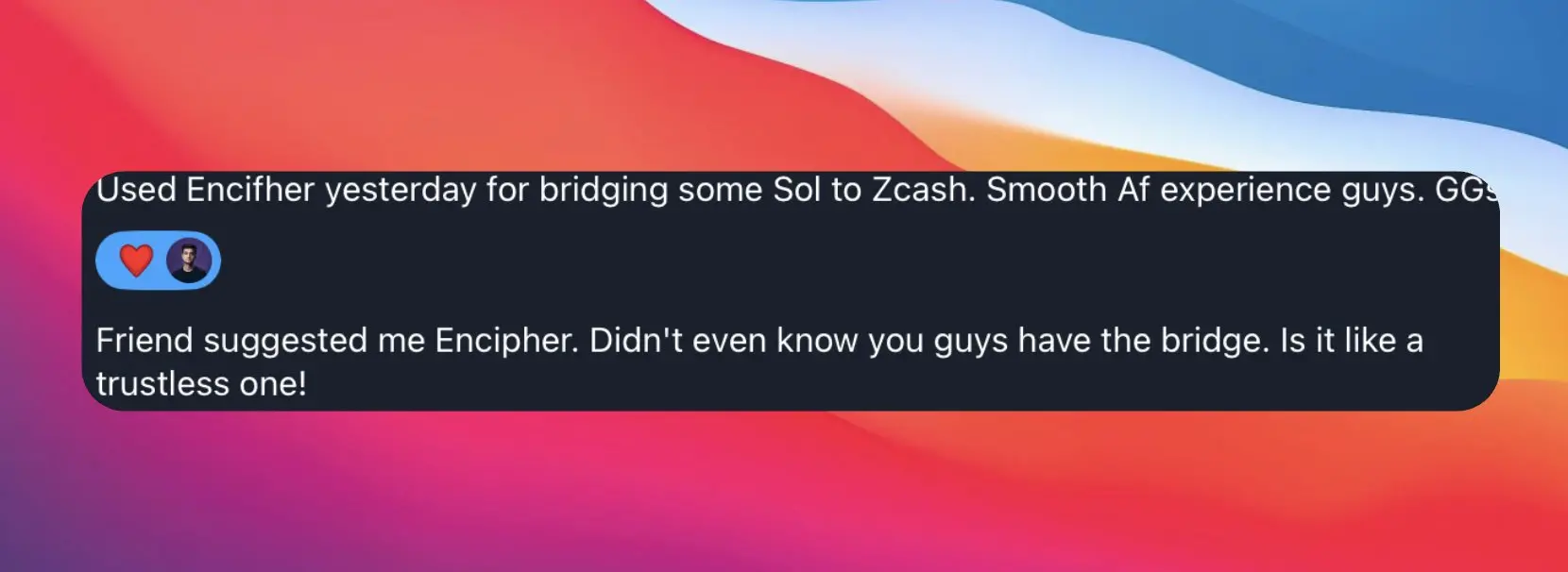
If your product gives users a reason to spontaneously share it with friends and communities, you've earned publicity without burning money. This is hard, but it's worth optimizing for from day one.

3. Launch Features Users Request as Soon as Possible

When users report a poor experience or a bug, fix it immediately, especially if it's a pain point that hinders use.

I used to wait until the end of the day to apply patches. The result was users DMing me: "Since your app doesn't have this feature, I'm going to use Product Y for now."

Once users go to a competitor and form a habit, it's hard to pull them back.

So, try to fix things immediately (ideally within 2-5 hours).

If multiple users request a feature and it's feasible:

  • Build it within 2-3 days.

  • Tell them it was launched based on their feedback.

  • Maybe even give them a reward.

This builds deep trust. Users will start to feel the product "belongs to them," and this sense of emotional ownership is incredibly powerful in early-stage products.
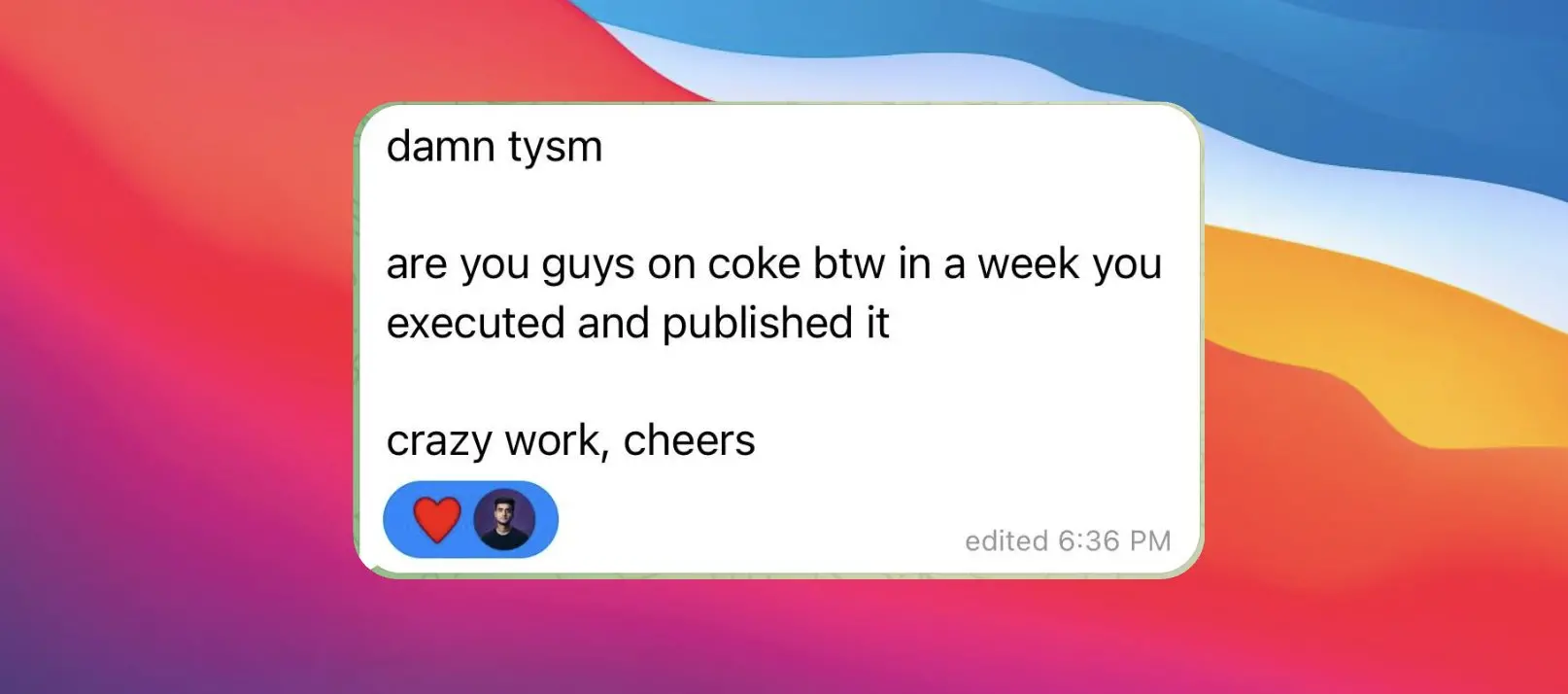
4. The App Name is Very Important

This seems simple, but many people (including me) have messed it up.

The app name should be highly recognizable and easy to share verbally.

My previous product was called "Encifher," a name extremely hard to remember. Even investors and partners would misspell it when creating group chats.

So we later changed it to encrypt.trade. Simple, memorable, sexy.

5. Talking to Users is Hard, But Essential

Finding and talking to users is extremely difficult, especially when what you're building isn't part of the current "hot narrative."

When I started working on privacy, it wasn't popular. I contacted nearly 1000 people via Cold-DM: maybe 10 out of 100 would reply. Only 3-4 of those could provide substantial help.
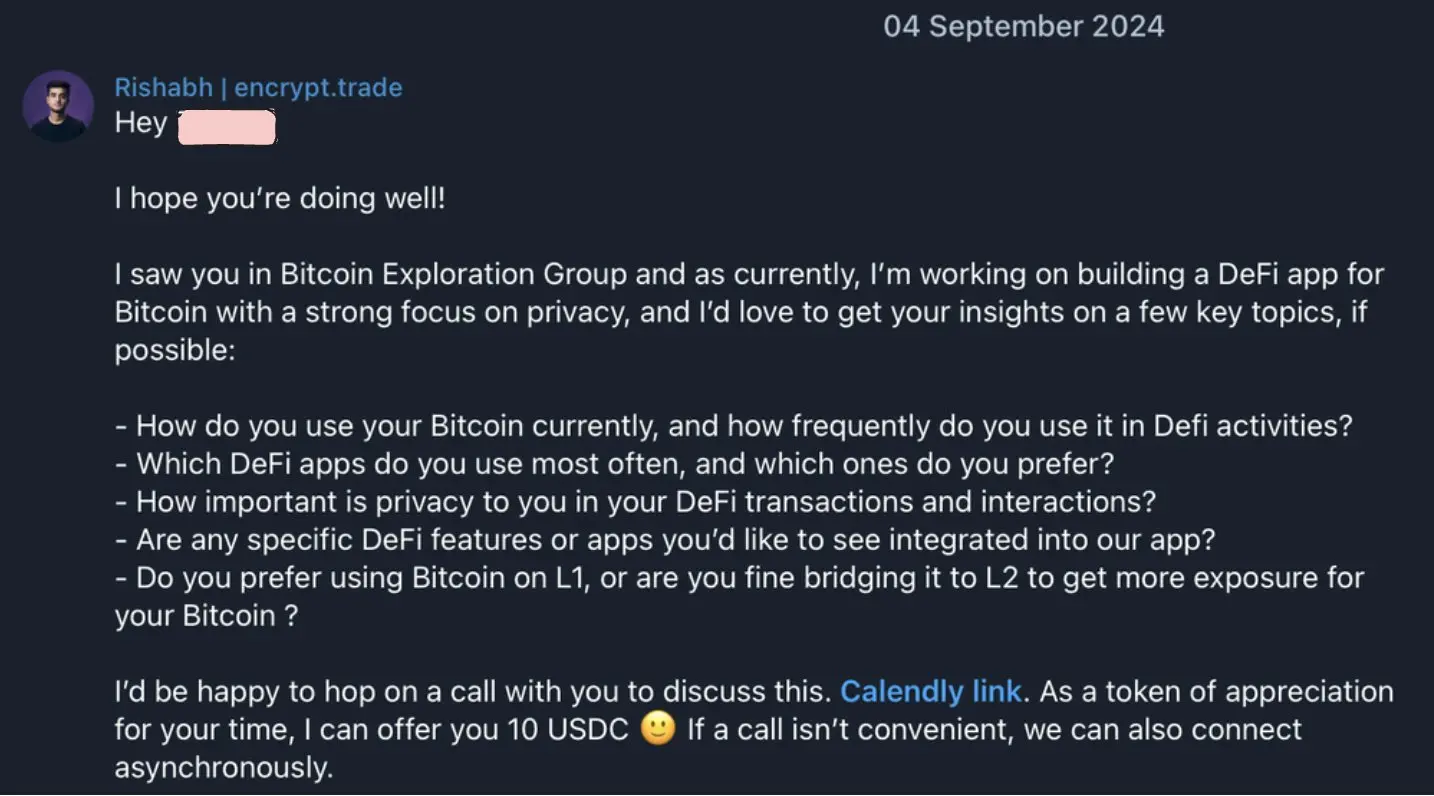
I talked to anyone who showed the slightest interest

I iterated on the product with them

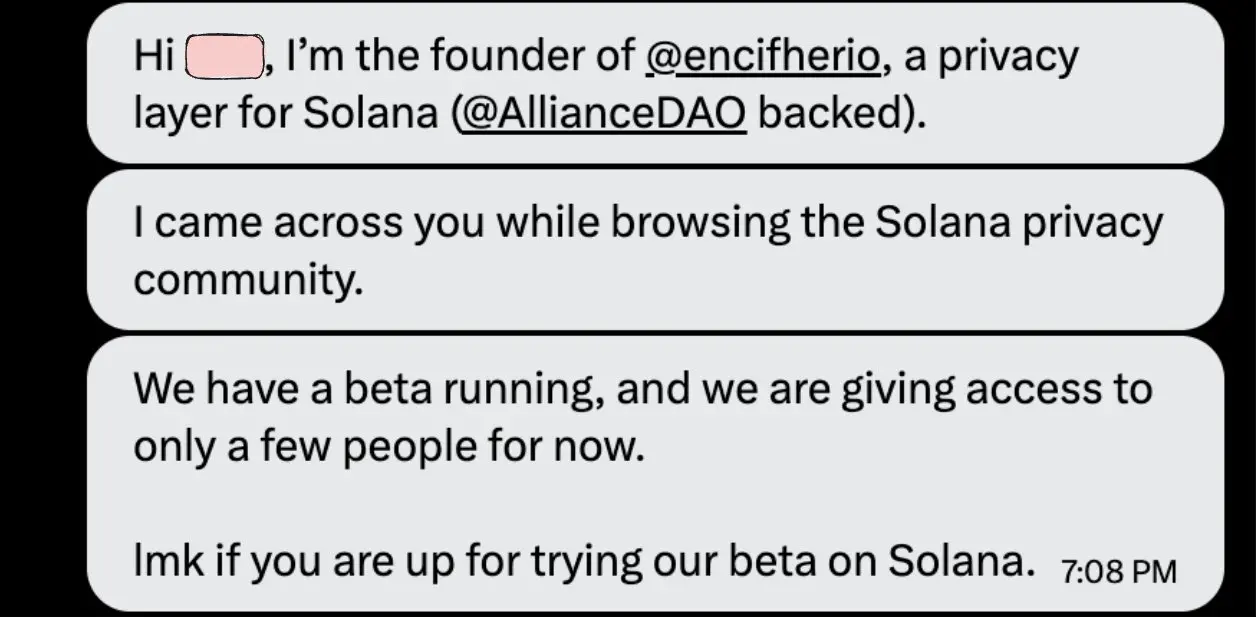
Framing a Cold-DM is also an iterative process. Here are some key points to note:

  • Start with a warm greeting.

  • Put the highlights (funding status, trading volume, etc.) at the beginning.

  • Mention where you found them.

  • Give a friendly call to action.

  • Always remember to follow up.

There's no perfect Cold-DM; you must A/B test to find what works for your target audience.

Here's a decent Cold-DM template to use: But be aware, this process is slow and exhausting.

In the crypto circle, few people reply to DMs because scams are everywhere.

Low reply rates are the norm (I know, it's a bit frustrating).

Nevertheless, you must do it.

Your goal at this stage is not to get 1000 users.

Your goal is 10-20 early users who care about the problem, are willing to try the product, and will provide honest feedback.

These early users will become your support system.

Early products often go wrong; these users will help you through that phase.

6. Iterate Quickly

The crypto industry changes rapidly, and attention spans are extremely short.

You must study user behavior, not just listen to their words:

  • What are they doing repeatedly?

  • What kind of workarounds are they using?

  • What are they already willing to pay for? (Many ideas sound good, but if users aren't willing to pay, it can't survive.)

7. Make Your Website Simple to the Point of Being "Foolproof"

Never make any assumptions about the user's knowledge.

As a developer, you've stared at the product for hundreds of hours and find it obvious, but for someone entering for the first time, it's completely foreign.

  • Don't introduce new terminology or complex processes.

  • Minimize the number of clicks.

  • The core value should be presented within 5 seconds of entering the app.

Conclusion

Building consumer crypto products is both fun and challenging. Speed of iteration, user-centric thinking, and marketing ability are more important than perfect technology. This is completely different from B2B.


Twitter:https://twitter.com/BitpushNewsCN

Bitpush TG Discussion Group:https://t.me/BitPushCommunity

Bitpush TG Subscription: https://t.me/bitpush

Original link:https://www.bitpush.news/articles/7599210

Questions liées

QWhat is one of the key lessons the founder learned about building Web3 products for user growth?

AOne key lesson is to build for young, early-adopter users (like those aged 13-21) who are naturally more receptive to new products and have higher social activity, making the product more inherently shareable.

QWhy is it important for a Web3 product to have built-in shareability?

ABuilt-in shareability is crucial because KOL marketing is expensive, trust is low in crypto, and users expect rewards. If the product gives users a reason to share it with friends and communities organically, it reduces marketing costs and drives growth without burning cash.

QHow should founders handle user feedback and feature requests according to the article?

AFounders should address user feedback and bugs immediately, ideally within 2-5 hours for critical issues. If multiple users request a feasible feature, build it within 2-3 days, inform them it was based on their feedback, and even offer rewards to build deep trust and a sense of ownership.

QWhat did the founder realize about product names after his experience with 'Encifher'?

AHe realized that product names should be highly recognizable and easy to share verbally. 'Encifher' was hard to remember and often misspelled, so he changed it to 'encrypt.trade' for simplicity, memorability, and appeal.

QWhat is the recommended approach for cold outreach (Cold-DM) to potential users?

AThe approach includes starting with a warm greeting, highlighting key points (like funding or traction) upfront, mentioning where you found them, giving a friendly call-to-action, and always following up. The goal isn't to get thousands of users but to find 10-20 early users who care and provide honest feedback.

Lectures associées

Comment se rendre impossible à remplacer par l'intelligence artificielle

Avec l'essor de l'IA, le vrai défi n'est pas la technologie elle-même, mais notre dépendance à un emploi traditionnel pour survivre. L'article propose de rompre avec cet « esclavage salarial » en devenant un individu autonome et « inemployable », capable de créer sa propre voie grâce à des compétences impossibles à automatiser. Pour réussir dans ce nouveau paradigme, cinq éléments clés sont essentiels : l'autonomie d'action, le goût, la persuasion, la persévérance et l'itération. Ces qualités s'acquièrent non par la théorie, mais en créant ses propres projets. L'auteur soutient que parmi les leviers disponibles, la création de contenu (médias) est plus cruciale que le code, car la valeur du contenu est subjective et nécessite un jugement humain affiné par l'expérience. Le chemin commence par une transformation profonde de son identité et de son environnement. Un exercice pratique en trois étapes est proposé pour trouver sa vocation : 1) Identifier ses connaissances uniques et passions naturelles, 2) Définir ses convictions contraires à la sagesse conventionnelle, 3) Publier immédiatement une première idée pour obtenir un retour réel du monde. L'objectif est de bâtir une œuvre de vie authentique, en utilisant les outils numériques et l'IA non comme une fin, mais comme un levier pour amplifier sa voix et son impact personnels.

marsbitIl y a 16 mins

Comment se rendre impossible à remplacer par l'intelligence artificielle

marsbitIl y a 16 mins

Grâce aux lancers de dés, les clés Bitcoin sont stockées hors ligne, mais tout le monde ne s'y mettra pas

Le titre « Les clés Bitcoin protégées par des dés, mais la méthode reste marginale » introduit un article sur la génération manuelle de graines de portefeuille Bitcoin à l'aide de dés. L'article explique le concept d'entropie, illustré par Claude Shannon, où un dé à six faces génère environ 2,585 bits d'incertitude. Il aborde le scandale récent de Coldcard, où une vulnérabilité du générateur de nombres aléatoires matériel a compromis des fonds. Les utilisateurs ayant généré leur phrase de récupération avec des dés (environ 99 lancers pour une haute sécurité) n'étaient pas affectés pour leur seed principal. Cependant, l'analyse du chercheur Kevin Loaec montre que d'autres fonctions du portefeuille (clés de copie, portefeuilles papier, mots de passe, etc.) utilisaient ce générateur défectueux et restaient vulnérables. L'article souligne les défis pratiques de la méthode des dés : elle est longue, sujette aux erreurs de saisie, et peu adaptée aux nouveaux utilisateurs qui pourraient mal l'exécuter. Il conclut que si cette méthode manuelle est robuste pour les experts, l'objectif à long terme est d'avoir un matériel et des logiciels générant une entropie fiable de manière simple et sécurisée. Il conseille aux propriétaires de Coldcard de vérifier leur firmware et les fonctions utilisées, et rappelle l'intérêt des solutions multi-signatures avec différents fabricants pour limiter les risques.

cryptonews.ruIl y a 3 h

Grâce aux lancers de dés, les clés Bitcoin sont stockées hors ligne, mais tout le monde ne s'y mettra pas

cryptonews.ruIl y a 3 h

SUI est au seuil d'une nouvelle percée, les « taureaux » visant une hausse jusqu'à 20 dollars

Le protocole Sui a procédé à un déblocage de tokens le 1er août, libérant environ 13,72 millions de $SUI (valeur estimée à 9,9 millions de dollars) pour la communauté, les participants précoces et le Trésor de Mysten Labs. Ce déblocage fait partie d'une vague hebdomadaire plus large mais, contrairement à d'autres, Sui utilise un mécanisme de vesting quotidien continu pour atténuer la pression de vente. Sui est une blockchain de couche 1 fondée par d'anciens ingénieurs de Meta, se targuant d'un haut débit et de faibles frais. Environ 40% de son offre totale de 10 milliards de tokens sont actuellement en circulation. Malgré une activité réseau solide, incluant le lancement d'un fond tokenisé de 75M$ par Mubadala Capital et le testnet Hashi pour le Bitcoin en collatéral, le prix du $SUI a récemment baissé de plus de 5%, se négociant autour de 0,68$. Certains traders, comme CryptoPatel, voient la zone de 0,50$ à 0,70$ comme une opportunité d'accumulation, avec des objectifs de prix à long terme allant jusqu'à 20$. Cependant, les sentiments sur les réseaux sociaux sont légèrement baissiers et les traders surveillent une zone de support clé autour de 0,71$-0,73$. La baisse semble principalement liée à l'augmentation de l'offre due au déblocage et aux conditions du marché général plutôt qu'à des problèmes fondamentaux du réseau.

cryptonews.ruIl y a 5 h

SUI est au seuil d'une nouvelle percée, les « taureaux » visant une hausse jusqu'à 20 dollars

cryptonews.ruIl y a 5 h

Trading

Spot
活动图片





