From Stanford Labs to Silicon Valley Streets: How OpenMind Solves the 'Last Mile' Problem of the Machine Economy?

marsbitPublié le 2026-03-02Dernière mise à jour le 2026-03-02

Résumé

OpenMind, a Silicon Valley robotics infrastructure company, is tackling the "last mile" problem in the machine economy by developing foundational technologies that enable robots to become autonomous economic agents. Its core contributions include OM1, an open-source, AI-native operating system that gives robots advanced perception, memory, and decision-making capabilities, and FABRIC, a decentralized protocol providing on-chain identity, secure collaboration, and automated USDC-based payment settlement for machines. Backed by a team from Stanford, Google DeepMind, and other leading institutions, and having raised $20M from investors like Pantera Capital and Sequoia China, OpenMind is already deploying real-world solutions. Key milestones include a pilot with Circle where robots autonomously navigate to and pay for charging, and the BrainPack—a plug-and-play compute module that upgrades existing robots with advanced AI and crypto-economic functions. By building an open ecosystem akin to "Android for robots," OpenMind aims to solve the industry's fragmentation and lack of economic interoperability, positioning itself as a pioneering infrastructure project at the intersection of robotics, AI, and crypto.

Author: momo, ChainCatcher

On February 27, Binance Alpha and Binance Futures Market listed Fabric Protocol (ROBO), with its 24-hour trading volume exceeding 140 million in the first two days. Additionally, ROBO was subsequently listed on spot or futures markets of several major exchanges including OKX, Coinbase, Kraken, Bybit, Gate.io, HTX, etc., becoming one of the first batch of new projects to enter mainstream liquidity channels after the Spring Festival holiday resumption, sparking extensive attention and discussion.

In a phase where the overall crypto market is returning to rationality, few new tokens can sustain discussion热度. ROBO had already formed strong expectations before TGE, was oversubscribed on Kaito, and its热度 further amplified after listing. Clearly, it's not just a short-term effect of exchange listings.

The key lies more in its fundamentals. OpenMind, one of the core contributing teams of the Fabric Foundation, is a Silicon Valley company focused on robotics infrastructure. Unlike common projects that remain conceptual, it切入 a direction with greater industrial certainty: one end is the global tech主线 of embodied AI and robotics, the other end is the machine economy framework carried by on-chain identity, collaboration, and settlement networks.

It attempts to solve not a single-point application, but the more fundamental, harder-to-replace infrastructure problems that have long existed in the process of large-scale robot deployment: system fragmentation, inefficient collaboration, and lack of economic capabilities.

Furthermore, while many projects are still in the whitepaper and vision stage, OpenMind's products have already begun real-world deployment, installed in robotic devices around the world. It can be said that OpenMind is currently a rare, even unique, robotics infrastructure project in the related crypto market. Precisely because of this, ROBO更像 a fundamental industry sample that can be dissected, rather than a short-term sentiment-driven trading opportunity.

Next, let's look specifically at the team background, core products, and deployment progress: What exactly is OpenMind doing? Is its scaling path proven? And can this robotics × Crypto infrastructure logic truly open up new growth space?

I. The Composite Team from Stanford and Google DeepMind

Unlike most projects starting from the Crypto community and then adding hype narratives, OpenMind's team background更像 a typical Silicon Valley robotics/AI startup.

Founder Jan Liphardt is a professor of bioengineering at Stanford University, long engaged in AI, biocomputing, and distributed systems research, having received research grants from NIH, NSF, NCI, and the US Department of Energy.

CTO Boyuan Chen comes from MIT CSAIL and previously worked on cutting-edge AI and robotics research at Google DeepMind, with core capabilities focused on reinforcement learning and embodied AI systems.

The advisory layer also consists mainly of academic and industrial technical leaders, including former Willow Garage CEO and key promoter of the ROS ecosystem Steve Cousins, University of Oxford blockchain researcher Bill Roscoe, and Imperial College London safe AI professor Alessio Lomuscio.

Overall, this is a composite team from top academic institutions and the front lines of Silicon Valley tech—a "research派 + engineering派" blend. Their tech stack covers robotics, AI, and Crypto等多个前沿交叉领域, understanding both underlying algorithms and system architecture, and having truly worked with complex hardware and real-world deployment.

Precisely because of this明显偏 hard tech infrastructure capability structure, OpenMind from the start更像 building a long-term technical foundation, not a short-cycle project围绕 concepts讲故事. This is likely also a key reason for its continued support from top-tier capital.

According to RootData, in August 2025, OpenMind completed a $20 million funding round led by Pantera Capital, with participation from Ribbit Capital, Sequoia China, Coinbase Ventures, Digital Currency Group, Lightspeed Faction, Anagram, Primitive Ventures, Amber Group, and others. The investors span deep tech, fintech, and crypto infrastructure.

Why could OpenMind secure collective bets from头部 capital of both Web2 and Web3? When such a group from the forefront of research and engineering starts a company together, what structural pain points in the robotics industry did they see? And why use blockchain protocols to重构 the underlying infrastructure of this track?

II. Solving the 'Last Mile' Problem of the Machine Economy

Simply put, if we compare today's robotics industry to the smartphone era over a decade ago, what OpenMind wants to do is essentially build an "Android" system for robots.

In the past two years, robots have truly moved out of the lab. Tesla has sent humanoid robots into factories for production line testing, Unitree's quadruped robots have begun shipping at scale, and Boston Dynamics is also accelerating commercial deployment. Robots are moving from demonstration prototypes to warehousing, manufacturing, inspection, and even consumer scenarios, gradually becoming new productivity infrastructure.

But as deployment numbers scale, problems emerge, and the robotics industry begins to face issues similar to the "山寨机 era": system fragmentation, closed ecosystems, and lack of interoperability.

Founder Jan Liphardt mentioned in a previous ChainCatcher interview that, on one hand, there are over 150 robot hardware manufacturers globally, each building their own systems and ecosystems, almost every one wanting to be the iPhone of robots. The result is the same capabilities being repeatedly developed and adapted, applications难以复用, ecosystems remain fragmented,始终 lacking a universal base like Android. On the other hand, mainstream software systems still focus on motion control and navigation. Robots can work but have no identity, cannot automatically settle income, cannot establish credit, and更无法 participate in real-world collaboration and transactions.

In other words, they look like humans with hands and feet, but lack a unified brain and neural network like humans, making it difficult for them to become economic agents capable of independent decision-making, continuous learning, and mutual collaboration.

From OpenMind's perspective, what robots lack is never more hardware, but an infrastructure layer that simultaneously connects devices, applications, and the network, both unifying system capabilities like Android to carry the application ecosystem, and赋予 robots identity, collaboration, and settlement capabilities, allowing them to truly integrate into the real-world economic system. Only then can robots evolve from tools into participants that can perceive, learn, collaborate, and create value. This is precisely the starting point of OpenMind's venture.

After two years of refinement, OpenMind has built two core products: the open-source robot operating system OM1 + the decentralized collaboration network FABRIC. The former solves单体智能, the latter solves群体协作.

1. OM1: Giving Robots a Real "Brain"

If today's robots are still at the stage of being able to move, what OM1 does is make them start to understand and think.

OM1 is essentially an open-source, AI-native robot operating system. Unlike traditional ROS, which only handles motion control and navigation, it integrates perception, memory, reasoning, and action into a unified framework, giving robots a complete decision-making loop similar to humans.

Simply understood, it's four steps: See the world, Remember information, Think about tasks, Execute actions. The implementation is driven by large models and multimodal models. For example, cameras, lidar, voice, and other sensors handle perception; a long-term memory system saves environment and history; mainstream LLMs handle planning and reasoning; which are then converted into specific control commands to complete actions.
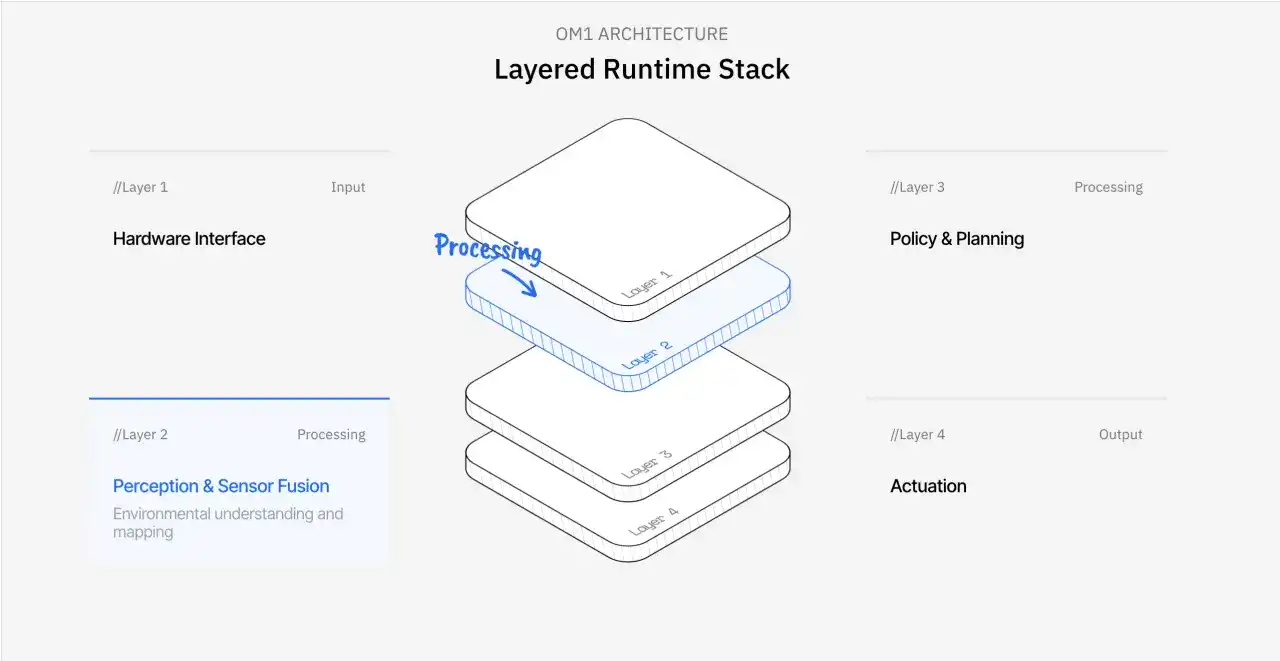
This gives robots真正的 "natural language interaction + autonomous decision-making" capabilities for the first time, rather than just being preset script executors.

The highlight of OM1 is its openness and generality. Its hardware-agnostic design allows developers don't need to rewrite code for each robot type. It currently supports various forms like the Unitree G1 humanoid robot, quadruped robots, etc. Software-wise, it integrates mainstream LLMs like GPT-4o, Gemini, equipped with functions like lidar, SLAM navigation, voice interaction, etc. The team will prioritize technical integration with Unitree, Agibot, UBTECH, Dobot, Cloudminds, Accelerated Evolution, Jueji Power, Zhongqing.

Furthermore, OM1's AI-native architecture supports plug-and-play integration of mainstream models, enabling natural interaction. Its modular structure, like an App Store, facilitates skill expansion.

OM1 released its Beta version in September 2025, is open-sourced on GitHub (MIT license), attracting thousands of global developers to contribute and test, and has been adapted to various robot forms including Unitree, DEEP Robotics, Dobot, and UBTECH, beginning the phase of real device deployment.

It is worth mentioning that at the ETF listing ceremony hosted by Nasdaq and launched by KraneShares, OpenMind's humanoid robot equipped with the OM1 operating system appeared on site and participated in the listing启动仪式.
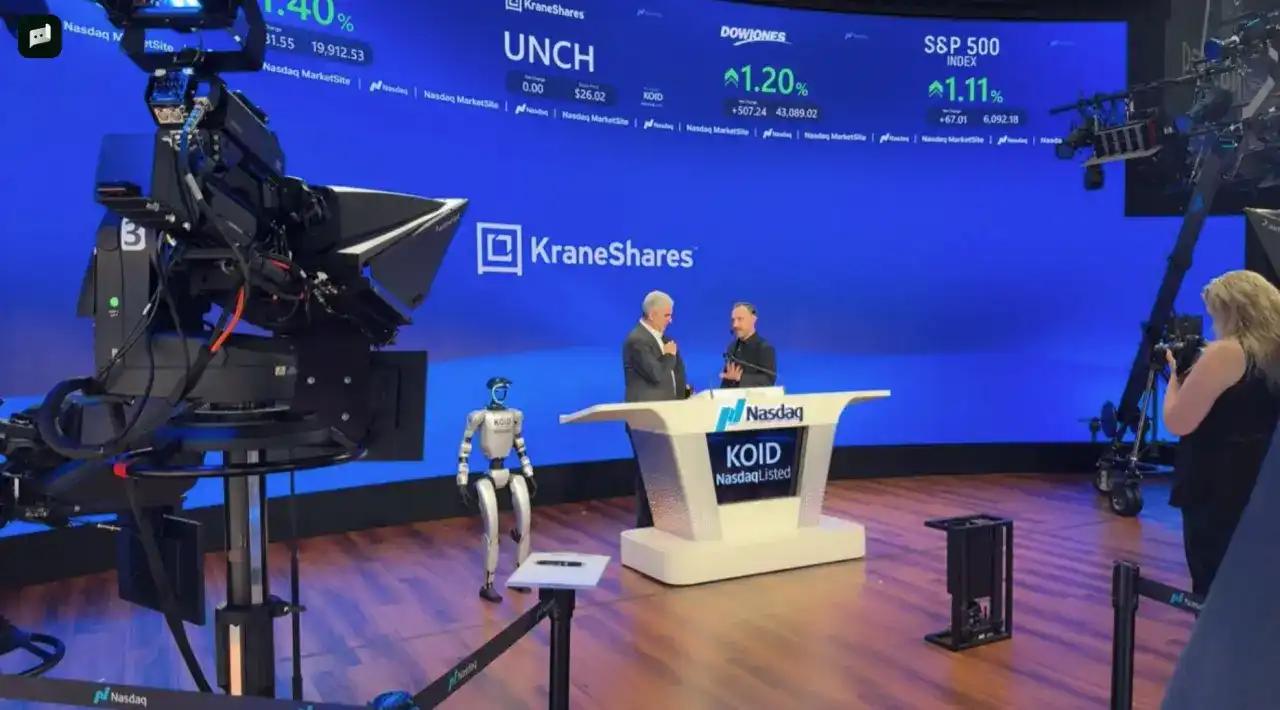
Overall, OM1更像 a "universal brain + application platform" for robots. This model essentially replicates the successful path of Android当年: unify the base, reduce development costs to attract developers, and form an application ecosystem.

2. FABRIC: The Network Layer Letting Robots "Know" and "Collaborate" with Each Other

But a brain alone is not enough. In the real world, robots rarely operate alone. They need cross-manufacturer coordination, information sharing, task分配, and even automated settlement.

The problem is, traditional robot systems are mostly closed networks. Once跨品牌 or跨平台, collaboration almost has to start from scratch.

This is why, beyond OM1, OpenMind also built the Fabric Protocol (FABRIC).

If OM1 solves whether I am smart enough, FABRIC solves how I securely cooperate with other robots. FABRIC is essentially a decentralized collaboration and trust network. It assigns an on-chain identity to each robot, allowing devices to be identified, build credit, record behavior, and automatically complete task settlement.

In other words, robots are no longer just tools executing commands, but economic nodes with identity and accounts.

In this network, robots can share skills, synchronize experiences, call each other's capabilities, and even complete automated stablecoin micropayments and incentive distribution. From a Web3 perspective, it's closer to the identity layer + trust layer + collaboration layer between machines.

III. From Vision to Reality: OpenMind's Actual Deployment Progress

After talking so much about protocols, networks, and visions, the only真正关键 question is: Are these things actually running?

In the crypto industry, we've seen too many projects that issue coins first and then look for落地场景. Whitepapers are grand, demo videos are炫, but products remain in the testnet stage, with almost no real deployment in the real world.

The reason OpenMind has attracted so much attention this time is perhaps because its path is the opposite: it推进 TGE after OM1 and FABRIC were already running in real robots.

Currently, the two most representative pieces of落地成果 are: 1) the USDC automatic payment charging network launched in cooperation with Circle; 2) the BrainPack robot intelligence module sold to developers and hardware manufacturers.

1. Letting Robots Pay for Charging Themselves for the First Time

Last December, OpenMind announced a cooperation with Circle, deploying the world's first "USDC Robot Self-Charging Point" in Silicon Valley.

Simply put, robots can pay by themselves. When battery is low, it automatically navigates to the charging station, identifies the location, completes the USDC payment, then charges and continues working, all without human intervention.

It sounds small, but the significance is huge. This should be the first time robots possess autonomous consumption capability. They are no longer just managed devices, but begin to resemble economic agents.

2. Equipping Robots with a Universal Brain "BrainPack"

At the same time, OpenMind launched BrainPack and配套 robot solutions, aiming to help a larger scale of robots solve the problem of insufficient intelligence.

It is essentially a plug-and-play computing backpack, a module about the size of a backpack, integrating high-performance computing, sensors, and software. It can be directly installed on third-party robots. Once installed, ordinary robots immediately gain perception, mapping, planning, memory, and the complete autonomous capabilities like the aforementioned USDC payment-based self-charging management, edge inference, etc.

For example, it can help robots achieve real-time 3D mapping, object recognition/annotation, privacy-preserving vision (automatically blurring faces), and other operations.

Its core hardware is based on NVIDIA Jetson Thor and runs the self-developed OM1 system and FABRIC protocol, supporting ROS2, JetPack 7.05, etc. You can understand it as installing an Android system-level brain for the robot. No need to rebuild hardware or wait for the next generation of robots; old equipment is directly upgraded to AI-native robots.

BrainPack announced specific robot dog products last November. According to the official pre-sale page, the deposit is $999. It supports bundled Unitree robot packages. The first batch of complete deliveries is expected around Q1 2026. Although currently in the pre-order stage, some developers and labs have received beta or early delivery versions.
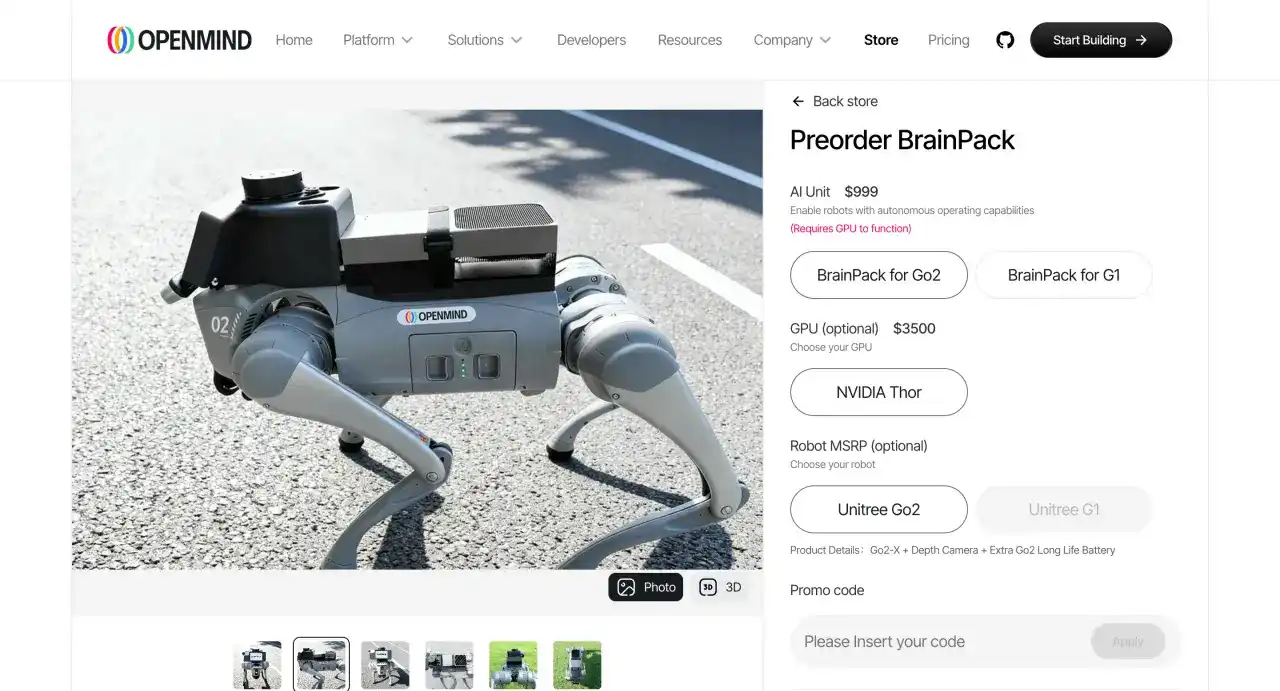
3.配套 App Store: Beginning to Form an Ecosystem

While hardware is being delivered, OpenMind is also building another key piece of the puzzle—the application ecosystem—launching a robot version of the App Store.

The logic is simple, just like we download Apps on our phones, developers can develop skills and applications for robots, and users can install them on their devices with one click.

Currently, the first batch of applications for quadruped and humanoid robots has been launched. Although still in the early stages, the significance of this step is that OpenMind is not just selling hardware or systems, but attempting to establish a sustainably scalable developer platform.

As more and more robots connect to OM1 + FABRIC, coupled with application distribution capabilities, the entire network truly gains scale effects.

Conclusion: Will OpenMind Drive the "Robotics+Crypto" Concept Heat?

In recent years, the market has just experienced a wave of AI + Crypto热潮. But most projects are essentially "computing power narrative + token model", with a layer still separating the chain from the real world. The special thing about OpenMind is that it is the first to truly embed Crypto into robots, this kind of physical world productivity tool.

From the industry side, OpenMind is already doing something more long-term: education and ecosystem. They jointly with Unitree Robotics' largest distributor in the US, RobotShop (Robostore), launched complete humanoid robot education courses and solutions, currently serving over 100 research and education institutions, including Harvard University, Massachusetts Institute of Technology, Stanford University, and other top universities. This may lay a good foundation for the future ecosystem and network effects of its machine economy, as well as卡位 in the "robotics + Crypto" track.

Perhaps precisely because of this, many people started to seriously pay attention to the robotics+Crypto infrastructure track through OpenMind.

Of course, for OpenMind, deployment speed is more important than concept热度. If viewed more rationally, OpenMind's advantages are very clear:

First, the team: top academic background + robotics/AI/blockchain交叉 capabilities. This kind of composite team from various fields is not common in Crypto projects.

Second, track卡位. In the加密 field, there are almost no similar projects truly深耕 "robotics infrastructure". It is the leader and seed player in this direction. When the market starts talking about "embodied AI + Web3", capital and attention will naturally集中 on it first.

Third,落地 rhythm. OM1, FABRIC, USDC self-charging points, BrainPack, App Store—these are not roadmaps, but products that have already begun delivery. This makes it更像 a technology company building long-term infrastructure, rather than a narrative-driven token project.

Of course, challenges also exist. The robotics industry itself is a hard tech track with heavy assets and long cycles. Hardware deployment is slow, costs are high, and commercialization paths are complex. It cannot replicate the exponential expansion of pure software protocols. At the same time, whether跨厂商 standards can truly be unified, whether the developer ecosystem can take off, and whether the machine economy truly forms a closed loop all still need time to verify.

In other words, OpenMind faces a marathon requiring patience and sustained effort.

Questions liées

QWhat is the core problem that OpenMind is trying to solve in the robotics industry?

AOpenMind is tackling the fundamental infrastructure problems hindering the large-scale adoption of robots: systemic fragmentation, inefficient collaboration, and a lack of economic capabilities. It aims to create a unified operating system and a decentralized collaboration network to allow robots from different manufacturers to work together, share information, and perform automated transactions.

QWhat are the two core products developed by OpenMind and what are their respective functions?

AOpenMind has developed two core products: 1) OM1: An open-source, AI-native robot operating system that serves as a 'general brain' for individual robots, enabling perception, memory, reasoning, and action. 2) FABRIC Protocol: A decentralized collaboration and trust network that provides robots with on-chain identities, allowing them to be recognized, build credit, record behavior, and perform automated task settlement, enabling machine-to-machine collaboration and micro-payments.

QWhat was the significance of OpenMind's collaboration with Circle in December?

AThe collaboration with Circle led to the deployment of the world's first 'USDC robot self-charging point' in Silicon Valley. This allows robots to autonomously navigate to a charging station, identify their location, complete a USDC payment, and charge themselves without human intervention. This is significant as it marks one of the first instances of robots acting as independent economic agents capable of autonomous consumption.

QWhat is the purpose of the BrainPack hardware module launched by OpenMind?

ABrainPack is a plug-and-play 'computing backpack' module designed to upgrade existing third-party robots. It integrates high-performance computing, sensors, and software (including the OM1 OS and FABRIC protocol) to instantly grant ordinary robots advanced capabilities such as perception, mapping, planning, memory, autonomous charging management with USDC payments, and edge inference, effectively giving them a generic 'Android-like' AI brain.

QHow does OpenMind's approach to the 'robot economy' differ from typical AI + Crypto projects?

AUnlike many AI + Crypto projects that focus primarily on 'compute narrative + tokenomics' with a disconnect from the physical world, OpenMind embeds crypto (specifically its FABRIC protocol and stablecoins like USDC) directly into physical robots—the productivity tools of the real world. It provides the essential layers of identity, trust, and settlement, enabling robots to become verifiable economic participants that can collaborate and transact autonomously, thus bridging the gap between blockchain and real-world physical assets and actions.

Lectures associées

Bitwise : Optimiste quant à la performance du Bitcoin au second semestre, l'IA et la régulation vont déclencher une nouvelle saison des altcoins

Lors d'un récent épisode du Milk Road Show, les dirigeants de Bitwise, Matt Hougan (CIO) et Ryan Rasmussen (responsable de la recherche), ont partagé une vision extrêmement optimiste pour le Bitcoin et l'écosystème crypto. Ils estiment que l'objectif de 1 million de dollars par Bitcoin pourrait être « trop conservateur », le décrivant comme un pari « deux en un » : une réserve de valeur numérique (or digital) assortie d'une option d'appel hors de la monnaie pour devenir un actif de règlement international, une idée renforcée par l'instabilité géopolitique récente. Ils reconnaissent que le premier trimestre 2026 a été médiocre avec des baisses généralisées, mais soulignent que les flux d'actualités positifs (lancements de ETF par Morgan Stanley et Goldman Sachs, nouveau cadre réglementaire) sont tournés vers l'avenir et justifient l'optimisme actuel. Un point de données clé est l'explosion des actifs du monde réel tokenisés (RWA), passant de moins de 2 milliards il y a quelques années à près de 30 milliards de dollars aujourd'hui. Enfin, Hougan prédit un « nouvel altseason » pour 2026, catalysé par la combinaison de trois facteurs : le nouveau cadre réglementaire clair de la SEC pour les jetons, l'émergence de blockchains performantes et les capacités de l'IA. Cela permettra, selon lui, une nouvelle vague d'innovation et de projets légitimes, bien différente de l'ère ICO. Bitwise mise également sur cette diversification en annonçant un ETF Avalanche (AVAX), citant son architecture unique et sa croissance dans le secteur RWA.

marsbitIl y a 1 h

Bitwise : Optimiste quant à la performance du Bitcoin au second semestre, l'IA et la régulation vont déclencher une nouvelle saison des altcoins

marsbitIl y a 1 h

Trading

Spot
Futures

Articles tendance

Qu'est ce que BNB WHALES

Comprendre les Baleines BNB : Une Plongée Profonde dans le Paysage des Cryptomonnaies Introduction aux Baleines BNB Dans le monde vibrant des cryptomonnaies, de nouveaux projets émergent régulièrement, promettant souvent des solutions innovantes et des expériences uniques. Un tel projet est les Baleines BNB, lancé en 2023 et construit sur la BNB Smart Chain (BEP20). Les Baleines BNB visent à établir une présence distinctive au sein de l'écosystème des cryptomonnaies, en se concentrant sur la création d'une plateforme engageante qui combine les avantages de la technologie blockchain avec des interactions sociales et de jeu. Cet article vise à explorer plus en profondeur les Baleines BNB, en examinant ses composants clés, ses mécanismes et sa trajectoire de développement. Que sont les Baleines BNB ? Les Baleines BNB sont une initiative de cryptomonnaie qui cherche à fournir une gamme variée de fonctionnalités et d'opportunités à ses utilisateurs dans l'environnement Web3 en pleine croissance. Utilisant le standard BEP20, le projet fonctionne avec un approvisionnement total en tokens de 100 trillions (100 000 000 000 000 000). Malgré ce chiffre significatif, il est à noter qu'aucun token n'est actuellement en circulation, ce qui indique que le projet pourrait encore être à ses débuts en termes de développement. L'objectif principal des Baleines BNB est de créer une plateforme où les utilisateurs peuvent participer à diverses activités interactives tout en bénéficiant de la sécurité et de la transparence offertes par la technologie blockchain. En favorisant un environnement unique et engageant, les Baleines BNB visent à construire une communauté solide d'utilisateurs investis dans le projet et son développement. Qui est le Créateur des Baleines BNB ? L'identité du créateur des Baleines BNB reste non divulguée pour le moment, ce qui présente un défi pour ceux qui cherchent à comprendre les principes fondateurs et les visions du projet. Cette absence d'informations publiquement disponibles concernant la direction du projet peut susciter des questions parmi les investisseurs potentiels et les utilisateurs sur sa gouvernance et sa structure de responsabilité. Qui sont les Investisseurs des Baleines BNB ? Alors que les Baleines BNB continuent d'évoluer, les informations concernant des investisseurs spécifiques ou le soutien d'organismes d'investissement ne sont actuellement pas disponibles. La documentation officielle du projet, y compris son livre blanc, ne dévoile pas de bailleurs de fonds individuels ou institutionnels. Le manque de transparence à cet égard peut parfois soulever des questions sur la légitimité et la durabilité des nouveaux projets au sein de l'écosystème des cryptomonnaies. Comment Fonctionnent les Baleines BNB ? Les Baleines BNB fonctionnent sur la BNB Smart Chain utilisant le standard BEP20, connu pour son efficacité et ses faibles frais de transaction, attirant une variété de développeurs et de projets. L'aspect unique des Baleines BNB réside dans son accent sur la création d'une plateforme dirigée par la communauté. Bien que les détails opérationnels précis soient rares, le projet met l'accent sur l'interaction et l'engagement, intégrant potentiellement des éléments de gamification dans ses offres. L'accent mis sur la communauté est essentiel, car il s'aligne avec les tendances dominantes dans l'espace des cryptomonnaies, où les contributions et la participation des utilisateurs dictent souvent le succès d'un projet. Une innovation supplémentaire peut être attendue, mais pour l'instant, les mécanismes et fonctionnalités spécifiques qui distinguent les Baleines BNB des autres initiatives crypto restent à être pleinement élucidés. Sans informations détaillées concernant sa fonctionnalité, il est difficile d'évaluer les éléments distinctifs du projet de manière exhaustive. Chronologie des Baleines BNB Le développement des Baleines BNB s'est déroulé à travers des étapes clés, marquant son parcours dans le paysage des cryptomonnaies. Voici une chronologie des événements significatifs relatifs au projet : 2023 : Lancement des Baleines BNB, marquant l'entrée du projet sur le marché. 2023 : Publication du livre blanc du projet, qui expose les objectifs globaux et le cadre opérationnel. En Cours : Les Baleines BNB continuent de développer ses caractéristiques, visant à construire une base d'utilisateurs solide et élargir ses offres. Points Clés à Propos des Baleines BNB Plateforme : BNB Smart Chain (BEP20) Approvisionnement Total : 100 trillions de tokens (100 000 000 000 000 000) Approvisionnement Circulant : 0 tokens (indiquant un stade naissant) Objectif du Projet : Favoriser une plateforme de cryptomonnaie engageante pour l'interaction et la construction de communauté. Créateur : Inconnu Investisseurs : Non divulgué Statut Opérationnel : Actif avec un développement et une expansion en cours Conclusion Alors que les Baleines BNB naviguent dans le paysage concurrentiel des cryptomonnaies, elles offrent un aperçu du potentiel des projets dirigés par la communauté construits sur les fondements de la technologie blockchain. En se concentrant sur l'engagement et l'interaction, l'initiative se situe à l'avant-garde de l'innovation dans l'espace Web3. Cependant, le succès du projet dépend en fin de compte de la clarté de ses mécanismes opérationnels, de la divulgation de sa gouvernance et de l'établissement d'une solide communauté d'utilisateurs. Pour les utilisateurs et investisseurs potentiels, les Baleines BNB représentent une étude de cas sur la nature évolutive des projets de cryptomonnaie — une qui illustre à la fois les possibilités passionnantes et les complexités associées aux nouvelles initiatives. Alors que le paysage continue d'évoluer, il sera essentiel de surveiller les progrès des Baleines BNB et leur impact sur l'écosystème plus large des cryptomonnaies.

450 vues totalesPublié le 2024.04.05Mis à jour le 2024.12.03

Qu'est ce que BNB WHALES

Comment acheter BNB

Bienvenue sur HTX.com ! Nous vous permettons d'acheter Binance Coin (BNB) de manière simple et pratique. Suivez notre guide étape par étape pour commencer votre parcours crypto.Étape 1 : Création de votre compte HTXUtilisez votre adresse e-mail ou votre numéro de téléphone pour ouvrir un compte sur HTX gratuitement. L'inscription se fait en toute simplicité et débloque toutes les fonctionnalités.Créer mon compteÉtape 2 : Choix du mode de paiement (rubrique Acheter des cryptosCarte de crédit/débit : utilisez votre carte Visa ou Mastercard pour acheter instantanément Binance Coin (BNB).Solde :utilisez les fonds du solde de votre compte HTX pour trader en toute simplicité.Prestataire tiers :pour accroître la commodité d'utilisation, nous avons ajouté des modes de paiement populaires tels que Google Pay et Apple Pay.P2P :tradez directement avec d'autres utilisateurs sur HTX.OTC (de gré à gré) : nous offrons des services personnalisés et des taux de change compétitifs aux traders.Étape 3 : stockage de vos Binance Coin (BNB)Après avoir acheté vos Binance Coin (BNB), stockez-les sur votre compte HTX. Vous pouvez également les envoyer ailleurs via un transfert sur la blockchain ou les utiliser pour trader d'autres cryptos.Étape 4 : tradez des Binance Coin (BNB)Tradez facilement Binance Coin (BNB) sur le marché Spot de HTX. Il vous suffit d'accéder à votre compte, de sélectionner la paire de trading, d'exécuter vos trades et de les suivre en temps réel. Nous offrons une expérience conviviale aux débutants comme aux traders chevronnés.

1.2k vues totalesPublié le 2024.12.12Mis à jour le 2025.03.21

Comment acheter BNB

Qu'est ce que BNB CARD

Comprendre la carte BNB : Révolutionner l'identité numérique dans le Web3 Dans le paysage en évolution rapide de la technologie blockchain et des cryptomonnaies, la carte BNB ou $BNBCARD se distingue comme un projet remarquable. Ce jeton utilitaire de mème, porté par la communauté, exploite la BNB Smart Chain (BSC), visant à intégrer la culture des mèmes avec des solutions innovantes d'identité numérique. Alors que de plus en plus d'utilisateurs plongent dans les domaines de la décentralisation, il est crucial d'analyser ce que la carte BNB offre, ses nuances opérationnelles et son impact potentiel sur le marché. Qu'est-ce que la carte BNB ($BNBCARD) ? Au cœur de la carte BNB se trouve un jeton mème avec une utilité substantielle. Il est conçu pour autonomiser les utilisateurs en leur permettant de créer des cartes d'identité numériques personnalisées qui sont à la fois expressives et fonctionnelles. Le projet encapsule plusieurs caractéristiques clés : Cartes d'identité personnalisables : Les utilisateurs ont la possibilité de concevoir des cartes d'identité numériques sur le thème de Binance, leur offrant une plateforme pour l'expression de soi et une interaction communautaire améliorée. Cadre décentralisé : Développée sur la BSC, la carte BNB met l'accent sur des attributs clés tels que la sécurité, la transparence et la souveraineté des utilisateurs. La nature décentralisée du cadre permet des transactions à la fois efficaces et sécurisées. Modèle centré sur la communauté : L'accent mis sur la participation de base plutôt que sur des modèles financiers pilotés par des laboratoires crée un environnement engageant pour ses utilisateurs. En tirant parti de la viralité inhérente à la culture des mèmes, la carte BNB favorise un mouvement communautaire robuste. L'objectif principal de la carte BNB est de démocratiser les outils d'identité numérique dans le Web3, offrant des solutions accessibles qui bénéficient aux utilisateurs sans les contraintes généralement associées aux systèmes traditionnels de gestion d'identité. Créateur et investisseurs En explorant l'identité derrière la carte BNB, il est important de noter qu'aucun créateur unique n'est explicitement crédité. Au lieu de cela, le projet semble être porté par la communauté, suggérant un effort collectif inspiré par la notion de “carte de constructeur précoce” de Binance. Cette approche de développement organique est courante parmi les projets du spectre des jetons mèmes, où le développement est souvent influencé par la passion de la communauté plutôt que par une autorité centrale. En termes d'investissement, l'absence de soutiens institutionnels publiquement divulgués souligne davantage la fondation communautaire du projet. Il prospère grâce à un soutien communautaire organique, reflétant une caractéristique habituelle des projets axés sur les mèmes qui engagent souvent leur public par le biais de canaux sociaux plutôt que par des voies d'investissement formelles. Comment ça fonctionne La carte BNB emploie plusieurs mécanismes qui délimitent son fonctionnement et son esprit innovant : Utilité du jeton : Le jeton BNBCARD permet aux utilisateurs d'accéder à une suite d'outils de création d'identité tout en fournissant une plateforme pour la gouvernance communautaire. Le jeton sert de pièce maîtresse qui permet ces fonctionnalités. Intégration blockchain : En utilisant la BSC, la carte BNB assure la compatibilité avec les applications basées sur la machine virtuelle Ethereum (EVM). Cette intégration offre aux utilisateurs les avantages de faibles frais de transaction tout en améliorant l'accessibilité. Écosystème DIY : Au cœur de l'attrait de la carte BNB se trouve son approche faites-le vous-même (DIY) pour la génération de cartes d'identité numériques. Cet élément participatif encourage les utilisateurs à s'engager dans l'expression créative, favorisant une culture inclusive qui prospère grâce à la contribution et à la collaboration. Chronologie La chronologie est essentielle pour comprendre la trajectoire de la carte BNB. Les jalons importants de l'histoire du projet incluent : 18 mars 2025 : La carte BNB a été listée sur LBank, marquant une étape significative dans son parcours d'échange et ouvrant des portes pour la liquidité et l'accessibilité des utilisateurs. 19 mars 2025 : Un moment décisif s'est produit lorsque le jeton a connu une augmentation astronomique de 26 000 % en 24 heures, attirant l'attention pour son potentiel et l'enthousiasme de la communauté. Développements en cours : Le projet continue d'élargir ses partenariats avec des échanges décentralisés (DEX) comme PancakeSwap, améliorant ainsi la liquidité et l'engagement des utilisateurs. Innovation et différenciation Comprendre ce qui distingue la carte BNB implique une exploration plus approfondie de son cadre innovant : Hybride mème-utilité : La carte BNB fusionne avec succès l'attrait ludique de la culture des mèmes avec des applications pratiques dans la gestion de l'identité numérique. Cette approche de niche répond efficacement à une large démographie, attirant à la fois les utilisateurs technophiles et ceux qui découvrent le crypto. Gouvernance décentralisée : Fonctionner sans contrôle centralisé permet au projet de tirer directement parti des contributions de la communauté. Le processus de prise de décision collective soutenu par l'implication de la communauté donne aux utilisateurs le pouvoir de s'assurer que leurs voix contribuent au développement et à l'orientation du projet. Scalabilité : La carte BNB devrait bénéficier énormément des améliorations de la feuille de route 2025 pour la chaîne BNB, qui incluent des améliorations telles que l'augmentation des vitesses de transaction et l'intégration d'outils d'intelligence artificielle. Ces améliorations positionnent le projet de manière avantageuse dans un environnement hautement concurrentiel. Conclusion La carte BNB est emblématique d'une nouvelle vague de solutions d'identité numérique au sein de l'écosystème Web3. En mélangeant amusement, engagement communautaire et utilité pratique, elle invite les utilisateurs à participer activement à la création de leurs personas numériques. Alors que le projet navigue dans le paysage dynamique des cryptomonnaies, son succès dépendra probablement du maintien d'un fort soutien communautaire tout en s'adaptant aux avancées technologiques et aux besoins des utilisateurs. L'intégration de la décentralisation avec la culture des mèmes sert non seulement de moyen d'engagement dirigé par les utilisateurs, mais aussi de fondation pour le récit évolutif entourant l'identité numérique à l'ère de la blockchain. En résumé, la carte BNB illustre non seulement la convergence de la créativité et de l'utilité dans l'espace crypto, mais souligne également l'importance de la communauté dans l'orientation de l'avenir des technologies décentralisées.

457 vues totalesPublié le 2025.03.26Mis à jour le 2025.03.26

Qu'est ce que BNB CARD

Discussions

Bienvenue dans la Communauté HTX. Ici, vous pouvez vous tenir informé(e) des derniers développements de la plateforme et accéder à des analyses de marché professionnelles. Les opinions des utilisateurs sur le prix de BNB (BNB) sont présentées ci-dessous.

活动图片