Dissecting Circle's Q1 Earnings Report: After the Interest Rate Dividend Ebbs, USDC Prepares for a Big Chess Game

marsbitPublié le 2026-05-11Dernière mise à jour le 2026-05-11

Résumé

Title: Circle Q1 2026 Earnings: Shifting Strategy as Interest Rate Windfall Subsides Circle reported its Q1 2026 financial results. While total revenue and reserve income of $694M slightly missed expectations, adjusted EBITDA grew 24% to $151M. A key trend is the decline in reserve income due to lower Federal Reserve interest rates, which Circle is countering by diversifying its revenue streams. Notably, non-interest "Other Revenue" hit a record $42M. USDC's circulation reached 77 billion, up 28% year-over-year, but its on-chain transaction volume surged 263% to $21.5 trillion, indicating significantly higher utilization in payments and DeFi. Financially, the core RLDC Margin improved to 41%, showing better cost control. However, operating expenses nearly doubled, partly due to post-IPO stock compensation costs. Looking ahead, Circle is expanding beyond being a simple stablecoin issuer. It highlighted the $222M presale for its Arc Network (valued at $3B) and launched new services like Managed Payments and the "Agent Stack" for AI-driven commerce. The company's strategy is evolving to position USDC as the foundational dollar network for the internet, targeting broader payment, enterprise, and AI agent economies.

Original | Odaily Planet Daily(@OdailyChina)

Author | Azuma(@azuma_eth)
Before the US stock market opened on May 11th, stablecoin issuer Circle officially announced its Q1 2026 earnings report.

The financial report data shows, Circle's total revenue and reserve income for Q1 was $694 million, slightly below market expectations of $715 million; EPS was $0.21, higher than market expectations of $0.18; adjusted EBITDA was $151 million, a year-on-year increase of 24%; net profit was $55 million, a year-on-year decrease of 15%.

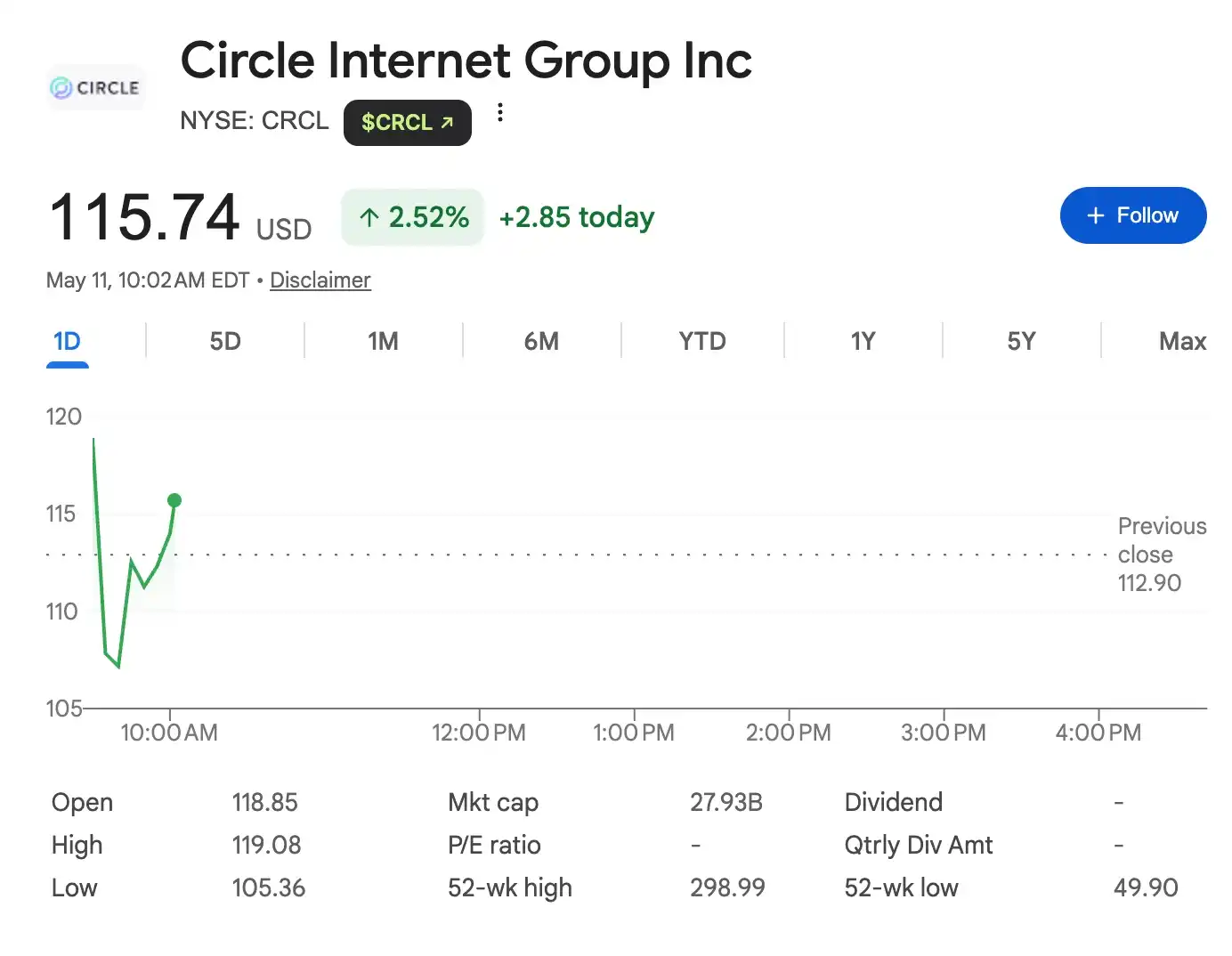
Affected by the earnings release, CRCL experienced significant pre-market volatility, with nearly a 6% pre-market gain gradually being erased amid fluctuations. As of 22:00, after the opening of US stocks, CRCL once continued to plummet but then quickly turned from loss to gain, temporarily quoted at $115.74, with an intraday increase of 2.52%.
Interpretation of Core Data

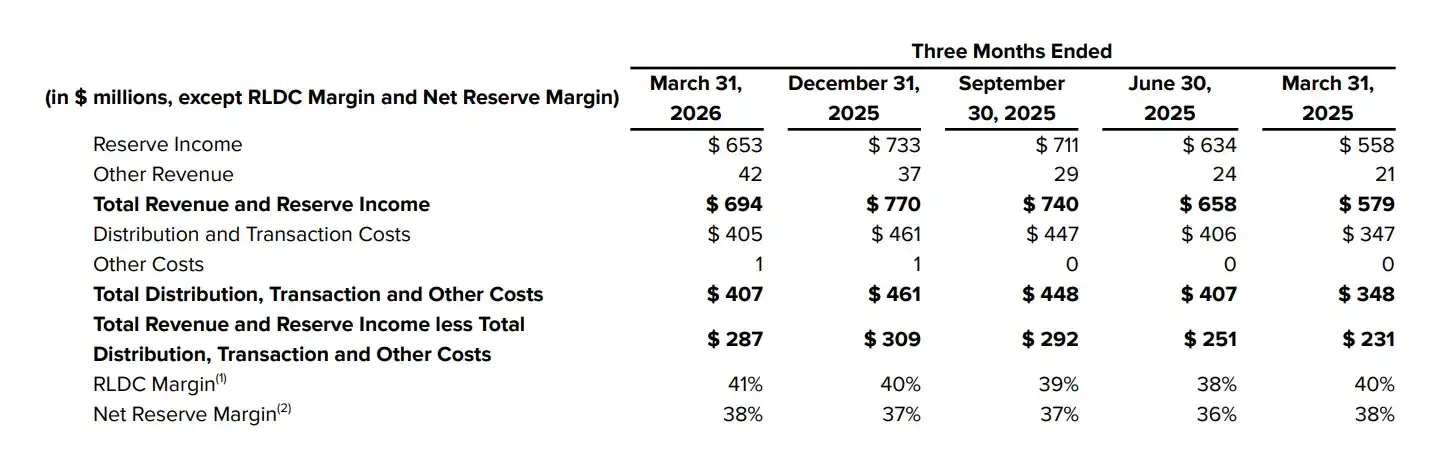
As shown in the report, Circle's total revenue and reserve income for this quarter was $694 million. Although it increased by 20% year-on-year, it broke the growth trend of previous consecutive quarters ($579M → $658M → $740M → $770M → $694M) and also fell short of market expectations.

Circle attributed the slowdown in revenue growth to a decline in the Reserve Return Rate. On December 10, 2025, the Federal Reserve lowered the federal funds rate target range by 25 basis points to 3.5%-3.75%, thereby compressing the yield of Circle's primarily US Treasury-backed reserve assets.
However, despite the relatively weak revenue, this earnings report from Circle still reveals some locally optimistic data.

First, Circle's Other Revenue, excluding Reserve Income, reached a new high of $42 million, showing a growth trend over multiple consecutive quarters ($21M → $24M → $29M → $37M → $42M).

As we mentioned in this afternoon's article "Earnings Report, Bill, Federal Reserve... Circle Faces Three Major Tests This Week", this means Circle's revenue sources are becoming more diversified. Its platform services, API tools, and payment products are generating tangible commercial returns, and reliance on interest income is decreasing.

Another noteworthy data point is RLDC Margin, the profit margin after revenue minus distribution costs. This reflects the core business profitability after deducting distribution expenses and is widely regarded as Circle's most crucial profit metric. This quarter, Circle's RLDC Margin reached 41%, achieving growth for four consecutive quarters (36% → 39% → 40% → 41%). This means Circle's control over distribution costs is becoming more efficient.
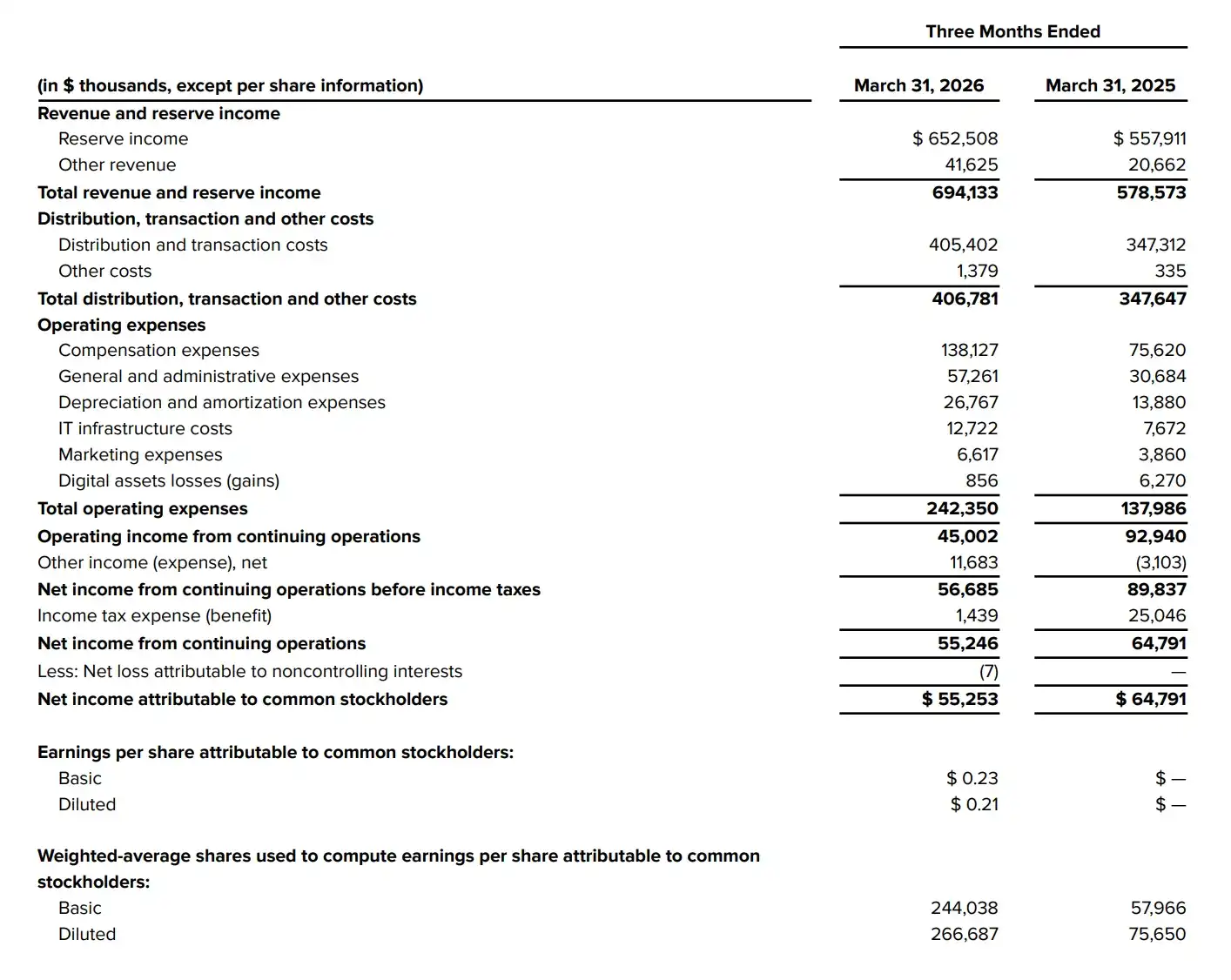
Now let's look at the expense situation. Distribution and Transaction Costs remain Circle's largest expense item, reaching a high of $405 million this quarter, a 17% year-on-year increase. This expense is mainly tied to the USDC distribution contract with Coinbase. This contract is set to expire in August this year. How it is renewed (primarily looking at whether the revenue-sharing ratio will be adjusted) will greatly impact Circle's subsequent expenses and profit status.

Apart from distribution costs, Total Operating Expenses also surged from $138 million last year to $242 million, a year-on-year increase of 76%. The primary increase came from Compensation expenses, which nearly doubled from $75.62 million to $138 million—Circle explained this was mainly due to IPO-related stock-based compensation expenses and related taxes.

Affected by the surge in expenses, Circle's operating profit for this quarter dropped to $45 million from $92.94 million in the same period last year; net profit attributable to common shareholders decreased from $64.79 million to $55.25 million; earnings per share (EPS) were $0.23, diluted to $0.21.

Other Operational Highlights

In addition to core financial data, Circle disclosed several operational highlights in its Q1 earnings report.

The most crucial data point is that USDC's circulation at the end of Q1 reached 77 billion tokens, a year-on-year increase of 28%. However, at the same time, USDC's on-chain transaction volume in Q1 reached a staggering $21.5 trillion, a year-on-year increase of 263%. Visa Onchain Analytics data also shows that USDC accounted for 63% of the total stablecoin transaction volume in Q1.
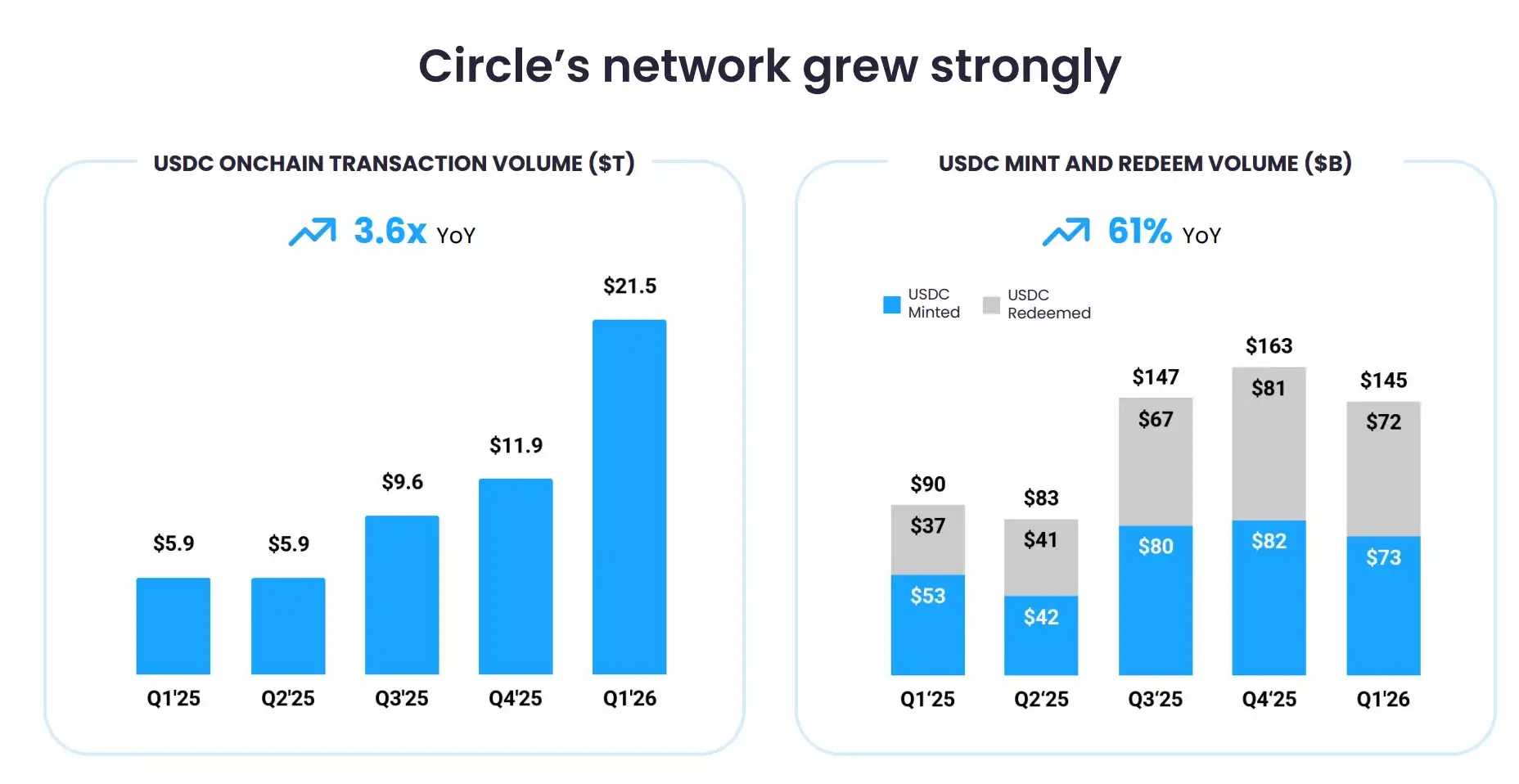
The transaction volume growth rate far exceeding the circulation growth rate means that the turnover and application frequency of each USDC token on-chain has significantly increased — USDC is not lying statically in wallets but is being genuinely and frequently used in scenarios like payments, DeFi, and cross-border settlements.

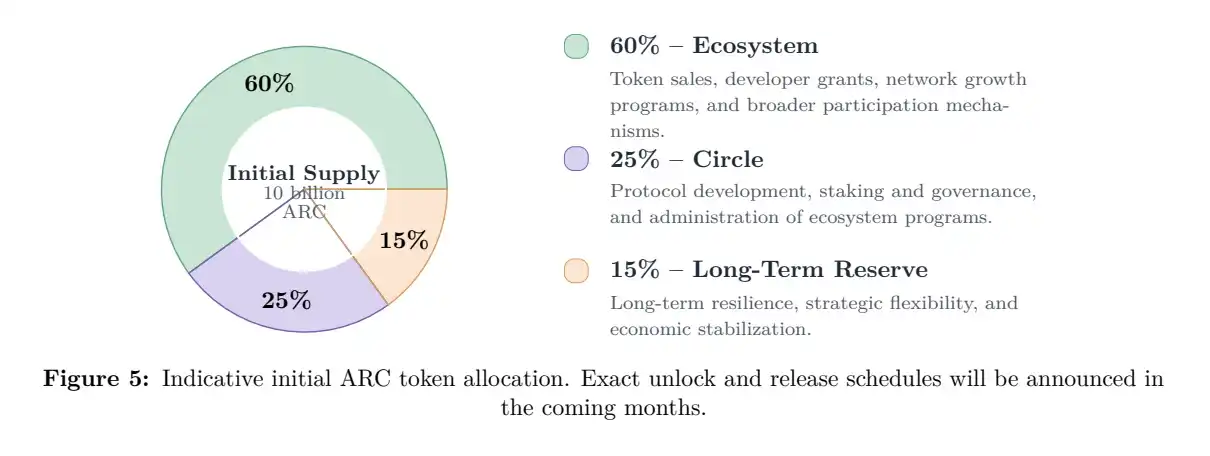
Another important point is that Circle also disclosed that its payment network, Arc Network, has completed a $222 million ARC token pre-sale with a valuation as high as $3 billion. Investors include renowned institutions such as a16z, BlackRock, Intercontinental Exchange, Standard Chartered, and SBI. The ARC token whitepaper disclosed today shows that 60% of the tokens will be allocated to the ecosystem (token sales, developer grants, network growth); 25% will be allocated to Circle (protocol development, staking & governance); 15% will be allocated to a long-term reserve (strategic flexibility & economic stability).
In the subsequent earnings call, when asked how the ARC tokens belonging to Circle would be accounted for, Circle Co-founder and CEO Jeremy Allaire stated: "When ARC tokens are created, they will be recorded on Circle's balance sheet at cost, and their cost is zero. Subsequently, after Circle fulfills its obligations under the token pre-sale agreement, we will recognize the value of these tokens as 'Other Revenue', and this value will then be directly reflected in RLDC and Adjusted EBITDA."

This also means that in a future quarter, Circle's reported revenue data will look "exceptionally good" due to the inclusion of ARC token value.

Furthermore, the estimated annual transaction volume for Circle's institutional payment service, Circle Payments Network (CPN) (extrapolated based on 30-day data as of March 31st), has also reached $8.3 billion; In April, Circle launched the "Managed Payments" product to expand its payment offerings. This product allows financial institutions to launch stablecoin payment services without having to manage digital assets themselves.

To prepare for the AI Agent-driven commercial future, Circle also announced the launch of Agent Stack, a set of infrastructure services and toolkits for the AI Agent economy, designed to provide high-speed, low-cost financial service capabilities for autonomously operating AI Agents. Jeremy Allaire's vision for this is: "With the ARC token pre-sale, the momentum building for Arc Network, and the launch of Agent Stack, we are building trusted infrastructure for AI-native economic activity and a more programmable internet financial system."

Circle's New Chess Game

Against the macroeconomic backdrop of receding high-interest dividends (Warsh is expected to promote a "rate cut + balance sheet reduction" strategy upon succeeding as Fed Chair), Circle clearly does not want to be entirely at the mercy of the Federal Reserve's interest rate policy. Its strategic focus has quietly shifted towards diversified expansion of non-interest revenue.

Judging from the details disclosed in this quarterly report, after successively launching services like CPN, Managed Payments, Agent Stack, and Arc Network, Circle's goal is no longer just to be a "stablecoin issuer." It is attempting to build USDC into the underlying dollar network for the internet era. Under this new vision, Circle's service targets are no longer limited to exchanges or crypto-native users but are extending comprehensively into cross-border payments, corporate settlements, and even the AI Agent economy.

Circle's ambition is now abundantly clear: to transform USDC from a "static reserve asset" into "flowing economic blood." This is perhaps the big chess game Circle truly wants to play.


Questions liées

QWhat were Circle's total revenue and reserve income for Q1 2026, and how did it compare to market expectations?

ACircle's total revenue and reserve income for Q1 2026 was $6.94 billion, which was slightly below the market expectation of $7.15 billion.

QAccording to the article, what are the two key positive data points from Circle's Q1 report despite slowing revenue growth?

ATwo key positive data points are: 1) Other Revenue (excluding Reserve Income) reached a new high of $42 million, showing a consecutive growth trend. 2) The RLDC Margin, a core profitability indicator, reached 41%, marking four consecutive quarters of growth.

QWhat major operational highlight regarding USDC usage is mentioned in the Q1 report?

AA major operational highlight is that the on-chain transaction volume of USDC reached $21.5 trillion in Q1, a 263% year-over-year increase, significantly outpacing its circulation growth of 28%. This indicates much higher frequency of real-world use.

QWhat is the significance of the Arc Network and its ARC token for Circle's future financials, as explained by CEO Jeremy Allaire?

AThe ARC tokens allocated to Circle will be recorded on its balance sheet at cost (which is zero). Once Circle fulfills its obligations under the token presale agreement, the value of these tokens will be recognized as 'other revenue,' which will directly boost the RLDC and Adjusted EBITDA figures in a future quarter.

QHow does the article describe Circle's strategic shift and ultimate ambition in the context of declining interest rate benefits?

ACircle's strategy is shifting from relying on interest income to diversifying into non-interest revenue streams. Its ultimate ambition is to transform USDC from a 'static reserve asset' into 'circulating economic blood,' aiming to build it as the foundational dollar network for the internet era, extending into cross-border payments, corporate settlement, and the AI Agent economy.

Lectures associées

La Banque d'Italie ne voit pas d'avantages systémiques des stablecoins dans les transferts

L'étude de la Banque d'Italie conclut que les stablecoins n'offrent pas d'avantage systémique durable en termes de coût et de rapidité pour les transferts d'argent. Les avantages potentiels sont annulés par les frais de conversion vers et depuis les monnaies fiduciaires et par l'efficacité des infrastructures de paiement locales. La recherche a comparé des transferts de 200 USDC sur 10 couloirs bilatéraux (Italie vers Brésil, Argentine, Japon, Émirats Arabes Unis, Afrique du Sud). Le coût total des transferts en stablecoins variait de 0,3% à près de 9%. Les délais étaient inférieurs à 20 minutes dans les pays dotés de systèmes de paiement instantané, mais pouvaient atteindre 1 à 2 jours ouvrables ailleurs. Les principaux coûts et retards sont liés au change de devises et à la qualité de l'infrastructure locale, plutôt qu'aux frais de blockchain. Bien que souvent moins chers que la moyenne mondiale des transferts (6,65%), les stablecoins n'étaient plus avantageux que dans 3 cas sur 7 par rapport au service Wise. Les auteurs estiment que l'utilité serait plus forte si les stablecoins pouvaient être dépensés directement, sans reconversion. Ils notent également qu'une réglementation trop restrictive complique l'usage pour les clients tout en n'éliminant pas la demande. Le marché des stablecoins a enregistré en juillet sa plus forte baisse mensuelle depuis l'effondrement de Terra, perdant plus de 10 milliards de dollars.

cryptonews.ruIl y a 1 h

La Banque d'Italie ne voit pas d'avantages systémiques des stablecoins dans les transferts

cryptonews.ruIl y a 1 h

Le « boom du Bitcoin » en plein essor : Une nouvelle déclaration de Saylor suscite des spéculations sur des achats

Michael Saylor, président exécutif de MicroStrategy (MSTR), a relancé les spéculations sur un nouvel achat de bitcoins par la société en publiant le message « Bitcoin Drive engaged » le 2 août, accompagné de son tableau de suivi habituel. Cette pratique précède généralement les annonces officielles du trésor. Le rapport affiché montrait que les réserves de MicroStrategy s'élevaient à 843 775 BTC, d'une valeur marchande d'environ 53,25 milliards de dollars, avec un prix d'acquisition moyen de 75 653 dollars et une perte non réalisée de 10,58 milliards de dollars. Cependant, le registre public en temps réel de la société indique deux ventes récentes totalisant 3 588 BTC, ramenant le stock de 847 363 à 843 775 BTC. Ces ventes, déclarées à la SEC, visaient à financer des dividendes d'actions privilégiées et à reconstituer les réserves en dollars, qui s'élèvent désormais à environ 3,75 milliards de dollars. La société a subi une perte opérationnelle de 8,33 milliards de dollars au deuxième trimestre 2026, en grande partie due à une perte non réalisée sur ses actifs numériques. La direction pourrait vendre jusqu'à 1,25 milliard de dollars de bitcoins supplémentaires pour ses obligations en cash. L'annonce attendue lundi révélera si le message « Bitcoin Drive » signale une reprise des achats d'accumulation, alors que MicroStrategy équilibre son énorme stock de bitcoins avec ses engagements financiers croissants.

cryptonews.ruIl y a 1 h

Le « boom du Bitcoin » en plein essor : Une nouvelle déclaration de Saylor suscite des spéculations sur des achats

cryptonews.ruIl y a 1 h

Le motif « Tête et Épaules inversé » sur le graphique du Bitcoin annonce une montée vers 67 200 $

Malgré un léger recul début août, les graphiques de prix, notamment celui du Bitcoin, forment un modèle de renversement baissier. Actuellement, le BTC oscille autour de 63 200 $, formant l'épaule droite de la classique figure inversée "tête et épaules". L'analyste Axel Kibard de TechCharts voit là la seule réelle raison d'optimisme à court terme pour les haussiers ce mois-ci. La question principale est de savoir si les acheteurs auront la force de pousser le Bitcoin vers le niveau clé de 67 000 $. Parallèlement, dans la paire ETH/BTC, un fond de renversement similaire a déjà été franchi à la hausse. L'Ethereum, en tendance haussière, se dirige vers un objectif technique de 0,0312, indiquant que les grands capitaux préfèrent actuellement investir dans l'ETH plutôt que dans le Bitcoin, ce qui draine la liquidité et les volumes nécessaires à une reprise rapide du BTC. Face au dollar, l'Ethereum teste prudemment le niveau de support à 1 875 $, une résistance qui, si elle est maintenue, pourrait ouvrir la voie vers 2 163 $. Cette force relative de l'ETH est un signal positif pour le marché, mais la situation reste tendue pour les détenteurs de Bitcoin. Soit le BTC suit l'exemple de l'ETH et monte rapidement au-dessus de 67 200 $ pour confirmer le renversement, soit le modèle échoue. Selon Kibard, si une attaque de la ligne de cou (neckline) n'intervient pas dans les prochains jours, les baissiers reprendront le contrôle et pousseront le Bitcoin vers des niveaux de support solides à 60 000 $, voire 58 000 $.

cryptonews.ruIl y a 1 h

Le motif « Tête et Épaules inversé » sur le graphique du Bitcoin annonce une montée vers 67 200 $

cryptonews.ruIl y a 1 h

Les actions des entreprises d'IA se négocient comme des « mèmes cryptos », tandis que le Bitcoin reste stable – Revue de la semaine

Cette semaine, l'attention financière s'est largement détournée du Bitcoin, relativement stable autour de 64 000 $, pour se concentrer sur une volatilité extrême dans le secteur des actions liées à l'intelligence artificielle (IA). Les marchés asiatiques, notamment en Corée du Sud, ont subi des chutes sévères, en partie déclenchées par la liquidation forcée du fonds « Situational Awareness » de Leopold Aschenbrenner, entraînant des pertes massives. Le secteur des semi-conducteurs et de l'IA montre des signes de surchauffe, suscitant des débats sur un éventuel ralentissement. Dans le domaine des cryptomonnaies, l'ambiance reste difficile. Plusieurs plateformes d'échange (BitMEX, BitMart) ont annoncé leur fermeture, tandis que d'autres entreprises comme Coinbase et Uphold procèdent à des réductions de personnel. MicroStrategy continue sa stratégie d'accumulation de bitcoins et de rachat de ses propres actions. Les discussions portent également sur les risques potentiels pour des écosystèmes comme Solana si des applications populaires (Pump.fun, Trade.xyz) décidaient de lancer leur propre blockchain. Par ailleurs, une faille de sécurité majeure concernant le portefeuille matériel Coldcard a été mise en lumière, rappelant les risques du self-custody. Enfin, le projet d'IA décentralisée Bittensor (TAO) a attiré l'attention de certains investisseurs de capital-risque, mais des mises en garde sont émises contre un possible engouement spéculatif similaire à celui pour les memecoins. La semaine a été marquée par des interventions macroéconomiques, comme celle de la Japon pour soutenir le yen, et par les anticipations concernant la politique de la Fed.

cryptonews.ruIl y a 1 h

Les actions des entreprises d'IA se négocient comme des « mèmes cryptos », tandis que le Bitcoin reste stable – Revue de la semaine

cryptonews.ruIl y a 1 h

Trading

Spot
活动图片




