Dissecting Circle's Q1 Earnings Report: After the Interest Rate Dividend Ebbs, USDC Prepares for a Big Chess Game

marsbitPublié le 2026-05-11Dernière mise à jour le 2026-05-11

Résumé

Title: Circle Q1 2026 Earnings: Shifting Strategy as Interest Rate Windfall Subsides Circle reported its Q1 2026 financial results. While total revenue and reserve income of $694M slightly missed expectations, adjusted EBITDA grew 24% to $151M. A key trend is the decline in reserve income due to lower Federal Reserve interest rates, which Circle is countering by diversifying its revenue streams. Notably, non-interest "Other Revenue" hit a record $42M. USDC's circulation reached 77 billion, up 28% year-over-year, but its on-chain transaction volume surged 263% to $21.5 trillion, indicating significantly higher utilization in payments and DeFi. Financially, the core RLDC Margin improved to 41%, showing better cost control. However, operating expenses nearly doubled, partly due to post-IPO stock compensation costs. Looking ahead, Circle is expanding beyond being a simple stablecoin issuer. It highlighted the $222M presale for its Arc Network (valued at $3B) and launched new services like Managed Payments and the "Agent Stack" for AI-driven commerce. The company's strategy is evolving to position USDC as the foundational dollar network for the internet, targeting broader payment, enterprise, and AI agent economies.

Original | Odaily Planet Daily(@OdailyChina)

Author | Azuma(@azuma_eth)
Before the US stock market opened on May 11th, stablecoin issuer Circle officially announced its Q1 2026 earnings report.

The financial report data shows, Circle's total revenue and reserve income for Q1 was $694 million, slightly below market expectations of $715 million; EPS was $0.21, higher than market expectations of $0.18; adjusted EBITDA was $151 million, a year-on-year increase of 24%; net profit was $55 million, a year-on-year decrease of 15%.

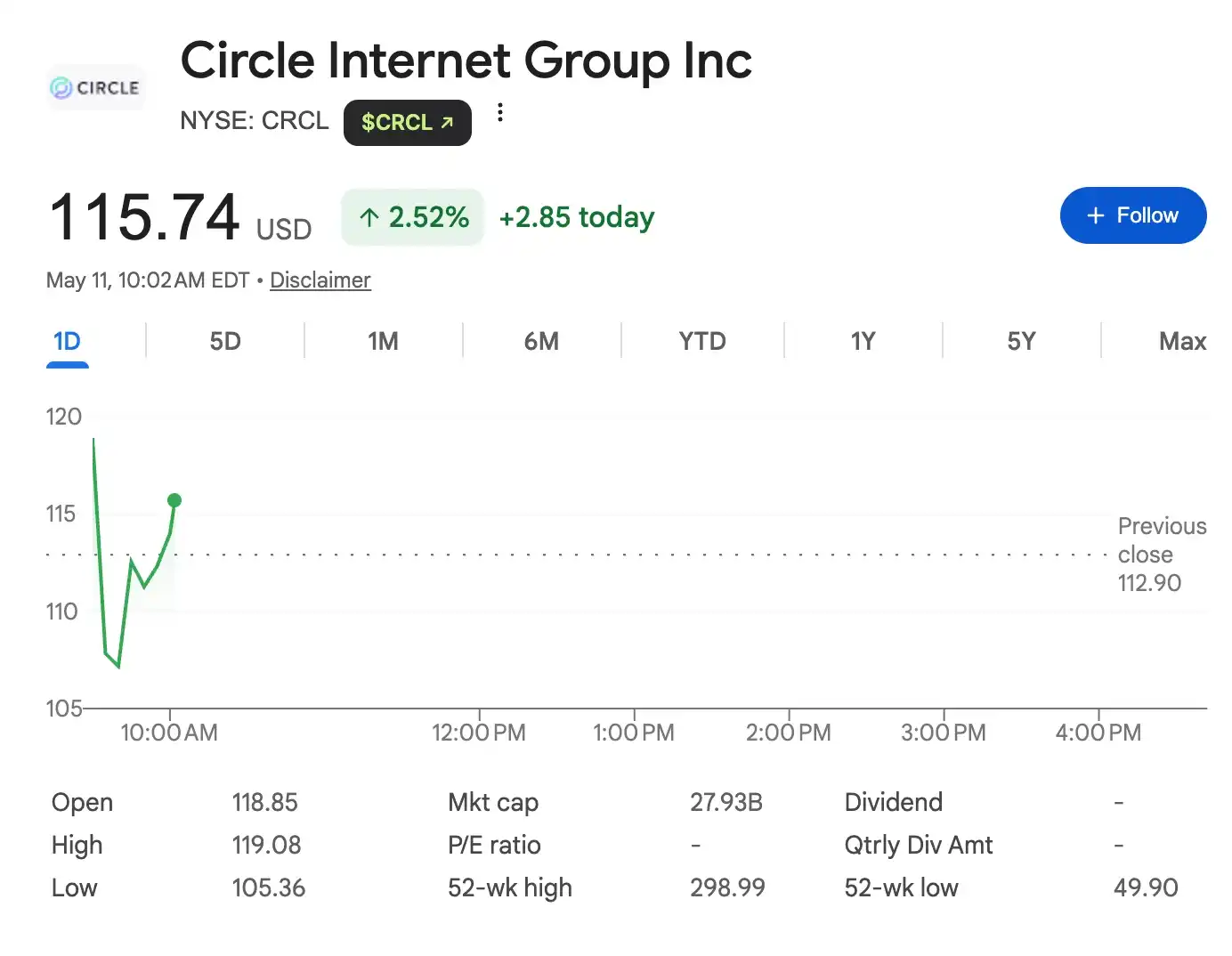
Affected by the earnings release, CRCL experienced significant pre-market volatility, with nearly a 6% pre-market gain gradually being erased amid fluctuations. As of 22:00, after the opening of US stocks, CRCL once continued to plummet but then quickly turned from loss to gain, temporarily quoted at $115.74, with an intraday increase of 2.52%.
Interpretation of Core Data

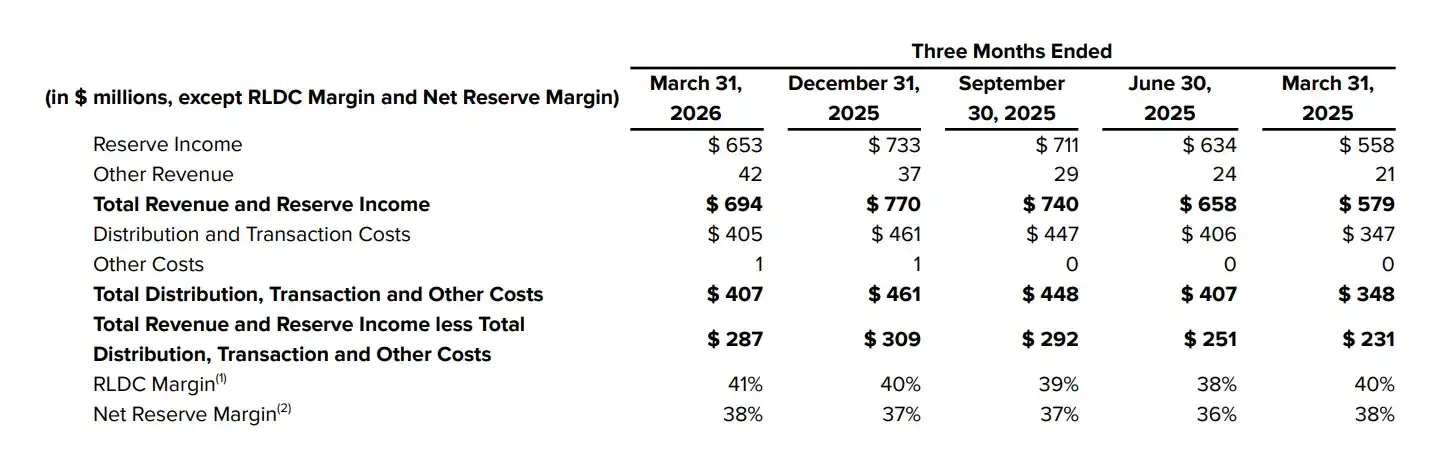
As shown in the report, Circle's total revenue and reserve income for this quarter was $694 million. Although it increased by 20% year-on-year, it broke the growth trend of previous consecutive quarters ($579M → $658M → $740M → $770M → $694M) and also fell short of market expectations.

Circle attributed the slowdown in revenue growth to a decline in the Reserve Return Rate. On December 10, 2025, the Federal Reserve lowered the federal funds rate target range by 25 basis points to 3.5%-3.75%, thereby compressing the yield of Circle's primarily US Treasury-backed reserve assets.
However, despite the relatively weak revenue, this earnings report from Circle still reveals some locally optimistic data.

First, Circle's Other Revenue, excluding Reserve Income, reached a new high of $42 million, showing a growth trend over multiple consecutive quarters ($21M → $24M → $29M → $37M → $42M).

As we mentioned in this afternoon's article "Earnings Report, Bill, Federal Reserve... Circle Faces Three Major Tests This Week", this means Circle's revenue sources are becoming more diversified. Its platform services, API tools, and payment products are generating tangible commercial returns, and reliance on interest income is decreasing.

Another noteworthy data point is RLDC Margin, the profit margin after revenue minus distribution costs. This reflects the core business profitability after deducting distribution expenses and is widely regarded as Circle's most crucial profit metric. This quarter, Circle's RLDC Margin reached 41%, achieving growth for four consecutive quarters (36% → 39% → 40% → 41%). This means Circle's control over distribution costs is becoming more efficient.
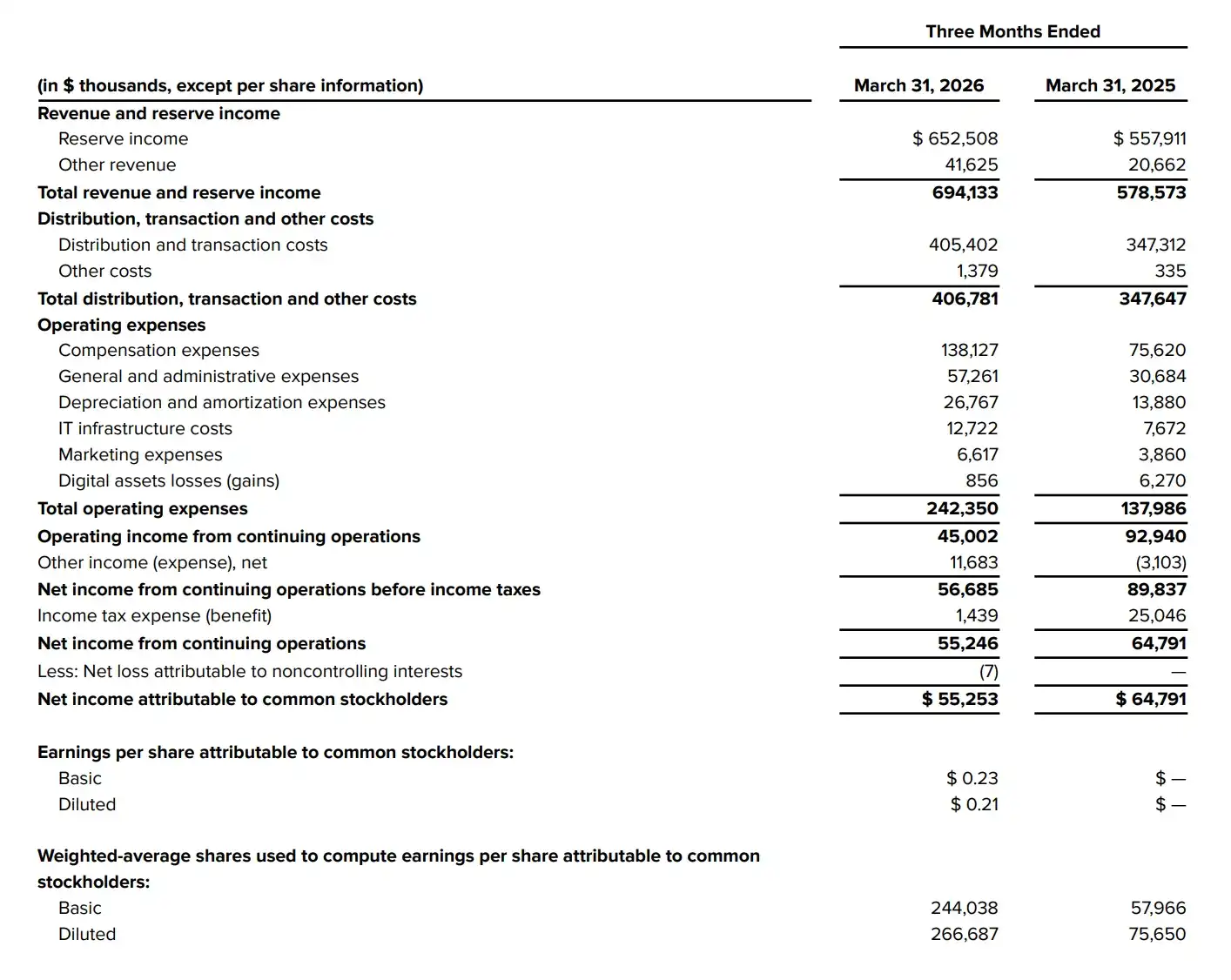
Now let's look at the expense situation. Distribution and Transaction Costs remain Circle's largest expense item, reaching a high of $405 million this quarter, a 17% year-on-year increase. This expense is mainly tied to the USDC distribution contract with Coinbase. This contract is set to expire in August this year. How it is renewed (primarily looking at whether the revenue-sharing ratio will be adjusted) will greatly impact Circle's subsequent expenses and profit status.

Apart from distribution costs, Total Operating Expenses also surged from $138 million last year to $242 million, a year-on-year increase of 76%. The primary increase came from Compensation expenses, which nearly doubled from $75.62 million to $138 million—Circle explained this was mainly due to IPO-related stock-based compensation expenses and related taxes.

Affected by the surge in expenses, Circle's operating profit for this quarter dropped to $45 million from $92.94 million in the same period last year; net profit attributable to common shareholders decreased from $64.79 million to $55.25 million; earnings per share (EPS) were $0.23, diluted to $0.21.

Other Operational Highlights

In addition to core financial data, Circle disclosed several operational highlights in its Q1 earnings report.

The most crucial data point is that USDC's circulation at the end of Q1 reached 77 billion tokens, a year-on-year increase of 28%. However, at the same time, USDC's on-chain transaction volume in Q1 reached a staggering $21.5 trillion, a year-on-year increase of 263%. Visa Onchain Analytics data also shows that USDC accounted for 63% of the total stablecoin transaction volume in Q1.
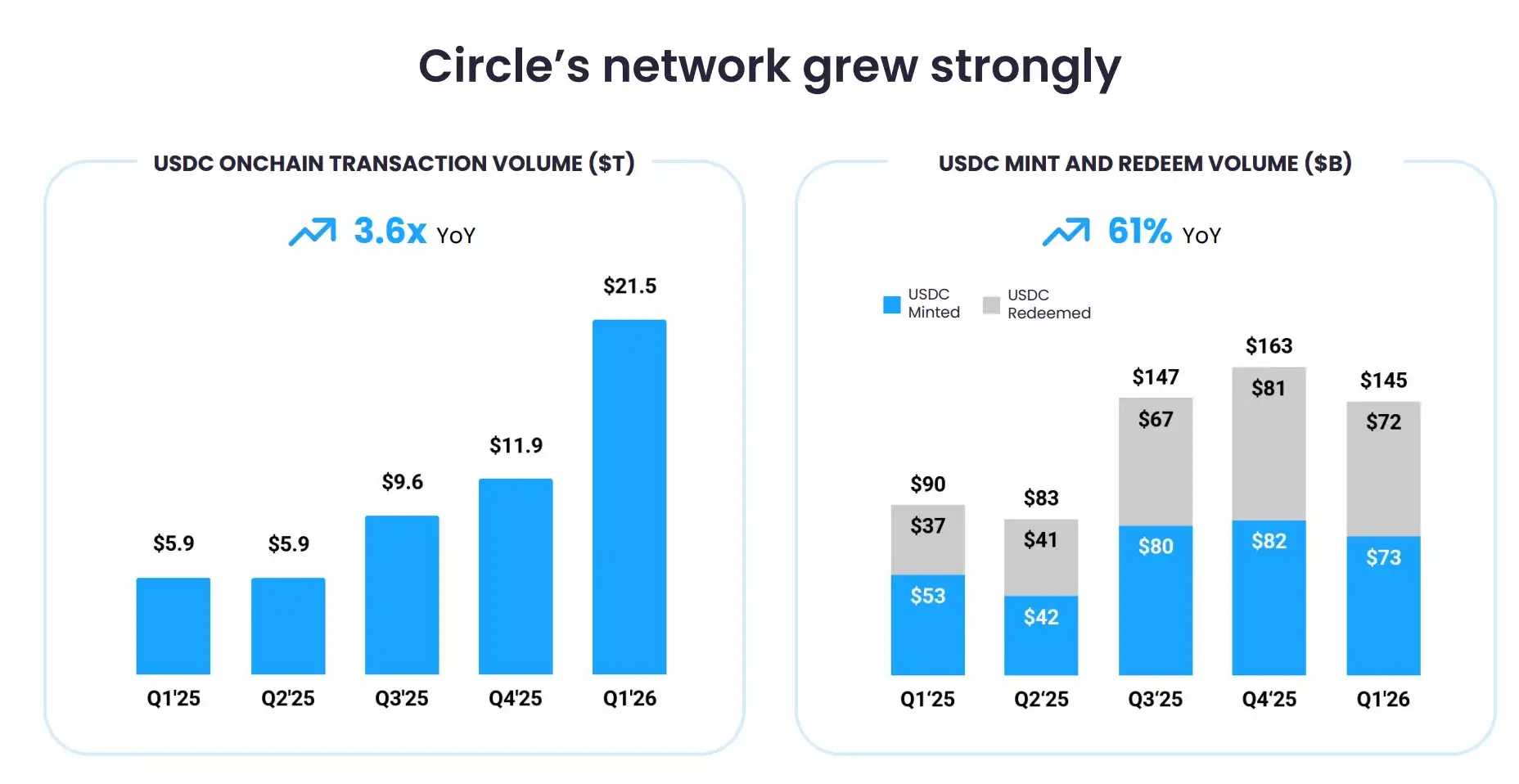
The transaction volume growth rate far exceeding the circulation growth rate means that the turnover and application frequency of each USDC token on-chain has significantly increased — USDC is not lying statically in wallets but is being genuinely and frequently used in scenarios like payments, DeFi, and cross-border settlements.

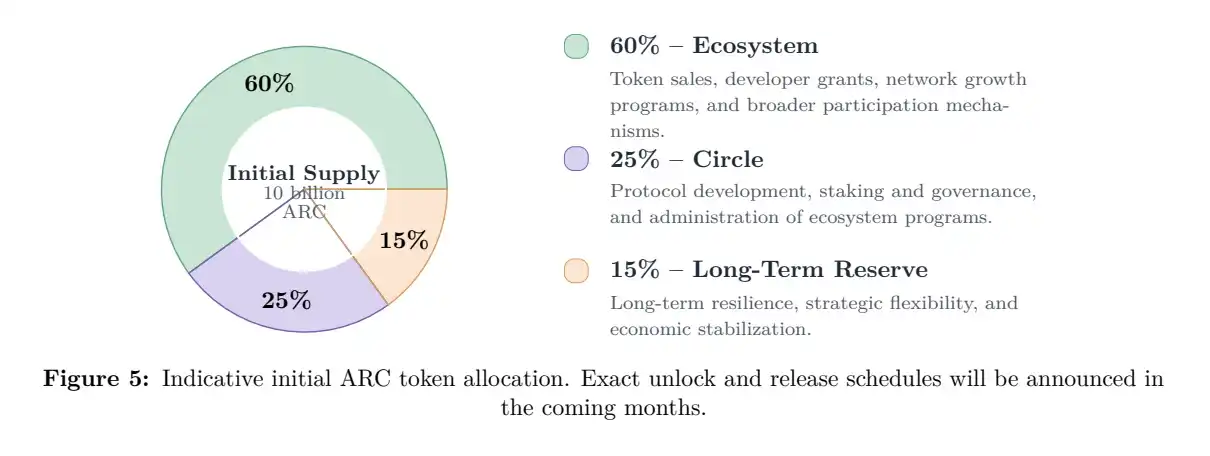
Another important point is that Circle also disclosed that its payment network, Arc Network, has completed a $222 million ARC token pre-sale with a valuation as high as $3 billion. Investors include renowned institutions such as a16z, BlackRock, Intercontinental Exchange, Standard Chartered, and SBI. The ARC token whitepaper disclosed today shows that 60% of the tokens will be allocated to the ecosystem (token sales, developer grants, network growth); 25% will be allocated to Circle (protocol development, staking & governance); 15% will be allocated to a long-term reserve (strategic flexibility & economic stability).
In the subsequent earnings call, when asked how the ARC tokens belonging to Circle would be accounted for, Circle Co-founder and CEO Jeremy Allaire stated: "When ARC tokens are created, they will be recorded on Circle's balance sheet at cost, and their cost is zero. Subsequently, after Circle fulfills its obligations under the token pre-sale agreement, we will recognize the value of these tokens as 'Other Revenue', and this value will then be directly reflected in RLDC and Adjusted EBITDA."

This also means that in a future quarter, Circle's reported revenue data will look "exceptionally good" due to the inclusion of ARC token value.

Furthermore, the estimated annual transaction volume for Circle's institutional payment service, Circle Payments Network (CPN) (extrapolated based on 30-day data as of March 31st), has also reached $8.3 billion; In April, Circle launched the "Managed Payments" product to expand its payment offerings. This product allows financial institutions to launch stablecoin payment services without having to manage digital assets themselves.

To prepare for the AI Agent-driven commercial future, Circle also announced the launch of Agent Stack, a set of infrastructure services and toolkits for the AI Agent economy, designed to provide high-speed, low-cost financial service capabilities for autonomously operating AI Agents. Jeremy Allaire's vision for this is: "With the ARC token pre-sale, the momentum building for Arc Network, and the launch of Agent Stack, we are building trusted infrastructure for AI-native economic activity and a more programmable internet financial system."

Circle's New Chess Game

Against the macroeconomic backdrop of receding high-interest dividends (Warsh is expected to promote a "rate cut + balance sheet reduction" strategy upon succeeding as Fed Chair), Circle clearly does not want to be entirely at the mercy of the Federal Reserve's interest rate policy. Its strategic focus has quietly shifted towards diversified expansion of non-interest revenue.

Judging from the details disclosed in this quarterly report, after successively launching services like CPN, Managed Payments, Agent Stack, and Arc Network, Circle's goal is no longer just to be a "stablecoin issuer." It is attempting to build USDC into the underlying dollar network for the internet era. Under this new vision, Circle's service targets are no longer limited to exchanges or crypto-native users but are extending comprehensively into cross-border payments, corporate settlements, and even the AI Agent economy.

Circle's ambition is now abundantly clear: to transform USDC from a "static reserve asset" into "flowing economic blood." This is perhaps the big chess game Circle truly wants to play.


Questions liées

QWhat were Circle's total revenue and reserve income for Q1 2026, and how did it compare to market expectations?

ACircle's total revenue and reserve income for Q1 2026 was $6.94 billion, which was slightly below the market expectation of $7.15 billion.

QAccording to the article, what are the two key positive data points from Circle's Q1 report despite slowing revenue growth?

ATwo key positive data points are: 1) Other Revenue (excluding Reserve Income) reached a new high of $42 million, showing a consecutive growth trend. 2) The RLDC Margin, a core profitability indicator, reached 41%, marking four consecutive quarters of growth.

QWhat major operational highlight regarding USDC usage is mentioned in the Q1 report?

AA major operational highlight is that the on-chain transaction volume of USDC reached $21.5 trillion in Q1, a 263% year-over-year increase, significantly outpacing its circulation growth of 28%. This indicates much higher frequency of real-world use.

QWhat is the significance of the Arc Network and its ARC token for Circle's future financials, as explained by CEO Jeremy Allaire?

AThe ARC tokens allocated to Circle will be recorded on its balance sheet at cost (which is zero). Once Circle fulfills its obligations under the token presale agreement, the value of these tokens will be recognized as 'other revenue,' which will directly boost the RLDC and Adjusted EBITDA figures in a future quarter.

QHow does the article describe Circle's strategic shift and ultimate ambition in the context of declining interest rate benefits?

ACircle's strategy is shifting from relying on interest income to diversifying into non-interest revenue streams. Its ultimate ambition is to transform USDC from a 'static reserve asset' into 'circulating economic blood,' aiming to build it as the foundational dollar network for the internet era, extending into cross-border payments, corporate settlement, and the AI Agent economy.

Lectures associées

Tendances du marché américain (16 juin) : SpaceX grimpe de 42% en deux jours, la nouvelle présidente de la Fed prend ses fonctions aujourd'hui

Le marché boursier américain a réagi avec enthousiasme lundi suite à l'annonce d'un accord imminent entre les États-Unis et l'Iran pour rouvrir le détroit d'Hormuz. Les principaux indices ont progressé, le Nasdaq bondissant de 3,07%, porté par un rallye des actions technologiques, notamment des semi-conducteurs. Micron a mené la charge avec une hausse de 9,2%. L'introduction en bourse récente de SpaceX a également bénéficié de la dynamique, stimulée par des achats institutionnels importants. À l'inverse, le secteur énergétique a chuté avec le pétrole brut (-5%), tandis que les valeurs défensives comme la santé et les télécommunications ont été délaissées. Les investisseurs ont opéré un transfert net de capitaux vers les actifs à risque, anticipant un assouplissement des pressions inflationnistes. Cette reprise du risque a vu le VIX chuter et les rendements des Treasuries reculer. Cependant, cette phase d'optimisme doit être mise à l'épreuve par un agenda macroéconomique chargé cette semaine. La Banque du Japon devrait relever ses taux mardi, et la Réserve fédérale américaine, sous sa nouvelle présidence, conclura sa réunion mercredi. Le marché attend des indications sur la trajectoire future des taux, l'accord formel sur le détroit d'Hormuz étant attendu vendredi. La volatilité pourrait donc rapidement revenir, en particulier pour les secteurs récemment surperformants comme la technologie, si les communications des banques centrales ou les détails de l'accord géopolitique déçoivent les attentes.

marsbitIl y a 21 mins

Tendances du marché américain (16 juin) : SpaceX grimpe de 42% en deux jours, la nouvelle présidente de la Fed prend ses fonctions aujourd'hui

marsbitIl y a 21 mins

Le deuxième grand voyage maritime de Xiaohongshu, cette fois vers l'IA

En 2022, peu après le lancement de ChatGPT, le fondateur de Xiaohongshu, Mao Wenchao, s'est inquiété de savoir si l'IA pourrait menacer sa plateforme. En 2023, il a noté que ChatGPT était souvent interrogé sur des expériences de vie – un domaine central pour Xiaohongshu. La plateforme, avec 300 millions d'utilisateurs actifs mensuels, a réalisé son premier bénéfice en 2023 (5 milliards de dollars de profit). Sa valeur réside dans des milliards de notes basées sur l'expérience réelle des utilisateurs ("je l'ai essayé"). Face à l'IA qui fournit des réponses instantanées, Xiaohongshu craint que la patience des utilisateurs ne s'érode. Pour éviter de devenir une simple source de données pour d'autres, elle développe activement sa propre stratégie IA. En 2026, elle a créé le département Dots, a lancé RED Skill (transformant les expériences en outils utilisables par des agents IA), et a acquis l'application de recherche IA Diandian. La plateforme investit également dans des startups d'IA (comme MiniMax, Moon) et du matériel AI. Elle a obtenu une licence de paiement pour contrôler la transaction après une recommandation. Sa monétisation (via AIPS) vise à retracer le long cycle de décision d'achat des utilisateurs. Un défi crucial est de préserver la confiance. Xiaohongshu impose l'étiquetage du contenu généré par IA et interdit les comptes entièrement automatisés pour éviter que les expériences authentiques ne soient noyées par des contrefaçons. Son objectif est d'utiliser l'IA pour organiser et délivrer de la valeur à partir de l'expérience humaine, sans la remplacer. La réussite future dépend de son équilibre entre l'efficacité de l'IA et l'authenticité des témoignages humains qui constituent son fondement. Des rumeurs d'introduction en bourse à Hong Kong circulent, évaluant l'entreprise à 310 milliards de dollars.

marsbitIl y a 50 mins

Le deuxième grand voyage maritime de Xiaohongshu, cette fois vers l'IA

marsbitIl y a 50 mins

PDG de SharpLink : Comment interpréter le fait que le nombre de développeurs Ethereum vient de dépasser le million ?

D'après Joseph Chalom, PDG de SharpLink, le nombre de développeurs historiques ayant contribué à l'écosystème Ethereum vient de franchir le seuil du million (1 012 824 selon Electric Capital), soit le plus grand bassin de talents techniques du domaine des blockchains ouvertes. Environ 232 000 d'entre eux sont actifs mensuellement. Ce chiffre témoigne d'un avantage durable : les meilleurs constructeurs choisissent Ethereum pour ses fondements institutionnels, culturels et économiques uniques, forgés sur une décennie. Ethereum est devenu le système d'exploitation par défaut pour la finance programmable. Son « fossé » (moat) se renforce grâce à des travaux sur des défis majeurs : l'évolutivité du protocole (via la future mise à jour Glamsterdam), la composabilité synchrone entre rollups pour unifier l'expérience utilisateur, et la préparation à la cryptographie post-quantique, un domaine où Ethereum est leader. Au-delà des développeurs, les effets de réseau découlent de la composabilité profonde, des standards partagés comme l'EVM et de la confiance institutionnelle. La neutralité crédible (900 000 validateurs), l'architecture modulaire et une culture de recherche d'excellence attirent les acteurs majeurs de la finance traditionnelle. En définitive, l'accumulation de talents, de liquidités et de standards consolide Ethereum comme couche de coordination fondamentale pour la finance native Internet.

marsbitIl y a 1 h

PDG de SharpLink : Comment interpréter le fait que le nombre de développeurs Ethereum vient de dépasser le million ?

marsbitIl y a 1 h

Trading

Spot
Futures
活动图片