Crypto traders alert! Why Trump’s weekend post could trigger liquidations on Monday

ambcryptoPublié le 2026-04-04Dernière mise à jour le 2026-04-04

Résumé

Crypto traders are on high alert as former President Trump's weekend social media post regarding a potential escalation with Iran could trigger significant market liquidations on Monday. The crypto market, already vulnerable, closed Q1 with a nearly 21% loss, extending a severe downturn. This decline has moved in lockstep with soaring oil prices, which surged nearly 70% in Q1 due to Middle East tensions. Trump's post, warning of a severe attack on Iran's infrastructure, adds a critical layer of uncertainty. With U.S. stock markets closed over the weekend, the full market reaction has been delayed. Analysts now anticipate a highly volatile session when markets reopen, with oil potentially surging toward $200 per barrel. This could spark a sharp sell-off in equities, which would severely impact the crypto market. Bitcoin's positioning index has already turned negative, indicating traders are betting on further downside. The market is trapped in a liquidity crunch, making it extremely sensitive to any catalyst. A major, liquidation-driven downturn is now likely as Monday's session begins.

Is the worst still yet to come for crypto?

From a technical standpoint, the market is officially rolling into Q2. However, to see where it’s headed, we need to check where it’s been. Q1 closed with the total crypto market cap down nearly 21%, extending losses from Q4 2025 when it fell by about 24%.

In just six months, crypto has technically lost over $1.5 trillion. Bitcoin [BTC] hasn’t been spared either, making up 60% of those outflows – A sign that it’s lagging compared to other volatile assets. Backing this, the XAU/BTC ratio closed Q1 up almost 40%, underlining BTC’s relative weakness versus gold.
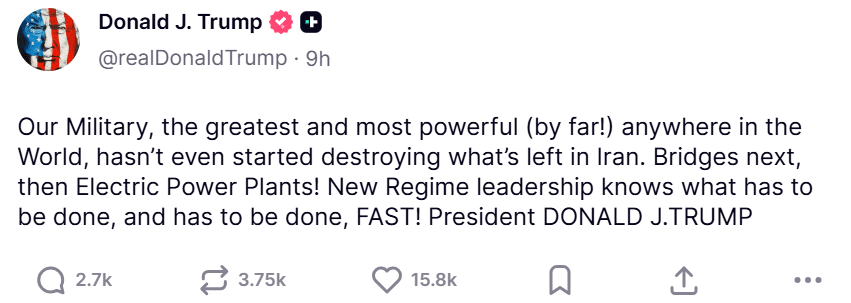
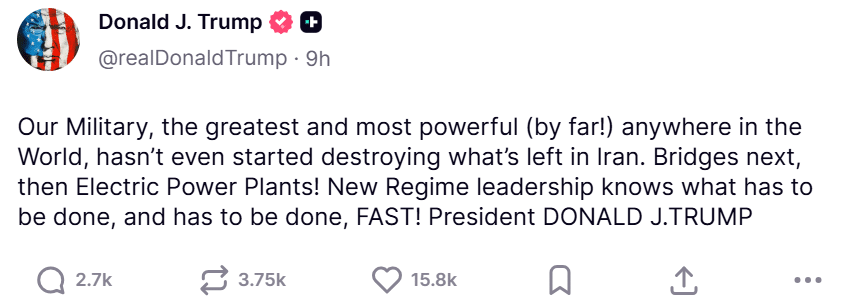
Source: TruthSocial

In short, despite recent optimism around Bitcoin’s “relative” resilience, Q1 revealed crypto was still the weakest performer across asset classes. Against this backdrop, a recent post by U.S President Donald Trump couldn’t have come at a more critical time.

In it, President Trump sounded a warning about a potentially severe attack on Iran’s infrastructure, putting ceasefire expectations on hold. However, more than the content, it’s the “timing” of the post that’s sparked a full-blown market frenzy. Notably, the U.S stock market will remain closed over the weekend, which means the post has temporarily prevented a liquidation cascade.

The real momentum shift, however, is in oil prices. Even before the post, oil had been rattling global markets. Now, the added geopolitical risk layers in more uncertainty. Traders and investors are likely to react as soon as the market reopens, making Monday a highly volatile session for equities. The spotlight, however, falls on crypto – Is a massive bloodbath looming?

Crypto locked in a liquidity trap as weekend market risk spikes

The crypto market’s nearly 21% drop in Q1 has moved almost in lockstep with oil prices.

Notably, this trend is set to shape Monday’s market, especially with equities likely to react. Take the NASDAQ (NDX), for example – It closed Q1 down nearly 6%, marking its worst quarterly performance since Q1 2025.

Here, the culprit is the ongoing Middle East conflict, which has created a massive oil supply squeeze. The Strait of Hormuz, responsible for roughly 20% of global oil exports, remains under serious threat. The impact is clear – Oil closed Q1 up nearly 70%, sending ripples across risk assets, including crypto.
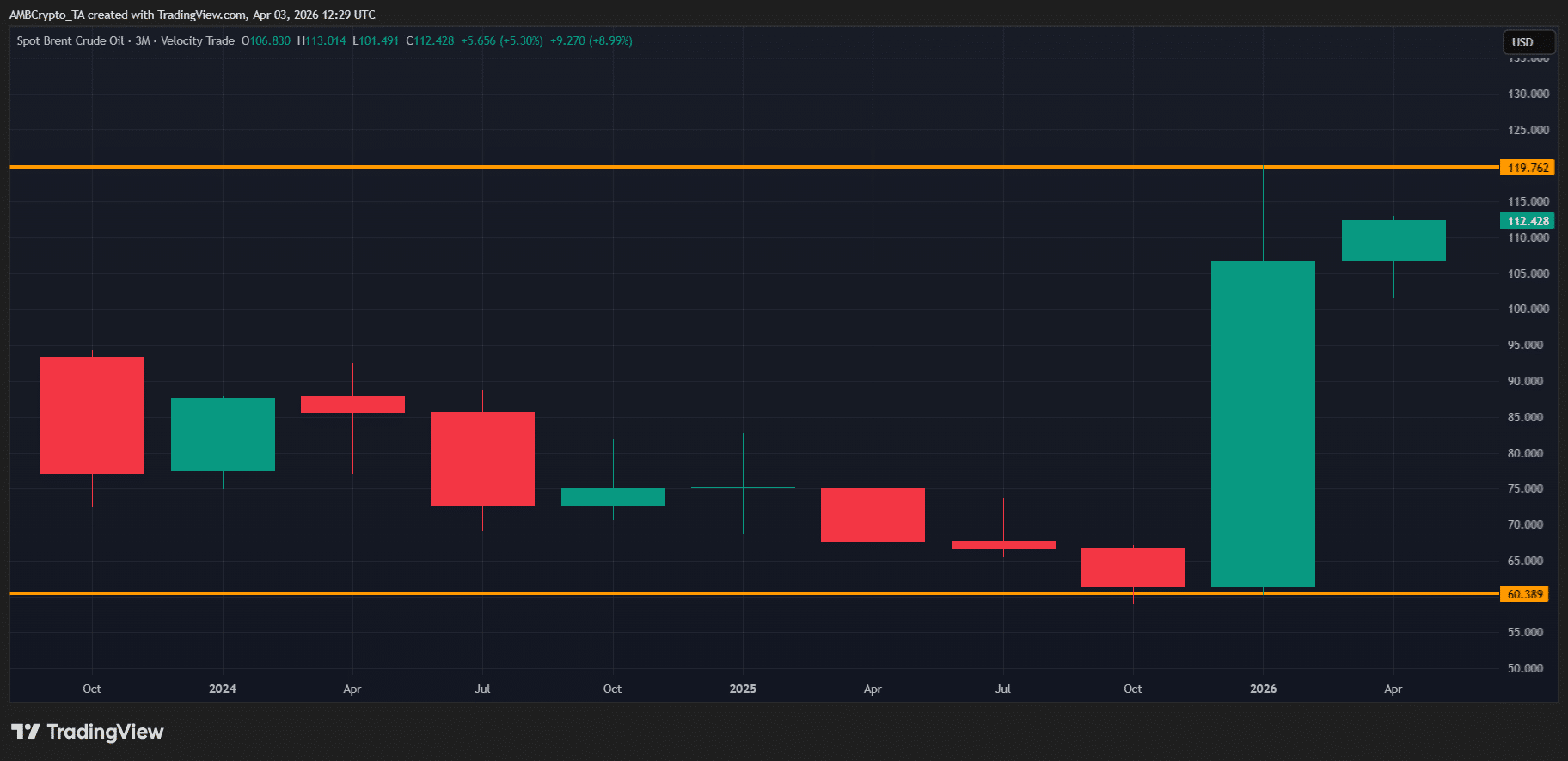
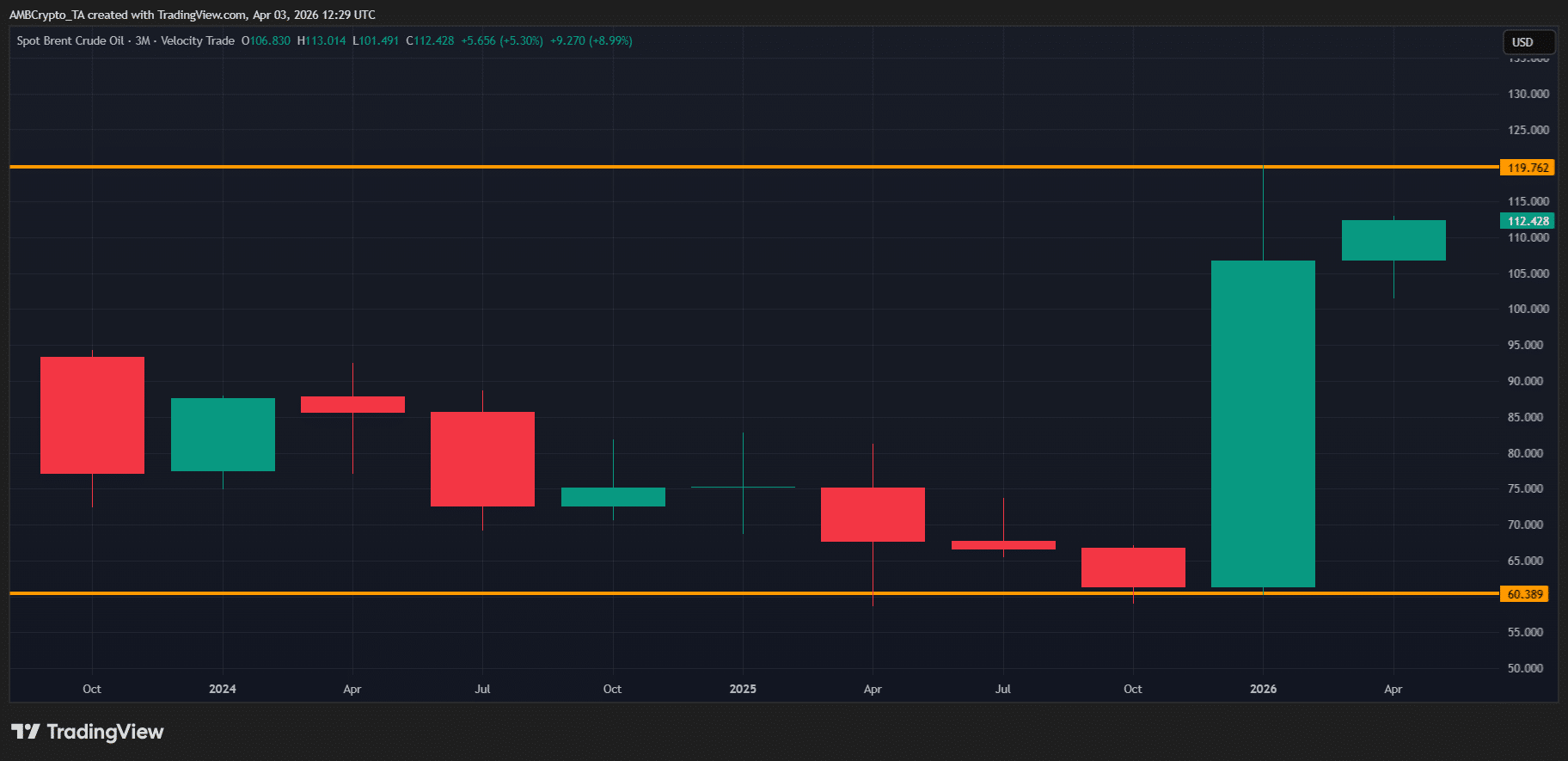
Source: TradingView (BRENT/USD)

According to AMBCrypto, that’s where President Trump’s recent post comes into play. With the escalation now official, analysts are expecting oil prices to surge towards $200 per barrel. In this context, Monday’s market reaction could be critical, with the odds of a sharp sell-off looking high.

Meanwhile, Bitcoin’s positioning index flipped negative, signaling that shorts are returning. This isn’t random. Instead, it’s a strategic move by traders, positioning for a potential downside in crypto once Monday’s session kicks off. With crypto heavily locked in a liquidity trap, even a small move could trigger sharp price swings, making the market extra sensitive to any catalyst.

Against this backdrop, President Trump’s post is now a key bearish trigger. Once Monday’s session begins, equities are set to react, putting crypto at high risk of a liquidation-driven bloodbath.


Final Summary

  • Q1 losses, negative positioning, and a liquidity trap are setting the stage for sharp downside moves.
  • President Trump’s post and surging oil prices could trigger a major market reaction on Monday.

Questions liées

QWhat was the overall performance of the crypto market in Q1, and how does it compare to Q4 2025?

AThe total crypto market cap was down nearly 21% in Q1, which extended the losses from Q4 2025 when it fell by about 24%.

QAccording to the article, what is the significance of the XAU/BTC ratio closing Q1 up almost 40%?

AThe XAU/BTC ratio's significant increase underlines Bitcoin's relative weakness as an asset compared to gold.

QWhy is the timing of President Trump's post considered so critical for the markets?

AThe timing is critical because the U.S. stock market was closed over the weekend, temporarily preventing an immediate liquidation cascade. The post is expected to trigger a major market reaction when trading resumes on Monday.

QWhat key factor, besides Trump's post, is identified as a major driver of risk asset performance and a threat to crypto?

ASurging oil prices, driven by the ongoing Middle East conflict and a potential supply squeeze from the Strait of Hormuz, are a major driver putting pressure on risk assets like crypto.

QWhat does the shift in Bitcoin's positioning index to negative signal, according to the analysis?

AThe shift to a negative positioning index signals that traders are opening short positions, strategically preparing for a potential downside move in the crypto market once Monday's trading session begins.

Lectures associées

Notes de huit ans d'entrepreneuriat du partenaire IA d'a16z

En 2018, bien avant l'émergence du GPT, l'auteur a fondé Rosebud AI avec la vision de rendre la création aussi simple que de jouer à un jeu. Travaillant initialement avec des modèles comme CycleGAN et StyleGAN, il a exploré le potentiel des médias synthétiques et développé des outils créatifs alimentés par l'IA, tels que TokkingHeads, qui a atteint plus de 2 millions d'utilisateurs. Au cours de ces 8 ans, l'accent a été mis sur la conception d'expériences utilisateur qui masquent les limitations des modèles précoces, en misant sur des solutions "approximatives mais utilisables". La pandémie et les crises bancaires ont rappelé la fragilité de l'écosystème, mais aussi le privilège de pouvoir innover. Avec l'avènement du GPT-4 en 2023, la génération de code est devenue suffisamment mature pour permettre la création des jeux via prompt. L'auteur souligne que les jeux représentent un terrain idéal pour l'IA générative, car ils combinent intuition créative et technicalité, tout en restant en dehors des priorités immédiates des grands labos de recherche. Aujourd’hui, l'auteur rejoint a16z en tant que partenaire pour investir dans la pile de modèles frontière et les infrastructures d'IA. Il passe le flambeau de Rosebud AI à un nouveau CEO, tout en restant convaincu que la prochaine phase de l'IA générative ne dépendra pas seulement des avancées techniques, mais de leur intégration produit, distribution et monétisation dans le monde réel.

marsbitIl y a 9 mins

Notes de huit ans d'entrepreneuriat du partenaire IA d'a16z

marsbitIl y a 9 mins

Turbulences sur le marché crypto : qui achète à contre-courant ?

Le marché crypto a connu une correction sévère au premier trimestre 2026, avec Bitcoin en baisse de plus de 25 % et Ethereum de 35 %. Pourtant, les flux institutionnels sont restés robustes, marqués par une forte dichotomie. Les acheteurs institutionnels ont été actifs : Strategy (ex-MicroStrategy) a accru ses réserves de Bitcoin pour atteindre 815 061 BTC, tandis que des fonds souverains comme Mubadala ont augmenté leurs positions dans les ETF Bitcoin. Plusieurs nouveaux ETF ont été lancés, notamment par Morgan Stanley (MSBT, premier ETF Bitcoin d'une grande banque) et BlackRock (ETHB, premier ETF de staking d'Ethereum). Les banques européennes ont formé un consortium pour un stablecoin euro (Qivalos), et des institutions comme UBS et Citi ont élargi leurs services crypto. À l’inverse, certains hedge funds (Brevan Howard, Tudor) et mineurs ont massivement vendu. Les investissements en capital-risque ont chuté de 49 % en nombre de transactions, mais trois méga-deals (BVNK, Kalshi, Polymarket) ont représenté la moitié des fonds levés (environ 34 milliards de dollars). Les secteurs dominants sont les paiements/stablecoins et les marchés prédictifs, supplantant la DeFi. En résumé, l’accumulation institutionnelle se poursuit, portée par les trésoreries d’entreprise, les fonds souverains et les nouveaux produits ETF, tandis que le risque se concentre sur quelques acteurs majeurs.

marsbitIl y a 2 h

Turbulences sur le marché crypto : qui achète à contre-courant ?

marsbitIl y a 2 h

Test pratique de Hunyuan Hy3 preview : L'IA de Tencent est-elle enfin compétitive ?

Le modèle de langage Hy3 preview de Tencent, récemment lancé en open source, présente des capacités améliorées en raisonnement complexe, génération de code, compréhension contextuelle et interaction naturelle. Avec 295 milliards de paramètres et une prise en charge de contexte jusqu'à 256K, il est présenté comme le modèle le plus performant de la série Hunyuan. Les tests montrent des forces dans le raisonnement logique structuré et l'extraction d'informations en contexte bruité, mais une certaine instabilité face aux pièges logiques ou aux questions ambiguës. En génération de code et en tant qu'agent intelligent (via WorkBuddy), il excède dans les tâches simples et fermées (comme créer un jeu Snake) mais peine à mener à bien des missions complexes nécessitant une analyse approfondie et une livraison complète de résultats. Ses progrès les plus notables concernent le dialogue naturel et l'écriture créative, où il produit des textes fluides, moins stéréotypés et mieux contextualisés, imitant même des styles littéraires spécifiques avec succès. Bien que Hy3 preview ne soit pas révolutionnaire dans tous les domaines, il se positionne comme un modèle pratique et polyvalent. Son lancement marque un virage important pour Tencent, qui cherche à rattraper son retard perçu dans la course à l'IA et à intégrer un modèle performant dans son écosystème de produits (QQ, Tencent Docs, etc.). Une version plus grande est attendue prochainement.

marsbitIl y a 4 h

Test pratique de Hunyuan Hy3 preview : L'IA de Tencent est-elle enfin compétitive ?

marsbitIl y a 4 h

Trading

Spot
Futures
活动图片





