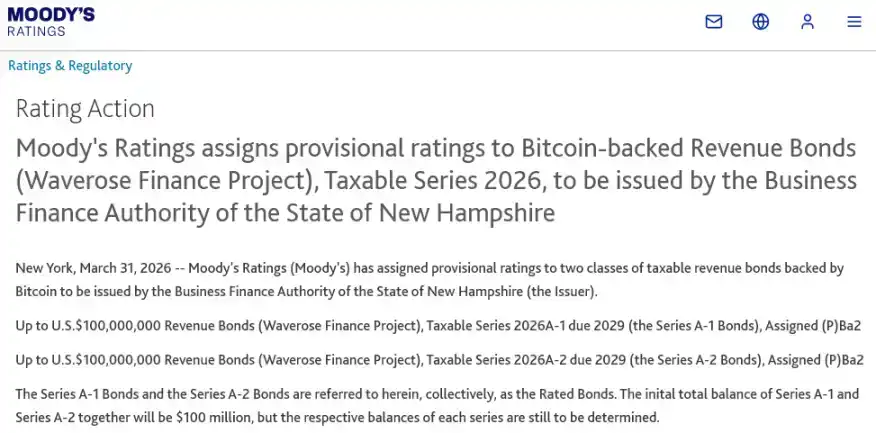
On March 31, Moody's Ratings assigned a provisional credit rating of Ba2 to a Bitcoin-collateralized bond issued by the New Hampshire Business Finance Authority (BFA). This marks the first time in history that a traditional rating agency has conducted a credit assessment for a Bitcoin-collateralized municipal bond.
What is This Bond
This is a $100 million Bitcoin-backed taxable revenue bond linked to the Waverose Finance Project, divided into two series, 2026A-1 and 2026A-2, both maturing in 2029.
The bond was structured by Wave Digital Assets, with Rosemawr Management serving as the investment manager and Orrick providing legal services. The fees BFA receives from the transaction will be used to create a "Bitcoin Economic Development Fund."
The core of the bond structure lies in its independence from any entity's cash flow, relying directly on Bitcoin as collateral for repayment. The Bitcoin collateral is custodied by BitGo Trust Company, Inc. and held in regulated cold storage.
When the borrower needs to pay interest or repay principal, the collateral will be liquidated to cover the expenses. The bond also includes a clause relatively favorable to holders. Series A-2 holders are entitled to receive an additional share of BTC profits after full repayment of principal and interest if the price of Bitcoin is higher than the pricing date at maturity.
Compared to Bitcoin lending tools on platforms like Coinbase, the most significant aspect of this bond is that it provides cryptocurrencies with their first opportunity to enter the public bond market for financing. Borrowers no longer rely on private loans from centralized platforms but instead, through publicly rated bonds with traditional credit ratings, leverage institutional funds on a large scale and at low cost within a compliant framework.
How Institutions Assess Bitcoin's Risks
Moody's stated in its report that the provisional rating primarily reflects risks related to collateral, structure, and operations, with Bitcoin's high volatility being the primary consideration.
To hedge against price fluctuations, the issuance structure introduced a 1.6x over-collateralization requirement, meaning the value of BTC collateral must always remain at least 160% of the debt exposure.
If the collateral ratio falls to the 1.4x trigger line (i.e., LTV deteriorates to approximately 71%), a mandatory full redemption mechanism will be triggered, causing the bond to mature early and the Bitcoin to be liquidated for repayment.
In other words, for every $100 borrowed, at least $160 worth of Bitcoin must be collateralized. If the collateral value shrinks to below $140, the system triggers forced repayment, the bond matures early, and the Bitcoin is sold to repay the debt.
To assess conservatism, Moody's used a 72% advance rate and a shorter liquidation window in its rating report, simulating an extreme scenario where Bitcoin's price drops approximately 28% from the pricing date. Tests showed that the 1.6x initial over-collateralization and 1.4x trigger mechanism still provide sufficient protection, supporting the Ba2 rating outcome.
This parameter design is quite conservative, but for an asset with historical drawdowns often exceeding 50%, this conservatism may also be a prerequisite for Moody's willingness to issue a rating.
Another noteworthy detail is that although this bond bears the name of the New Hampshire Business Finance Authority, it has no connection to the state's public credit. Moody's explicitly stated in its report that no public funds from the state can be used to repay this bond.
The issuer acts as a "conduit issuer" in the structure, providing issuance channels and nominal endorsement but assuming no credit guarantee responsibility.
This structure is not uncommon in the traditional municipal bond field and is often used for financing special projects such as healthcare and education.
Why This Transaction is Important
To understand the historical significance of this bond, it must be viewed in a broader context.
Over the past few years, institutional attitudes toward Bitcoin have gone through three stages: from exclusion, to holding it as an asset (BTC reserves on corporate balance sheets), to using it as collateral for financing (pledging BTC for fiat loans). This bond represents the beginning of the fourth stage: Bitcoin, as the underlying collateral for publicly rated debt instruments, has entered the track of traditional public financial markets.
This track signifies three things: opening a window for institutional investors to indirectly gain Bitcoin exposure through compliant channels; prompting Moody's to begin establishing a rating methodology for crypto collateral, attracting more rating agencies to follow suit; proving that Bitcoin can, under certain conditions, serve as the underlying logic for "interest-bearing assets," not just zero-interest holdings.
This bond is not an isolated event. Concurrently, the U.S. Department of Labor, pursuant to President Trump's executive order, released a proposal to expand the availability of digital assets in retirement investment portfolios; multiple states are considering "Bitcoin strategic reserve" legislation; New Hampshire is also the first state in the U.S. to pass a cryptocurrency reserve law.
The Ba2 rating, frankly, is "junk bond" level, but this label itself can be misleading. In Moody's rating sequence, Ba2 is the second tier of speculative grade, still quite distant from the bottom (C/D).
Tesla did not receive investment-grade ratings from S&P and Moody's until between 2022 and 2023; Ford still maintains a speculative grade (Ba1) in Moody's system and barely holds the lowest investment grade with a negative outlook in S&P's system. This does not prevent them from being important allocation targets for institutional investors.
Secondly, the fact that this bond received Ba2 rather than a lower rating itself indicates that the 1.6x over-collateralization plus the forced liquidation mechanism passed the relevant scenario simulations in Moody's stress tests. Thus, Ba2 reflects the conservatism of the structural design, not a simple dismissal of the Bitcoin asset itself.
Looking at historical precedents, the first MBS (mortgage-backed security) and the first green bond similarly started at similar points when entering the rating system. As pricing experience accumulated and structures matured, ratings often improved accordingly. In this sense, Ba2 is merely a starting point.




















