After a Missile Hit an Amazon Data Center

marsbitPublié le 2026-04-03Dernière mise à jour le 2026-04-03

Résumé

On April 3, a missile reportedly struck an Amazon data center in Bahrain, following similar attacks on its facilities in the UAE and Bahrain in early March. These incidents highlight how large-scale data centers are becoming strategic targets in conflict zones. The attacks caused significant service disruptions, including banking, payment, and food delivery outages, and revealed limitations in redundancy systems. Physical damage and service recovery are expected to take weeks, with direct losses estimated in the billions of dollars. Data centers are not only costly—up to $50 billion per GW for AI facilities—but also critical digital infrastructure. Major tech firms like Amazon, Microsoft, Google, and Meta plan to invest heavily in the Middle East, with Saudi Arabia alone securing over $21 billion in data center commitments. However, rising geopolitical risks may shift future investments to more stable regions. While the current impact on global computing capacity is limited, the attacks may lead to higher costs due to increased security measures, multi-region backup requirements, and rising energy and insurance prices. Experts suggest that the growing strategic value of data centers makes them vulnerable, and future expansion may prioritize safety over low-cost advantages.

On April 3, multiple foreign media outlets, including the Financial Times, cited insider sources reporting that an Amazon data center in Bahrain had been hit by a missile strike.

The day before the attack, entities and related assets operated by Silicon Valley giants in the Middle East, including 18 US companies such as Microsoft, Apple, Google, and Meta, had been warned of the risks.

Just in early March, two other Amazon data centers in Bahrain and the UAE had also been attacked.

The targeting of hyperscale data centers in conflict zones signifies that they have become highly "tempting" strategic targets—according to public data, the total investment for a 1GW data center exceeds $50 billion.

It is important to note that the destruction of a data center is not just about physical damage or losses amounting to tens of billions of dollars in assets. As critical infrastructure, being attacked could also impact the internet and artificial intelligence development progress of a country or region.

01 Your Takeout Order Is Offline

The most direct consequence of a data center being bombed is the interruption of related services.

During the first attack in early March, two of the three AWS data center "availability zones" in the UAE went offline simultaneously, causing widespread paralysis of local internet services.

Online services for Abu Dhabi Commercial Bank and Emirates NBD were interrupted, the payment platform Hubpay became unusable, and the food delivery app Careem was paralyzed. Millions of users relying on these digital services found that their wallets, ride-hailing apps, and business operations were rendered inoperable due to the data center shutdown.

Although AWS has always emphasized redundant design in its data centers—where backups automatically take over if one facility fails—the redundancy mechanism largely failed to function this time as multiple facilities were hit simultaneously.

It is worth noting that physical damage includes structural collapse, power supply interruption, fires, and secondary water damage caused by activated fire suppression systems. Amazon explained on its service health dashboard that the rebuilding and recovery process for the data centers would be "very prolonged," with some services taking weeks to restore.

For the operators and owners of data center assets, physical damage is directly linked to economic losses.

Building a traditional data center costs an estimated $7 to $12 million per MW. For AI data centers equipped with the latest Blackwell and Rubin chips and sophisticated power and cooling systems, the cost per GW, as mentioned earlier, can reach $50 billion.

Data disclosed by the US construction analysis firm ConstructConnect in February showed that the average cost of data centers breaking ground in 2025 would be $633 million.

Including the recently attacked Bahrain data center, the combined direct losses from physical damage, equipment replacement, and reduced revenue for the four AWS facilities are conservatively estimated to be in the billions of dollars.

Additionally, Amazon stated in emails to affected users that it would waive their usage fees for March, a move that could also dilute company profits in the short term.

02 Critical Infrastructure Within Range

Compared to the capital expenditures of tech giants, the losses from a single data center attack are "insignificant."

Public data shows that Amazon, Alphabet, Meta, and Microsoft plan to spend a total of $630 billion in 2026, a 62% increase from the $388 billion in 2025, with Amazon alone allocating $200 billion. About 75% of the combined expenditure (approximately $450 billion) will be directly invested in AI infrastructure.

A significant portion of these funds was originally planned for the Middle East.

From 2021 to 2024, the Middle East has been a hot region for cloud provider expansion. In early 2025, Saudi Arabia alone secured over $21 billion in data center investment commitments.

Among these, Microsoft plans to invest $15.2 billion in the UAE between 2023 and 2029, having already spent $7.3 billion on partnerships with G42 and infrastructure; Google, in collaboration with the Saudi Public Investment Fund, committed $10 billion to build a global AI hub; Amazon plans to invest an additional $5.3 billion in Saudi Arabia to establish a new region including an "AI Zone"; Oracle has invested $1.5 billion to expand its cloud footprint in Saudi Arabia and is deeply integrated with Nvidia to support sovereign AI projects.

US tech giants are building infrastructure in the Middle East partly to cater to local AI development plans and partly to court Middle Eastern capital, such as Gulf sovereign wealth funds.

Trump is also actively promoting the expansion of US data centers in the Middle East.

In May 2025, Trump led a delegation of tech giant executives, including Amazon CEO Andy Jassy and OpenAI CEO Sam Altman, to the Middle East, attempting to secure over $2 trillion in data center investment commitments through a vision of "turning from chaos to commerce."
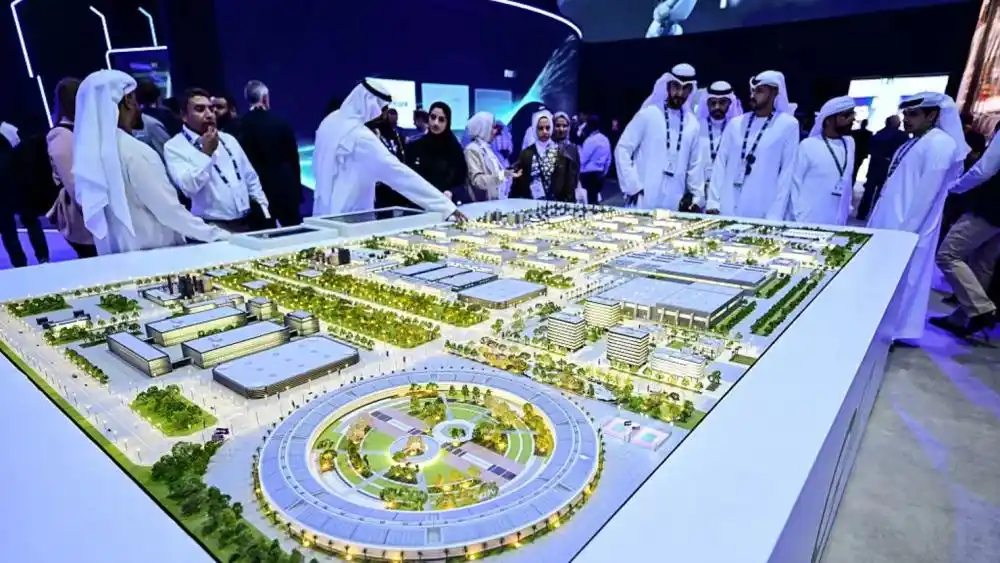
Model of the largest data center under construction in the UAE, part of the Middle East's version of the "Stargate Project"

The most notable among these is the "Stargate" super-large AI data center plan in Abu Dhabi. This project aims to leverage the Middle East's cheap energy and land to build the largest AI infrastructure outside the US mainland.

When data centers are endowed with such high strategic value, they inevitably become targets for attack.

Ioannis Kalpouzos, a visiting professor at Harvard Law School, believes that whether a data center should be a target depends on the facts at the time of the incident, not its past uses.

Kalpouzos explained: "If the facility is currently used to train large language models with strategic value, for example, by fine-tuning to optimize specific functions, then this might make it a potential target."

This "dual-use" attribute turns data centers from quiet power consumers into strategic "chokepoints." This also means that future data centers may no longer need just security guards and fences but will require specialized defense systems and counter-drone technology.

As Aalto University professor Vili Lehdonvirta stated, when state actors increasingly incorporate commercial cloud and AI into strategic operations, adversaries will view them as critical facilities. This makes data centers legally "transparent" and vulnerable. Once deemed to significantly enhance an adversary's strategic capabilities, the entire physical entity may be considered a legitimate target from the perspective of international law.

03 Uncertainty for Middle Eastern Computing Power

After the attack on the Amazon data center, will computing power prices rise? The short-term impact is limited.

Knight Frank's "Global Data Centre Report 2024-2025" pointed out that although the Middle East (especially the Gulf states) has strong capital and energy advantages, it currently accounts for only about 1% of the global operational third-party data center capacity share.

In other words, the current damage is not enough to cause a fundamental impact on the global supply of computing power.

Meanwhile, on Amazon's service health page, the company encouraged users to migrate some of their workloads to servers in Europe, North America, and the Asia-Pacific regions to somewhat alleviate the pressure caused by the regional outage.

However, in the medium to long term, computing power prices do face upward pressure, mainly from three channels.

The first is physical defense costs, which won't be elaborated on further here.

The second is multi-region backup. In the context of armed conflict, redundancy within a single geographic region is no longer sufficient to mitigate risks. If companies are forced to adopt disaster recovery solutions across regions or even continents, the cost of using cloud services will increase significantly.

The third is energy and insurance costs. Energy accounts for about 60% of data center operating costs. Conflict in the Middle East drives up oil and natural gas prices, and fluctuations in liquefied natural gas prices are directly reflected in electricity bills. Simultaneously, insurance premiums for data centers in high-risk areas may also increase.

Alok Mehta, Director of the Think Tank at the Center for Strategic and International Studies, said: This attack has changed how companies think about security. To maintain business continuity, enterprises are forced to adopt more expensive backup solutions. This investment in "digital resilience" is essentially a hidden markup on computing power.

It is worth noting that Knight Frank also predicted in its report that by 2030, data center capacity in the Middle East is expected to triple, reaching 3.3GW or even higher. The higher this capacity, the greater the losses from an attack will be magnified.

Although market institutions maintain optimistic expectations for future growth, the risk of conflict will also alter the calculation models of data center investors. Future incremental investments will face stricter cost-benefit assessments.

The judgment of Patrick J. Murphy, Executive Director of the Geopolitics Department at Hilco Global, and others is that the focus of the next wave of computing power construction may shift to regions with more predictable security situations.

04 In Conclusion

From the UAE to Bahrain, the repeated attacks on data centers as civilian facilities within a month are related to their status as critical infrastructure.

These data centers host almost everything from personal daily applications to commercial systems. When these facilities are attacked, the economy, daily life, and all industries, groups, and services operating on or related to them are directly affected.

In a way, the complex geopolitical environment has also taught tech companies a lesson—while investing hundreds of billions of dollars to expand computing power infrastructure, they must also reassess the associated physical security costs, whose value might soon surpass that of the chips themselves.

On this topic, I recall Musk's previously promoted space data centers and Microsoft's underwater data centers. Disregarding feasibility and construction timelines, is this unconventional construction approach the optimal solution to security concerns?

The answer might also be no.

This article is from the WeChat public account "Tencent Technology," author: Worth Watching

Questions liées

QWhat was the immediate impact of the missile strike on Amazon's data center in Bahrain?

AThe most direct result was the interruption of related services. For example, during a similar attack in March, two of the three AWS availability zones in the UAE went offline simultaneously, causing widespread paralysis of local internet services. This included the online services of banks like Abu Dhabi Commercial Bank and Emirates NBD, the payment platform Hubpay, and the food delivery app Careem, affecting millions of users.

QAccording to the article, what is the estimated total planned capital expenditure for Amazon, Alphabet, Meta, and Microsoft in 2026, and how much is allocated for AI infrastructure?

AThe four tech giants plan to spend a total of $630 billion in 2026, a 62% increase from the $388 billion in 2025. Approximately 75% of this combined expenditure, or about $450 billion, is allocated directly for AI infrastructure.

QWhy are large-scale data centers becoming attractive strategic targets in conflict zones according to the experts cited?

AExperts like Ioannis Kalpouzos from Harvard Law School suggest that a data center's status as a target depends on its current use. If the facility is used for training strategically valuable AI models, it could become a legitimate target. Vili Lehdonvirta from Aalto University adds that as state powers increasingly incorporate commercial cloud and AI into strategic operations, opponents will view these data centers as critical infrastructure, making them legally 'transparent' and vulnerable to attack.

QWhat are the three main channels through which the conflict could exert upward pressure on computing power prices in the medium to long term?

AThe three main channels are: 1. Increased physical defense costs. 2. The need for multi-region backup solutions, which are more expensive than single-region redundancy. 3. Rising energy and insurance costs, as conflict can drive up oil and gas prices (which affect electricity costs, ~60% of operational expenses) and lead to higher insurance premiums in high-risk areas.

QWhat shift in the focus of future computing power construction is predicted by analysts like Patrick J. Murphy following these attacks?

AAnalysts like Patrick J. Murphy, Executive Director of the Geopolitics Department at Hilco Global, predict that the focus of the next wave of computing power construction is likely to shift toward regions with more predictable security situations, away from high-risk conflict zones like the Middle East.

Lectures associées

La Banque d'Italie ne voit pas d'avantages systémiques des stablecoins dans les transferts

L'étude de la Banque d'Italie conclut que les stablecoins n'offrent pas d'avantage systémique durable en termes de coût et de rapidité pour les transferts d'argent. Les avantages potentiels sont annulés par les frais de conversion vers et depuis les monnaies fiduciaires et par l'efficacité des infrastructures de paiement locales. La recherche a comparé des transferts de 200 USDC sur 10 couloirs bilatéraux (Italie vers Brésil, Argentine, Japon, Émirats Arabes Unis, Afrique du Sud). Le coût total des transferts en stablecoins variait de 0,3% à près de 9%. Les délais étaient inférieurs à 20 minutes dans les pays dotés de systèmes de paiement instantané, mais pouvaient atteindre 1 à 2 jours ouvrables ailleurs. Les principaux coûts et retards sont liés au change de devises et à la qualité de l'infrastructure locale, plutôt qu'aux frais de blockchain. Bien que souvent moins chers que la moyenne mondiale des transferts (6,65%), les stablecoins n'étaient plus avantageux que dans 3 cas sur 7 par rapport au service Wise. Les auteurs estiment que l'utilité serait plus forte si les stablecoins pouvaient être dépensés directement, sans reconversion. Ils notent également qu'une réglementation trop restrictive complique l'usage pour les clients tout en n'éliminant pas la demande. Le marché des stablecoins a enregistré en juillet sa plus forte baisse mensuelle depuis l'effondrement de Terra, perdant plus de 10 milliards de dollars.

cryptonews.ruIl y a 48 mins

La Banque d'Italie ne voit pas d'avantages systémiques des stablecoins dans les transferts

cryptonews.ruIl y a 48 mins

Le « boom du Bitcoin » en plein essor : Une nouvelle déclaration de Saylor suscite des spéculations sur des achats

Michael Saylor, président exécutif de MicroStrategy (MSTR), a relancé les spéculations sur un nouvel achat de bitcoins par la société en publiant le message « Bitcoin Drive engaged » le 2 août, accompagné de son tableau de suivi habituel. Cette pratique précède généralement les annonces officielles du trésor. Le rapport affiché montrait que les réserves de MicroStrategy s'élevaient à 843 775 BTC, d'une valeur marchande d'environ 53,25 milliards de dollars, avec un prix d'acquisition moyen de 75 653 dollars et une perte non réalisée de 10,58 milliards de dollars. Cependant, le registre public en temps réel de la société indique deux ventes récentes totalisant 3 588 BTC, ramenant le stock de 847 363 à 843 775 BTC. Ces ventes, déclarées à la SEC, visaient à financer des dividendes d'actions privilégiées et à reconstituer les réserves en dollars, qui s'élèvent désormais à environ 3,75 milliards de dollars. La société a subi une perte opérationnelle de 8,33 milliards de dollars au deuxième trimestre 2026, en grande partie due à une perte non réalisée sur ses actifs numériques. La direction pourrait vendre jusqu'à 1,25 milliard de dollars de bitcoins supplémentaires pour ses obligations en cash. L'annonce attendue lundi révélera si le message « Bitcoin Drive » signale une reprise des achats d'accumulation, alors que MicroStrategy équilibre son énorme stock de bitcoins avec ses engagements financiers croissants.

cryptonews.ruIl y a 50 mins

Le « boom du Bitcoin » en plein essor : Une nouvelle déclaration de Saylor suscite des spéculations sur des achats

cryptonews.ruIl y a 50 mins

Le motif « Tête et Épaules inversé » sur le graphique du Bitcoin annonce une montée vers 67 200 $

Malgré un léger recul début août, les graphiques de prix, notamment celui du Bitcoin, forment un modèle de renversement baissier. Actuellement, le BTC oscille autour de 63 200 $, formant l'épaule droite de la classique figure inversée "tête et épaules". L'analyste Axel Kibard de TechCharts voit là la seule réelle raison d'optimisme à court terme pour les haussiers ce mois-ci. La question principale est de savoir si les acheteurs auront la force de pousser le Bitcoin vers le niveau clé de 67 000 $. Parallèlement, dans la paire ETH/BTC, un fond de renversement similaire a déjà été franchi à la hausse. L'Ethereum, en tendance haussière, se dirige vers un objectif technique de 0,0312, indiquant que les grands capitaux préfèrent actuellement investir dans l'ETH plutôt que dans le Bitcoin, ce qui draine la liquidité et les volumes nécessaires à une reprise rapide du BTC. Face au dollar, l'Ethereum teste prudemment le niveau de support à 1 875 $, une résistance qui, si elle est maintenue, pourrait ouvrir la voie vers 2 163 $. Cette force relative de l'ETH est un signal positif pour le marché, mais la situation reste tendue pour les détenteurs de Bitcoin. Soit le BTC suit l'exemple de l'ETH et monte rapidement au-dessus de 67 200 $ pour confirmer le renversement, soit le modèle échoue. Selon Kibard, si une attaque de la ligne de cou (neckline) n'intervient pas dans les prochains jours, les baissiers reprendront le contrôle et pousseront le Bitcoin vers des niveaux de support solides à 60 000 $, voire 58 000 $.

cryptonews.ruIl y a 50 mins

Le motif « Tête et Épaules inversé » sur le graphique du Bitcoin annonce une montée vers 67 200 $

cryptonews.ruIl y a 50 mins

Les actions des entreprises d'IA se négocient comme des « mèmes cryptos », tandis que le Bitcoin reste stable – Revue de la semaine

Cette semaine, l'attention financière s'est largement détournée du Bitcoin, relativement stable autour de 64 000 $, pour se concentrer sur une volatilité extrême dans le secteur des actions liées à l'intelligence artificielle (IA). Les marchés asiatiques, notamment en Corée du Sud, ont subi des chutes sévères, en partie déclenchées par la liquidation forcée du fonds « Situational Awareness » de Leopold Aschenbrenner, entraînant des pertes massives. Le secteur des semi-conducteurs et de l'IA montre des signes de surchauffe, suscitant des débats sur un éventuel ralentissement. Dans le domaine des cryptomonnaies, l'ambiance reste difficile. Plusieurs plateformes d'échange (BitMEX, BitMart) ont annoncé leur fermeture, tandis que d'autres entreprises comme Coinbase et Uphold procèdent à des réductions de personnel. MicroStrategy continue sa stratégie d'accumulation de bitcoins et de rachat de ses propres actions. Les discussions portent également sur les risques potentiels pour des écosystèmes comme Solana si des applications populaires (Pump.fun, Trade.xyz) décidaient de lancer leur propre blockchain. Par ailleurs, une faille de sécurité majeure concernant le portefeuille matériel Coldcard a été mise en lumière, rappelant les risques du self-custody. Enfin, le projet d'IA décentralisée Bittensor (TAO) a attiré l'attention de certains investisseurs de capital-risque, mais des mises en garde sont émises contre un possible engouement spéculatif similaire à celui pour les memecoins. La semaine a été marquée par des interventions macroéconomiques, comme celle de la Japon pour soutenir le yen, et par les anticipations concernant la politique de la Fed.

cryptonews.ruIl y a 1 h

Les actions des entreprises d'IA se négocient comme des « mèmes cryptos », tandis que le Bitcoin reste stable – Revue de la semaine

cryptonews.ruIl y a 1 h

Trading

Spot
活动图片





