a16z Crypto: 9 Charts to Understand the Evolution of Stablecoins

marsbitPublié le 2026-04-25Dernière mise à jour le 2026-04-25

Résumé

Stablecoins are evolving from trading instruments to core financial infrastructure, driven by regulatory clarity and increased adoption. Key trends include accelerated growth following the U.S. GENIUS Act and the EU’s MiCA framework, which spurred non-USD stablecoin activity. Consumer-to-business transactions are growing fastest, doubling in 2025, while stablecoin card usage has surged. Velocity has nearly doubled since 2024, indicating active use rather than passive holding. Geographically, Asia dominates volume, led by Singapore, Hong Kong, and Japan. Notably, domestic transactions now account for nearly three-quarters of payments, highlighting stablecoins' role as local payment mediums on global infrastructure. Non-USD stablecoins, like Brazil’s BRLA, are also gaining traction. The data suggests stablecoins are becoming ubiquitous payment tools—global in design but increasingly local in practice.

Author: a16z crypto

Compiled by: Jiahuan, ChainCatcher

Stablecoins have been finding their footing for years.

Initially, they were just a trading tool, a means to transfer dollars across exchanges. Then they evolved into a savings instrument, held rather than spent. Today, the data points in a new direction: stablecoins are increasingly becoming core financial infrastructure.

The following nine charts reveal the factors driving this trend.

Regulation Accelerates Market Growth

For most of their history, regulatory uncertainty limited institutional participation. Later, the GENIUS Act brought regulatory clarity. It didn't create this trend, but it amplified and accelerated it.
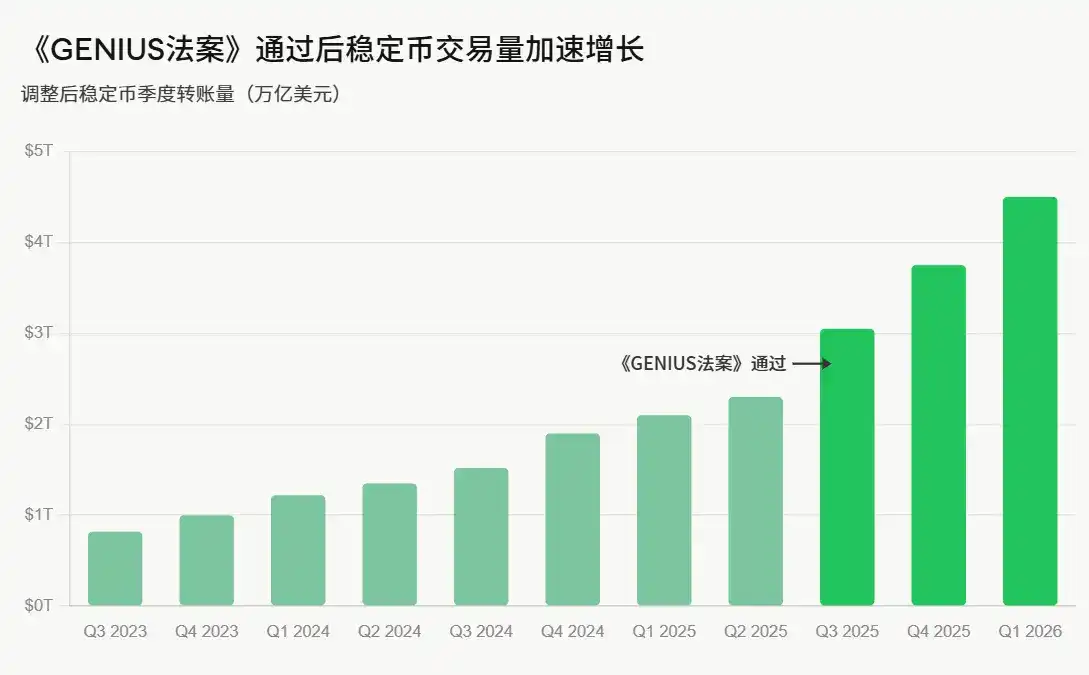
In the United States, the GENIUS Act established the first federal-level framework for stablecoin issuance. This shift is clearly visible in the data: adjusted trading volume had been rising for several quarters before the bill's passage, and growth accelerated further after its passage, reaching approximately $4.5 trillion in Q1 2026.

European regulation—the Markets in Crypto-Assets (MiCA) framework—tells a more complex story. When the法案 fully came into effect at the end of 2024, several major exchanges delisted USDT to comply, leading to a surge in activity for non-dollar stablecoins, which一度 exceeded $40 billion.
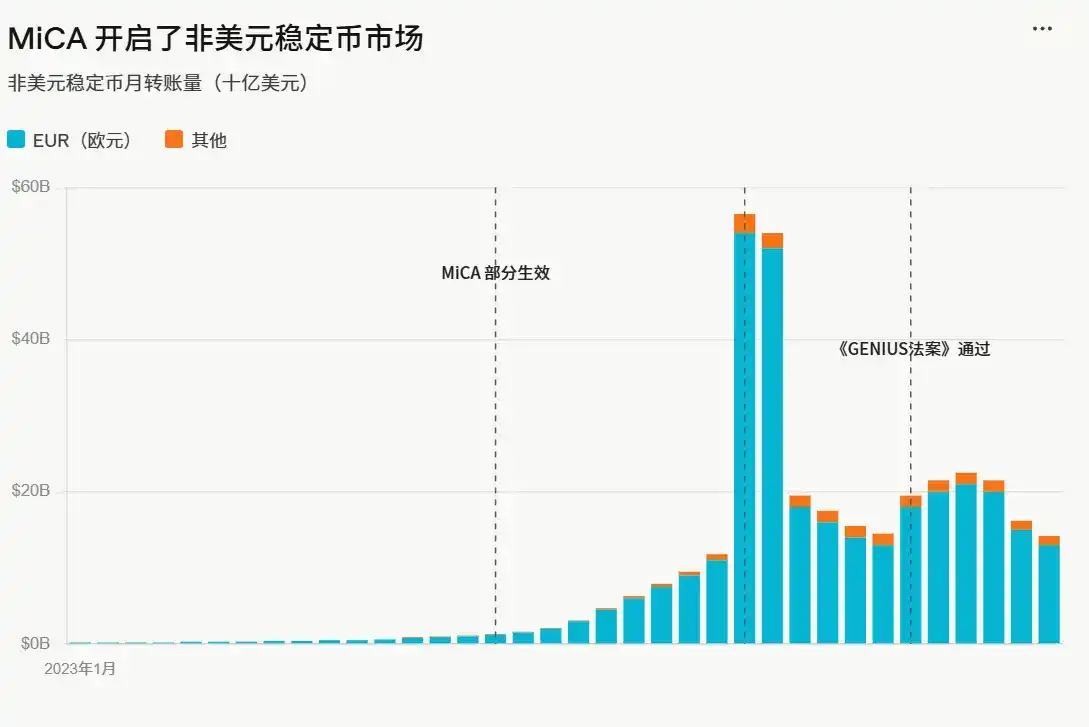
Since then, trading volume has stabilized at levels higher than the pre-MiCA baseline, around $15 billion to $25 billion per month. Regulation created a lasting market for non-dollar stablecoins that previously barely existed.

Stablecoin Commercial Activity is Growing

Perhaps the most noteworthy structural change lies in how people are actually using stablecoins.
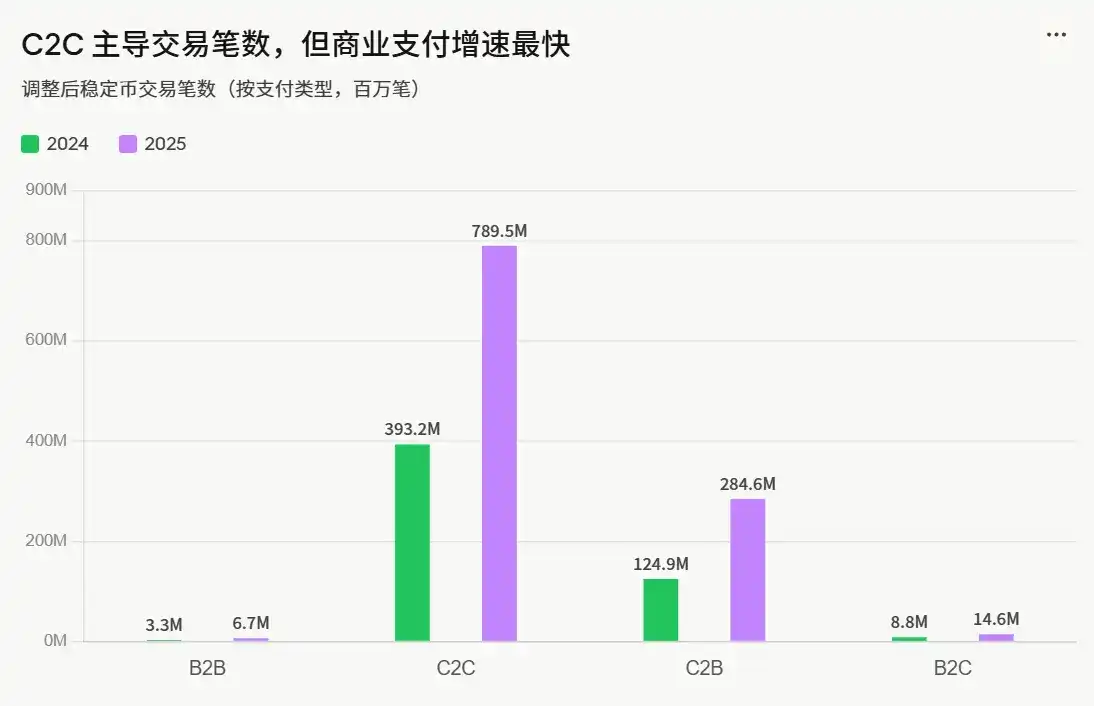
In terms of raw transaction count, the C2C category far surpasses all others: reaching 789.5 million in 2025. But Consumer-to-Business (C2B) stablecoin transactions grew the fastest, reaching 284.6 million in 2025 compared to 124.9 million in 2024, more than doubling year-over-year (+128%).

Data from stablecoin card infrastructure highlights this trend.
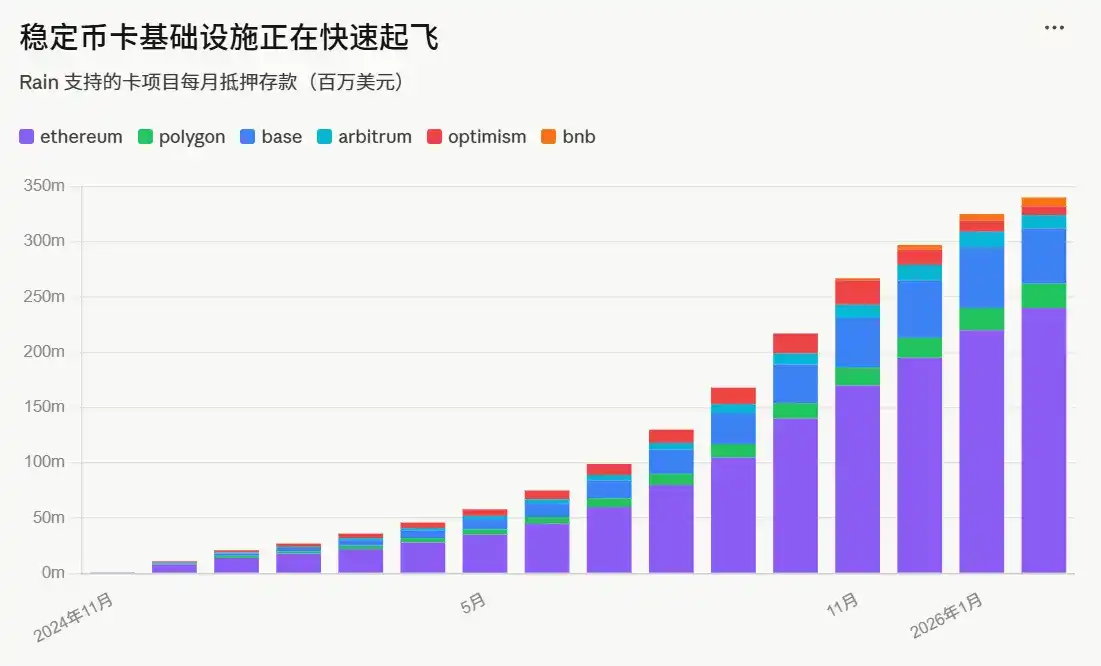
Monthly collateral deposits for stablecoin card programs supported by Rain (including Etherfi Cash, Kast, Wallbit, etc.) grew from nearly zero in November 2024 to over $300 million per month by early 2026. While this is collateral supporting spending, not direct spending of stablecoins, the trajectory is striking: stablecoin commercial activity is on the rise.

Stablecoin Velocity is Increasing

Every dollar of stablecoin supply is turning over more frequently.

Since early 2024, the velocity of stablecoins (the ratio of adjusted monthly transfer volume to circulating supply) has almost doubled, rising from 2.6x to 6x. An increase in velocity means demand for stablecoin transactions is outpacing new issuance, and the existing supply is working harder.
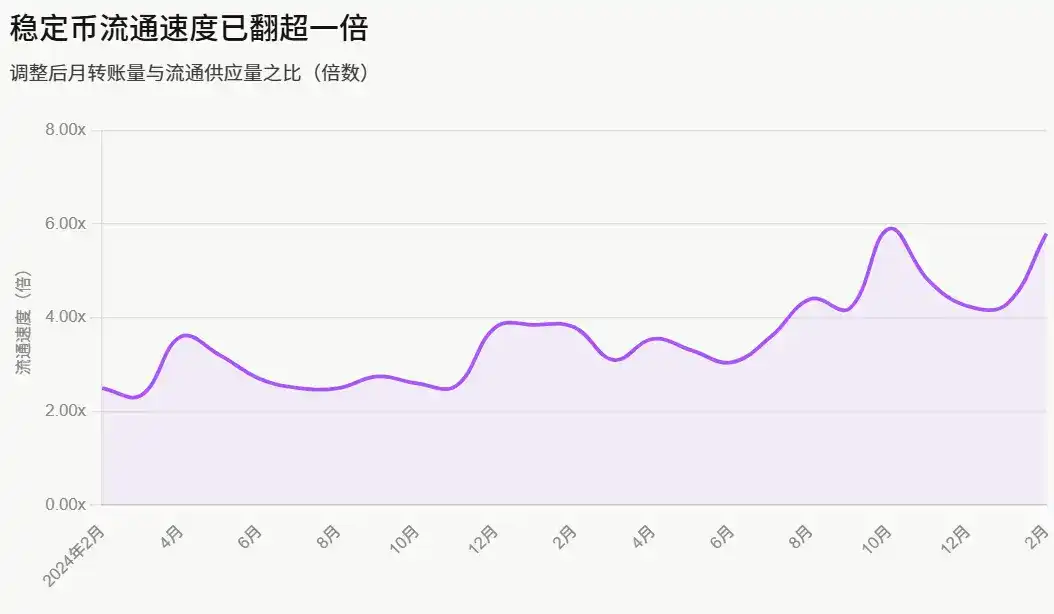
This is a hallmark of a true payment network—the base currency is being actively used, not just held.

Stablecoin Volume Reflects More Payments

If trading, fund flows, and exchange mechanisms—which make up the bulk of stablecoin transactions—are excluded, the estimated total for payments between different entities last year was still between $350 billion and $550 billion.

By volume, the Business-to-Business (B2B) sector dominates stablecoin payments (unsurprising given its scale). But other sectors, such as direct Consumer-to-Consumer (C2C) payments and interactions with merchants, are also expanding rapidly.

Stablecoin Payments are Currently Concentrated in Specific Regions

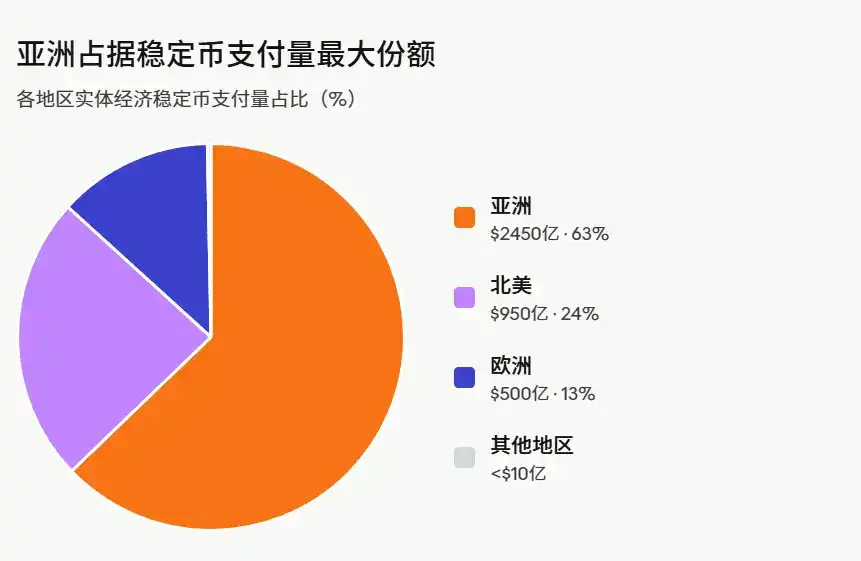
Geographically, stablecoin payment activity is not evenly distributed.

Nearly two-thirds of the transaction volume comes from Asia, primarily concentrated in Singapore, Hong Kong, and Japan.

North America accounts for about a quarter. Europe's share is around 13%. Latin America and Africa together make up only a very small portion, less than $1 billion.
Not Just Cross-Border Payments, But Local Currencies on Global Rails

The development of non-dollar stablecoins is not limited to Europe; it is also evident in emerging markets, driven by various factors.

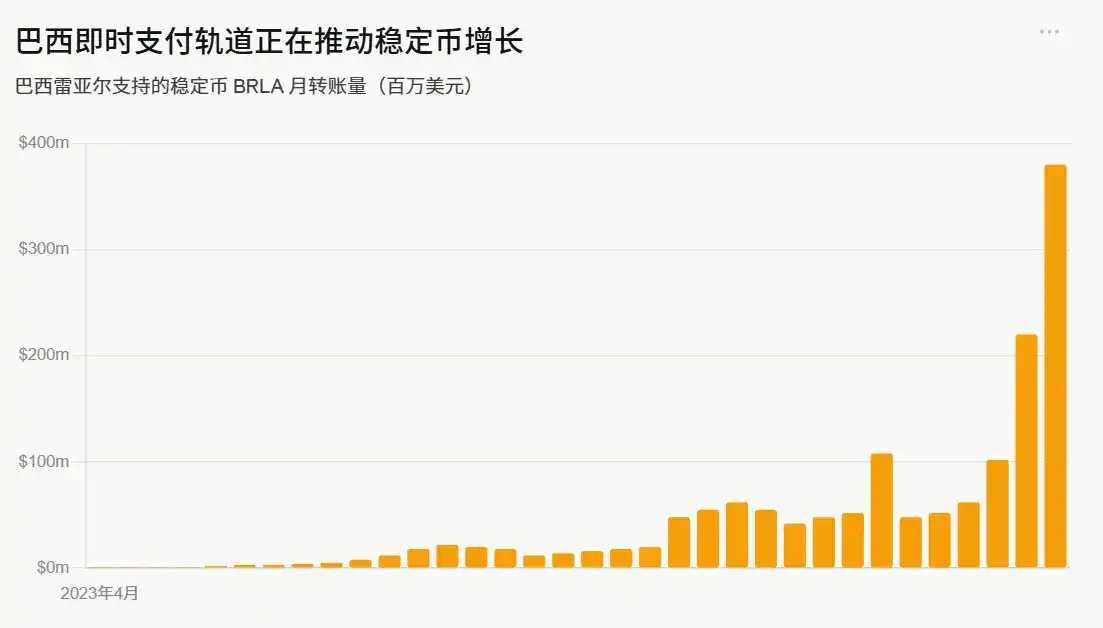
Brazil is a prime example. The monthly transfer volume of BRLA (a stablecoin backed by the Brazilian Real) has grown from nearly zero in early 2023 to about $400 million per month by early 2026. Access to the PIX instant payment network has driven its adoption.
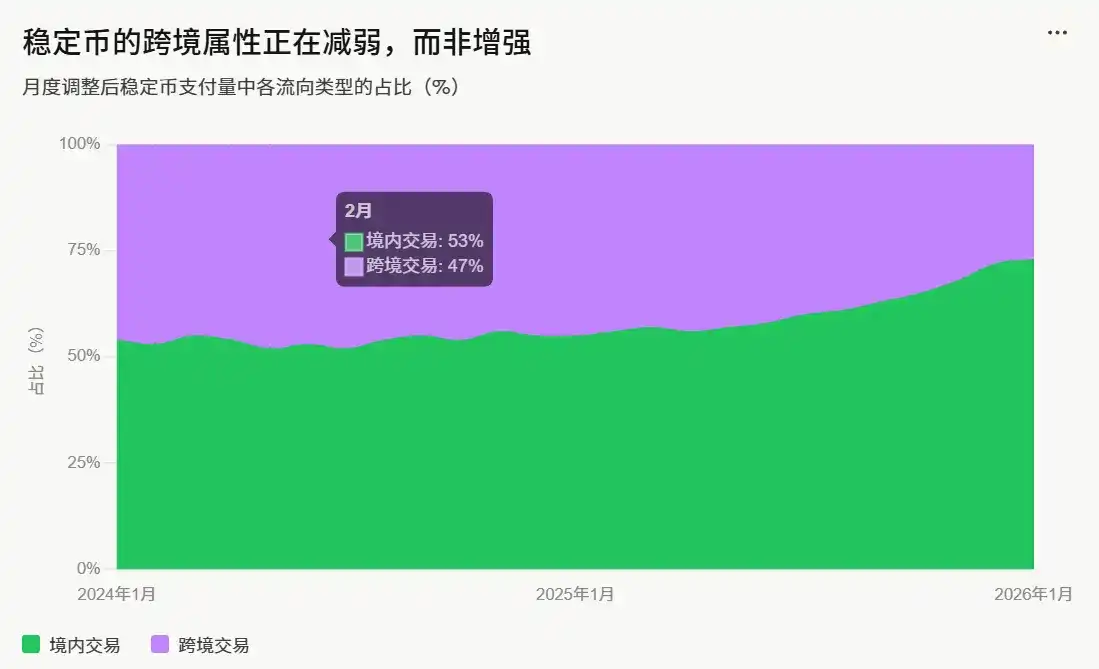
Although stablecoins are often described as cross-border tools, the proportion of cross-border activity has actually been declining, not rising.

Domestic transactions (stablecoin transfers occurring within the same country/region) have grown from about half of the payment volume in early 2024 to nearly three-quarters by early 2026. What does this mean? Stablecoins are not only establishing themselves as remittance or forex tools but also becoming a local payment medium running on global infrastructure.
Putting all these factors together, a clear picture emerges, though it's not the one most people expected: many thought stablecoins would be purely focused on cross-border transactions. Instead, they are becoming increasingly localized.

While the US dollar remains the core f币锚定 for the vast majority of stablecoins, stablecoins are by no means simply an export of the dollar. Non-dollar variants, such as euro-backed and Brazilian real-backed local currency stablecoins, are gaining popularity.

Although peer-to-peer (C2C) stablecoin transfers far exceed other types of payment flows in quantity, increasingly usage is flowing towards everyday consumption (C2B).

Each quarter's data provides more evidence that stablecoins are developing into general-purpose payment infrastructure. They are global by design but increasingly local in practice.

It's still early days. But the shape of this system is becoming clearer.

Questions liées

QWhat was the impact of the GENIUS Act on stablecoin trading volume in the US?

AThe GENIUS Act established the first federal-level framework for stablecoin issuance in the US. Before its passage, adjusted trading volume had been increasing for several consecutive quarters. After its enactment, growth accelerated further, reaching approximately $4.5 trillion in Q1 2026.

QWhich region accounts for the largest share of stablecoin payment volume, and which specific areas are the main contributors?

AAsia accounts for nearly two-thirds of the stablecoin payment volume. The main contributors are Singapore, Hong Kong, and Japan.

QWhat is the most significant structural change in how people use stablecoins, as indicated by transaction growth?

AThe most significant structural change is the growth in Consumer-to-Business (C2B) stablecoin transactions. This category saw the fastest growth, more than doubling (+128%) from 124.9 million transactions in 2024 to 284.6 million in 2025.

QWhat does the increasing velocity of stablecoins indicate about their use?

AThe increasing velocity of stablecoins, which nearly doubled from 2.6x to 6x since early 2024, indicates that the demand for stablecoin transactions is outpacing new issuance. It means the existing supply is circulating more frequently, which is a hallmark of a genuine payment network where the base currency is being actively used, not just held.

QContrary to common belief, what trend is observed in the proportion of cross-border stablecoin activity?

AContrary to the common belief that stablecoins are primarily for cross-border transactions, the proportion of cross-border activity has actually been decreasing. Domestic transactions (stablecoin transfers within the same country/region) grew from about half of the payment volume in early 2024 to nearly three-quarters by early 2026.

Lectures associées

Blocus des puces par les grandes puissances, les géants achètent des centrales nucléaires : pourquoi il faut sérieusement considérer la DeAI maintenant

En mai 2026, de nouvelles règles américaines d'exportation de puces AI, l'arrêt d'un centre de données géothermique au Kenya et les avancées de Huawei illustrent une réalité : la compétition pour la puissance de calcul dépasse désormais le secteur technologique. L'industrie de l'IA entre dans une ère d'oligopole, où quelques géants (NVIDIA, AWS, Microsoft, Google, OpenAI) contrôlent simultanément les puces, le cloud, les modèles et leur distribution. Cette concentration pose des risques systémiques : contrôle des prix, vulnérabilité des infrastructures, et création d'un "rideau de fer" géopolitique de l'IA, creusant les inégalités entre nations. Face à cela, l'IA décentralisée (DeAI) émerge comme une troisième voie. Son principe est de créer, via des protocoles ouverts et des incitations cryptographiques, un réseau mondial distribué de puissance de calcul, de données et de modèles. L'objectif est de briser les monopoles, répartir la pression énergétique, réduire les dépendances géopolitiques et offrir une alternative vérifiable et résiliente. Bien qu'encore naissante, la DeAI attire des investissements substantiels et son importance réside dans la création d'un contrepoids indispensable. L'histoire montre qu'un seul choix dans un secteur conduit inévitablement à des abus ; la compétition, elle, impose une forme de contrôle.

marsbitIl y a 31 mins

Blocus des puces par les grandes puissances, les géants achètent des centrales nucléaires : pourquoi il faut sérieusement considérer la DeAI maintenant

marsbitIl y a 31 mins

Évaluation d'Outpoll : une plateforme de marchés prédictifs conçue pour les traders actifs

Outpoll est une nouvelle plateforme de marchés prédictifs conçue spécifiquement pour les traders actifs. Elle cherche à combler le manque d'infrastructures de trading sophistiquées dans ce secteur en pleine croissance. **Fonctionnalités principales :** * **Outils de trading avancés :** Interface avec ordres à cours limité et au marché, ainsi que des fonctionnalités de prise de profit et de stop-loss automatiques. * **API publique :** API REST et WebSocket complète pour l'automatisation, la surveillance et l'intégration dans des outils existants. * **Marchés menés par des créateurs :** Des experts ou influenceurs peuvent créer et gérer leurs propres marchés sous la supervision de la plateforme, élargissant la couverture thématique. * **Intégration actualités/trading :** Un flux d'actualités est intégré à l'interface de trading pour une prise de décision contextuelle rapide. * **Transparence et sécurité :** Mécanisme de marché prédictif standard avec collatéralisation totale au niveau du contrat, règlement en USDC et règles de résolution claires. Les frais de transaction sont d'environ 0,1 %. * **Application mobile :** Une application Android native est disponible (iOS prévu plus tard dans l'année). En résumé, Outpoll se distingue par son ensemble d'outils professionnels, son API pratique, son mécanisme transparent et son approche pour élargir l'éventail des marchés via des créateurs. La plateforme est accessible mondialement sur outpoll.com.

marsbitIl y a 40 mins

Évaluation d'Outpoll : une plateforme de marchés prédictifs conçue pour les traders actifs

marsbitIl y a 40 mins

ChatGPT pourrait bientôt disparaître

OpenAI vient d'annoncer lors de sa conférence *Intelligence at Work* l'intégration prochaine de Codex, son application dédiée aux tâches productives, directement dans l'application ChatGPT. Cette fusion, qui interviendra dans les prochaines semaines, marque une étape clé dans la transformation de ChatGPT d'un outil de conversation en une « super-application » ou plateforme agentique unifiée. Cette décision s'appuie sur le succès rapide de Codex, qui compte désormais 5 millions d'utilisateurs actifs hebdomadaires, avec une croissance trois fois plus rapide chez les professionnels non-développeurs. Financièrement, les produits entreprise comme Codex représentent déjà 40% des revenus d'OpenAI. La stratégie est claire : évoluer du « chat » vers l'« exécution ». L'objectif ultime est de combiner ChatGPT (compréhension), Codex (exécution via des agents) et le navigateur Atlas (accès web) en une seule interface permettant d'accomplir des tâches complexes sur simple instruction verbale. Pour renforcer Codex, OpenAI a dévoilé trois grandes mises à jour : des *plugins* d'agents pour six rôles métiers intégrant des outils comme Salesforce ou Figa, la fonction *Annotations* pour modifier du contenu directement dans son contexte original, et *Sites* pour générer des applications web partageables depuis n'importe quel projet. L'article souligne que cette course a été largement motivée par le succès du concurrent Claude Code d'Anthropic, qui a forcé OpenAI à rattraper son retard dans le domaine de la programmation assistée par IA. Si Claude Code reste souvent perçu comme plus performant, Codex le concurrence sur le prix et les limites d'utilisation. En interne, cette fusion ressemble moins à ChatGPT absorbant Codex qu'à l'inverse : l'équipe et la vision produit de Codex prennent le lead sur l'avenir de la plateforme. Le nom ChatGPT, actif de marque immense, restera probablement, mais son essence évoluera fondamentalement vers un assistant exécutant capable de travailler en autonomie.

marsbitIl y a 1 h

ChatGPT pourrait bientôt disparaître

marsbitIl y a 1 h

Trading

Spot
Futures
活动图片