A 2.85% Minor Deviation, $27 Million in Liquidations: The Full Story of the Aave Price Oracle Incident

marsbitPublié le 2026-03-17Dernière mise à jour le 2026-03-17

Résumé

A brief 2.85% pricing deviation in wstETH collateral on Aave triggered approximately $27 million in liquidations. The incident occurred because Aave's risk oracle module (CAPO) used outdated parameters, temporarily valuing wstETH at around 1.19 ETH instead of its market price of ~1.23 ETH. This made some borrowing positions appear under-collateralized, activating the protocol's automatic liquidation system. While the event highlighted the fragility of DeFi oracle systems and how minor technical misconfigurations can lead to significant financial consequences, no bad debt was incurred by the Aave protocol itself. The core issue was not a failure of the primary price oracle or the wstETH token, but an internal configuration error within Aave's additional risk management layer. The incident underscores the critical importance of reliable oracle infrastructure and precise parameter synchronization in decentralized finance.

Written by: Cointelegraph

Compiled by: AididiaoJP, Foresight News

Key Summary

  • A brief 2.85% pricing deviation in wstETH collateral triggered approximately $27 million in liquidations on Aave. This event demonstrates that even minor technical issues in automated DeFi lending systems can lead to significant financial impacts.
  • This wave of liquidations occurred because the Aave system briefly valued wstETH at approximately 1.19 ETH, while its market value was near 1.23 ETH, causing some borrowing positions to be mistakenly judged as undercollateralized.
  • Price oracles are critical DeFi infrastructure, responsible for transmitting external market data to smart contracts to determine collateral value, assess loan health, and trigger automatic liquidations.
  • The root cause was not a failure of the price data source, but a misconfiguration of Aave's CAPO risk oracle module. Outdated smart contract parameters within this module set a temporary cap on the token's exchange rate.

DeFi protocols rely on automated logic to handle everything from collateral management to risk assessment. While this mechanism builds a truly open, permissionless financial system, it also means that minor technical problems can quickly escalate, causing severe financial turmoil.

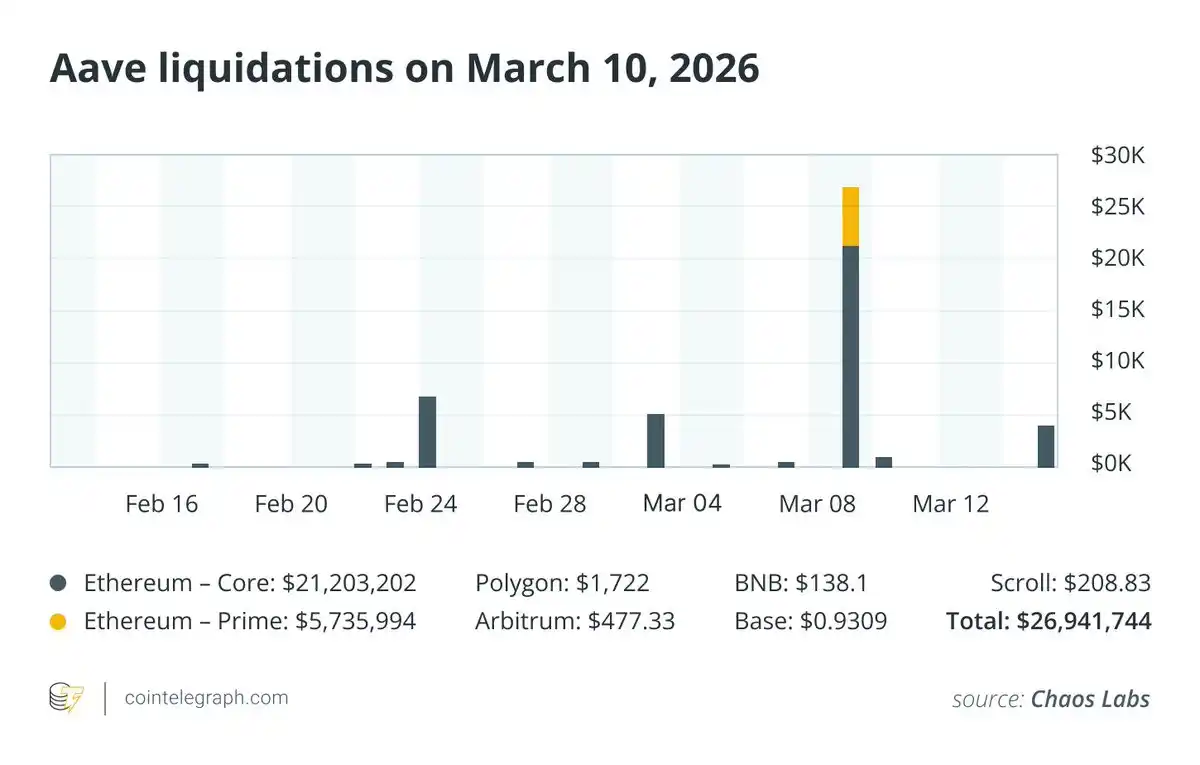
As reported by risk monitoring firm Chaos Labs, the market downturn on March 10, 2026, triggered approximately $27 million in borrower position liquidations on Aave, clearly demonstrating this fragility. Within 24 hours, user positions worth about $27 million were liquidated. Surprisingly, this event was not caused by a large-scale market sell-off but by a brief 2.85% price deviation in wrapped staked ETH (wstETH) collateral.

This event is a powerful reminder that the reliability of price oracles and a robust risk management framework are crucial for maintaining the stability of the DeFi ecosystem.

This article explains how a 2.85% pricing deviation in wstETH collateral triggered approximately $27 million in liquidations on the Aave lending protocol. It focuses on analyzing how oracle configuration, smart contract parameters, and automatic liquidation mechanisms amplified a minor pricing error in the DeFi market.

The Sudden Surge in Liquidations

When a wave of liquidations appeared on the Aave market, Chaos Labs, which closely monitors abnormal activity on lending protocols, quickly identified and reported the situation. Initially, market observers speculated that a price oracle failure might have caused the mispricing of collateral assets on the platform.

Price oracles play a key bridging role, providing external market prices for on-chain applications. In lending protocols like Aave, this price data directly determines whether a borrower's collateral is sufficient to cover their loan. Once the collateral value falls below the required safety threshold, the system automatically liquidates the position.

The core asset in this event was wstETH, a token widely used as collateral in the DeFi lending ecosystem.

Liquidation speeds on lending protocols like Aave are typically much faster than traditional margin calls. Because DeFi markets operate 24/7 through automated smart contracts, once the collateral ratio falls below the specified threshold, positions can be liquidated within seconds.

What is wstETH?

wstETH (wrapped staked Ether) is a token issued by the liquid staking protocol Lido.

When users stake Ether through Lido, they first receive stETH, a token representing their staked ETH principal and accumulated staking rewards. To enhance compatibility with various DeFi applications, stETH can be "wrapped" into wstETH.

Due to the continuous accumulation of staking rewards, the value of 1 wstETH is typically slightly higher than 1 ETH. This characteristic makes it an attractive and widely adopted type of collateral in the DeFi lending market.

The Pricing Deviation Event

During this liquidation wave, a deviation emerged between the actual market value of wstETH and the valuation used by Aave's risk system. Aave's algorithm priced wstETH at approximately 1.19 ETH, while the broader market valuation at the time was around 1.23 ETH.

The valuation difference of about 2.85% made positions collateralized with wstETH appear more undercollateralized than they actually were.

Consequently, some borrowing positions fell below the required safety threshold, triggering Aave's automatic liquidation process.
Why Price Oracles are Crucial in DeFi

Price oracles are the underlying infrastructure of DeFi. Because blockchains themselves cannot access real-world market data, they must rely on oracle services to provide external price information for assets. This price data directly impacts:

  • Valuation of collateral
  • Health of borrowing positions
  • Decision-making basis for triggering liquidations

Once a reported drop in collateral price occurs, the protocol may judge the loan as undercollateralized and automatically liquidate the relevant position.

Because this mechanism is entirely algorithm-driven, even minor pricing deviations can trigger serious chain reactions.

In the DeFi space, minor price deviations can also have huge impacts. Brief fluctuations in oracle prices or market prices, even by just a few percentage points, can trigger cascading liquidations. This risk is particularly pronounced when a large number of borrowers use highly leveraged positions collateralized by volatile cryptocurrencies.

The Real Cause: CAPO Risk Oracle Misconfiguration

In-depth investigation confirmed that Aave's main price oracle was functioning normally.

The problem actually lay in the "Correlated Asset Price Oracle" (CAPO) risk module, an additional protection layer for specific assets.

The primary function of CAPO is to set a rate cap on the value increase of yield-bearing tokens like wstETH, aiming to guard against sudden price spikes or potential oracle attack risks.

However, in this event, inconsistent configuration within the CAPO module led to the problem.

Technical Analysis of the Error

Chaos Labs disclosed that the problem stemmed from outdated parameters stored in the smart contract.

Two key parameters failed to update synchronously:

  • Reference exchange rate
  • Timestamp associated with that rate

Because these two parameters were not refreshed in sync, the CAPO calculated an allowed exchange rate cap that was temporarily lower than the actual market rate at the time.

This caused the protocol to value wstETH approximately 2.85% lower than the market price.

Aave relies on price oracles, which are data sources that provide real-time asset prices to smart contracts. If these data sources briefly reflect anomalous market prices from exchanges, the protocol automatically recalculates collateral values and may trigger liquidations.

The Chain Reaction of Liquidations

Once the collateral ratio fell below the safety threshold, Aave's automatic liquidation engine immediately activated.

Liquidators (typically high-speed trading bots) quickly stepped in, repaying part of the borrower's debt in exchange for the corresponding collateral at a predetermined discount.

In this event, a total of approximately $27 million in borrowing positions were liquidated.

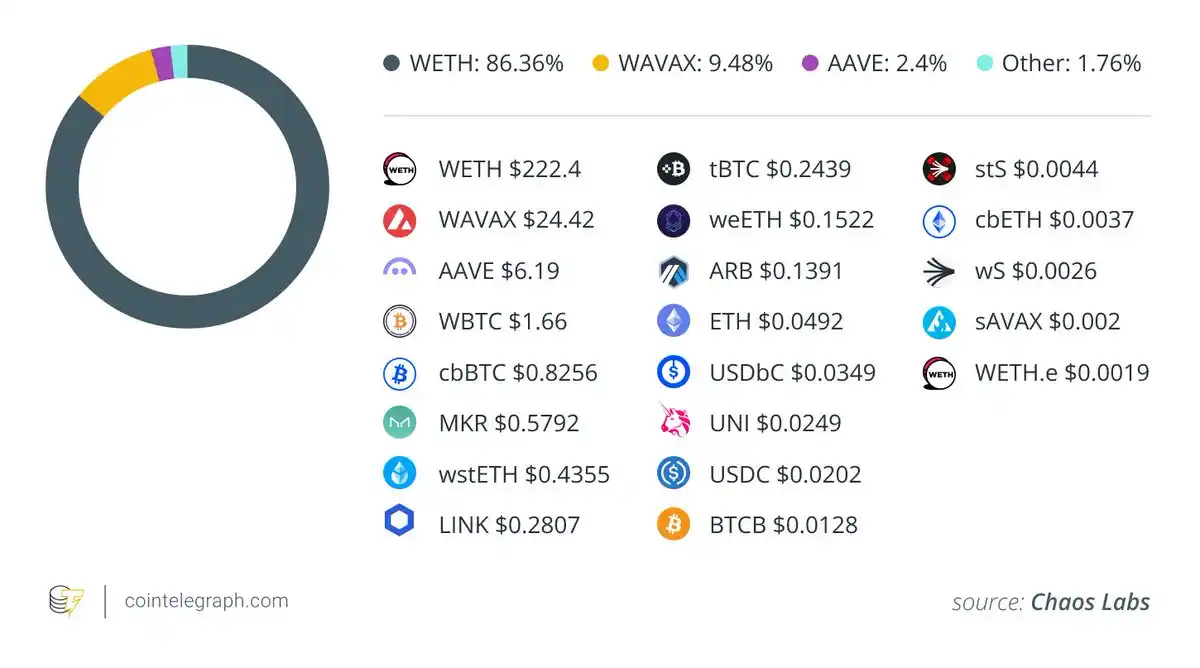
Liquidators exploited this brief price misalignment, collectively profiting about 499 ETH (including liquidation bonuses).
No Bad Debt Incurred by the Protocol

Despite the large scale of liquidations, the Aave protocol itself did not incur any bad debt. Aave founder Stani Kulechov stated, "No impact on the Aave protocol."

Chaos Labs pointed out that once positions breached the safety threshold, the platform's core risk control and liquidation mechanisms all operated as designed. Therefore, the impact of this event was limited to the relevant borrowers and did not threaten the overall solvency and stability of the Aave protocol. It was the brief, artificial depression of the collateral value that caused some borrowing positions to fall below the liquidation line.

The Aave governance layer subsequently proposed compensating affected users by utilizing recovered funds and the Decentralized Autonomous Organization (DAO) treasury. This approach reflects a new trend in DeFi governance: protocols are beginning to view such technical events as systemic infrastructure risks and tend to compensate受损 users rather than having them bear the full loss.

Another Warning on DeFi Oracle Risks

This event highlights that oracle mechanism design is both one of the most critical links in DeFi infrastructure and one of its most vulnerable weak points.

When automated mechanisms manage tens of billions of dollars in collateral value, even minor configuration errors can trigger consequences far exceeding expectations.

Similar events have occurred on other DeFi platforms. For example, one platform once briefly valued Coinbase's wrapped staked ETH (cbETH) at approximately $1 (actual value ~$2200) due to an oracle configuration error, causing widespread chaos.

These cases all indicate that maintaining reliable, accurate price data sources remains an ongoing challenge in decentralized financial systems.

wstETH and Lido Itself Are Not Responsible

Contributors related to the Lido ecosystem clearly stated that these liquidations were not caused by any failure or defect in the wstETH token itself.

The token functioned normally throughout the event, and the underlying Lido staking protocol remained fully available and unaffected.

The core of the problem lay in how the Aave lending protocol, through its own risk management configuration, processed and interpreted the price data, which deviated.

Implications for the Development of DeFi

As decentralized finance continues to develop, protocols are deploying increasingly sophisticated risk management systems to accommodate yield-bearing assets like wstETH.

These assets present unique pricing challenges because their value continuously grows with the accumulation of staking rewards.

Therefore, effective risk models must properly handle the following elements:

  • Dynamically changing exchange rates
  • Continuously accumulating staking rewards
  • Time-dependent parameter updates
  • Precise synchronization of various smart contract parameters

Even minor inconsistencies between these elements can escalate into large-scale liquidation events.


Questions liées

QWhat was the primary cause of the $27 million liquidation event on Aave, and what specific asset was involved?

AThe primary cause was a 2.85% pricing discrepancy in the wstETH (wrapped staked ETH) collateral valuation. Aave's risk oracle module, CAPO, temporarily valued wstETH at approximately 1.19 ETH, while its actual market value was around 1.23 ETH. This mispricing caused some borrowing positions to be incorrectly flagged as under-collateralized and subsequently liquidated.

QWhat is the role of a price oracle in a DeFi lending protocol like Aave?

AA price oracle is critical infrastructure that provides external market data to on-chain applications. In lending protocols, these price feeds are used to determine the value of collateral, assess the health of loans, and trigger automatic liquidations if the collateral value falls below a required safety threshold.

QWhat specific technical failure within Aave's system led to the wstETH mispricing, and what module was responsible?

AThe failure was not in the main price oracle but in the CAPO (Correlated Asset Price Oracle) risk module. The issue was caused by outdated smart contract parameters—specifically, a reference exchange rate and its associated timestamp that were not updated in sync. This configuration error caused the CAPO module to calculate a temporary cap on the wstETH exchange rate that was lower than the actual market rate.

QDespite the large-scale liquidations, what was the impact on the Aave protocol's financial health?

AThe Aave protocol itself did not incur any bad debt from this event. The core risk management and liquidation mechanisms functioned as designed once positions were deemed under-collateralized. The financial impact was limited to the affected borrowers, and the overall solvency and stability of the Aave protocol were not threatened.

QWhat does this incident reveal about the broader challenges and future development of DeFi?

AThe incident highlights that oracle reliability and robust risk management frameworks are paramount in DeFi. It demonstrates that even minor technical misconfigurations can be amplified by automated systems, leading to significant financial consequences. For future development, it underscores the need for sophisticated risk models that can accurately handle dynamic exchange rates, staking rewards, time-dependent parameter updates, and precise synchronization of all smart contract parameters, especially for yield-bearing assets like wstETH.

Lectures associées

La narration du BTC en tant qu'« or numérique » a-t-elle échoué ?

**Résumé en français :** L'article aborde la récente chute brutale du Bitcoin (plus de 50% depuis son pic de 2025) pour explorer la solidité de son récit de "l'or numérique". L'auteur développe trois points principaux. **1. La nature de l'actif Bitcoin :** Il est présenté comme une catégorie d'actif nouvelle et potentiellement supérieure à l'or physique en raison de son plafond fixe (21 millions), de sa facilité de transfert et de sa traçabilité sur la blockchain. L'auteur souligne son stade encore précoce (taux de pénétration ~3-4%), similaire à Internet dans les années 2000, ce qui explique une volatilité extrême. **2. Comprendre la correction actuelle :** Cette chute est interprétée comme une vente cyclique prévisible post-halving (2024), amplifiée par un "grand transfert" historique. L'arrivée des ETF a permis aux investisseurs institutionnels d'entrer, incitant les premiers détenteurs (miners, early adopters) à réaliser leurs bénéfices. L'auteur note que l'amplitude des baisses historiques diminue (93% → ~50%), signe d'une maturation et d'une diversification des détenteurs. **3. Perspective à long terme :** Le potentiel est évalué par rapport à la capitalisation boursière de l'or (~20 000 Md$). Même si le Bitcoin n'en captait que 30 à 50%, sa valorisation actuelle (~1 400 Md$) laisse une marge de hausse significative. Le véritable risque n'est pas la disparition du Bitcoin, mais une mauvaise gestion de portefeuille (effet de levier, allocation excessive) ou un manque de conviction qui empêcherait de supporter les fortes volatilités. **Conclusion :** L'auteur compare cette phase à la chute d'Amazon après la bulle internet. La question n'est pas de savoir si le Bitcoin va augmenter, mais si l'investisseur a la structure et la conviction pour survivre aux turbulences. La divergence actuelle entre la performance de l'or et celle du Bitcoin refléterait moins un échec du récit qu'une période nécessaire de transition et de consolidation vers un actif de placement mature.

marsbitIl y a 8 h

La narration du BTC en tant qu'« or numérique » a-t-elle échoué ?

marsbitIl y a 8 h

Le récit du Bitcoin en tant qu'« or numérique » a-t-il échoué ?

L'auteur Jason propose un cadre de réflexion sur le bitcoin, en abordant trois points essentiels. Il voit le bitcoin comme un nouvel actif, une forme de « digital gold » supérieur sur le long terme : offre fixe à 21 millions d'unités, transferabilité facile et vérifiabilité totale via la blockchain. Comparant sa pénétration actuelle (3-4%) à celle d'internet ou du e-commerce à leurs débuts, il souligne son potentiel de croissance, tout en rappelant sa très grande volatilité inhérente à ce stade précoce. Concernant la récente forte baisse (de 126 000 $ à environ 61 000 $), il l'interprète comme une vente cyclique attendue après le pic post-réduction de moitié (« halving ») de 2024, et surtout comme un « grand transfert » historique des premiers détenteurs vers les nouveaux investisseurs institutionnels via les ETF. Il note que l'amplitude des corrections historiques diminue (de -93% en 2011 à -50% actuellement), signe d'une maturité croissante de l'actif. Sur le long terme, en comparant la capitalisation du bitcoin (environ 7% de celle de l'or), il estime que son potentiel de hausse reste important si le récit d'« or numérique » se réalise, même partiellement. Il met cependant en garde : le risque principal n'est pas que le bitcoin échoue, mais une mauvaise gestion du portefeuille (position trop importante, effet de levier) ou un manque de compréhension profonde de l'actif, qui pourraient forcer une sortie prématurée lors des fortes corrections. La clé, comme pour Amazon après l'éclatement de la bulle internet, est de « survivre » assez longtemps pour bénéficier de la tendance à long terme.

链捕手Il y a 8 h

Le récit du Bitcoin en tant qu'« or numérique » a-t-il échoué ?

链捕手Il y a 8 h

Du code à la cognition : un guide de dix mille mots sur l'évolution du cerveau robotique

Auteur: Matt White, CTO AI mondial de la Linux Foundation. Compilé par: Felix, PANews. Cette longue exploration retrace l'évolution de l'intelligence des robots, des systèmes classiques codés à la main aux approches modernes fondées sur l'IA. **L'ère pré-LLM** était dominée par une pile logicielle modulaire (perception, estimation d'état, planification, contrôle) et des arbres de comportement, prévisible mais peu adaptable. **L'apprentissage automatique** a ensuite révolutionné la perception (réseaux neuronaux) et le contrôle (apprentissage par renforcement, imitation), mais chaque compétence restait étroite et spécifique. **L'avènement des LLM** a introduit un planificateur en langage naturel, capable de décomposer une instruction en séquences d'actions atomiques exécutées par des contrôleurs existants (ex: SayCan de Google). Le saut suivant fut les **modèles Vision-Langage-Action (VLA)**, comme RT-2 de DeepMind ou OpenVLA. Ces réseaux de neurones unifiés fusionnent flux visuel et instruction linguistique pour générer directement des commandes motrices, couplant raisonnement et action. Les architectures les plus performantes, comme le GR00T de NVIDIA ou Helix de Figure AI, adoptent une **stratégie à "deux cerveaux"** : un système 2 lent (VLA, ~7-9 Hz) pour la réflexion et un système 1 rapide (~200 Hz) pour l'exécution réactive, avec parfois un système 0 réflexe pour l'équilibre. Les calculs critiques s'exécutent localement (ex: sur module NVIDIA Jetson) pour la latence et la fiabilité. **L'essor des modèles open-source** (OpenVLA, GR00T N1.7, π0) est crucial, permettant aux startups de raffiner des bases pré-entraînées avec leurs propres données, accélérant le développement et favorisant l'audit de sécurité. Cependant, des défis persistent : récupération après erreur, efficacité des données, généralisation entre corps robotiques, planification à long terme et raisonnement physique/spatial. C'est là qu'interviennent les **modèles du monde (World Models)**, comme NVIDIA Cosmos ou Meta V-JEPA 2. Ces réseaux prédisent les conséquences futures d'une action (simulant une vidéo). Ils permettent au robot d'évaluer mentalement plusieurs scénarios avant d'agir, améliorant la reprise, la généralisation et la planification. Différentes approches architecturales coexistent (diffusion de pixels, JEPA, modèles à actions latentes). L'acquisition de **données** (téléopération) reste un gouffre clé. La simulation (Isaac Sim) permet un entraînement massif. Les coûts matériels chutent rapidement (ex: robots humanoïdes à ~2500$). Les modes de défaillance des robots pilotés par LLM peuvent être étranges, nécessitant des contraintes de sécurité. En conclusion, l'intelligence robotique migre progressivement du code des ingénieurs vers des modèles apprenant le monde lui-même. Nous en sommes à une phase de progression constante (analogue à GPT-2 pour l'IA physique), promettant à terme des robots bien plus généraux et adaptatifs. La question évolue de "que peuvent-ils faire ?" vers "que devrions-nous leur faire faire ?".

marsbitIl y a 9 h

Du code à la cognition : un guide de dix mille mots sur l'évolution du cerveau robotique

marsbitIl y a 9 h

Trading

Spot
Futures
活动图片