A $280 Million Lesson! The 2026 DeFi Security Guide to Avoiding Pitfalls

marsbitPublié le 2026-04-08Dernière mise à jour le 2026-04-08

Résumé

"DeFi Security Lessons from a $280M Hack: A 2026 Guide to Avoiding Pitfalls" The rapid growth of DeFi has turned it from a niche interest into a mainstream pursuit for high yields. However, this comes with significant risks, highlighted by a major attack on Solana's Drift Protocol in April 2026, resulting in losses between $220-$285 million. This event underscores that in DeFi, users bear full responsibility for their assets. Most losses occur during normal operations through common vulnerabilities: 1. **Excessive Token Approvals**: Granting unlimited contract permissions can lead to complete asset drainage. 2. **Phishing Websites**: Fake sites mimic legitimate projects to steal wallet credentials. 3. **Contract Exploits**: Code vulnerabilities allow hackers to legally drain funds. 4. **Rug Pulls**: Malicious projects withdraw liquidity, causing tokens to crash. The guide outlines five essential pre-interaction checks: 1. **Contract Security**: Verify contracts are open-source and audited by firms like CertiK. Avoid unaudited or newly deployed contracts. 2. **Authorization Management**: Avoid unlimited approvals; use minimal permissions and regularly revoke unused allowances via tools like revoke.cash. 3. **Official Access Points**: Bookmark official sites from trusted sources (e.g., project Twitter/Discord) to avoid phishing scams, which cause over 60% of losses. 4. **Abnormal Yields**: Extreme APYs (e.g., stablecoins >20%) often signal scams. Compare rates to est...

Author: Zero Time Technology

Preface

With the rapid development of DeFi, "Decentralized Finance" has evolved from a niche toy for geeks into fertile ground for ordinary people chasing high yields. Staking, liquidity mining, lending for interest... various strategies emerge endlessly, with annual percentage yields (APY) often reaching tens or even hundreds of percent, making it hard to resist.

However, the flip side of yield is risk. On April 1, 2026, Solana's leading perpetual contracts DEX, Drift Protocol, suffered a major attack, with losses estimated between $220 million and $285 million, making it the largest DeFi hack of 2026 so far.

This event once again sounds the alarm: In the DeFi world, there is no customer service to help you recover funds, no bank to back you up. Every interaction is your full responsibility for your assets.

To help everyone avoid risks, the Zero Time Technology security team, based on real attack cases, has summarized 5 key security checks that must be completed before participating in DeFi. These will help you identify risks before you act and safeguard the bottom line of your asset security.

How is DeFi Risk Actually Happening?

Many people think hacker attacks are far away from them, but the reality is: most asset losses occur during users' "normal operations."

You didn't do anything particularly wrong, you were just negligent in one step. Here are the four most common risk pathways:

1. Improper Approval → Assets Transferred Away

You clicked "Approve" once, granting the contract unlimited permission to access your wallet. Once the contract turns malicious or gets hacked, assets are emptied instantly.

2. Visiting a Phishing Website → Wallet Compromised

You searched for a project, clicked the top ad link, and the page looked exactly like the official site. After connecting your wallet, your seed phrase or signature was already captured by the hacker.

3. Contract Vulnerability → Funds "Legally Stolen"

The project itself is legitimate, but the code has a vulnerability. Hackers exploit the vulnerability to bypass restrictions and extract funds from the protocol's treasury—your assets are among them.

4. Project Rug Pull → Liquidity Drained

The project team was a scam from the start. Once enough of your funds are deposited, they directly withdraw the coins from the liquidity pool, and the token's value instantly drops to zero.

Understanding where the risks come from, the following 5 checks will show you exactly where each measure strikes.

Check 1: Contract Security — Open Source + Audit is the Baseline

Many people have their assets stolen not because hackers are highly skilled, but because the project contract itself is "toxic."

⚠️Your goal is not to "trust the project," but to:

Is the code open source: Check on a block explorer (like Etherscan, Solscan) if the contract is "Verified." An unopen-sourced contract is like hiding the rules in a black box—don't touch it.

Has it been audited: Go to audit firm websites like CertiK, PeckShield, SlowMist, search for the project name, confirm there is a genuine audit report, and that critical vulnerabilities have been fixed.

Does it have a history of vulnerabilities: Use third-party platforms like DeFi Safety, RugDoc, input the contract address, and check the security score and past risk records.

🚩High-Risk Signals:

•Contract not open source

• No third-party audit report, or only "self-audited"

• Contract deployed just days before launch

🔗Pro Tip: On the block explorer's "Contract" page, if you see "Source Code Not Verified," close the page immediately.

Check 2: Authorization Management — Don't Let Contracts Have "Unlimited Withdrawal"

Many people have their assets stolen not by being hacked, but by approving contracts they shouldn't have. Clicking "Approve" once is like giving the contract a key—if that key is a "master key," the contract can open the door to all assets of that type in your wallet at any time.

⚠️Key Checks

Is it requesting "unlimited approval": In the approval pop-up, if the amount shows "unlimited" or the uint256 maximum value. This means the contract can transfer an unlimited amount of your assets, not limited by the amount you deposited.

Is it an unfamiliar contract address: Carefully verify the contract address of the approval target. Does it match the address published by the project's official channels? A difference of one letter could be phishing.

👉Recommendations

Prefer "Minimum Approval": When approving, manually change the amount to the quantity needed for the current transaction. For example, if you are only depositing 0.1 ETH, set the approval amount to 0.1 ETH. Wallets like Rabby and customized MetaMask versions support this feature.

Regularly Review Approvals: Visit revoke.cash or etherscan.io/tokenapprovalchecker to see which contracts you have approved. If you find suspicious or unrecognized ones, revoke them with one click.
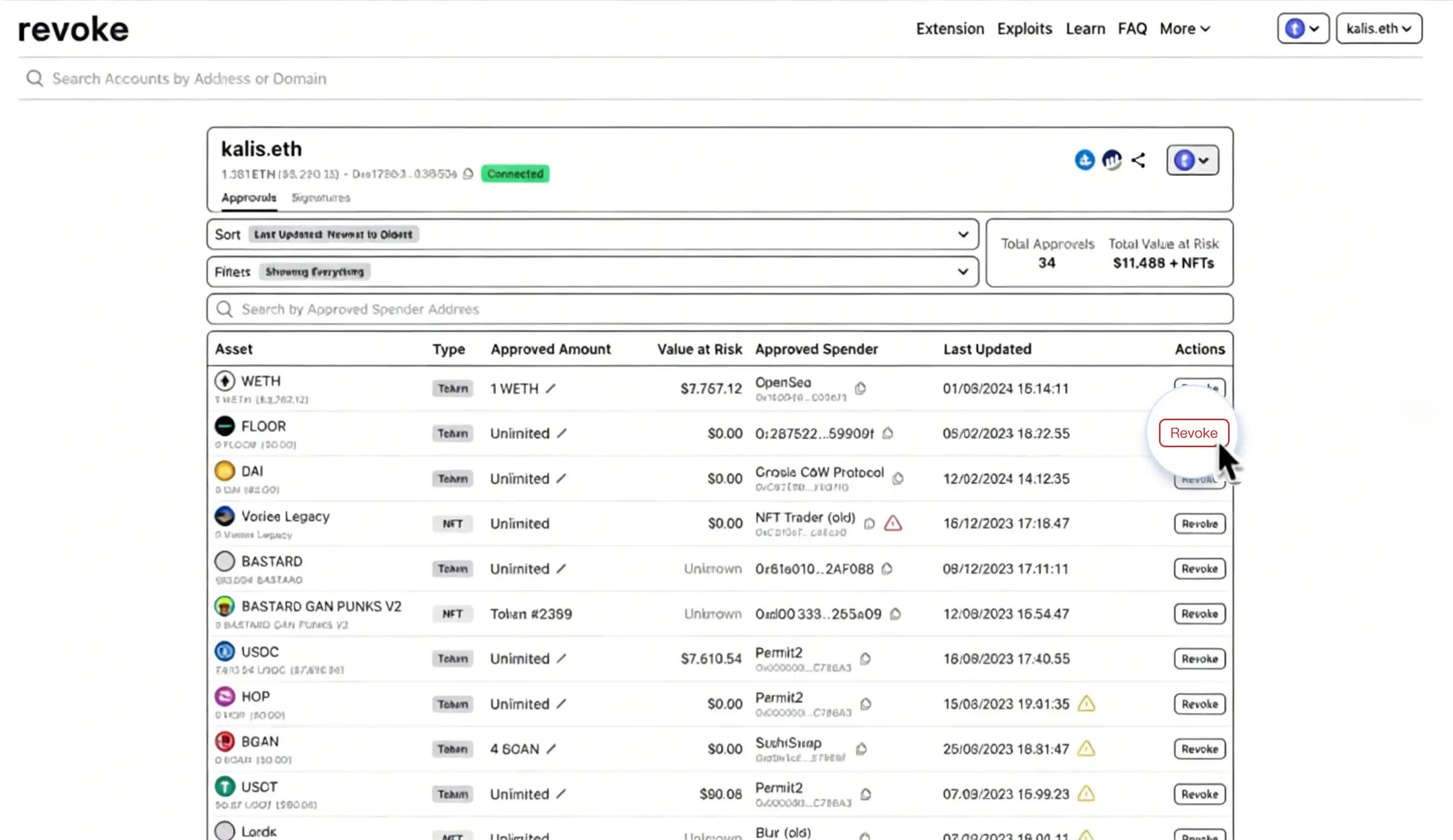
Example interface from revoke.cash website. The circled "Unlimited" approvals are recommended to be revoked promptly.

Check 3: Official Entry Points — Phishing Sites Are Scarier Than Hackers

According to statistics, over 60% of DeFi asset losses come from phishing attacks, not contract vulnerabilities.

⚠️Common Tactics

Imitating Official Websites: Domain names differ by only one letter (e.g., uniswap.com vs uniswao.com), with the page completely copied.

Fake Airdrop Pages: Promoting "free XX airdrop claims" on Twitter, Discord. After connecting your wallet, approvals are used to transfer assets away.

Search Engine Ad Poisoning: Searching for "Uniswap," the first ad might be a phishing site with a domain name extremely similar to the official one.

👉Recommendations

Only Enter Through Official Channels: Get the official link from the project's official Twitter, Discord announcements, or GitHub repository. Do not trust search engine ads.

Bookmark Frequently Used DeFi Sites: Add the official websites of protocols you often use to your browser bookmarks and always enter from there.

Don't Click Unfamiliar Links: Be suspicious of any link sent by anyone (including group members, private messages).

🔗Pro Tip: Install wallet extensions like Rabby or MetaMask's phishing detection version; they automatically block known phishing domains.

Check 4: Abnormal Yields — High Returns Inevitably Hide High Risks

If a project:

• Offers APY far above the average market rate (e.g., stablecoin APY over 20%)

• Emphasizes "risk-free arbitrage," "guaranteed profits"

• Encourages "early participation, quick investment," creating FOMO (Fear Of Missing Out) sentiment

It can basically be judged: Risk ≈ Promised Return × 10

Many Rug Pull projects use "high yield" to attract liquidity. Their initial yields might come from new users' principal (a Ponzi scheme). Once the inflow of new funds slows down, the project team directly pulls the liquidity and runs away.

👉Recommendations

Compare to Market Benchmarks: Mainstream DeFi protocols (like Aave, Compound) typically offer stablecoin APY between 2% - 8%. Be highly vigilant if it's 3 times higher than this range.

Check the Project's Lifespan: Projects offering super high yields just days after launch are likely "honeypots."

Search Project Name + scam / rug: Use Google or Twitter search to see if there are user reports.

🚩 One Rule: If it seems too good to be true, it probably is.

Check 5: Asset Isolation — Don't Put All Your Eggs in One Wallet

Many users only have one main wallet, where all assets, all DeFi interactions, and all NFT mints are done. Once this wallet is phished, approves a malicious contract, or has its private key leaked, all assets are wiped out at once.

Recommend establishing a "Three-Wallet" system:
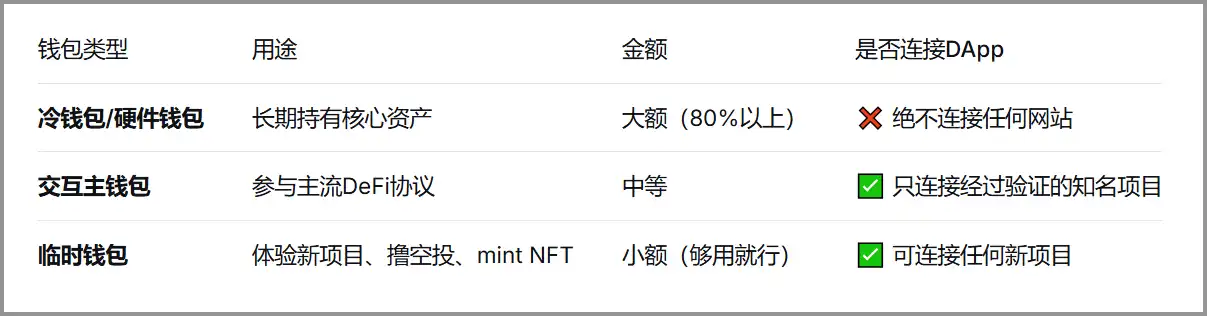
⚠️The essence is: Control single-point risk, avoid "total loss in one go"

• Participate in new projects or unverified protocols always using a temporary wallet, depositing the minimum amount required for testing.

• Regularly clean approvals for the interaction wallet (weekly or monthly).

• Keep core assets in a cold wallet, never sign, never approve, never connect to any website.

More Frightening Than Hackers Are the "Insiders"

Besides external attacks, there is another often overlooked risk—malicious insiders. They could be developers, operations staff, or even customer support.

⚠️Where do internal threats come from?

• Developers or auditors planting backdoors: Developers and auditors have commit access and system access. If any one of them turns malicious, they can plant backdoors, steal sensitive keys, and it's hard to detect as it's disguised as normal development activity.

• Core permission managers stealing: Those holding the admin private keys, if they have ill intentions, can empty all user assets in one go.

• Employees exploiting job permissions to steal user information: In February 2026, a 34-year-old network engineer at a Hong Kong cryptocurrency investment company used his system access rights to unauthorizedly log into the company database and stole approximately 2.67 million USDT (about HK$20.87 million) from about 20 clients. This employee had been with the company for 4 years, responsible for APP development and maintenance—it was this "legitimate access" that enabled the theft.

👉How to prevent?

• Individual Users: Choose protocols with a "timelock" (major operations require a 24-48 hour delay), pay attention to whether the project's multi-signature managers are publicly transparent.

• Project Teams: Core permissions must be managed with multi-signature wallets, set a timelock buffer period, and regularly audit internal access logs.

Why Do You "Get Hit" Even When You're "Very Careful"?

Because attacks have shifted from "technical vulnerabilities" to "human vulnerabilities."

⚠️Common Psychological Pitfalls

• "This project is hot, it should be fine"

• "Everyone is using it, nothing will happen"

• "I'll only do it once, it won't be me"

👉 The reality is: Attackers only need you to make one mistake

⚠️New Trend: AI + Phishing Attacks

• Highly imitated official website pages

• Automatically generated customer service dialogues

• Precisely targeted user投放 (投放 -投放 means delivery/targeting)

👉It's becoming increasingly difficult for users to distinguish real from fake

The Simplest Set of DeFi Security Principles

If you can't remember all the checks, remember these 3 👇

• Don't approve recklessly

• Don't click unfamiliar links

• Don't go All in on one project

🔑 In a nutshell: The risk in DeFi is not in the code you don't understand, but in every operation you overlook.

Conclusion

DeFi has brought openness and freedom, but also new security challenges. From the Drift Protocol incident to daily phishing attacks, risk has long shifted from "extreme events" to "constant threats."

Facing the complex on-chain environment, what truly protects assets is not luck, but awareness and habits.

If you have doubts about the DeFi project you are currently using, it is recommended to conduct a security check as soon as possible.

👉In the on-chain world, security is not an add-on; it's the entry ticket.

Questions liées

QWhat was the approximate financial loss in the Drift Protocol attack on Solana in April 2026?

AThe estimated financial loss from the attack on Drift Protocol was between 220 million and 285 million US dollars.

QWhat are the four most common risk paths that lead to asset loss in DeFi according to the article?

AThe four most common risk paths are: 1. Improper authorization leading to assets being transferred away. 2. Visiting a phishing website leading to wallet takeover. 3. Contract vulnerabilities leading to funds being 'legally stolen'. 4. Project Rug Pulls leading to liquidity being drained.

QWhat is the first key security check a user should perform before interacting with a DeFi project?

AThe first key security check is Contract Security: verifying that the project's smart contract is open-source, has been audited by a third-party firm like CertiK or PeckShield, and has no known historical vulnerabilities.

QWhat tool is recommended for users to check and revoke their existing token approvals?

AThe article recommends using tools like revoke.cash or etherscan.io/tokenapprovalchecker to check and revoke token approvals granted to smart contracts.

QWhat is the recommended 'three-wallet system' for managing risk and assets in DeFi?

AThe recommended 'three-wallet system' consists of: 1. A Main Wallet for interacting with well-known, trusted protocols. 2. A DeFi Wallet for testing new or unverified projects with minimal funds. 3. A Cold Storage Wallet for holding core assets, which never signs transactions or connects to any websites.

Lectures associées

La Banque d'Italie ne voit pas d'avantages systémiques des stablecoins dans les transferts

L'étude de la Banque d'Italie conclut que les stablecoins n'offrent pas d'avantage systémique durable en termes de coût et de rapidité pour les transferts d'argent. Les avantages potentiels sont annulés par les frais de conversion vers et depuis les monnaies fiduciaires et par l'efficacité des infrastructures de paiement locales. La recherche a comparé des transferts de 200 USDC sur 10 couloirs bilatéraux (Italie vers Brésil, Argentine, Japon, Émirats Arabes Unis, Afrique du Sud). Le coût total des transferts en stablecoins variait de 0,3% à près de 9%. Les délais étaient inférieurs à 20 minutes dans les pays dotés de systèmes de paiement instantané, mais pouvaient atteindre 1 à 2 jours ouvrables ailleurs. Les principaux coûts et retards sont liés au change de devises et à la qualité de l'infrastructure locale, plutôt qu'aux frais de blockchain. Bien que souvent moins chers que la moyenne mondiale des transferts (6,65%), les stablecoins n'étaient plus avantageux que dans 3 cas sur 7 par rapport au service Wise. Les auteurs estiment que l'utilité serait plus forte si les stablecoins pouvaient être dépensés directement, sans reconversion. Ils notent également qu'une réglementation trop restrictive complique l'usage pour les clients tout en n'éliminant pas la demande. Le marché des stablecoins a enregistré en juillet sa plus forte baisse mensuelle depuis l'effondrement de Terra, perdant plus de 10 milliards de dollars.

cryptonews.ruIl y a 31 mins

La Banque d'Italie ne voit pas d'avantages systémiques des stablecoins dans les transferts

cryptonews.ruIl y a 31 mins

Le « boom du Bitcoin » en plein essor : Une nouvelle déclaration de Saylor suscite des spéculations sur des achats

Michael Saylor, président exécutif de MicroStrategy (MSTR), a relancé les spéculations sur un nouvel achat de bitcoins par la société en publiant le message « Bitcoin Drive engaged » le 2 août, accompagné de son tableau de suivi habituel. Cette pratique précède généralement les annonces officielles du trésor. Le rapport affiché montrait que les réserves de MicroStrategy s'élevaient à 843 775 BTC, d'une valeur marchande d'environ 53,25 milliards de dollars, avec un prix d'acquisition moyen de 75 653 dollars et une perte non réalisée de 10,58 milliards de dollars. Cependant, le registre public en temps réel de la société indique deux ventes récentes totalisant 3 588 BTC, ramenant le stock de 847 363 à 843 775 BTC. Ces ventes, déclarées à la SEC, visaient à financer des dividendes d'actions privilégiées et à reconstituer les réserves en dollars, qui s'élèvent désormais à environ 3,75 milliards de dollars. La société a subi une perte opérationnelle de 8,33 milliards de dollars au deuxième trimestre 2026, en grande partie due à une perte non réalisée sur ses actifs numériques. La direction pourrait vendre jusqu'à 1,25 milliard de dollars de bitcoins supplémentaires pour ses obligations en cash. L'annonce attendue lundi révélera si le message « Bitcoin Drive » signale une reprise des achats d'accumulation, alors que MicroStrategy équilibre son énorme stock de bitcoins avec ses engagements financiers croissants.

cryptonews.ruIl y a 33 mins

Le « boom du Bitcoin » en plein essor : Une nouvelle déclaration de Saylor suscite des spéculations sur des achats

cryptonews.ruIl y a 33 mins

Le motif « Tête et Épaules inversé » sur le graphique du Bitcoin annonce une montée vers 67 200 $

Malgré un léger recul début août, les graphiques de prix, notamment celui du Bitcoin, forment un modèle de renversement baissier. Actuellement, le BTC oscille autour de 63 200 $, formant l'épaule droite de la classique figure inversée "tête et épaules". L'analyste Axel Kibard de TechCharts voit là la seule réelle raison d'optimisme à court terme pour les haussiers ce mois-ci. La question principale est de savoir si les acheteurs auront la force de pousser le Bitcoin vers le niveau clé de 67 000 $. Parallèlement, dans la paire ETH/BTC, un fond de renversement similaire a déjà été franchi à la hausse. L'Ethereum, en tendance haussière, se dirige vers un objectif technique de 0,0312, indiquant que les grands capitaux préfèrent actuellement investir dans l'ETH plutôt que dans le Bitcoin, ce qui draine la liquidité et les volumes nécessaires à une reprise rapide du BTC. Face au dollar, l'Ethereum teste prudemment le niveau de support à 1 875 $, une résistance qui, si elle est maintenue, pourrait ouvrir la voie vers 2 163 $. Cette force relative de l'ETH est un signal positif pour le marché, mais la situation reste tendue pour les détenteurs de Bitcoin. Soit le BTC suit l'exemple de l'ETH et monte rapidement au-dessus de 67 200 $ pour confirmer le renversement, soit le modèle échoue. Selon Kibard, si une attaque de la ligne de cou (neckline) n'intervient pas dans les prochains jours, les baissiers reprendront le contrôle et pousseront le Bitcoin vers des niveaux de support solides à 60 000 $, voire 58 000 $.

cryptonews.ruIl y a 34 mins

Le motif « Tête et Épaules inversé » sur le graphique du Bitcoin annonce une montée vers 67 200 $

cryptonews.ruIl y a 34 mins

Les actions des entreprises d'IA se négocient comme des « mèmes cryptos », tandis que le Bitcoin reste stable – Revue de la semaine

Cette semaine, l'attention financière s'est largement détournée du Bitcoin, relativement stable autour de 64 000 $, pour se concentrer sur une volatilité extrême dans le secteur des actions liées à l'intelligence artificielle (IA). Les marchés asiatiques, notamment en Corée du Sud, ont subi des chutes sévères, en partie déclenchées par la liquidation forcée du fonds « Situational Awareness » de Leopold Aschenbrenner, entraînant des pertes massives. Le secteur des semi-conducteurs et de l'IA montre des signes de surchauffe, suscitant des débats sur un éventuel ralentissement. Dans le domaine des cryptomonnaies, l'ambiance reste difficile. Plusieurs plateformes d'échange (BitMEX, BitMart) ont annoncé leur fermeture, tandis que d'autres entreprises comme Coinbase et Uphold procèdent à des réductions de personnel. MicroStrategy continue sa stratégie d'accumulation de bitcoins et de rachat de ses propres actions. Les discussions portent également sur les risques potentiels pour des écosystèmes comme Solana si des applications populaires (Pump.fun, Trade.xyz) décidaient de lancer leur propre blockchain. Par ailleurs, une faille de sécurité majeure concernant le portefeuille matériel Coldcard a été mise en lumière, rappelant les risques du self-custody. Enfin, le projet d'IA décentralisée Bittensor (TAO) a attiré l'attention de certains investisseurs de capital-risque, mais des mises en garde sont émises contre un possible engouement spéculatif similaire à celui pour les memecoins. La semaine a été marquée par des interventions macroéconomiques, comme celle de la Japon pour soutenir le yen, et par les anticipations concernant la politique de la Fed.

cryptonews.ruIl y a 43 mins

Les actions des entreprises d'IA se négocient comme des « mèmes cryptos », tandis que le Bitcoin reste stable – Revue de la semaine

cryptonews.ruIl y a 43 mins

Coinkite critiqué pour avoir conservé les e-mails des clients après le piratage de Coldcard s'élevant à 88 millions de dollars

Coinkite, la société derrière les portefeuilles matériels Coldcard, est vivement critiquée pour avoir conservé les adresses e-mail de ses clients après la découverte d'une faille majeure. Cette vulnérabilité, liée à la génération de phrases de récupération (seed phrases) aléatoires, a permis à des pirates de voler plus de 1 000 BTC (soit plus de 88 millions de dollars) en deux jours. Pour avertir le maximum de clients potentiellement touchés, Coinkite a envoyé des e-mails d'alerte aux adresses associées aux achats effectués depuis 2019. Face aux critiques concernant la conservation de ces données, la société a invoqué sa politique publique, précisant que les e-mails sont gardés pour permettre aux clients de vérifier la suppression de leurs autres informations. Cependant, elle n'a pas défini de délai précis pour l'effacement de ces adresses. Rodolfo Novak, co-fondateur et PDG de Coinkite, a pourtant affirmé que la société ne conservait pas les informations clients et n'avait aucun moyen de contacter directement les personnes affectées, appelant à l'aide pour les atteindre. Il avait précédemment déclaré que Coinkite offrait des achats anonymes et supprimait les données après 90 jours, soulignant son sérieux en matière de sécurité comparé à ses concurrents.

cryptonews.ruIl y a 45 mins

Coinkite critiqué pour avoir conservé les e-mails des clients après le piratage de Coldcard s'élevant à 88 millions de dollars

cryptonews.ruIl y a 45 mins

Trading

Spot
活动图片





